Model Answer:
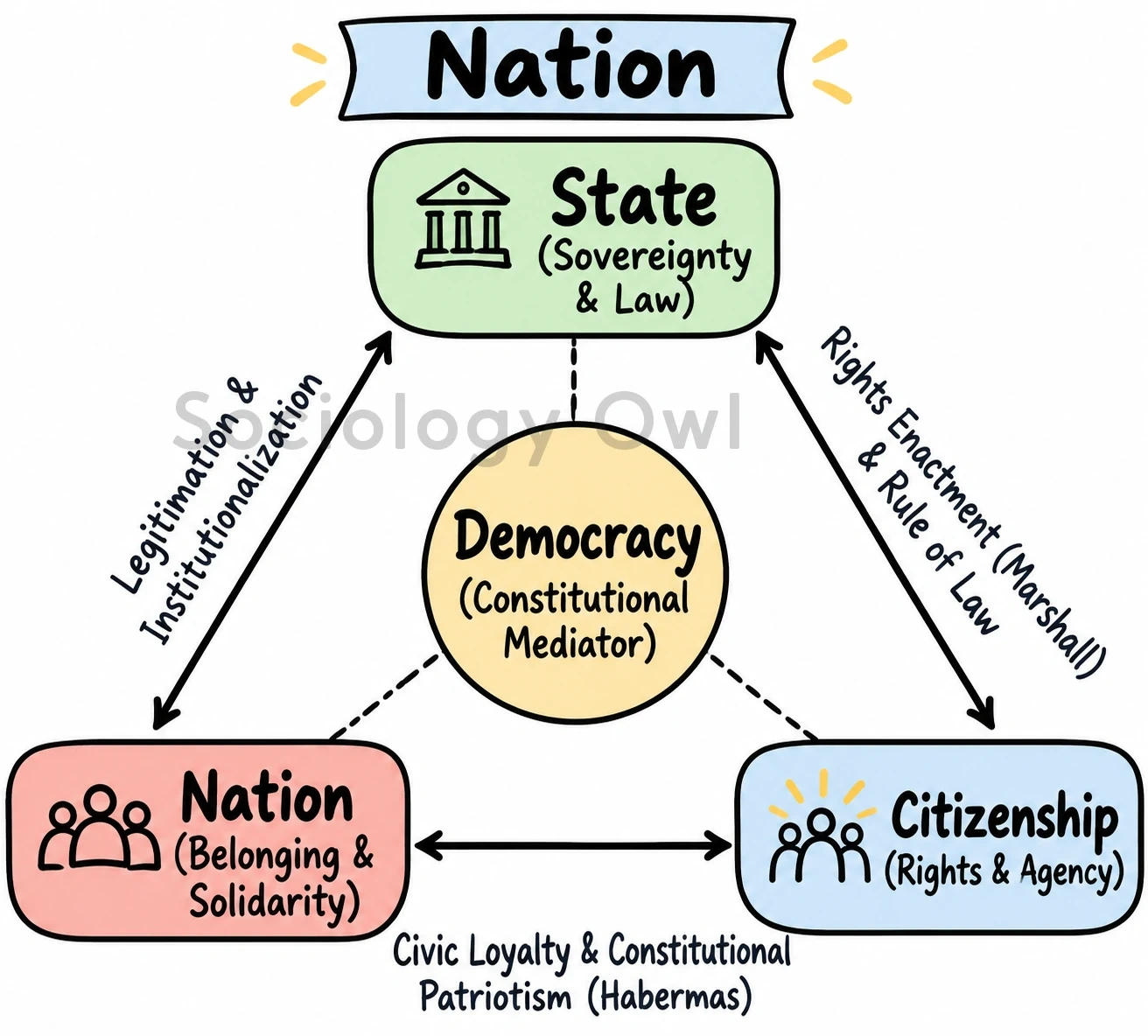
In political sociology, the nation (cultural identity), the state (sovereign political apparatus), and citizenship (legal-political membership) form an interdependent triad, where democracy functions as the institutional mediator balancing power, rights, and collective belonging.
Theoretical Co-Constitution: The Democratic Triad
- Democratic Legitimation of Authority: While Max Weber conceptualized the modern state through its monopoly on legitimate violence, a democracy derives that legitimacy from popular sovereignty, transforming the ‘state of rulers’ into an instrument of the ‘nation of citizens’.
- Institutionalizing the Imagined Community: Benedict Anderson‘s notion of the nation as an imagined community achieves tangible institutional manifestation through the democratic state, which anchors abstract fraternity into constitutional laws and civic duties.
- Evolutionary Expansion of Rights: T.H. Marshall demonstrated that citizenship expands through civil, political, and social stages, enabling democratic states to convert passive subjects into active co-creators of the national collective.
- Constitutional Patriotism over Primordialism: Jürgen Habermas argued that democratic states transcend ethnic nationalism through Verfassungspatriotismus (constitutional patriotism), where citizenship is bound by commitment to shared procedural democratic values rather than shared blood or ancestry.
- Universalism and the Civic Bond: In a democratic polity, citizenship functions as a dynamic universalizer, granting equal status (jus soli) to diverse groups, thereby welding a heterogeneous population into a unified political nation.
Structural Tensions and Democratic Dilemmas
- Civic vs. Ethnic Pulls: Democracies face constant friction between civic nationalism (rights-based, inclusive) and ethnic nationalism (majoritarian, exclusionary), where dominant groups often attempt to capture the state apparatus to define citizenship along cultural lines.
- Differentiated Citizenship: Challenging the myth of universal citizenship, Iris Marion Young argued that marginalized identities require group-differentiated rights to prevent democratic assimilation by the dominant national culture.
- Neoliberal Erosion of Social Citizenship: State retrenchment undermines Marshall’s social rights, fracturing national solidarity and turning citizens into fragmented consumers, which frequently fuels reactionary right-wing populism.
- Transnational Challenges: As Saskia Sassen highlighted, globalization and migration produce denationalized citizenship, forcing democratic states to negotiate legal rights detached from traditional nation-state boundaries.
- The ‘State of Exception’: In crises, democratic states often use national security imperatives to curtail civil liberties, creating what Giorgio Agamben termed zones of exclusion where individuals are stripped of active citizenship rights.
In a democracy, robust citizenship harmonizes the state’s institutional power with an inclusive, civic nation, preserving constitutional pluralism.