Model Answer:
In Economy and Society, Max Weber rejected economic determinism to advance a multidimensional model of stratification, arguing that social inequality is produced and sustained across three distinct yet interacting spheres: the economic (Class), the social (Status), and the political (Power/Party).
The Three Orders of Stratification
- Class (The Economic Order): Stratification determined by an individual’s market situation and resultant life chances, contingent not merely on property ownership, but on marketable skills, assets, and services.
- Status (The Social Order): Stratification conditioned by unequal distribution of social honor, prestige, and distinctive styles of life, actively reinforced via social exclusivity and endogamy.
- Power / Party (The Political Order): Stratification based on organized collective action aimed at influencing communal action and societal decision-making, residing within the sphere of struggle for domination.
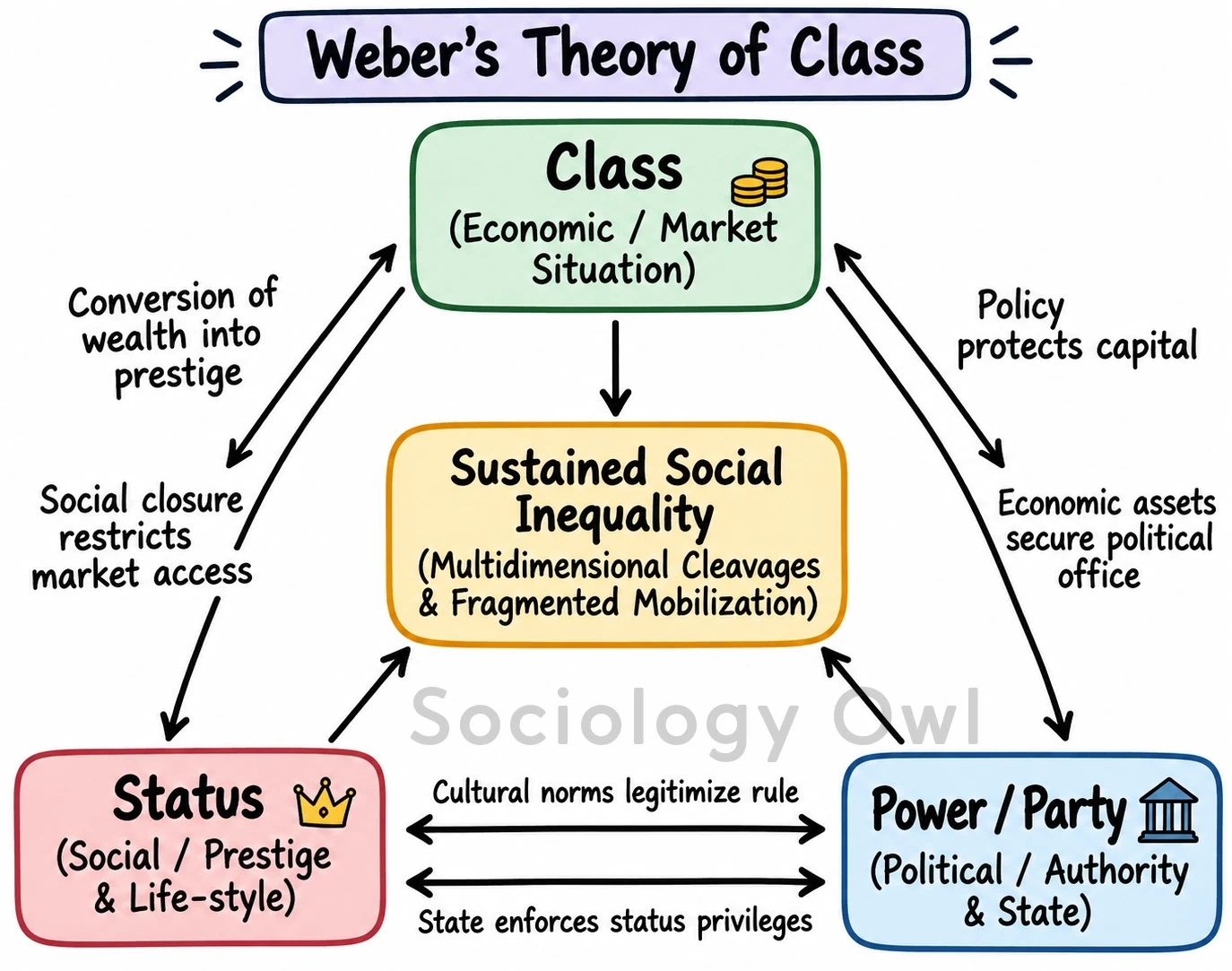
Dynamics of Interaction in Sustaining Inequality
- Cumulative Reinforcement: Class, status, and power routinely convert into one another; economic wealth buys elite education and cultural capital (status), which readily translates into bureaucratic and legislative clout (power).
- Ideological Legitimation of Exploitation: Dominant classes actively convert crude economic dominance into status distinction, utilizing monopolized cultural norms and prestige to make structural inequality appear natural, earned, and respectable.
- Status Inconsistency Mitigating Class Polarization: Because class, status, and power do not always overlap symmetrically (e.g., impoverished aristocrats or wealthy parvenus), structural tensions fragment along multiple cleavages, preventing unified revolutionary mobilization and stabilizing hierarchical order.
- Mechanisms of Social Closure (Schließung): Collectivities utilize status privileges and legal powers to restrict outsiders’ access to lucrative economic opportunities, effectively monopolizing resources across generations.
- Bureaucratic Entrenchment of Power: Power institutionalized within rational-legal bureaucracies insulates existing hierarchies, translating asymmetrical command structures into perceived legitimate authority (Herrschaft).
Weber’s multidimensional matrix demonstrates that cross-cutting, mutually legitimizing vectors of class, status, and power render modern inequality exceptionally resilient.