Model Answer:
In The Elementary Forms of the Religious Life, Emile Durkheim conceptualizes religion not as divine revelation or psychological illusion, but as a social fact—an objective, observable reality characterized by externality, coercive power, and a collective existence sui generis.
Durkheim’s Conceptualization of Religion as a Social Fact
- Externality and Pre-existence: Religious dogmas, rites, and symbols exist prior to the individual, transmitted across generations through socialization rather than personal invention.
- Moral Constraint and Coercion: Prescriptions, taboos, and ethical codes exert moral force over the individual, disciplining egoistic impulses to maintain normative order.
- The Sacred-Profane Dichotomy: Society categorizes the universe into the sacred (extraordinary, revered) and the profane (mundane, utilitarian), reflecting social valuations rather than intrinsic material properties.
- Society Worshiping Itself: Analyzing Australian Arunta totemism, Durkheim argues the sacred totem simultaneously represents the clan and the deity; God is simply society transfigured.
- Collective Effervescence: Religious fervor is generated during collective gatherings, where heightened emotional energy suspends individuality and reinforces the collective consciousness.
- Institutionalization into a Church: Unlike magic, which remains an individual transaction, religion inherently creates a single moral community bound by shared beliefs and institutionalized practices.
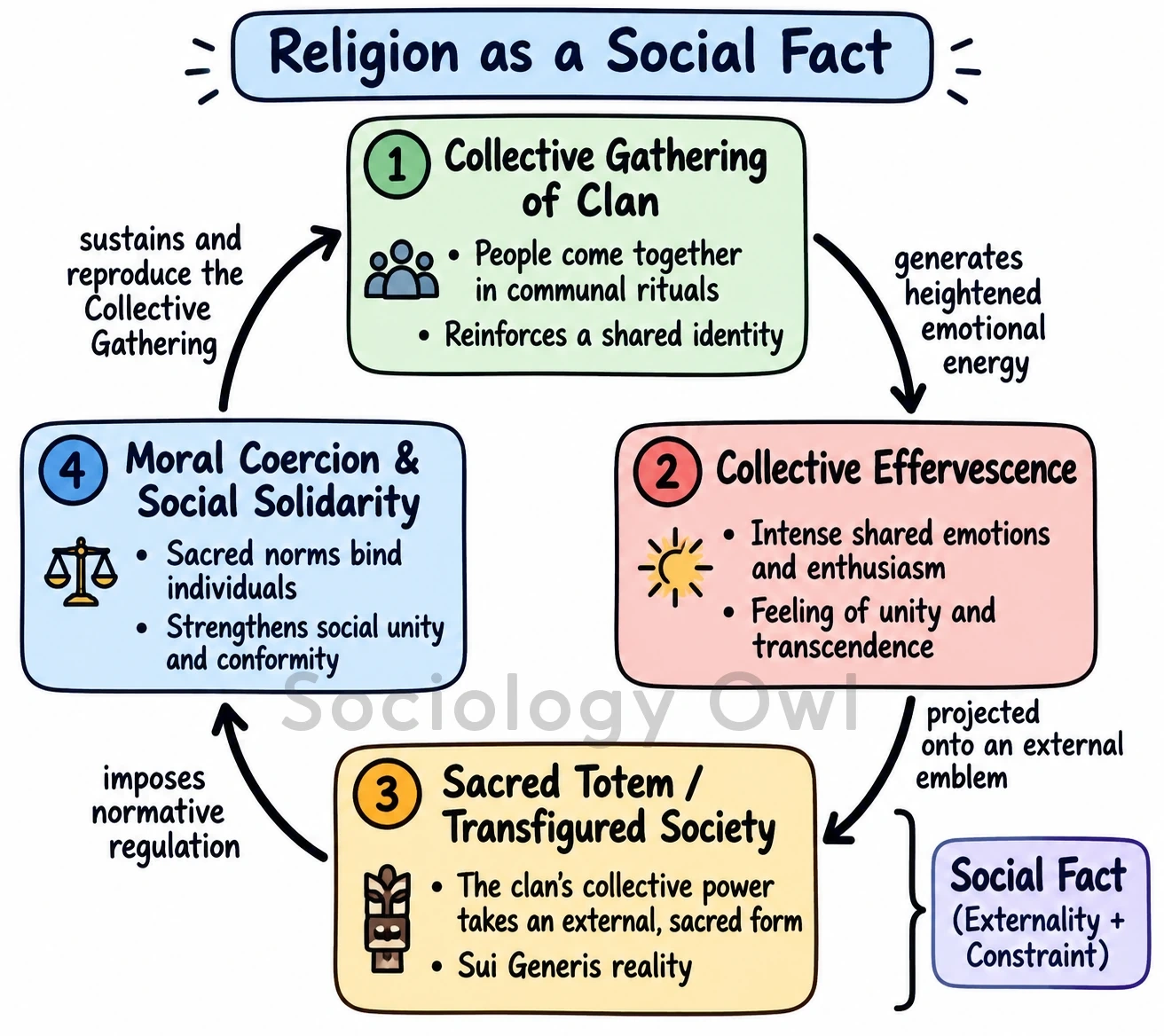
Ultimately, Durkheim establishes that religious reality is social reality, functioning as society’s vital symbolic mechanism for self-preservation and collective solidarity.