Model Answer:
Sociologically, power is the structural capacity to enforce decisions, command compliance, and shape social realities, spanning zero-sum domination, collective facilities, and pervasive institutional control.
Major Sociological Perspectives on Power
- Zero-Sum Coercive Model: Max Weber conceptualises power (Macht) as the capacity to realise one’s will against resistance, which becomes stable domination when institutionalised as legitimate authority (Herrschaft).
- Class-Domination Perspective: Karl Marx grounds power in the economic base; ownership of the forces of production enables the ruling class to instrumentalise the state for surplus extraction.
- Variable-Sum Functionalist Model: Talcott Parsons views power as a positive-sum circulating resource within the polity, functioning like money to facilitate collective goal attainment.
- Pluralist Model: Robert Dahl posits that power in modern polyarchies is dispersed across competing interest groups, preventing monopolistic political dominance.
- Discursive and Capillary Power: Michel Foucault rejects top-down state-centric views, demonstrating that power is omnipresent, relational, and embedded in everyday institutional power-knowledge regimes.
Mechanisms of Political Control by the Power Elite
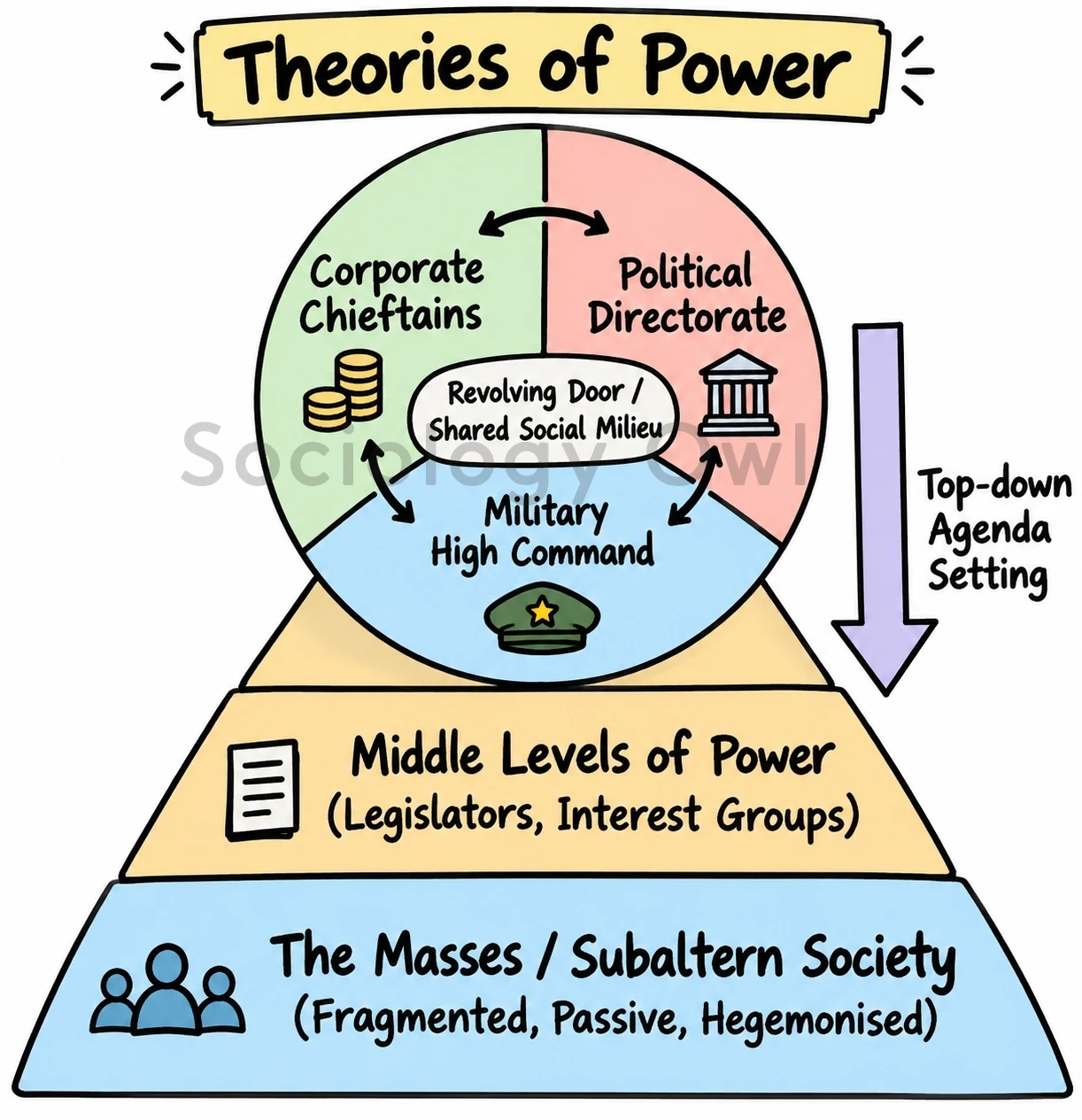
- Institutional Interlocking: C. Wright Mills in The Power Elite argues that corporate directors, high-ranking politicians, and military leaders share a common social background, fusing into a cohesive decision-making triumvirate.
- The “Revolving Door” Dynamic: Elite actors transition seamlessly between corporate boardrooms, regulatory agencies, and cabinet positions, systematically shaping industrial policy to elite interests.
- Agenda Setting and Non-Decision Making: Peter Bachrach and Morton Baratz show that elites exercise power by suppressing anti-capitalist or redistributive issues from entering legislative discourse.
- Electoral Financing and Lobbying: Concentrated corporate wealth dictates electoral outcomes through campaign contributions and think tanks, functionally filtering legislative priorities before citizens vote.
- Cultural and Media Hegemony: Media ownership allows the elite to manufacture ideological consensus (Antonio Gramsci), depoliticising subaltern classes by framing elite interests as universal societal goals.
The power elite subtly subvert formal democracy, rendering political processes instruments of concentrated institutional dominance rather than popular sovereignty.