Model Answer:
The Mode of Production Debate emerged within Marxist political economy to conceptualize post-colonial agrarian transitions, interrogating whether rural economies were characterized by persistent feudal remnants, emergent capitalism, or distinct colonial distortions.
Theoretical Perspectives on the Agrarian Transition
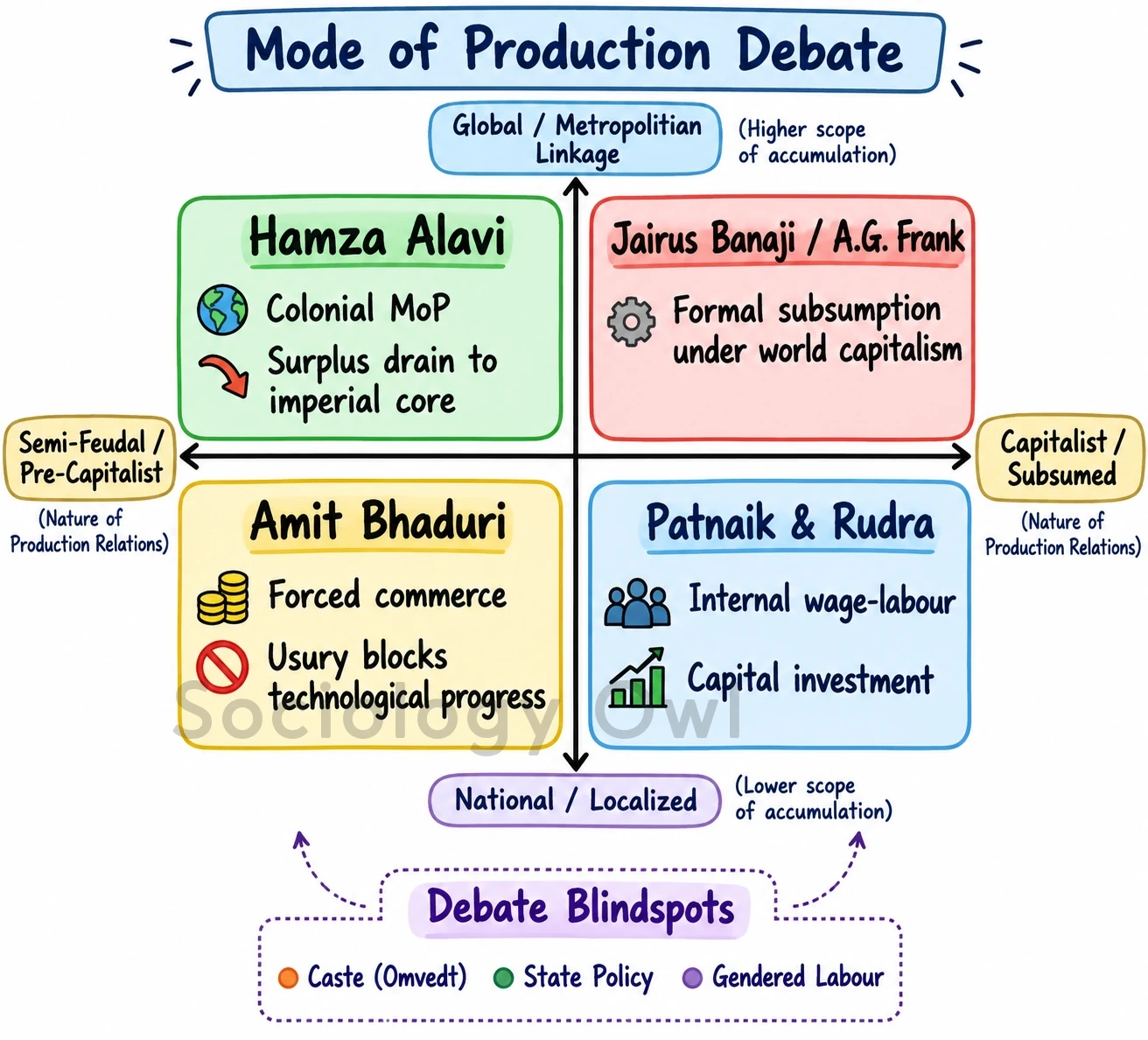
- Semi-Feudal Stagnation Thesis: Amit Bhaduri argued that usurious moneylending, tenancy, and bonded debt create “forced commerce,” disincentivizing landowners from technological innovation and entrapping the agrarian economy in semi-feudal relations.
- Emergent Agrarian Capitalism: Utsa Patnaik and Ashok Rudra identified capital accumulation, reinvestment, and wage-labour differentiation as markers of transition, using labour-exploitation criteria to establish the maturation of rural capitalism.
- Colonial Mode of Production: Hamza Alavi rejected the feudal-capitalist binary, arguing that imperialism created a distinct mode characterized by surplus extraction geared toward the imperial metropole rather than autonomous national accumulation.
- Subsumption of Labour: Jairus Banaji critiqued simplistic equations of wage-labour with capitalism, showing that seemingly “feudal” smallholders and sharecroppers were structurally subjected to the formal subsumption of labour under merchant and usurious capital.
- World-Systems Dependency: Drawing from Andre Gunder Frank, dependency theorists rejected agrarian dualism, contending that peripheral peasant production has historically functioned as an integrated, subordinated component of the global capitalist world-economy.
Critical Limitations and Methodological Blindspots
- Economic Reductionism: The debate remained excessively preoccupied with quantitative production indices, reducing dynamic social life to formal categories of tenancy, rent, and capital outlay.
- Invisibilisation of Caste: As Gail Omvedt argued, orthodox Marxist analyses mechanically collapsed caste into class, ignoring how caste-based exclusion autonomously operates to enforce agrarian labour bondage.
- Neglect of State Mediation: Theoretical models overlooked the proactive role of the post-colonial developmental state in directing agrarian transformations through land reforms, technology inputs, and price supports.
- Gender Blindness: The household was treated as an unproblematic, unified unit, concealing how unfree, unpaid female labour systematically subsidizes agrarian capitalist accumulation.
Ultimately, post-colonial agrarian structures defy orthodox binaries, demanding an integrated paradigm capturing localized caste, state, and global-capitalist intersections.