Model Answer:
Sociology emerged in 19th-century Europe as a distinct discipline to understand the ruptures of modernity, born at the intersection of dramatic intellectual awakenings and structural socio-economic transformations.
Intellectual Currents Shaping Sociological Thought
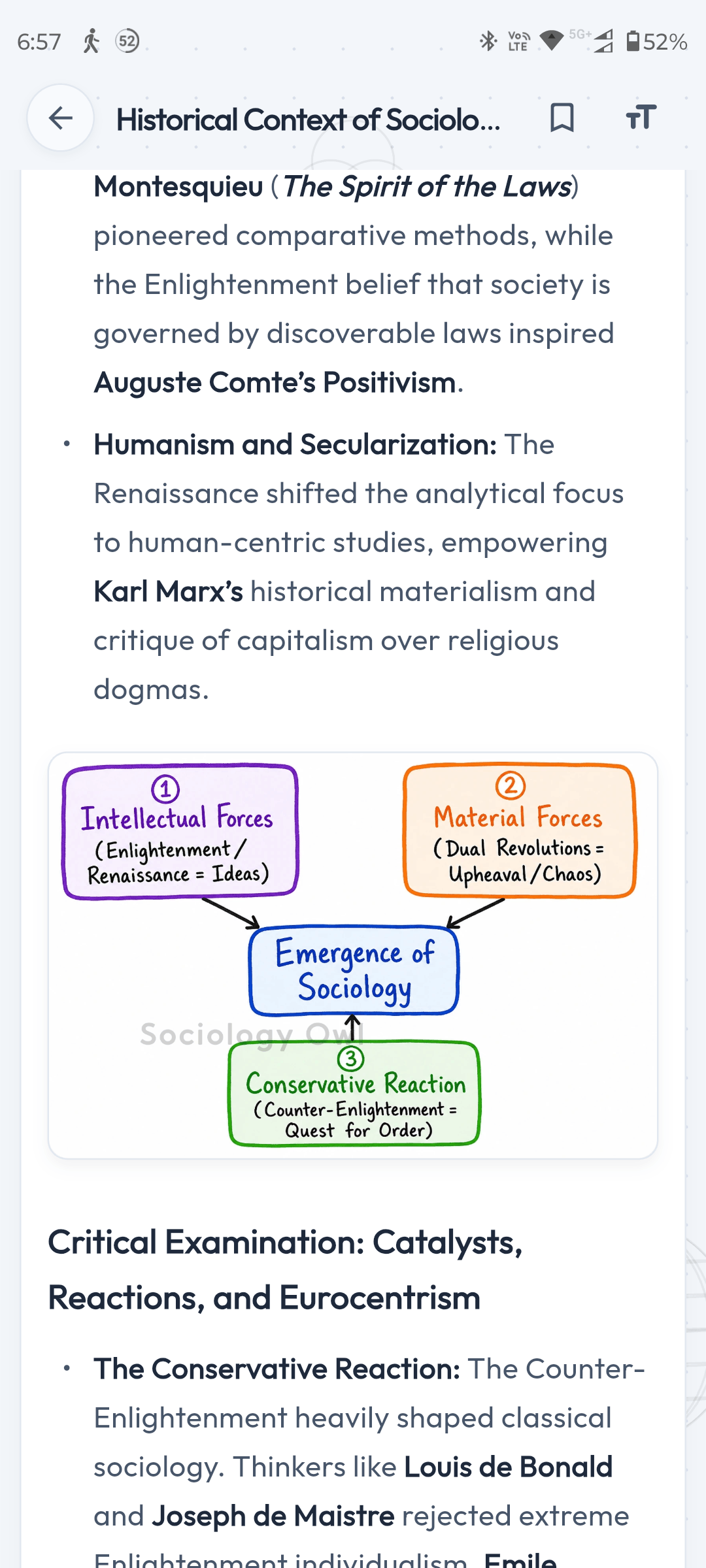
- Enlightenment Rationalism: Thinkers like Montesquieu in The Spirit of the Laws and Voltaire replaced theological explanations with secular reason, human agency, and empirical observation.
- Philosophy of History: Ideas of cumulative progress and linear historical stages—advanced by Condorcet and Hegel—convinced thinkers that society moves through identifiable, lawful evolutionary phases.
- Conservative Counter-Enlightenment: Thinkers like Louis de Bonald and Joseph de Maistre rejected radical individualism, emphasizing the functional necessity of institutions, moral order, and social integration.
- Biological and Evolutionary Metaphors: Early organic analogies by Herbert Spencer borrowed from biology, framing society as an evolving organism undergoing structural differentiation and functional adaptation.
- Political Economy: Classical economists like Adam Smith demonstrated that social formations are regulated by underlying structural patterns and systemic divisions of labor.
- Social Survey Movement: The rise of administrative statistics by pioneers like Adolphe Quetelet proved that human behaviors—such as crime and suicide—exhibit aggregate regularities, hinting at distinct social facts.
Historical Antecedents and Material Transformations
- The Scientific Revolution: The methodological triumphs of natural sciences inspired thinkers like Henri de Saint-Simon to envision an objective “science of society” to discover universal social laws.
- The French Revolution (1789): The sudden collapse of the Ancien Régime caused moral disorientation and political chaos, creating an intellectual urgency to restore social order without returning to feudalism.
- The Industrial Revolution: Rapid industrialization catalyzed massive urbanization, exploitative labor, and novel class polarization, demanding new conceptual frameworks beyond theology or speculative philosophy.
- The Crisis of Secularization: The decline of Church authority eroded the traditional moral matrix, leading Auguste Comte to institutionalize positivism as a secular mechanism for social cohesion.
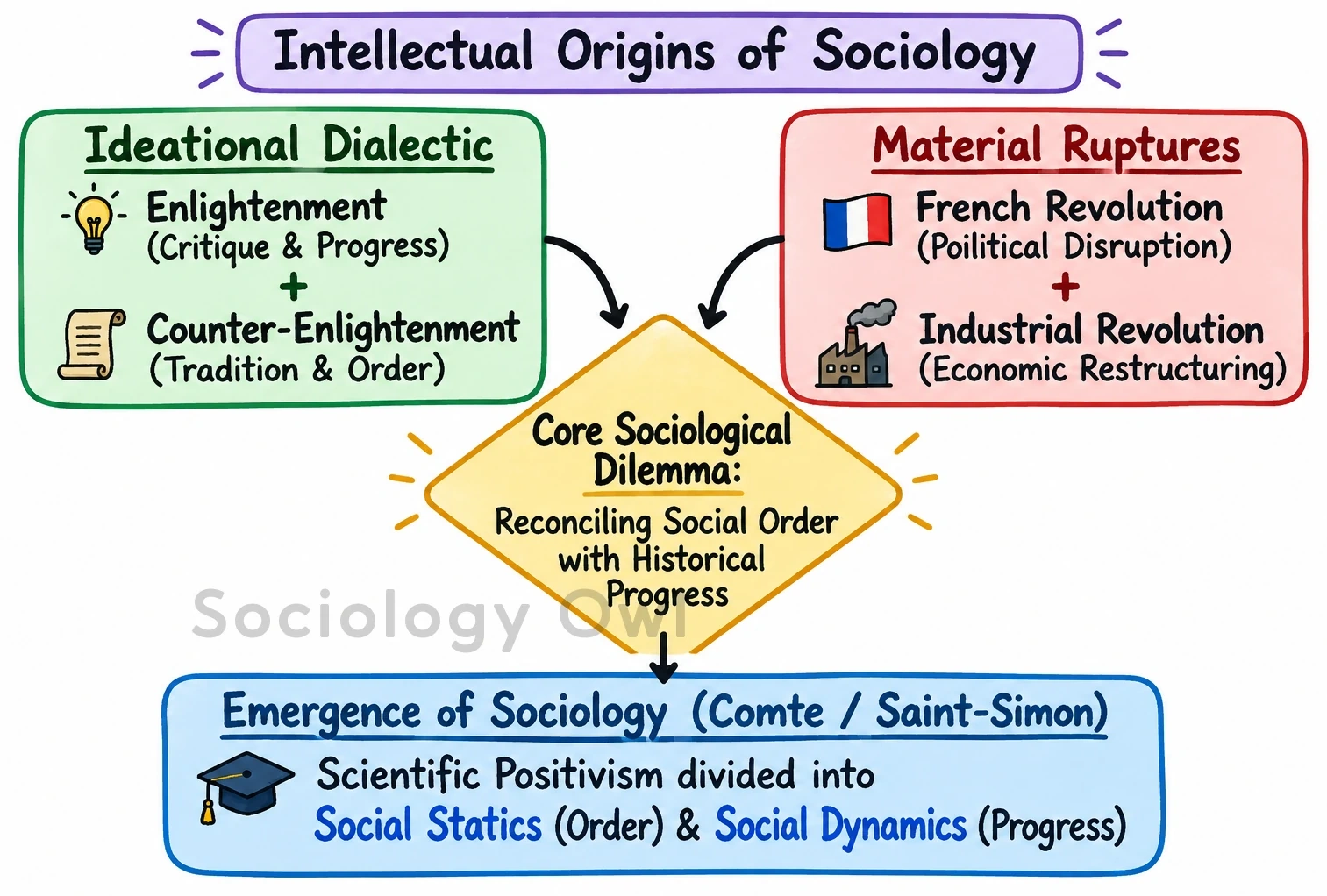
Sociology emerged as a modern science of society, uniting scientific method with humanistic concern to decode order amid radical transformation.