Model Answer:
Colonial rule acted as an exogenous catalyst that fundamentally ruptured India’s civilizational matrix, replacing fluid, localized social institutions with codified, bureaucratic, and modern structures.
Multidimensional Transformation Under Colonial Rule
- Reification of Caste: Colonial ethnographic exercises and decennial censuses transformed fluid social identities into a rigid, pan-Indian hierarchy, crystallizing what Nicholas Dirks terms the “invention of caste.”
- Agrarian Class Restructuring: Formal land revenue settlements commodified land, dismantling the traditional jajmani moral economy and creating polarized agrarian strata of absentee landlords, sharecroppers, and landless laborers.
- De-industrialization and Ruralization: Destruction of indigenous artisanal industries forced urban craftspeople into agriculture, skewing the occupational structure and creating structural underdevelopment.
- Legal and Bureaucratic Rationalization: The introduction of uniform penal codes and rational-legal institutions replaced customary community jurisprudence, giving rise to an overdeveloped state apparatus.
- Emergence of a Westernized Intelligentsia: English education produced a modern middle class (M.N. Srinivas) that spearheaded both socio-religious reform movements and anti-colonial nationalism.
- Institutionalization of Communalism: Administrative policies such as separate electorates and community-based enumeration hardened religious boundaries, institutionalizing competitive communal politics.
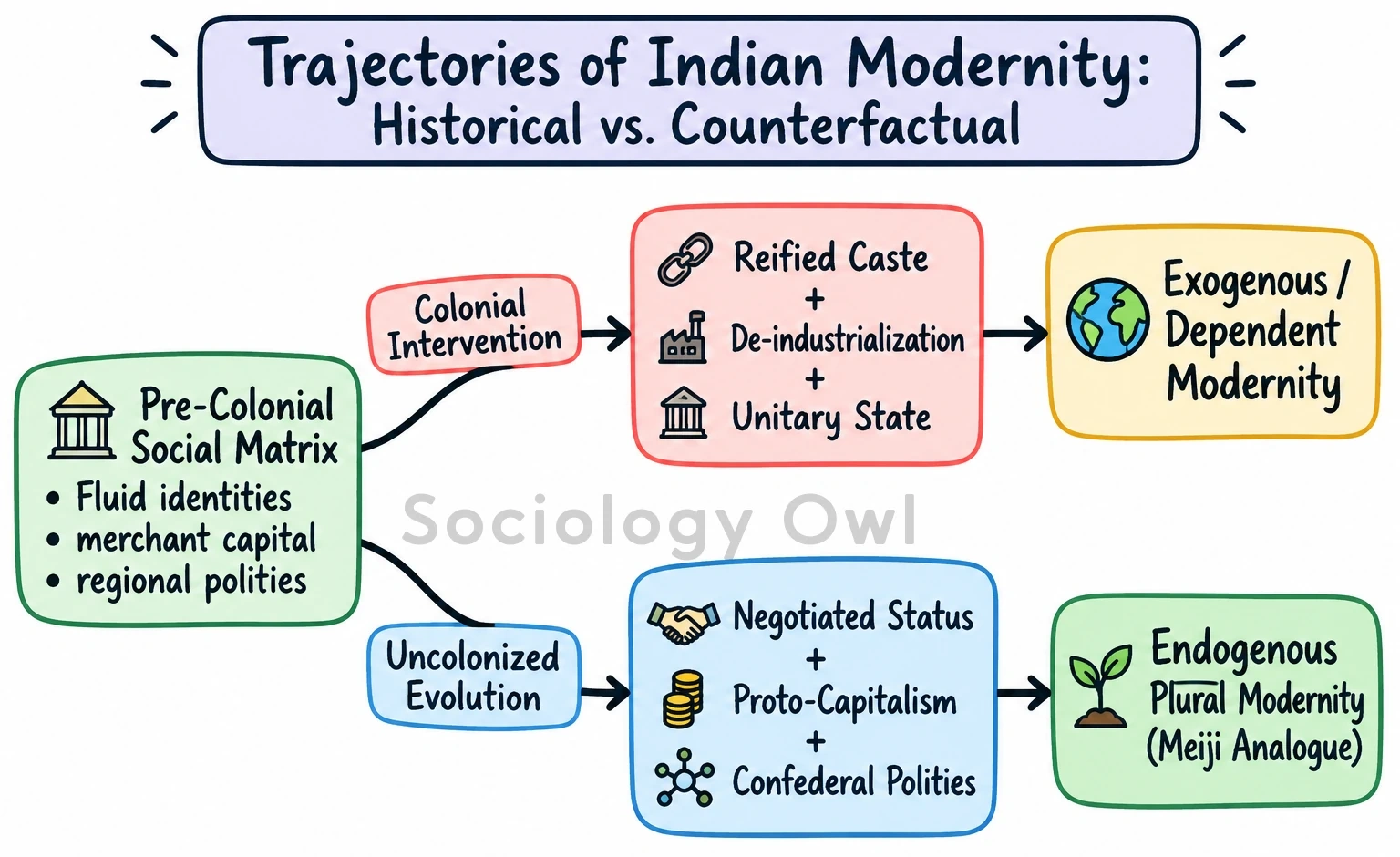
Counterfactual Trajectory: An Uncolonized Indian Society
- Endogenous Modernization: As Yogendra Singh notes regarding orthogenetic change, India possessed intrinsic modernizing capacities; social transition would likely have mirrored Meiji-era Japan’s state-directed, culturally rooted adaptation.
- Organic Proto-Industrialization: Thriving pre-colonial mercantile centers in Bengal, Awadh, and Gujarat could have transitioned into indigenous manufacturing capitalism without the systemic drain of wealth.
- Fluid Status Hierarchies: Absent colonial codification and judicial freezing of custom, caste dynamics would have remained flexible, negotiated through local political dominance and devotional Bhakti-Sufi contestations.
- Confederal Political Evolution: Rather than a centralized unitary state, India may have evolved into a pluralistic confederation of regional linguistic polities (Maratha, Sikh, or regional successor states).
- Vernacular Epistemology: Traditional knowledge systems and scientific traditions would have integrated into higher education naturally, preventing intellectual dependency on Western hegemony.
Colonialism forced exogenous modernization; uncolonized India would have evolved an endogenous, pluralistic modernity anchored in organic socio-economic transformations.