Model Answer:
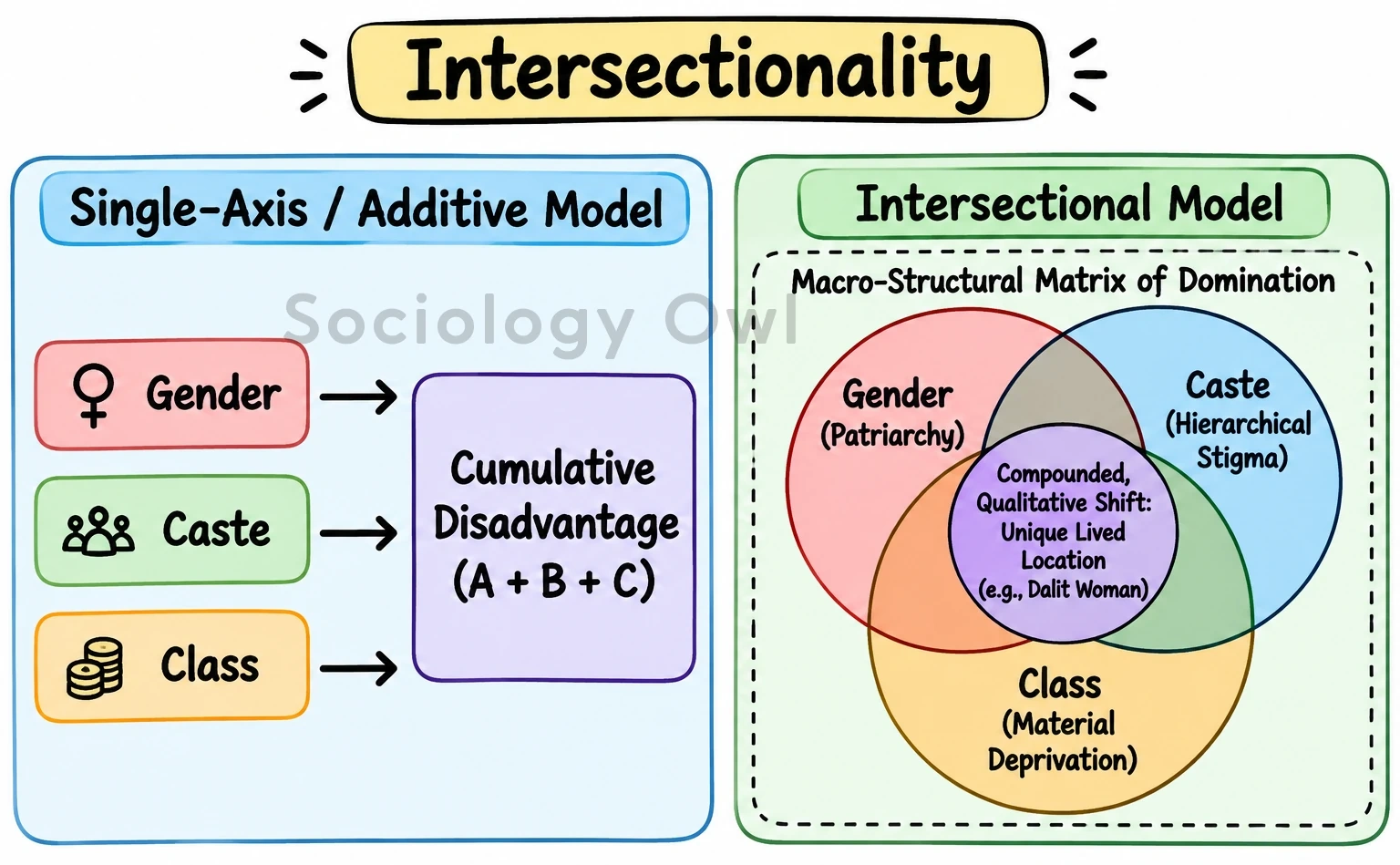
Coined by Kimberlé Crenshaw, intersectionality posits that social categories—such as caste, race, class, and gender—do not operate independently, but intersect to produce complex, interdependent systems of discrimination, marginalization, and privilege.
Significance in Sociological Inquiry
- Deconstructing Homogeneity: Rejects universalist, unitary categories (e.g., generic “women” or “working class”), exposing internal stratification and differentiated lived realities (Patricia Hill Collins).
- Analytical Granularity: Unpacks compounded, non-additive vulnerabilities—such as the distinct triple oppression of Dalit women—that single-axis frameworks fail to capture.
- Methodological Reflexivity: Compels researchers to acknowledge their own structural positionality and power dynamics within the research field.
- Targeted Interventions: Moves policy discourse beyond blunt, one-size-fits-all welfare approaches to nuanced, context-specific social remedies.
Methodological and Theoretical Limitations
- Operational Ambiguity: Lacks standardized empirical metrics, complicating cross-sectional quantitative analysis and generalizability across diverse societies.
- Risk of Infinite Regress: The endless multiplication of sub-identities risks hyper-individualization, paralyzing systematic categorization and comparative sampling.
- Macro-Structural Neglect: Excessive focus on micro-level subjective identities can obscure overarching structural forces like global capitalism (Nancy Fraser).
Intersectionality remains an indispensable heuristic, provided researchers balance localized identity dynamics with macro-structural political-economic realities.