Model Answer:
The insider (emic) versus outsider (etic) debate concerns whether Indian society is best deciphered through external, objective analytical tools or experiential, indigenous value systems.
Methodological Contours and Key Debates
- Colonial Imposition vs. Indological Rootedness: Colonial ethnographers like Herbert Risley applied external racial classifications to caste, which Indologists like G.S. Ghurye contested by utilizing indigenous textual traditions to demonstrate civilizational continuity.
- Structural Ideology vs. Lived Empirical Field: Outsider Louis Dumont framed Indian society around an idealized purity-pollution dichotomy, while M.N. Srinivas argued that external models miss pragmatic ground realities like Dominant Caste revealed only through immersive fieldwork.
- Radical Insider Incommensurability: Thinkers like A.K. Saran claimed that traditional Indian ethos cannot be understood through secular Western positivism, demanding an epistemological approach rooted entirely within internal metaphysical worldviews.
- Heterogeneity of the ‘Insider’: B.R. Ambedkar and Dalit perspectives challenged high-caste nationalist “insiders” for romanticizing the Indian village, demonstrating that insider status is fragmented by structural marginalization.
- Gender and Erasure: Feminist scholars highlighted that both colonial outsiders and native patriarchal insiders historically neglected women’s lived realities, rendering systemic domestic oppression invisible.
- Situational Epistemology: T.K. Oommen argued that insiderness and outsiderness are not rigid dichotomies but a continuum, where critical sociological reflexivity bridges the distance between the observer and the observed.
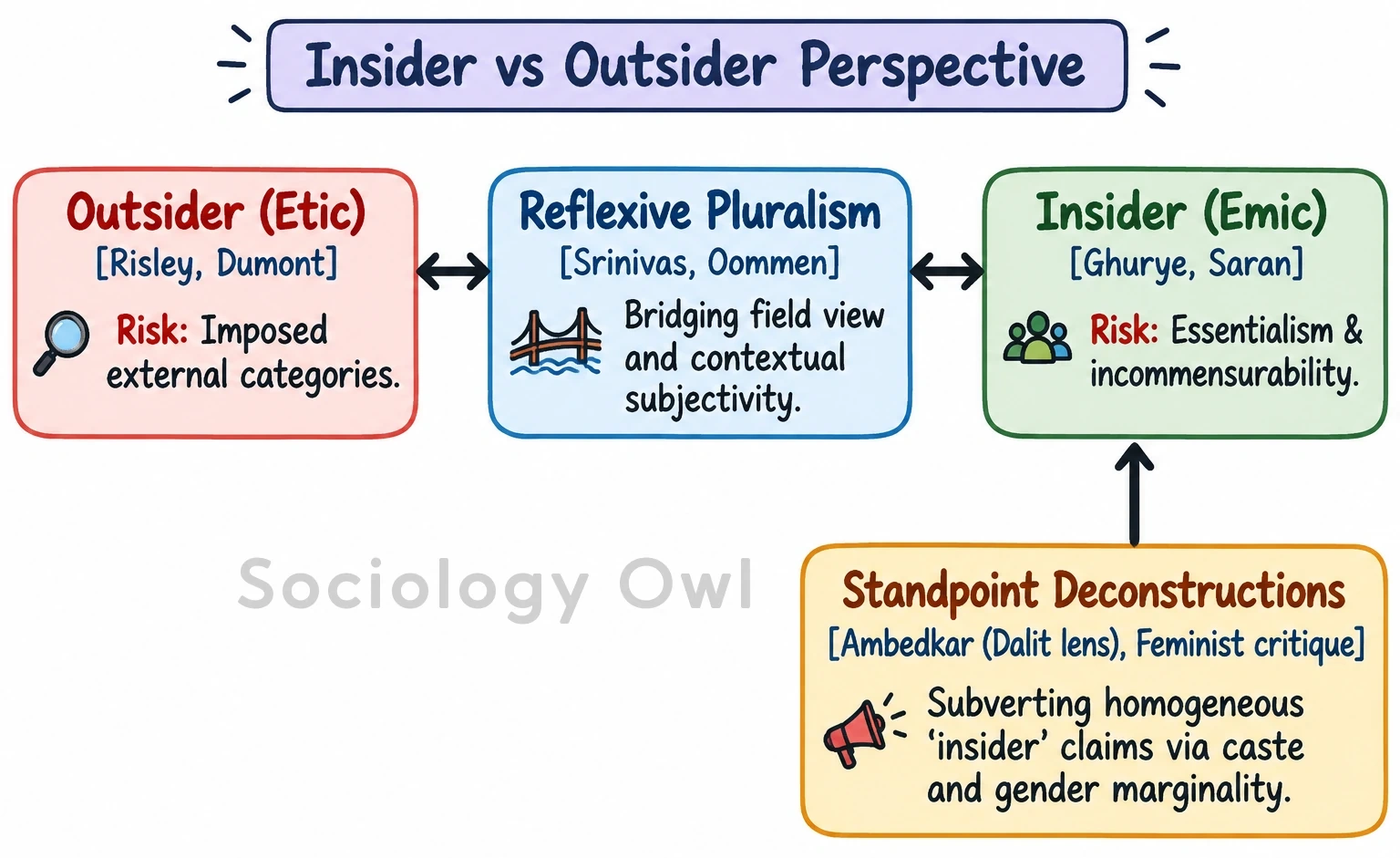
Understanding Indian society requires transcending this binary through a reflexive synthesis that blends empirical rigor with internalized experiential realities.