Model Answer:
Textually, tribes existed outside the four-fold Chaturvarna scheme as exterior groups (Avarna), yet historically they maintained dynamic, porous relationships with mainstream society, resisting any static structural categorization.
Locating Tribes within the Varna Matrix
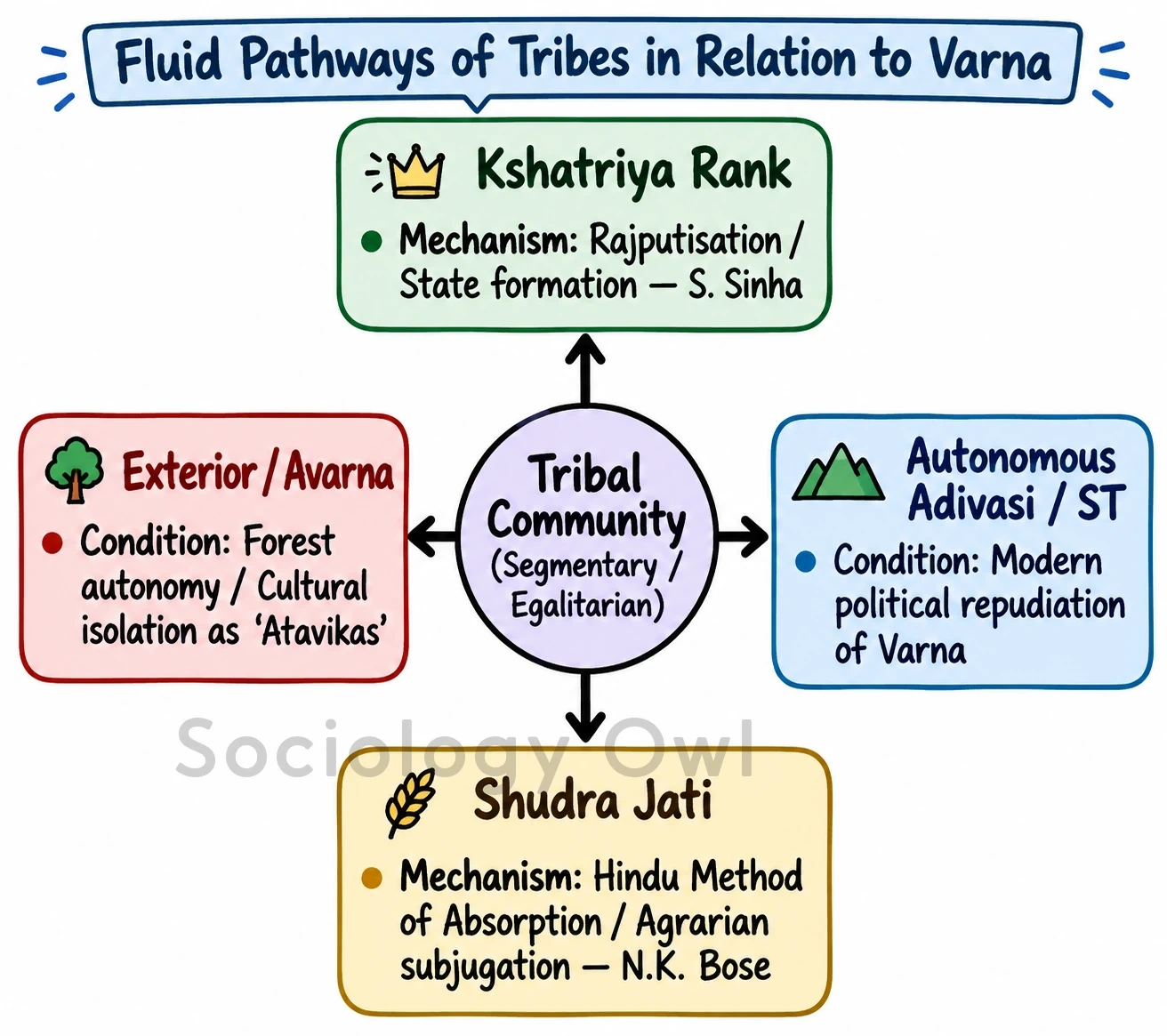
- Exteriority (Avarna Status): Classical Brahmanical texts relegated forest-dwelling communities (Atavikas) outside the ritual hierarchy, treating them as autonomous, unranked mlecchas operating beyond ritual pollution-purity codes.
- Absorption into Lower Strata: N.K. Bose articulated the Hindu method of tribal absorption, showing how economically subdued tribes were gradually integrated into local agrarian economies as subordinate peasant or service-providing Shudra jatis.
- Upward Mobility via Kshatriyaisation: Elite segments of powerful tribes (e.g., Gonds, Bhils) successfully claimed Kshatriya status through state-building and Brahmanical patronage, conceptualized by Surajit Sinha as Rajputisation.
- The Tribe-Caste Continuum: F.G. Bailey argued against rigid placement, demonstrating that tribes occupy intermediate, shifting positions along a tribe-caste continuum based on land control and political cohesion.
- The “Backward Hindus” Formulation: G.S. Ghurye in The Scheduled Tribes rejected external categorization, arguing that tribes are imperfectly integrated groups belonging intrinsically within the broader Hindu fold.
- Conscious Repudiation of Varna: Contemporary constitutional categorization as Scheduled Tribes and the rise of Adivasi consciousness actively reject Varna assimilation, asserting distinct indigenous identities.
Rather than occupying a fixed Varna rank, tribes occupy fluid positions along a continuum of historical absorption and political autonomy.