Model Answer:
In the Indian social context, the Constitution envisions education not merely as human capital accumulation, but as an emancipatory project to dismantle entrenched caste, class, and gender hierarchies, establishing an egalitarian democratic order.
Constitutional Architecture Promoting Education
- Justiciable Right to Schooling (Article 21A): Elevated elementary education (ages 6–14) from a non-enforceable directive into an actionable Fundamental Right, operationalised through the Right to Education (RTE) Act.
- Affirmative Social Inclusivity (Articles 15(4), 15(5), and 15(6)): Empowers the state to reserve seats in public and private educational institutions for SCs, STs, SEBCs, and EWS, neutralising historical educational exclusion.
- Minority Rights and Pluralism (Articles 29 and 30): Protects linguistic and religious minorities’ autonomy to establish and administer educational institutions, preventing majoritarian cultural assimilation.
- Welfare Foundations (Articles 45 and 46): Directs the state to ensure early childhood care (below six years) and specifically promote the educational and economic interests of weaker sections.
- Reciprocal Civic Duty (Article 51A(k)): Locates educational facilitation as a Fundamental Duty of parents and guardians, anchoring universalisation within family socialisation.
- Concurrent Legislative Framing (Seventh Schedule): Placing education in the Concurrent List (Entry 25) balances national pedagogical standards with contextual, vernacular state realities.
Education as an Instrument of Social Change: Potentials and Structural Limits
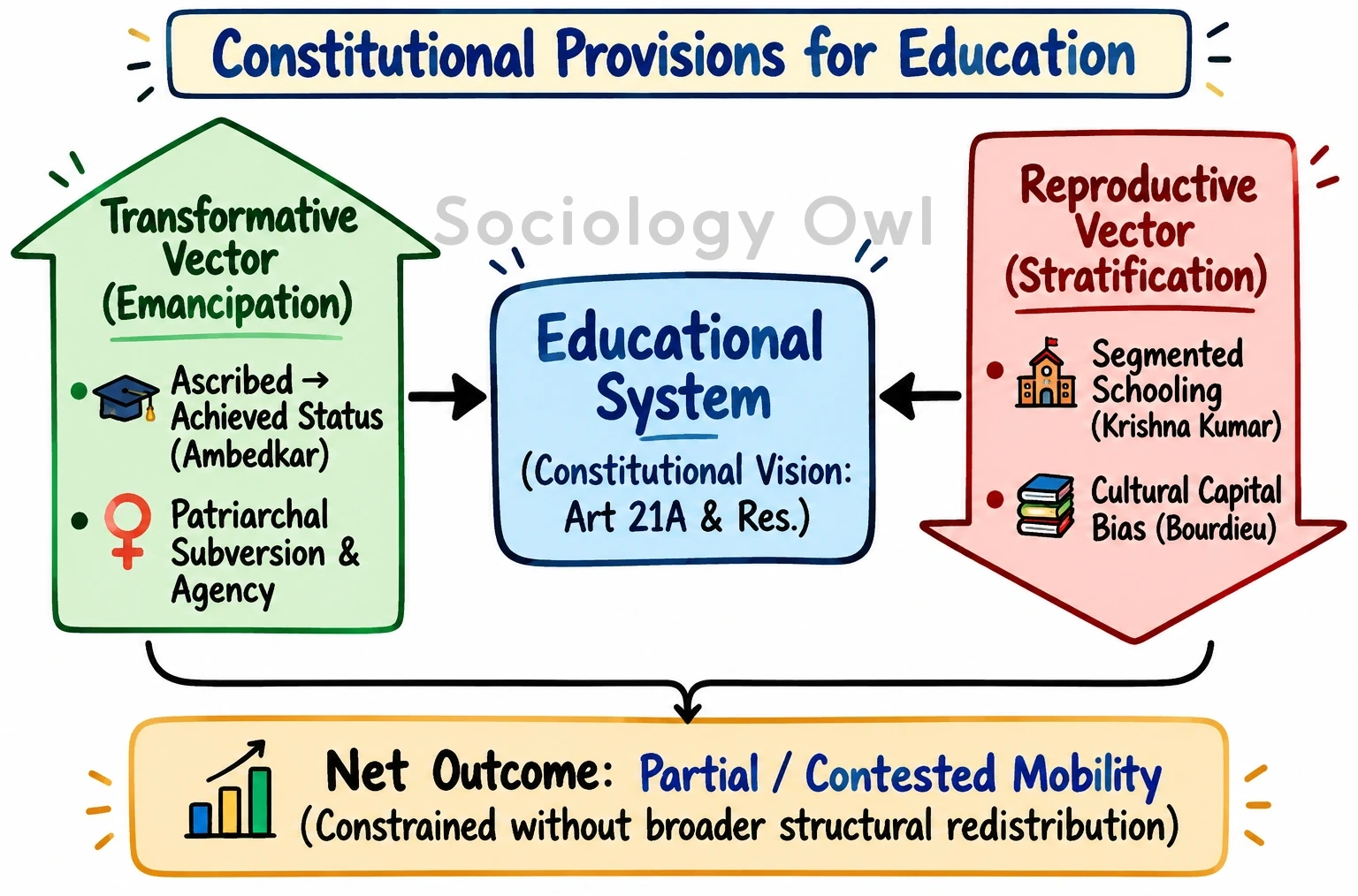
- Subversion of Ascribed Status: As envisioned by B.R. Ambedkar, education acts as the primary weapon to dismantle caste hegemony, facilitating occupational mobility and replacing ritual hierarchy with achievement orientation.
- Gender Transformation: Increased female literacy delays early marriage, reduces fertility rates, and enhances intra-household bargaining power, directly subverting patriarchal domesticity.
- Secular-Rational Socialisation: Formal curricula cultivate constitutional morality, scientific temper, and democratic consciousness, weakening ritual orthodoxies and primordial loyalties.
- Reproduction of Stratification: Sociologist Krishna Kumar highlights that India’s segmented educational market (elite English-medium versus underfunded vernacular schools) reproduces existing class-caste divides rather than dissolving them.
- Cultural Capital Asymmetry: Pedagogic practices often privilege dominant-caste urban cultural capital (Pierre Bourdieu), leading to persistent exclusion, alienation, and dropout rates among first-generation Adivasi and Dalit students.
- Limits of Credentialism: Education acts as a weak catalyst for structural transformation when unaccompanied by agrarian reforms, employment generation, and social asset redistribution.
Education catalyzes transformative social mobility, yet true emancipation requires dismantling deep-rooted structural inequalities beyond classroom walls.