Model Answer:
Post-independence land reforms and the Green Revolution dismantled traditional semi-feudal agrarian hierarchies. This catalyzed the rise of an enterprising, self-cultivating intermediate stratum, famously conceptualized by Lloyd and Susanne Rudolph as bullock capitalists.
Genesis and Drivers of the Agrarian Middle Class
- Tenancy Reforms: The abolition of intermediaries conferred proprietary ownership on erstwhile tenants drawn predominantly from intermediate, middle-ranking castes.
- Technological Modernization: The Green Revolution favored medium-sized holdings, enabling peasants with family labor and capital to maximize yields through mechanized inputs.
- State Subsidies and Price Support: State-backed credit institutions, cheap power, fertilizer subsidies, and the Minimum Support Price (MSP) regime cushioned middle farmers against free-market volatility.
- Peasant Differentiation: As argued by Utsa Patnaik, generalized commercialization triggered class polarization, shifting upper-middle peasants into a commercially oriented agrarian bourgeoisie.
- Democratic Enfranchisement: Universal adult suffrage enabled demographically dense peasant communities to convert numerical strength into economic concessions and institutional leverage.
Socio-Structural Implications on Indian Society
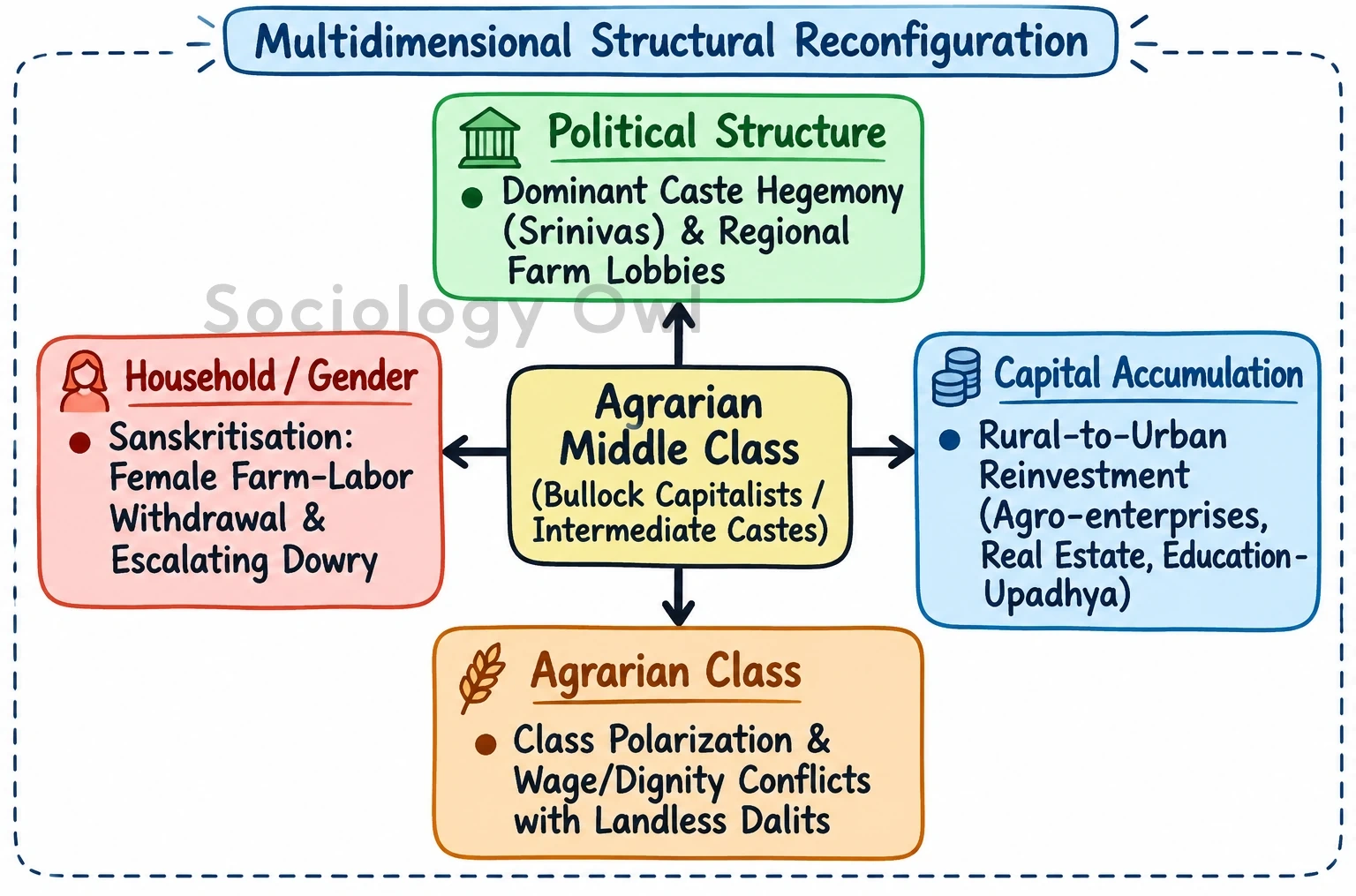
- Ascendance of Dominant Castes: Intermediate peasant castes (e.g., Jats, Marathas, Patidars, Kammas) translated landownership into socio-political dominance, replacing traditional upper-caste hegemony (M.N. Srinivas).
- Deepening Agrarian Labor Conflict: The class divide widened between middle-class landholders and landless Dalit agricultural laborers, fueling structural conflict over wages, dignity, and farm-labor casualization.
- Rise of Agrarian Politics: The emergence of powerful non-party farm lobbies (e.g., Bharatiya Kisan Union) and regional political formations decentralized India’s federal dynamic.
- Diversification into Non-Farm Economy: As observed by Carol Upadhya, agrarian surplus was actively reinvested into agro-processing, petty trading, real estate, and private educational enterprises, blurring rural-urban binaries.
- Patriarchal Retrenchment: Upward economic mobility fostered Sanskritisation, causing the withdrawal of women from manual farm labor and escalating hypergamy and dowry practices.
This intermediate agrarian class restructured rural power dynamics, cementing caste-capital linkages that continue to dictate regional political economy today.