Model Answer:
The premise that Indian villages are static, harmonious repositories of basic civilizational values is highly contested in sociology. While colonial administrators (like Charles Metcalfe’s “little republics”) and nationalists romanticized the village, empirical sociologists like André Béteille demonstrated that villages are not isolated relics, but dynamic entities marked by shifting inequalities and contested power dynamics.
The Village as a Civilizational Microcosm
- The Indological/Nationalist View: Mahatma Gandhi asserted that India’s civilizational soul—rooted in truth, non-violence, and self-sufficiency—resides in its villages.
- The Structural View: Louis Dumont saw the village as an architectural expression of the civilizational value of Homo Hierarchicus (purity and pollution). M.N. Srinivas highlighted how villages are structurally integrated via the Jajmani system and connected to the macro-civilization through Sanskritization.
Béteille’s Empirical Intervention and Critiques
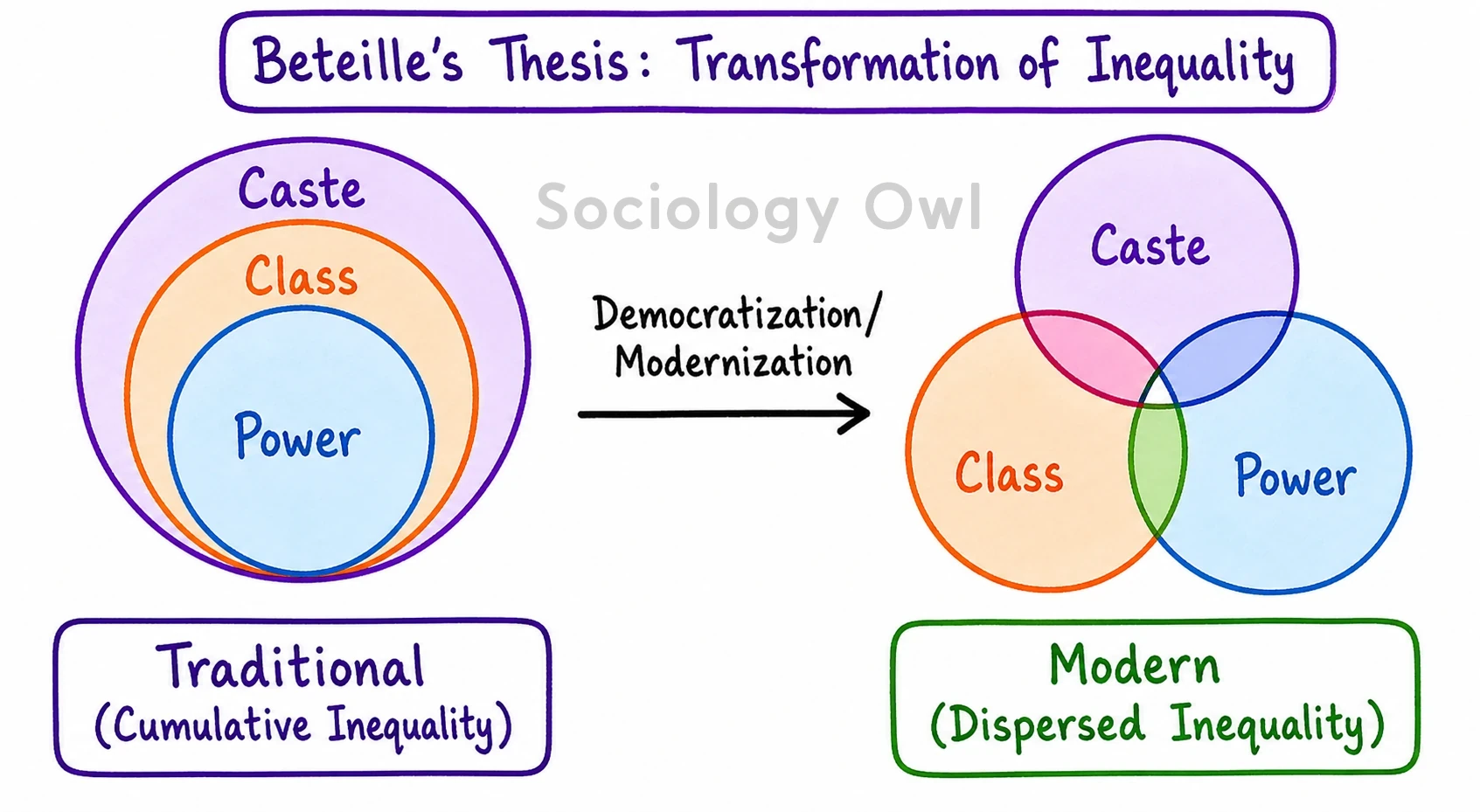
- Dissociation of Power: In his seminal work, Caste, Class, and Power, André Béteille dismantled the romanticized view. Studying Sripuram, he showed that the traditional, overlapping civilizational hierarchy of status (caste), economy (class), and dominance (power) is breaking down into a differentiated, contested structure.
- The Subaltern Critique: B.R. Ambedkar fiercely rejected the village as a positive civilizational model, famously terming it a “sink of localism, a den of ignorance, narrow-mindedness, and communalism” characterized by oppressive caste dynamics.
- The Vanishing Village: Dipankar Gupta argues the village is no longer the primary site of civilizational identity due to rapid de-peasantization and rural-urban migration.
- Shifting Agrarian Relations: Surinder Jodhka notes that traditional patronage has been replaced by market exploitation, echoing Jan Breman’s concept of “footloose labor.” Furthermore, the politicization of Dominant Castes (e.g., Marathas demanding reservations) proves villages are now hubs of democratic mobilization, not static harmony.
Conclusion
While the village remains a crucial methodological site to study Indian society, it cannot be viewed as the sole, unchanging repository of its civilizational values. As rural-urban boundaries blur, Indian civilizational values are themselves transforming from traditional, rigid hierarchies toward dynamic, constitutional, and democratic aspirations.