UPSC Mains 2022 GS4 Model Answer

Q. What do you understand by term ‘good governance’? How far recent initiatives in terms of e-Governance steps taken by the State have helped the beneficiaries? Discuss with suitable examples.

Q. What do you understand by term ‘good governance’? How far recent initiatives in terms of e-Governance steps taken by the State have helped the beneficiaries? Discuss with suitable examples.

Question from UPSC Mains 2022 GS4 Paper

Model Answer: 

Good governance represents the ethical exercise of political, economic, and administrative authority to manage public affairs transparently, ensuring justice and maximum public welfare.

1. Principles of Good Governance

Guided by the World Bank’s 8 Pillars and the 2nd ARC, its core ethical premises include:

  • Accountability & Transparency: Open public decision-making and strict answerability.
  • Responsiveness & Efficiency: Timely, optimal utilization of resources for service delivery.
  • Equity & Inclusiveness: Protecting vulnerable sections without discrimination or bias.

2. Impact of e-Governance on Beneficiaries

E-governance translates these principles into SMART (Simple, Moral, Accountable, Responsive, Transparent) administration:
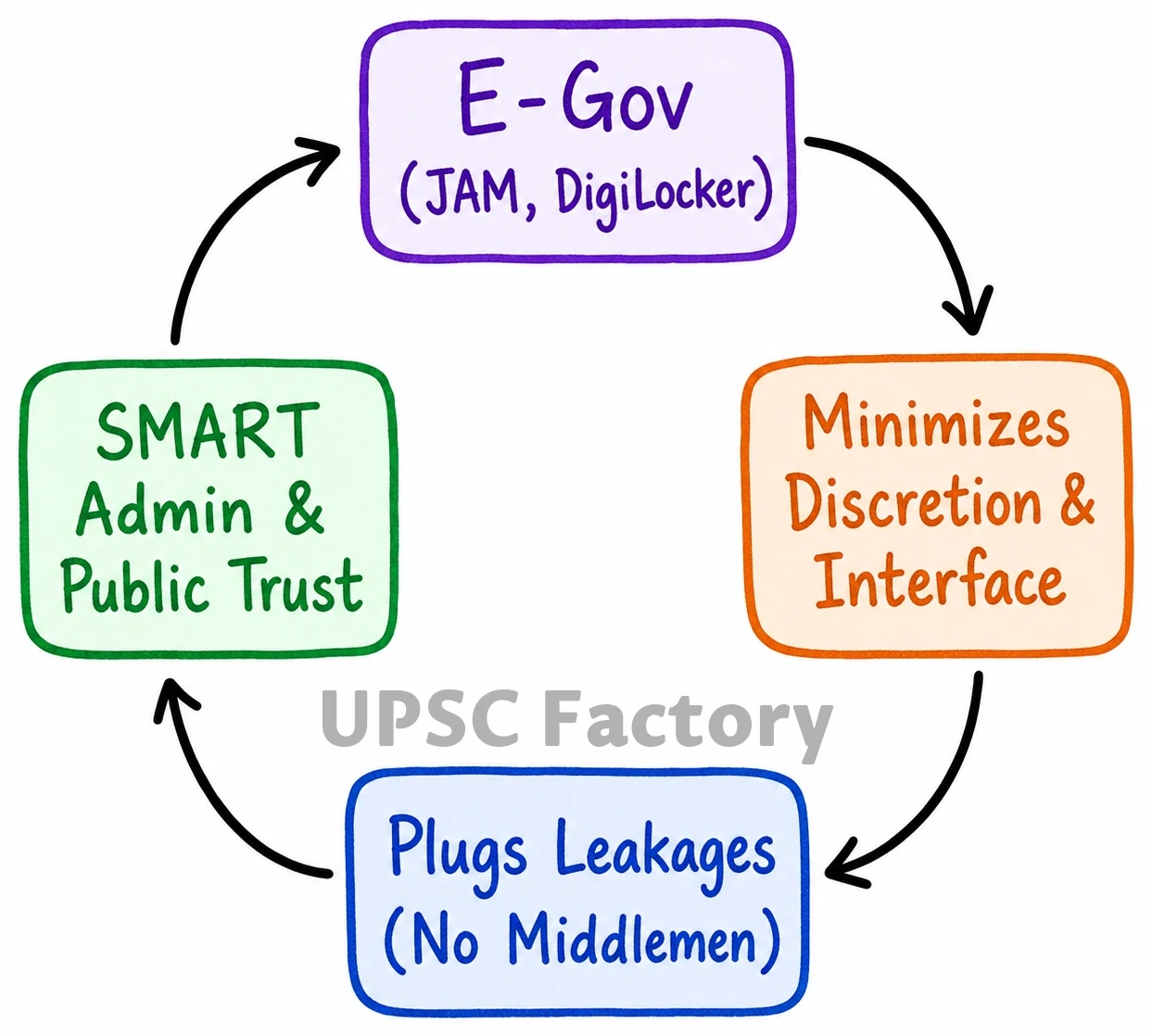
  • Plugging Leakages: Direct benefit transfers eliminate middlemen, ensuring exact socio-economic targeting (JAM Trinity for PM-KISAN).
  • Accessibility & Convenience: Remote access to essential records saves time and reduces petty bribery (DigiLocker, Karnataka’s Bhoomi).
  • Swift Grievance Redressal: Empowers citizens to directly escalate administrative failures to higher authorities (CPGRAMS, MyGov).
  • Inclusivity Gaps: Despite successes, digital illiteracy and infrastructural deficits occasionally exclude marginalized beneficiaries (Digital Divide).

E-governance is not merely a technological upgrade but an ethical imperative. Bridging the digital divide remains critical to achieving true Antyodaya through citizen-centric, technology-driven administration.
Q. What do you understand by term ‘good governance’? How far recent initiatives in terms of e-Governance steps taken by the State have helped the beneficiaries? Discuss with suitable examples. Read More »

Q. “Judge your success by what you had to give up in order to get it.” Dalai Lama.

Q. “Judge your success by what you had to give up in order to get it.” Dalai Lama.

Question from UPSC Mains 2022 GS4 Paper

Model Answer: 

The quote emphasizes the “Purity of Means”. It asserts that true success is measured by the ethical costs and moral trade-offs incurred during a pursuit, not merely the final material achievement.

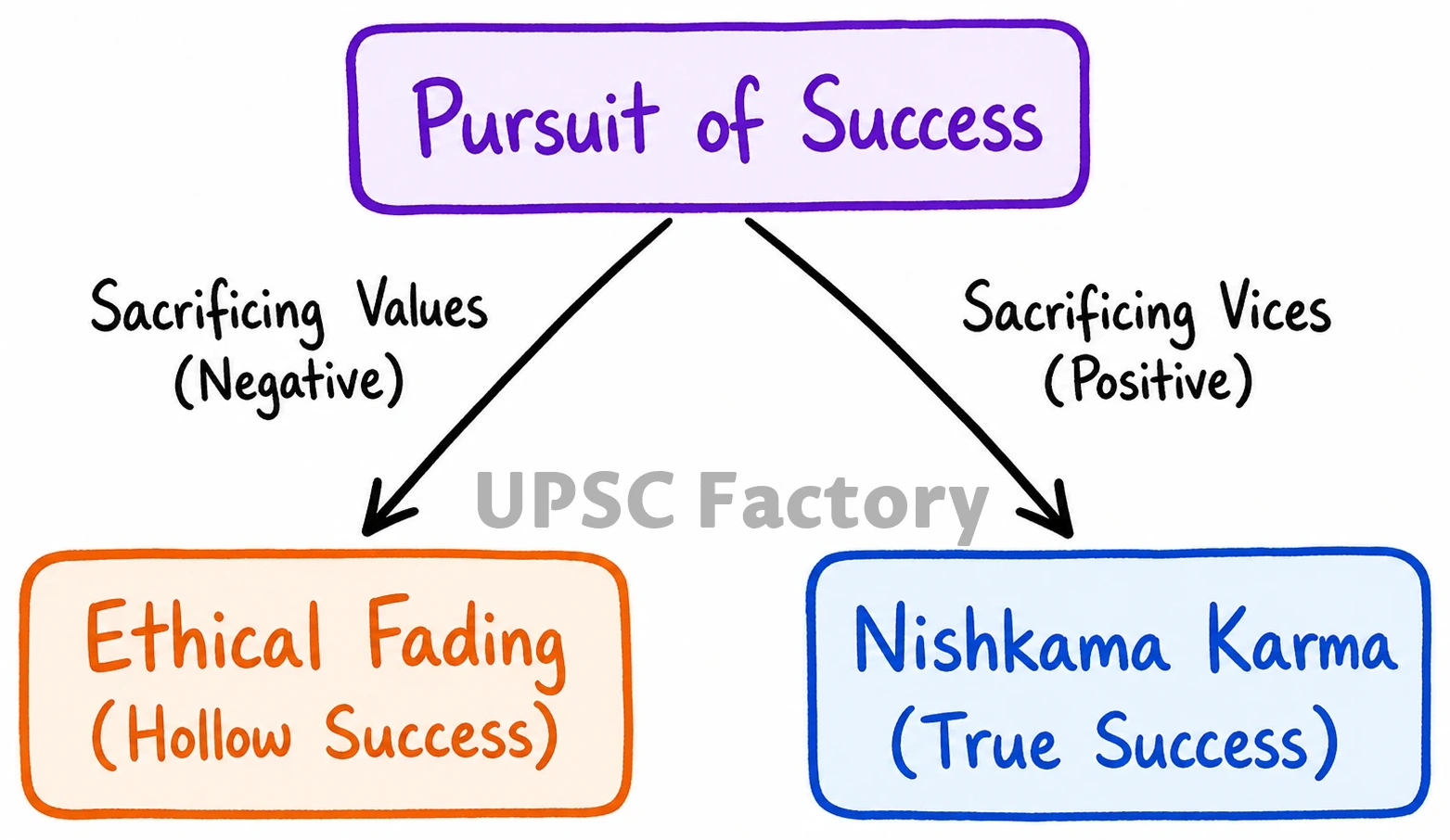
1. Negative Sacrifices (Compromising Ethics for Goals)

  • Ethical Fading: Sacrificing moral integrity for rapid wealth creates a hollow illusion of success (e.g., Satyam/Enron corporate frauds).
  • Purity of Means: Unjust means inevitably corrupt the end result, leading to spiritual bankruptcy (Gandhian philosophy).
  • Deontological Failure: Ignoring moral duty and human dignity for utilitarian gains violates core ethical principles (Kantian ethics).
  • Holistic Toll: Giving up family, health, or inner peace for blind career progression reflects misplaced life priorities.

2. Positive Sacrifices (Giving up Vices for Noble Ends)

  • Selfless Duty: Sacrificing personal greed and comfort for citizen welfare defines true administrative success (Nishkama Karma).
  • Overcoming Ego: Giving up the desire for conquest and vengeance for peace marks supreme moral triumph (e.g., Ashoka embracing Dhamma).
  • Delayed Gratification: Sacrificing immediate, reckless economic growth to ensure long-term environmental sustainability (e.g., global climate action).

Ultimately, success devoid of moral grounding is a failure of character. True triumph lies in achieving noble ends while steadfastly preserving one’s foundational integrity and human values.

Q. “Judge your success by what you had to give up in order to get it.” Dalai Lama. Read More »

Q. “If a country is to be corruption free and become a nation of beautiful minds, I strongly feel there are three key societal members who can make a difference. They are the father, the mother and the teacher.” – Abdul Kalam.

Q. “If a country is to be corruption free and become a nation of beautiful minds, I strongly feel there are three key societal members who can make a difference. They are the father, the mother and the teacher.” – Abdul Kalam.

Question from UPSC Mains 2022 GS4 Paper

Model Answer: 

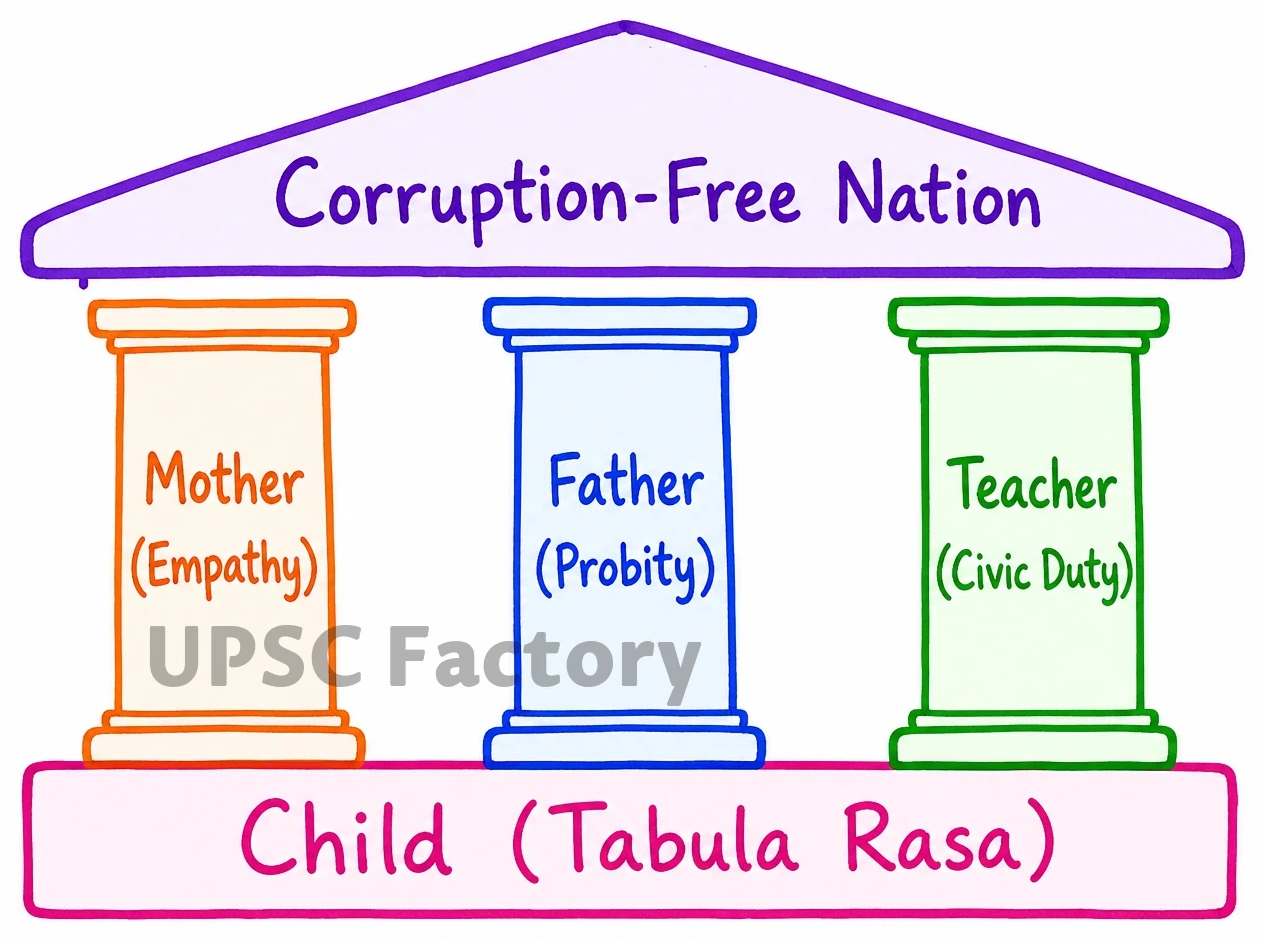
Kalam’s quote underscores that a child’s mind is a tabula rasa. The foundational triad—mother, father, and teacher—drives primary and secondary socialization, inherently shaping a nation’s ethical capital.

1. Parents: Architects of Primary Values

  • Foundational Integrity: Children absorb honesty and empathy via observational learning, establishing early anti-corruption attitudes (Bandura’s Social Learning Theory).
  • Emotional Intelligence: Mothers instill foundational compassion and selfless care, naturally mitigating greed (e.g., Jijabai shaping Shivaji’s moral righteousness).
  • Discipline & Probity: Fathers often anchor austerity, accountability, and financial integrity (e.g., Kalam learning austere honesty from his father).

2. Teachers: Catalysts of Civic Ethics

  • Public Morality: Teachers transition children from private family loyalties to universal civic virtues and constitutional ethics.
  • Scientific Temper: They cultivate “beautiful minds” by fostering rational inquiry, critical thinking, and intellectual objectivity.
  • Resolving Prejudice: Teachers correct cognitive biases by promoting egalitarianism (e.g., Sivasubramania Iyer breaking social barriers for young Kalam).

While statutory laws only deter corruption extrinsically, this triad intrinsically re-engineers human behavior, cultivating a robust conscience essential for building a morally resilient India.

Q. “If a country is to be corruption free and become a nation of beautiful minds, I strongly feel there are three key societal members who can make a difference. They are the father, the mother and the teacher.” – Abdul Kalam. Read More »

Q. Ethics is knowing the difference between what you have the right to do and what is right to do.’-Potter Stewart .

Q. Ethics is knowing the difference between what you have the right to do and what is right to do.’-Potter Stewart .

Question from UPSC Mains 2022 GS4 Paper

Model Answer: 

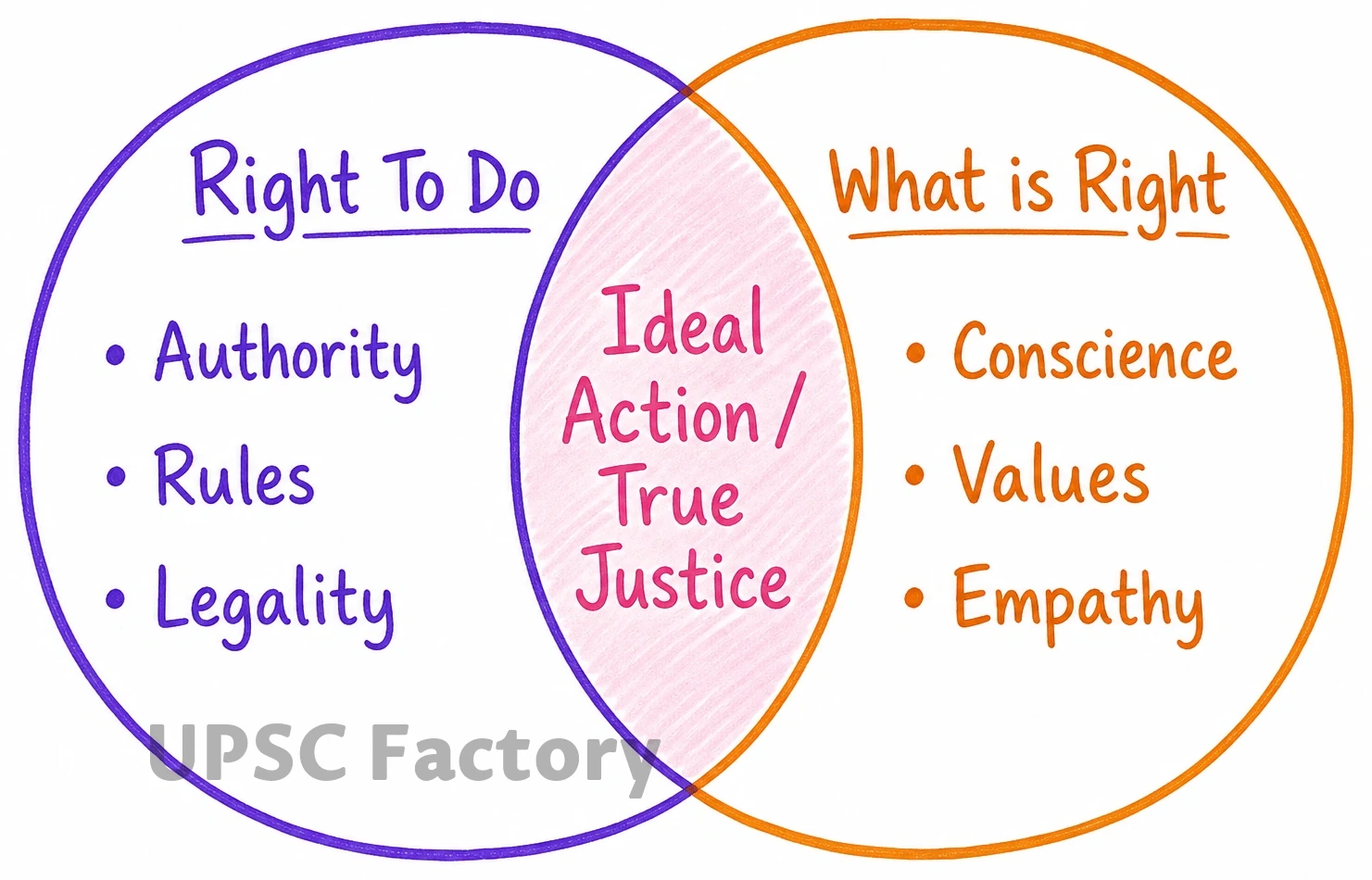
Potter Stewart’s quote highlights the dichotomy between legal entitlement and moral obligation, emphasizing that mere statutory legality does not guarantee ethicality.

1. The Dichotomy: Legal Entitlement vs. Moral Obligation

  • Scope of Conduct: Law dictates the minimum acceptable standards, whereas ethics demands a higher alignment with inner conscience.
  • Exercising Rights: Individuals have the legal right to free speech, but ethical duty restrains them from causing emotional harm (Article 19 vs. Cyberbullying).
  • Corporate Governance: Mass layoffs during economic downturns may be legally permitted to protect margins, but often lack compassion (Corporate Social Responsibility).
  • Global Commons: Nations possess sovereign rights to exploit natural resources, but bear an ethical duty toward future generations (Climate Justice).

2. Application in Public Administration

  • Exercising Discretion: Administrators must prioritize human welfare over rigid bureaucratic compliance (e.g., Granting PDS rations without Aadhaar to starving citizens).
  • Use of Authority: Police have the legal right to clear encroachments, but doing so during severe monsoons violates basic human dignity.
  • Constitutional Morality: Civil servants must let constitutional ethos guide their decisions where formal laws remain silent or ambiguous.

Ultimately, while laws dictate what authority we can wield, ethics illuminates how we should wield it, ensuring that power is exercised with empathy, proportionality, and justice.

Q. Ethics is knowing the difference between what you have the right to do and what is right to do.’-Potter Stewart . Read More »

Q. It is believed that adherence to ethics in human actions would ensure in smooth functioning of an organization/system. If so, what does ethics seek to promote in human life? How do ethical values assist in the resolution of conflicts faced by him in his day-to-day functioning?

Q. It is believed that adherence to ethics in human actions would ensure in smooth functioning of an organization/system. If so, what does ethics seek to promote in human life? How do ethical values assist in the resolution of conflicts faced by him in his day-to-day functioning?

Question from UPSC Mains 2022 GS4 Paper

Model Answer: 

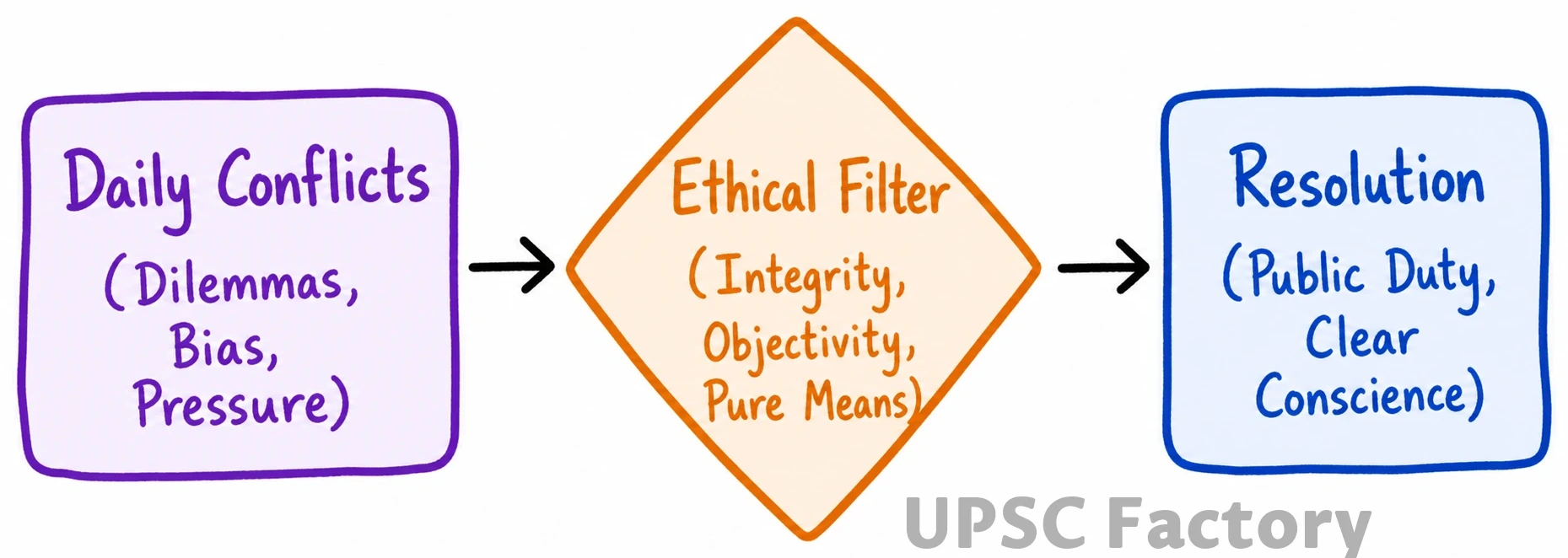
Ethics acts as the foundational moral compass guiding human actions, ensuring the smooth functioning of systems by aligning individual behavior with collective well-being.

1. What Ethics Seeks to Promote in Human Life

  • Human Flourishing: Promotes ultimate well-being, self-realization, and a meaningful existence (Aristotle’s Eudaimonia).
  • Social Harmony: Fosters mutual trust, justice, and cooperation, preventing societal breakdown and anarchy.
  • Character Excellence: Cultivates intrinsic virtues like compassion and honesty, shaping conscientious individuals.
  • Principled Existence: Elevates human actions above base animalistic instincts, ensuring duty-bound, rational behavior (Kant’s Categorical Imperative).

2. Role of Ethical Values in Conflict Resolution

  • Overcoming Cognitive Dissonance: Aligns personal beliefs with practical actions, resolving internal psychological conflicts and guilt.
  • Objective Decision-Making: Values like impartiality resolve dilemmas of favoritism versus merit in resource allocation (Nolan Principles).
  • Balancing Means and Ends: Purity of values guides ethical prioritization during crises (Gandhi withdrawing the Non-Cooperation Movement).
  • Public Duty over Private Gain: Values like integrity and courage resolve conflicts between hierarchical compliance and individual conscience (Ashok Khemka prioritizing institutional integrity).

Ultimately, ethics transforms individuals from mere organizational cogs into active moral agents, bridging the crucial gap between personal fulfillment and the greater public good.

Q. It is believed that adherence to ethics in human actions would ensure in smooth functioning of an organization/system. If so, what does ethics seek to promote in human life? How do ethical values assist in the resolution of conflicts faced by him in his day-to-day functioning? Read More »

Q. The Rules and Regulations provided to all the civil servants are same, yet there is difference in the performance. Positive minded officers are able to interpret the Rules and Regulations in favour of the case and achieve success, whereas negative minded officers are unable to achieve goals by interpreting the same Rules and Regulations against the case. Discuss with illustrations.

Q. The Rules and Regulations provided to all the civil servants are same, yet there is difference in the performance. Positive minded officers are able to interpret the Rules and Regulations in favour of the case and achieve success, whereas negative minded officers are unable to achieve goals by interpreting the same Rules and Regulations against the case. Discuss with illustrations.

Question from UPSC Mains 2022 GS4 Paper

Model Answer: 

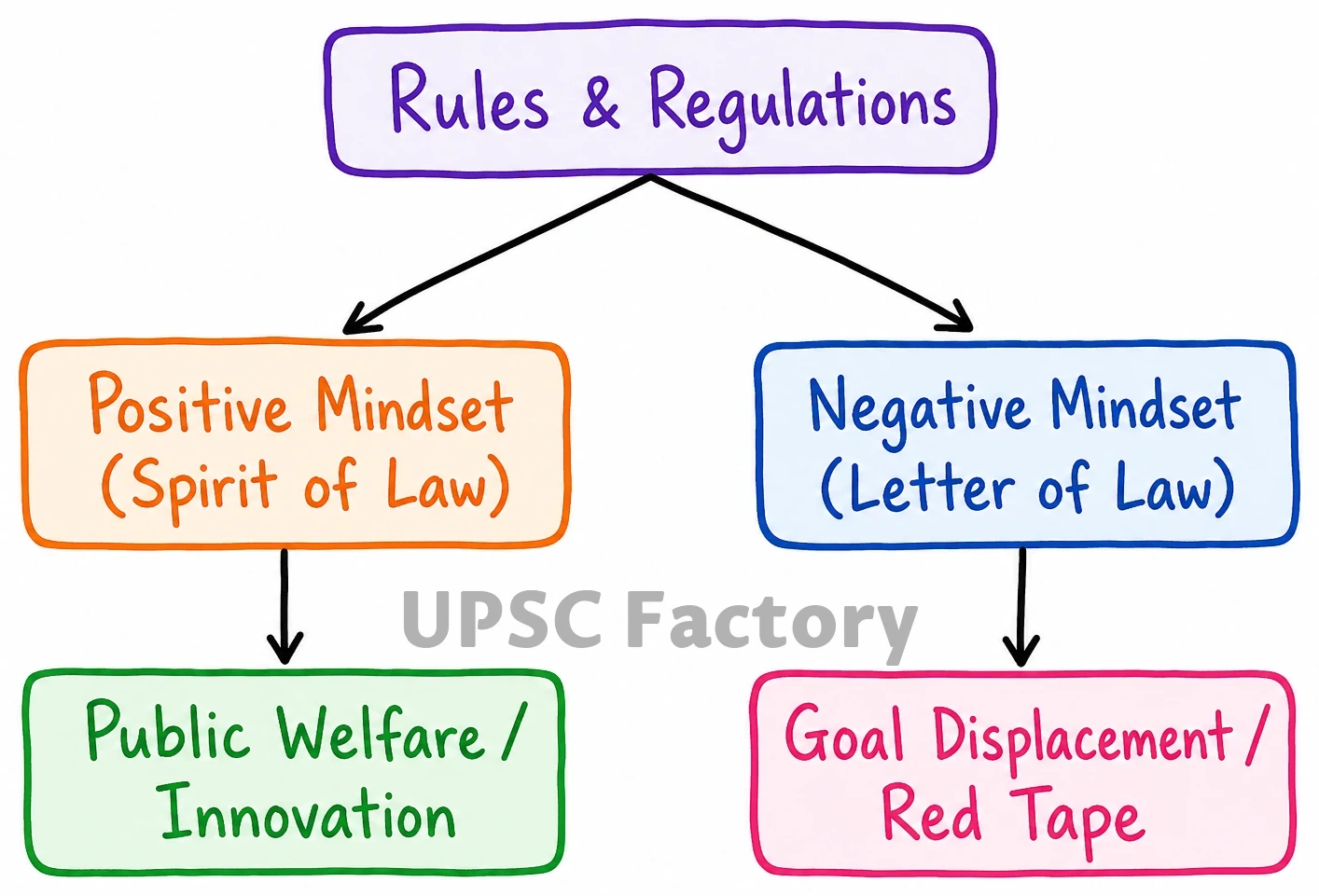
Rules provide the administrative framework, but an officer’s attitude dictates their application, differentiating between the pro-active “spirit” and the rigid “letter” of the law.

1. Positive Mindset: Upholding the “Spirit of the Law”

  • Pro-Public Alignment: Interprets legal ambiguities to maximize citizen welfare and resolve grievances proactively.
  • Ethical Innovation: Applies Emotional Intelligence to overcome procedural bottlenecks without violating statutory boundaries.
  • Outcome-Oriented: Focuses on effective service delivery rather than finding procedural excuses to reject files.
  • Illustration: IAS officer Armstrong Pame utilizing crowdfunding to build the 100km ‘People’s Road’ in Manipur, successfully bypassing bureaucratic funding delays.

2. Negative Mindset: Fixation on the “Letter of the Law”

  • Goal Displacement: Procedures become the ultimate end, trapping administration in Weber’s rigid ‘Iron Cage’.
  • Risk Aversion: Uses complex regulations as a defensive shield to avoid decision-making and accountability (red-tapism).
  • Apathetic Compliance: Refuses to exercise lawful administrative discretion, even for highly vulnerable populations.
  • Illustration: Denying life-saving PDS rations to starving citizens purely due to technical biometric/Aadhaar mismatches (e.g., Jharkhand starvation deaths).

Civil servants must be trained beyond mere procedural compliance toward true constitutional morality, ensuring that rules act as facilitators rather than barriers to public welfare.

Q. The Rules and Regulations provided to all the civil servants are same, yet there is difference in the performance. Positive minded officers are able to interpret the Rules and Regulations in favour of the case and achieve success, whereas negative minded officers are unable to achieve goals by interpreting the same Rules and Regulations against the case. Discuss with illustrations. Read More »

Q. Apart from intellectual competency and moral qualities, empathy and compassion are some of the other vital attributes that facilitate the civil servants to be more competent in tackling the crucial issues or taking critical decisions. Explain with suitable illustrations.

Q. Apart from intellectual competency and moral qualities, empathy and compassion are some of the other vital attributes that facilitate the civil servants to be more competent in tackling the crucial issues or taking critical decisions. Explain with suitable illustrations.

Question from UPSC Mains 2022 GS4 Paper

Model Answer: 

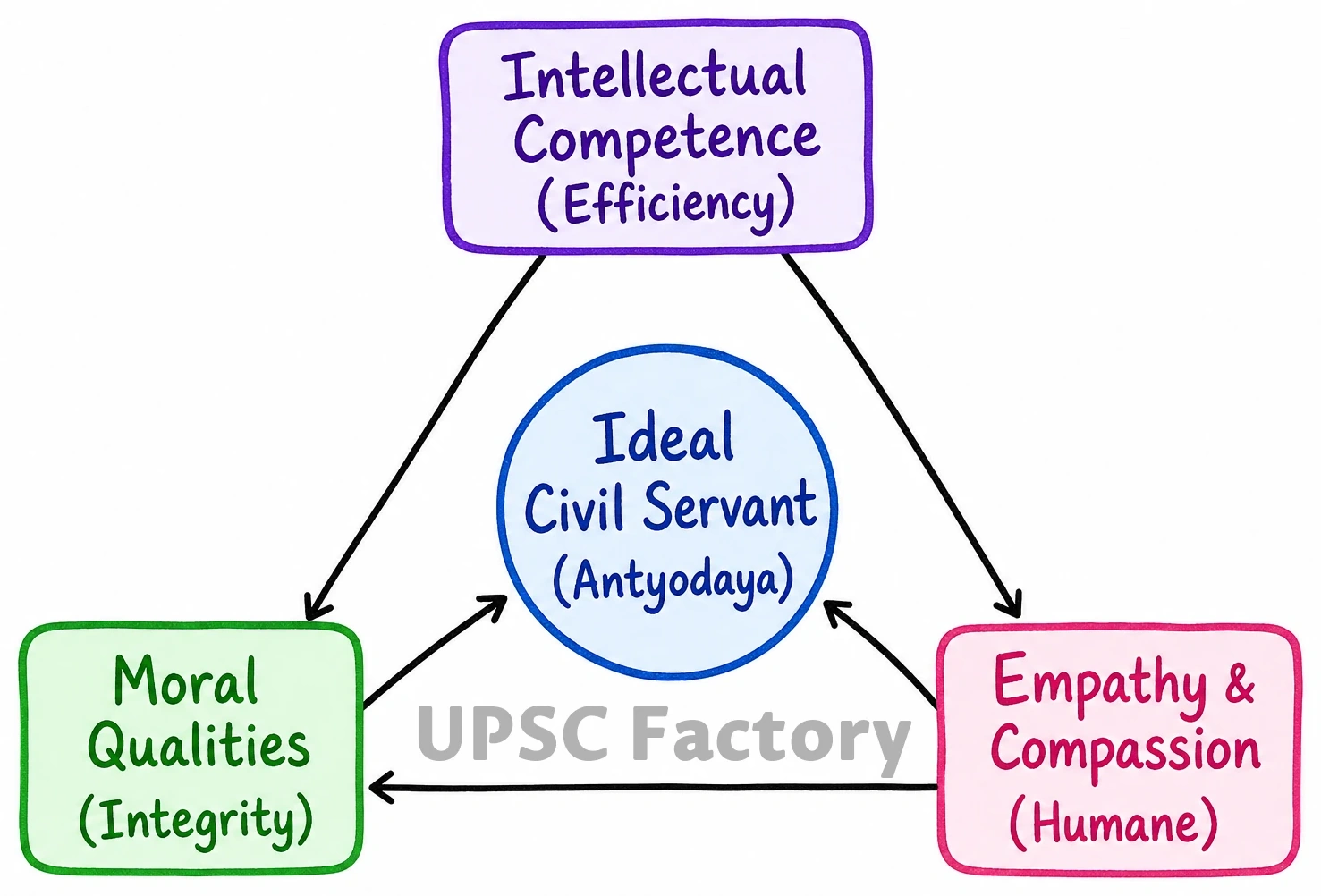
While intellectual competency ensures administrative efficiency, empathy and compassion align governance with Antyodaya, ensuring inclusive and humane decision-making during critical challenges.

1. Role of Empathy & Compassion in Critical Decisions

  • Targeting the Vulnerable: Prioritizes the voiceless and marginalized in resource allocation (e.g., focusing on elderly/disabled during disaster relief).
  • Contextual Problem-Solving: Moves beyond rigid bureaucratic red-tapism to find humane, situational solutions (e.g., relaxing strict document norms for orphans).
  • Conflict Resolution: Builds public trust and de-escalates law-and-order tensions through active listening (e.g., empathetic dialogue during citizen protests).
  • Proactive Governance: Drives out-of-the-box administrative actions motivated by genuine care rather than mere statutory duty.

2. Administrative Illustrations

  • Overcoming Resource Deficits: IAS Armstrong Pame’s compassion for disconnected remote villagers led him to crowdfund the 100km ‘People’s Road’ without initial government funds (Manipur).
  • Dignified Welfare Innovation: IAS Prashant Nair’s ‘Operation Sulaimani’ utilized community empathy to provide free, dignified meals to eradicate urban hunger (Kozhikode).
  • Inclusive Empowerment: IAS Sandeep Nanduri established ‘Cafe Able’, driven by empathy, to provide sustainable livelihoods to differently-abled citizens (Thoothukudi).

As highlighted by the Second ARC, empathy and compassion are foundational values that transform mere bureaucratic efficiency into effective, humane, and constitutionally moral public service.

Q. Apart from intellectual competency and moral qualities, empathy and compassion are some of the other vital attributes that facilitate the civil servants to be more competent in tackling the crucial issues or taking critical decisions. Explain with suitable illustrations. Read More »

Q. Wisdom lies in knowing what to reckon with and what to overlook. An officer being engrossed with the periphery, ignoring the core issues before him, is no rare in the bureaucracy. Do you agree that such preoccupation of an administrator leads to travesty of justice to the cause of effective service delivery and good governance? Critically evaluate.

Q. Wisdom lies in knowing what to reckon with and what to overlook. An officer being engrossed with the periphery, ignoring the core issues before him, is no rare in the bureaucracy. Do you agree that such preoccupation of an administrator leads to travesty of justice to the cause of effective service delivery and good governance? Critically evaluate.

Question from UPSC Mains 2022 GS4 Paper

Model Answer: 

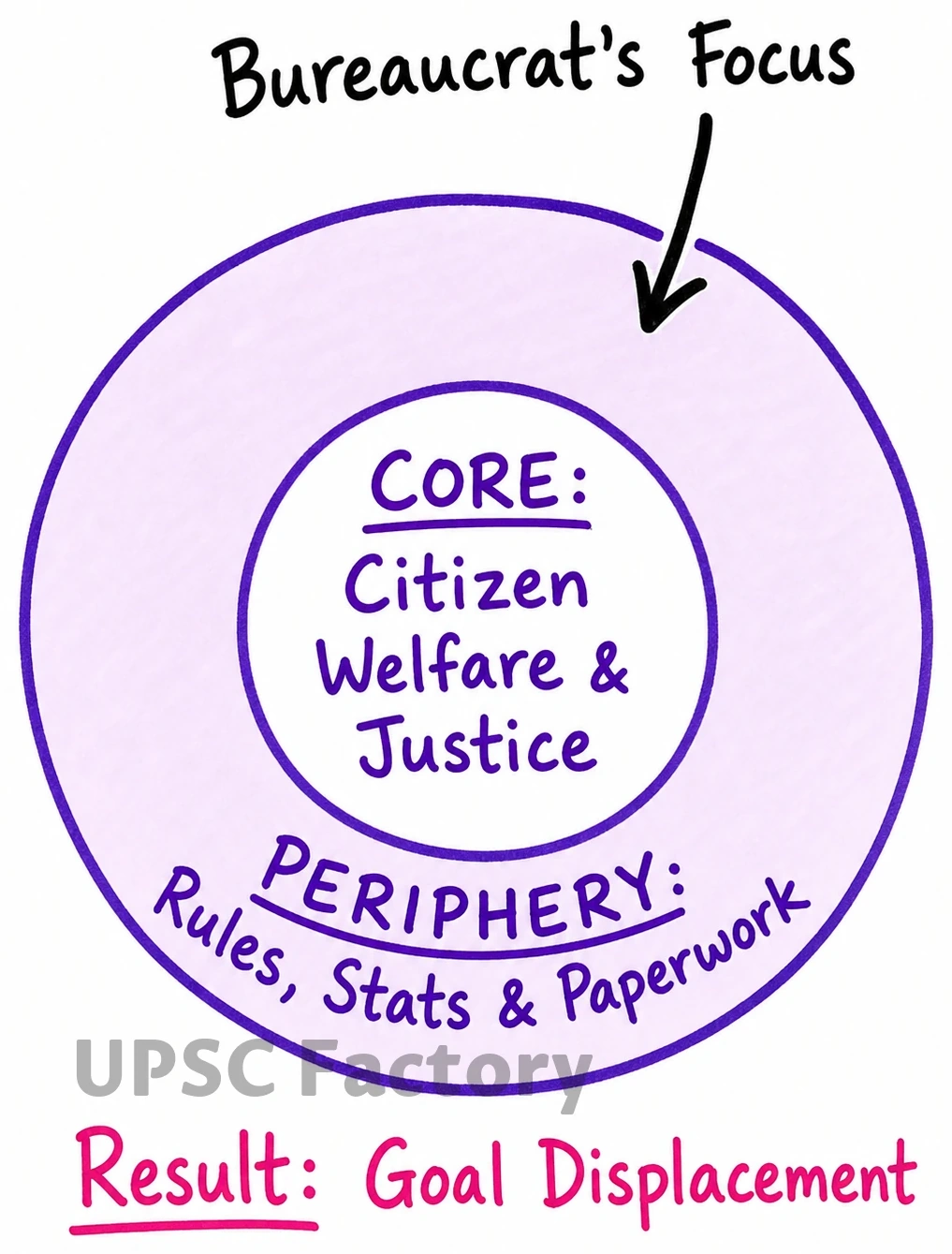
Bureaucratic obsession with procedures over outcomes reflects Robert Merton’s concept of “Goal Displacement,” where administrative means (periphery) defeat the actual service goals (core).

Impact: Travesty of Justice and Service Delivery

  • Exclusion Errors: Rigid procedural compliance actively denies fundamental rights (e.g., PDS ration denial/starvation due to Aadhaar mismatch).
  • Outcome Failure: Focusing on quantitative output rather than qualitative behavioral change (e.g., Counting toilet construction instead of usage in Swachh Bharat).
  • Red-Tapism: Over-focusing on paperwork and hierarchical protocols delays critical grievance redressal (Parkinson’s Law).
  • Erosion of Public Trust: Mechanistic rigidity makes the administration appear apathetic, violating the social contract.

Systemic Causes (Critical Evaluation)

  • Risk Aversion: Fear of punitive action by the “3Cs” (CBI, CVC, CAG) drives officers toward safe, defensive procedural compliance.
  • Top-Down Pressures: Unrealistic statistical targets force administrators to prioritize immediate data reporting over sustainable core solutions.
  • Colonial Legacy: Outdated civil service conduct rules prioritize rigid rule-following over innovative, compassionate problem-solving.

Administrators must cultivate Aristotle’s “Phronesis” (practical wisdom) to distinguish between vital principles and trivial procedures, ensuring a transition from mere administration to citizen-centric governance (2nd ARC).

Q. Wisdom lies in knowing what to reckon with and what to overlook. An officer being engrossed with the periphery, ignoring the core issues before him, is no rare in the bureaucracy. Do you agree that such preoccupation of an administrator leads to travesty of justice to the cause of effective service delivery and good governance? Critically evaluate. Read More »

Q. You have done MBA from a reputed institution three years back but could not get campus placement due to COVID-19 generated recession.

Q. You have done MBA from a reputed institution three years back but could not get campus placement due to COVID-19 generated recession.

However, after a lot of persuasion and series of competitive tests including written and interview, you managed to get a job in a leading shoe company. You have aged parents who are dependent and staying with you. You also recently got married after getting this decent job. You were allotted the Inspection Section which is responsible for clearing the final product. In first one year, you learnt your job well and was appreciated for your performance by the management. The company is doing good business for last five years in domestic market and this year it is decided even to export to Europe and Gulf countries. However, one large consignment to Europe was rejected by their Inspecting Team due to certain poor quality and was sent back. The top management ordered that ibid consignment to be cleared for the domestic market. As a part of Inspecting Team, you observed the glaring poor quality and brought to the knowledge of the Team Commander. However, the top management advised all the members of the team to overlook these defects as the management cannot bear such a huge loss. Rest of the team members except you promptly signed and cleared the consignment for domestic market, overlooking glaring defects. You again brought to the knowledge of the Team Commander that such consignment, if cleared even for domestic market, will tarnish the image and reputation of the company and will be counter-productive in the long run. However, you were further advised by the top management that if you do not clear the consignment, the company will not hesitate to terminate your services citing certain innocuous reasons.

(a) Under the given conditions, what are the options available to you as a member of the Inspecting Team?
(b) Critically evaluate each of the options listed by you.
(c) What option would you adopt and why?
(d) What are the ethical dilemmas being faced by you?
(e) What can be the consequences of overlooking the observations raised by the Inspecting Team?

Question from UPSC Mains 2022 GS4 Paper

Model Answer: 

(a) Options available to you as a member of the Inspecting Team:

Overlook the glaring defects and sign the clearance for the domestic market as instructed by the top management.
Refuse to sign the clearance and risk losing your job.
Report the matter to higher authorities or legal agencies.
Seek support from other employees or unions within the company.

(b) Critical evaluation of each of the options listed by you:

Overlook the glaring defects and sign the clearance for the domestic market as instructed by the top management: This option would involve compromising on professional ethics and principles. It would also lead to tarnishing the company’s reputation and could have negative long-term consequences. Therefore, this option is not desirable.

Refuse to sign the clearance and risk losing your job: This option would involve taking a risk and facing the consequences of losing your job. However, it would uphold professional ethics and principles and protect the company’s reputation. Therefore, this option can be considered.

Report the matter to higher authorities or legal agencies: This option would involve seeking legal or administrative intervention to protect professional integrity and uphold principles of ethical conduct. However, it would require courage and determination to pursue the matter despite the possible risks. Therefore, this option can also be considered.

Seek support from other employees or unions within the company: This option would involve building a network of support to amplify the impact of the observations raised by the Inspecting Team and protect the employee from possible retaliation. However, it would also require time and effort to establish such a network. Therefore, this option can also be considered.

(c) The option you would adopt and why:

The most appropriate option for you would be to refuse to sign the clearance and risk losing your job. This option would uphold professional ethics and principles and protect the company’s reputation. It would also ensure that the company does not suffer long-term consequences due to poor quality products. Moreover, you have a responsibility as a professional to maintain ethical standards and protect the company’s image.

(d) The ethical dilemmas being faced by you:

You are faced with the ethical dilemma of whether to uphold professional ethics and principles or to compromise on these principles to protect your job. You also need to consider the consequences of your actions on your career, your family, and your personal safety.

(e) Consequences of overlooking the observations raised by the Inspecting Team:

If the glaring defects are overlooked, it could have negative consequences for the company’s reputation and business prospects. It could lead to a loss of trust among customers, suppliers, and partners, and could impact the company’s long-term growth prospects. Moreover, it could lead to legal and regulatory action against the company, which could result in financial penalties and damage to the company’s reputation.

Q. You have done MBA from a reputed institution three years back but could not get campus placement due to COVID-19 generated recession. Read More »