2024 Sociology Paper 2

Q. What do you understand by decentralisation of power? What is its role in strengthening the roots of democracy in India? Elaborate.

Q. What do you understand by decentralisation of power? What is its role in strengthening the roots of democracy in India? Elaborate.

UPSC Sociology 2024 Paper 2

Model Answer:

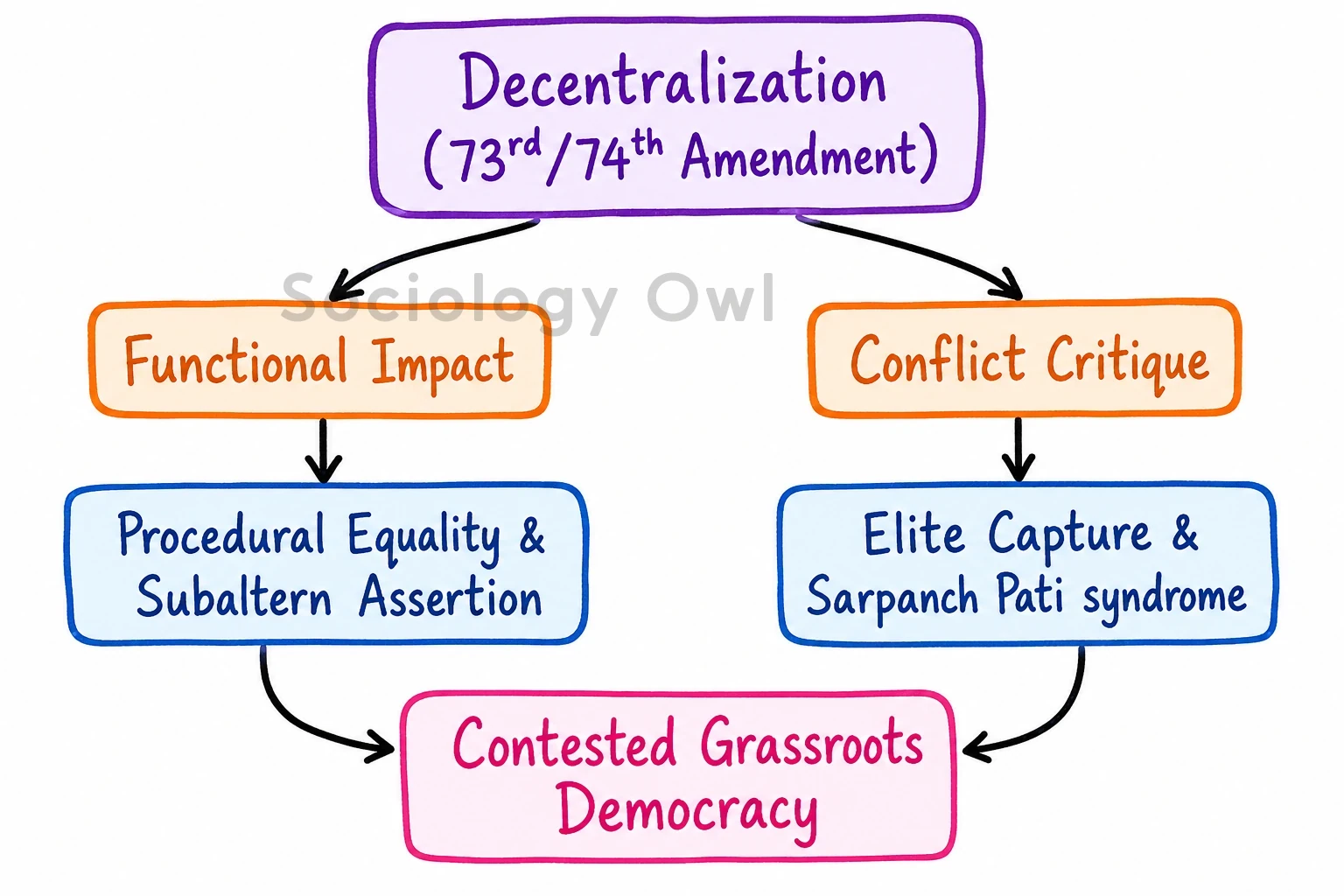
Decentralization of power refers to the devolution of administrative, financial, and political authority to the grassroots. Institutionalized via the 73rd and 74th Amendments, it catalyzed a structural transformation in India, shifting the locus of power from traditional caste hierarchies to statutory, democratic institutions.

Democratization of the Social Structure

  • Shift in Power Dynamics: Andre Beteille, in his study of Sripuram, observed that decentralization shifted power away from traditional Caste Panchayats to secular Gram Panchayats, slowly replacing substantive hierarchy with procedural equality.
  • Modernization of Tradition: Yogendra Singh notes that local self-governance exemplifies the Modernization of Indian Tradition, where traditional village bodies adapt to democratic, egalitarian processes.
Subaltern Empowerment and Gender Dynamics

  • The Subaltern Critique: While Mahatma Gandhi romanticized Gram Swaraj (village self-rule), B.R. Ambedkar warned that Indian villages were “dens of ignorance and communalism.” Decentralization mandated power-sharing through reservations, acting as a catalyst for Dalit and Adivasi political assertion.
  • The Conflict Perspective: Conversely, M.N. Srinivas demonstrated how the Dominant Caste utilizes numerical strength and land ownership to capture Panchayats. Marxist sociologist A.R. Desai argued that this caste-class nexus often decentralizes exploitation rather than power, empowering the “rural bourgeoisie.”
  • Negotiating Patriarchy: Women’s reservation initially faced pushback via the “Sarpanch Pati” syndrome (husbands wielding actual proxy power). However, Bina Agarwal highlights that sustained participation eventually creates genuine female agency, reorienting rural priorities toward water, sanitation, and health.

The Kudumbashree model in Kerala proves how integrating women’s Self-Help Groups (SHGs) with local Panchayats dismantles traditional class-gender hierarchies. Furthermore, scholars like Gopal Guru note the rising political socialization of Dalit Sarpanches in Tamil Nadu, marking deep grassroots democratization despite instances of violent upper-caste backlash.

Conclusion

While democratic decentralization continuously navigates the complex fault lines of India’s entrenched social stratification, it has initiated an irreversible democratization of the rural matrix. It remains a vital tool for transforming the Indian village from an arena of rigid hierarchy to a nursery of participatory democracy.
Q. What do you understand by decentralisation of power? What is its role in strengthening the roots of democracy in India? Elaborate. Read More »

Q. How do religious communities contribute to the cultural diversity of India?

Q. How do religious communities contribute to the cultural diversity of India?

UPSC Sociology 2024 Paper 2

Model Answer:

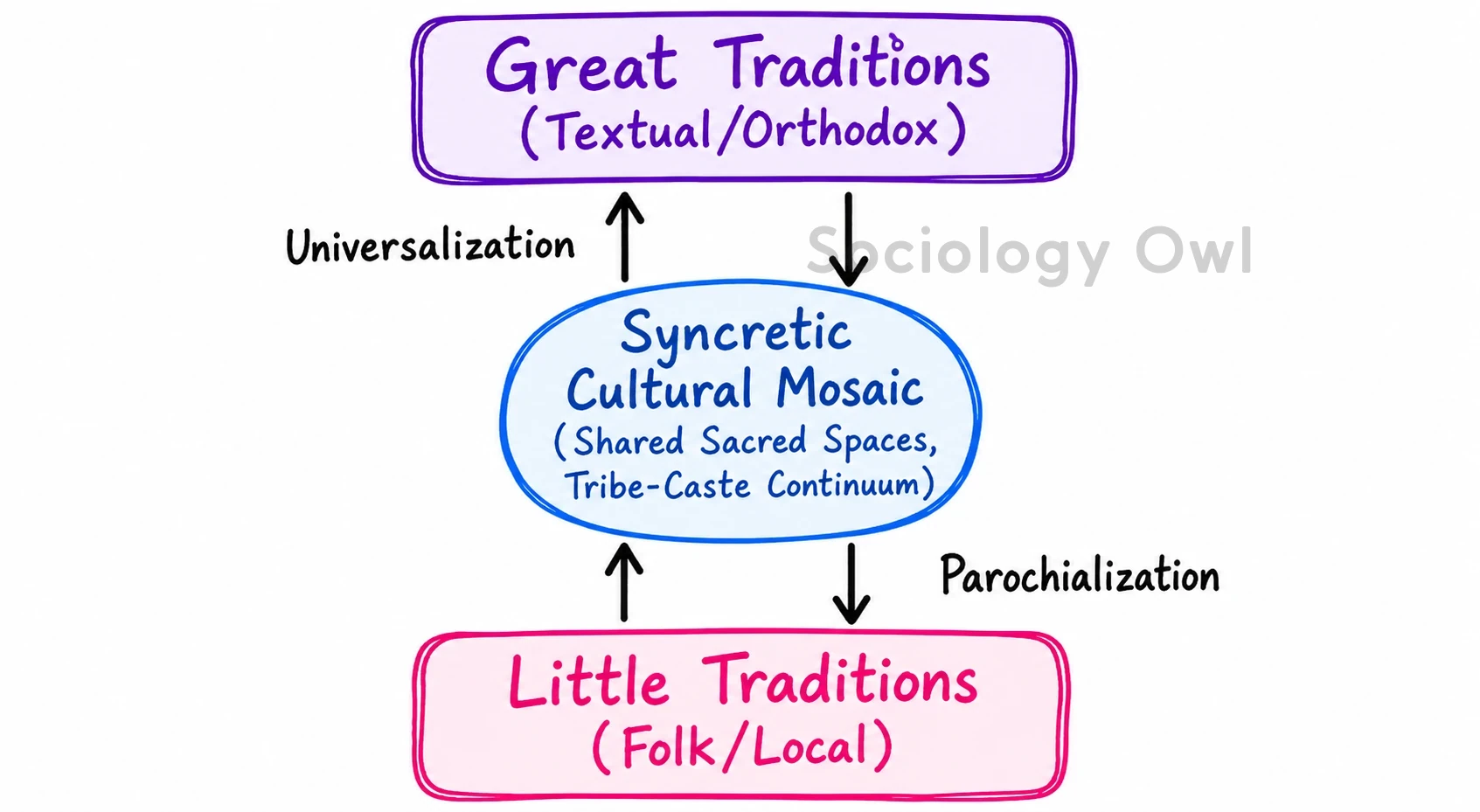
Sociologically, India’s religious communities foster cultural diversity by localizing text-based “Great Traditions” into diverse, folk-based “Little Traditions” (Milton Singer and Robert Redfield). While G.S. Ghurye emphasized the assimilative unity of Hinduism, this pluralistic landscape is a dynamic mosaic of distinct religious identities, socio-cultural negotiations, and shared practices.

Dimensions of Religious and Cultural Diversity

  • Syncretism and Shared Spaces: T.N. Madan highlights how blended traditions enrich cultural expressions. S.C. Dube observed this in the Meo Muslims (blending Islamic and Rajput customs), while Susan Bayly notes that shared sacred spaces like Dargahs act as cultural melting pots.
  • Sacred Geography: L.P. Vidyarthi’s concept of the “Sacred Complex” demonstrates how pilgrimage centers integrate linguistically and regionally diverse communities, acting as dynamic vehicles for cultural exchange.
  • Tribal Pluralism: Tribal animism adds ecological and egalitarian dimensions to India’s culture. Surajit Sinha’s Tribe-Caste Continuum explains the continuous cultural negotiation between indigenous faiths and mainstream religions.
  • Material Culture and Boundaries: Food and dress act as cultural markers. Utilizing Emile Durkheim’s perspective on symbols, attire maintains religious boundaries, while dietary laws dictate Commensality, simultaneously driving structural interdependence.
  • Modernization: As Yogendra Singh argues, traditions adapt to modernity. Milton Singer’s “Compartmentalization” explains how communities maintain diverse traditional rituals at home while adopting uniform secular practices in modern workspaces.

Critique and Homogenization Threats

This diversity faces structural challenges from political homogenization. Ashis Nandy distinguishes between religion as faith (which is inherently plural and syncretic) and religion as ideology (which promotes homogenization and communalism, threatening cultural diversity).

The ongoing demand by tribal communities in Jharkhand and Odisha for a separate “Sarna Religious Code” in the Census exemplifies contemporary struggles to assert and preserve unique cultural-religious identities against mainstream assimilation.

Conclusion

India’s religious communities inherently provide the sociological foundation for cultural diversity. However, as Andre Beteille suggests, it is the modern constitutional framework of secularism and minority rights that institutionally protects and sustains this dynamic, pluralistic society today.

Q. How do religious communities contribute to the cultural diversity of India? Read More »

Q. Critically examine the relevance of development planning in India ?

Q. Critically examine the relevance of development planning in India ?

UPSC Sociology 2024 Paper 2

Model Answer:

Development planning in post-independent India was conceived as an instrument of directed social change and state-led modernization (Yogendra Singh) to dismantle feudal structures and reduce inequalities.

Sociological Critiques of Planning

  • Marxist Perspective: A.R. Desai argued that planning merely facilitated a capitalist path of development, enriching the bourgeoisie while marginalizing the proletariat.
  • Agrarian Inequality: Utsa Patnaik noted that planned agricultural interventions (Green Revolution) disproportionately benefited the Dominant Castes (M.N. Srinivas), deepening rural caste-class divides.
  • Subaltern Critique: Top-down infrastructural projects massively displaced Adivasis, causing systemic marginalization, as critiqued by Walter Fernandes.

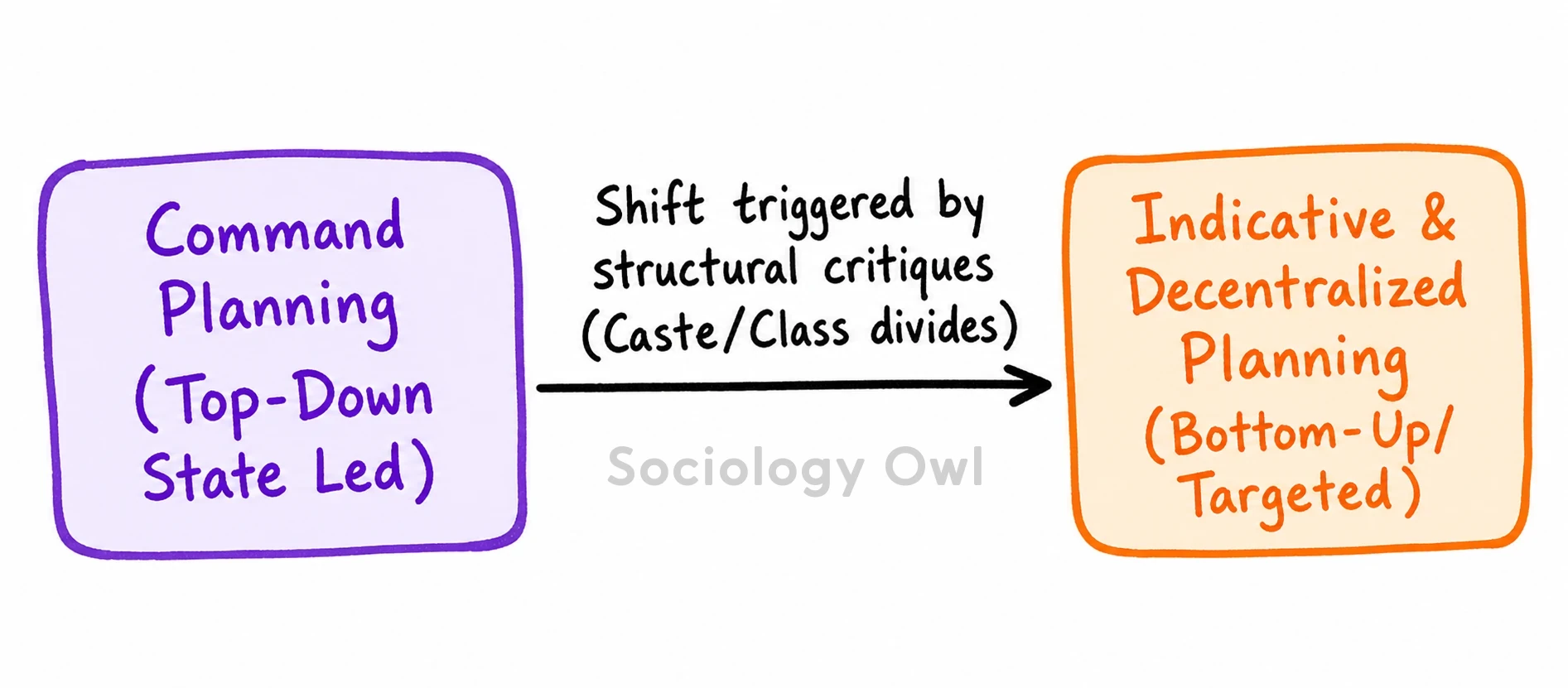
  • Post-1991, imperative planning yielded to indicative planning via NITI Aayog to balance market forces with social equity.
  • Decentralized Planning: The 73rd and 74th Amendments shifted focus towards bottom-up, participatory governance.
  • Targeted Planning: Initiatives like the Aspirational Districts Programme directly address structural and regional disparities.

Conclusion

As Partha Chatterjee observes, while “civil society” leverages free markets, the marginalized “political society” relies heavily on state welfare. Therefore, decentralized planning remains indispensable for achieving equitable social change in India.

Q. Critically examine the relevance of development planning in India ? Read More »

Q. Differentiate between ‘Western’ and ‘Indological’ perspectives on the study of Indian society. Bring out the major aspects of G. S. Ghurye’s contribution to ‘Indological’ approach.

Q. Differentiate between ‘Western’ and ‘Indological’ perspectives on the study of Indian society. Bring out the major aspects of G. S. Ghurye’s contribution to ‘Indological’ approach.

UPSC Sociology 2024 Paper 2

Model Answer:

Differentiating Western and Indological Perspectives

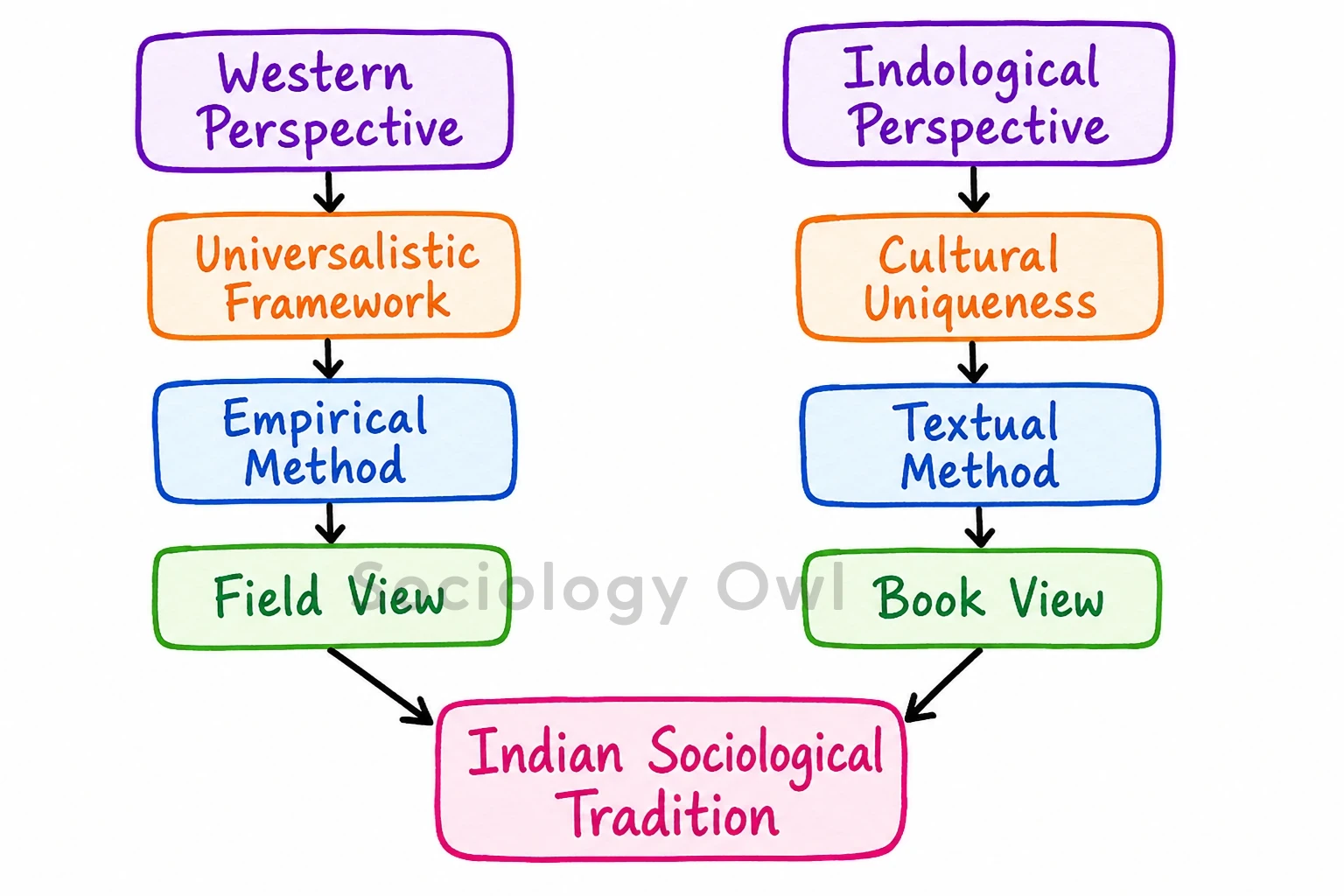
The sociological study of Indian society is characterized by a dialectic between the empirical “Field View” derived from Western perspectives and the textual “Book View” of the Indological perspective.

Epistemology and Methodology

Early Western perspectives (like colonial ethnography or Marxist models) applied universalistic frameworks to India. Conversely, Indology stresses the cultural uniqueness and historical continuity of Indian civilization.

Western sociology emphasizes empirical field studies and participant observation, a “Field View” later championed by Indian sociologists like M.N. Srinivas. Indology relies on the textual analysis of scriptures like Vedas and Dharmashastras (the “Book View”). Notably, Louis Dumont synthesized both in Homo Hierarchicus, using French structuralism to analyze Hindu texts.

Focus

Western approaches prioritize material reality, structural differentiation, and modernization, whereas Indology examines traditional ideologies, values, and normative structures.

indian sociology

G.S. Ghurye’s Contribution and Critique

G.S. Ghurye utilized Indology with a nationalist undertone to counter colonial narratives, establishing India’s underlying socio-cultural unity:

Diffusionism and Integration

He applied a diffusionist approach to trace how Indo-Aryan Brahmanical culture spread from the Gangetic plains, binding the subcontinent together.

In The Aborigines – So-called – And Their Future, he famously termed tribes as “Backward Hindus,” actively challenging the colonial isolationist policies of Verrier Elwin.

Synthesis of Text and Science

In Caste and Race in India, he combined ancient textual evidence with empirical anthropometric data to analyze social stratification.

Ghurye’s Indology faces severe criticism from Marxist (A.R. Desai) and Subaltern scholars for its Brahmanical and elitist bias, which often marginalized the lived realities of Dalits and women. Today, the tension between Indological cultural assimilation and empirical ground realities remains highly relevant in debates surrounding the Uniform Civil Code (UCC) and tribal assertion against Sanskritization.

Conclusion

While Ghurye’s Indological approach laid the bedrock for Indian sociology by establishing India’s cultural unity, the subsequent shift towards empirical studies proved that an authentic understanding requires a dynamic synthesis of both the historical text and the modern context.

Q. Differentiate between ‘Western’ and ‘Indological’ perspectives on the study of Indian society. Bring out the major aspects of G. S. Ghurye’s contribution to ‘Indological’ approach. Read More »

Q. To what extent have the legal provisions been effective in curbing violence against women in India? Give your argument.

Q. To what extent have the legal provisions been effective in curbing violence against women in India? Give your argument.

UPSC Sociology 2024 Paper 2

Model Answer:

Violence against women

Violence against women in India remains a pervasive issue despite numerous legal provisions aimed at its eradication. The effectiveness of these laws in curbing such violence is a matter of considerable debate.

Several legal measures have been enacted, such as the Protection of Women from Domestic Violence Act (PWDVA) 2005, the Dowry Prohibition Act 1961, and the Criminal Law Amendment Act 2013, which strengthened anti-rape laws. These provisions aim to protect women from various forms of violence, reflecting the state’s commitment to gender equality as per constitutional mandates.

• However, the effectiveness of these laws is often undermined by patriarchal social structures. Sociological theories on patriarchy, highlight how institutionalized gender norms perpetuate male dominance.

• There’s often a gap between legislation and enforcement. The lack of sensitization among law enforcement agencies leads to underreporting of cases. For instance, incidents of domestic violence are frequently dismissed as ‘family matters’ by authorities.

• Cultural factors also play a role. The stigma attached to victims of sexual violence discourages reporting. The Nirbhaya case of 2012 led to nationwide protests and legal reforms, yet crimes against women persist.

• Economic dependence is another factor affecting the effectiveness of legal provisions. Women often lack the resources to pursue legal action. Marxist feminists argue that without economic empowerment, legal measures cannot fully address gender-based violence.

In conclusion, while legal provisions are essential, their effectiveness is limited without addressing underlying sociocultural factors.

Q. To what extent have the legal provisions been effective in curbing violence against women in India? Give your argument. Read More »

Q. Discuss the changing nature of political elites in India.

Q. Discuss the changing nature of political elites in India.

UPSC Sociology 2024 Paper 2

Model Answer:

Changing Nature of Political Elites in India

The political elite in India has undergone significant transformations since independence, reflecting broader socio-economic changes and shifting power dynamics within the country.

• Post-independence era: Initially dominated by upper-caste, educated leaders from the Congress party, reflecting M.N. Srinivas’s concept of the “dominant caste.”

• Affirmative policies: Implementation of Mandal Commission recommendations led to the rise of OBC and SC leaders, challenging the traditional elite. Rajni Kothari termed this shift the “democratization of the political system.”

• Regional parties: Alongside caste-based changes, the emergence of state-level leaders further diversified the elite landscape. For example, M.G. Ramachandran in Tamil Nadu represented both regional and linguistic interests.

• Economic liberalization: Post-1991 reforms brought businessmen into politics, adding an economic dimension to elite composition. This shift coincided with and sometimes conflicted with caste-based representation.

• Media and technology: The rise of new communication channels created opportunities for tech-savvy politicians, further diversifying elite backgrounds and strategies.

• Increased representation: Building on earlier changes, there’s growing participation of women and youth in politics. Leaders like Mayawati and Mamata Banerjee embody multiple aspects of this evolving landscape.

Conclusion: India’s political elite has evolved to embrace diversity, reflecting complex interactions between caste, class, region, and gender in the political sphere.

Q. Discuss the changing nature of political elites in India. Read More »

Q. What, according to André Beteille, are the bases of agrarian class structure in India? Analyse.

Q. What, according to André Beteille, are the bases of agrarian class structure in India? Analyse.

UPSC Sociology 2024 Paper 2

Model Answer:

André Béteille’s Analysis of Agrarian Class Structure in India

André Béteille, extensively studied India’s agrarian society, identifying several key bases for its class structure in his work “Caste, Class, and Power.” His analysis provides a multidimensional understanding of rural stratification in India.

1. Land Ownership: Béteille emphasized that control over land is the primary determinant of agrarian class distinctions. Large landowners, small peasant proprietors, and landless laborers form the main classes based on this criterion.

2. Caste System: While not perfectly aligned, caste often correlates with land ownership and economic status, reinforcing class divisions. Upper castes typically owned more land, while lower castes were often landless laborers.

3. Relations of Production: The complex system of tenancy, including sharecropping arrangements, creates intermediary classes between landowners and laborers, contributing to a more nuanced class structure.

4. Status and Power Dynamics: Local political influence often stemmed from land ownership and caste status, creating a mutually reinforcing relationship between economic and political power.

5. Economic Shifts: Béteille observed that modernization and commercialization of agriculture were altering traditional class relations, allowing for some mobility between classes regardless of caste.

Béteille’s analysis recognizes the interplay between economic, social, and political factors in shaping India’s agrarian class structure.

Q. What, according to André Beteille, are the bases of agrarian class structure in India? Analyse. Read More »

Q. What are the definitional problems involved in identifying tribes in India? Discuss the main obstacles to tribal development in India.

Q. What are the definitional problems involved in identifying tribes in India? Discuss the main obstacles to tribal development in India.

UPSC Sociology 2024 Paper 2

Model Answer:

Identification and Development of tribes

The identification and development of tribes in India present complex sociological and administrative challenges, rooted in historical, cultural, and political factors. The term “tribe” itself is contested, with anthropologists like Verrier Elwin highlighting the fluidity of tribal identities and the dangers of stereotyping.

Definitional problems in identifying tribes:

1. Heterogeneity: Indian tribes vary greatly in language, culture, and socioeconomic status, making a uniform definition difficult.

2. Colonial legacy: The concept of “tribe” has colonial origins, often used to signify “primitive” societies. Scholars like G.S. Ghurye criticized this classification for perpetuating stereotypes.

3. Criteria ambiguity: The Constitution lists Scheduled Tribes but provides no clear identification criteria. The Lokur Committee (1965) suggested subjective and outdated criteria like primitive traits and geographical isolation.

4. Socioeconomic changes: Modernization has altered traditional tribal lifestyles, complicating classification.

Main obstacles to tribal development:

1. Land alienation: Displacement due to development projects like the Sardar Sarovar Dam has affected thousands of tribal families without adequate rehabilitation.

2. Limited access to services: Inadequate infrastructure in remote areas hinders access to education and healthcare. Tribal literacy rates remain significantly below the national average.

3. Economic exploitation: Vulnerability to moneylenders and traders due to lack of formal financial access leads to debt traps and poverty.

4. Cultural assimilation pressures: Policies promoting assimilation rather than integration threaten tribal identities and traditions.

5. Policy implementation gaps: Despite protective legislation like the Forest Rights Act (2006), weak implementation and bureaucratic hurdles impede tribals from exercising their rights.

6. Political marginalization: Limited political representation results in inadequate attention to tribal issues in policymaking.

In conclusion, addressing definitional ambiguities and development obstacles requires nuanced policies that respect tribal diversity while empowering communities.

Q. What are the definitional problems involved in identifying tribes in India? Discuss the main obstacles to tribal development in India. Read More »