2024 Sociology Paper 2

Q. Do you think that family bondings are being affected by the changing kinship patterns in India? Comment.

Q. Do you think that family bondings are being affected by the changing kinship patterns in India? Comment.

UPSC Sociology 2024 Paper 2

Model Answer:

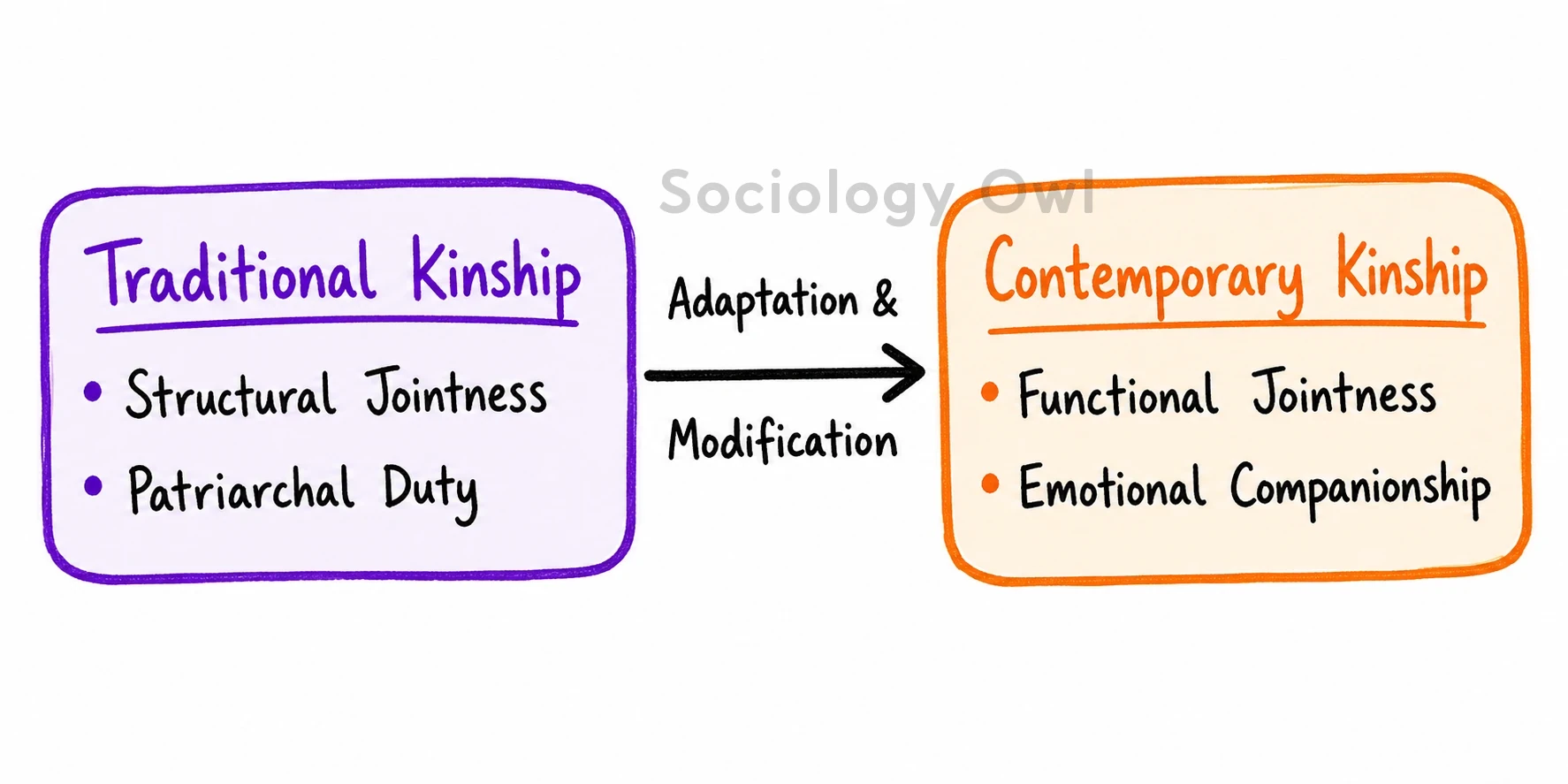
Iravati Karve viewed kinship as the bedrock of Indian families. Today, Indian kinship is transitioning from structural to functional jointness, fundamentally altering, rather than destroying, family bondings.

Transformation of Family Bondings

  • “Household vs. Family”: A.M. Shah in The Household Dimension of the Family in India argues families are structurally nuclear but remain functionally joint, maintaining bonds through shared rituals and finances.
  • “Sentiment of Jointness”: I.P. Desai notes psychological kinship ties remain strong despite physical migration. Sylvia Vatuk observes urbanites relying on kin networks, forming a “modified extended family”.
  • Shifting Intimacy: Patricia Uberoi notes that family bonding is moving from patriarchal duty to emotional companionship. Additionally, Leela Dube highlights that changing patrilocality allows women stronger ties with their natal families.
The increasing reliance on the Maintenance and Welfare of Parents and Senior Citizens Act (2007) reflects the strain of spatial nuclearization on traditional intergenerational caregiving bonds.

Conclusion

Indian family bondings are not decaying but adapting. They are evolving from rigid obligatory kinship to negotiated, emotional relationships, ensuring the institution’s continued resilience in modern society.
Q. Do you think that family bondings are being affected by the changing kinship patterns in India? Comment. Read More »

Q. What is your assessment about the recent farmers’ movement in India? Elaborate.

Q. What is your assessment about the recent farmers’ movement in India? Elaborate.

UPSC Sociology 2024 Paper 2

Model Answer:

The 2020 farmers’ movement against three agricultural laws was a collective response to India’s capitalist agrarian crisis and the perceived “corporate squeeze” (Utsa Patnaik) on traditional agriculture.

Sociological Assessment of the Movement

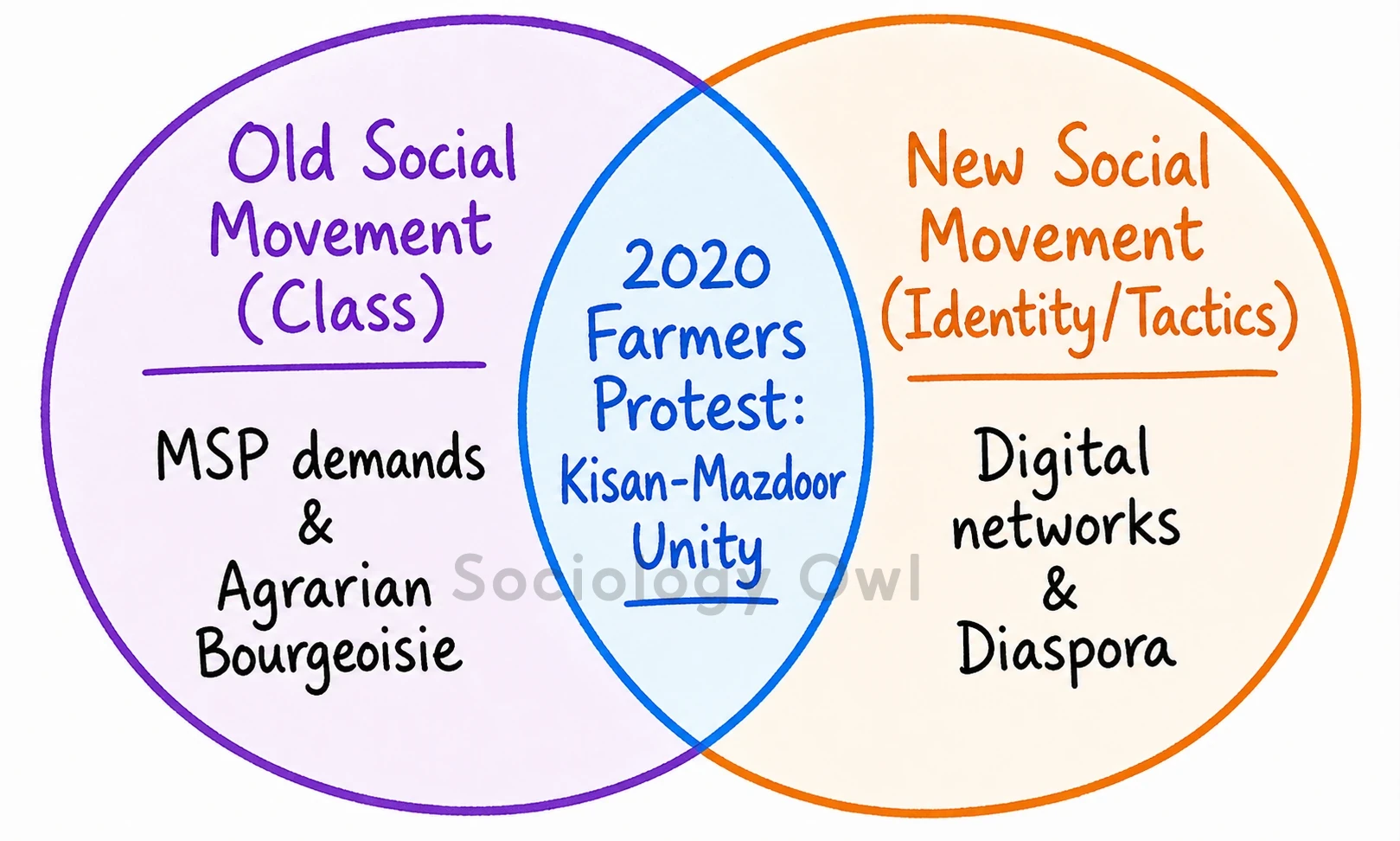
Hybrid Character: Merging “Old” economic class interests (MSP protection) with New Social Movement tactics (digital mobilization, diaspora networks), it revived Dipankar Gupta’s “Bharat vs. India” binary (rural-agrarian versus urban-corporate elites).

Caste-Class Nexus: Led primarily by traditional Dominant Castes (M.N. Srinivas) like Jats and Jat Sikhs. Surinder Jodhka notes that while spearheaded by the “agrarian bourgeoisie” (rich farmers), it temporarily bridged deep-seated caste-class divides via Kisan-Mazdoor (farmer-laborer) unity.

Effective Resource Mobilization was visible through langars (community kitchens), establishing casteless commensality and civic solidarity. However, its primary structural limitation was its geographical concentration within the Green Revolution belt, largely bypassing marginal farmers of Eastern India.

Conclusion

Despite regional and class limitations, the movement successfully demonstrated the enduring political agency of the Indian peasantry against neoliberal state interventions, forcefully reasserting agrarian identity.

Q. What is your assessment about the recent farmers’ movement in India? Elaborate. Read More »

Q. What are pressure groups? Discuss their role in decision-making in democracy.

Q. What are pressure groups? Discuss their role in decision-making in democracy.

UPSC Sociology 2024 Paper 2

Model Answer:

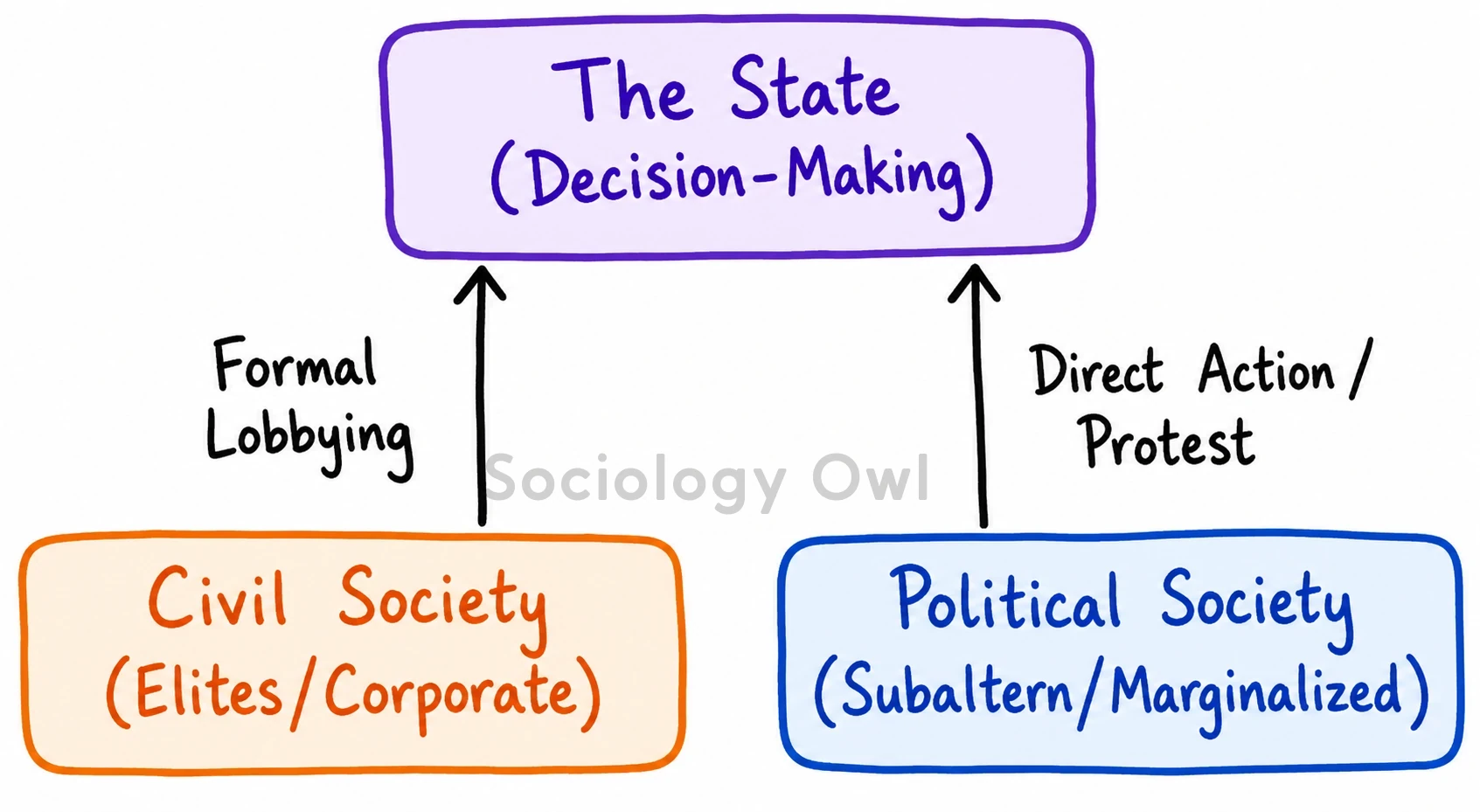
Sociologically, pressure groups are manifestations of Civil Society mediating between citizens and the State. Pluralists like Robert Dahl view them as vital for power dispersal, while Lloyd and Susanne Rudolph term them “Demand Groups” in India’s political economy.

Role in Democratic Decision-Making

  • Interest Aggregation: Subaltern mobilizations translate grassroots demands into institutional policy (e.g., MKSS driving the formulation of the RTI Act).
  • Politicization of Caste: Rajni Kothari highlights how traditional structures transform into Caste Associations, acting as modern pressure groups to influence state reservation decisions.
  • Civil vs. Political Society: Partha Chatterjee notes that elites (e.g., FICCI) lobby formally, whereas marginalized communities negotiate via direct action in “Political Society.”

The Bharatiya Kisan Union (BKU) during the 2020-21 Farmers’ Protests exemplifies an agrarian pressure group successfully mobilizing to force national legislative reversals.

Conclusion

While pressure groups drive democratic deepening, A.R. Desai warns of a capitalist Caste-Class Nexus leading to Elite Capture. The state must actively ensure subaltern “demand groups” are not overshadowed by powerful corporate lobbying.

Q. What are pressure groups? Discuss their role in decision-making in democracy. Read More »

Q. Analyse the trilogy between environmental movement, development and tribal identity.

Q. Analyse the trilogy between environmental movement, development and tribal identity.

UPSC Sociology 2024 Paper 2

Model Answer:

Development, Tribal Identity, and Environmental Resistance

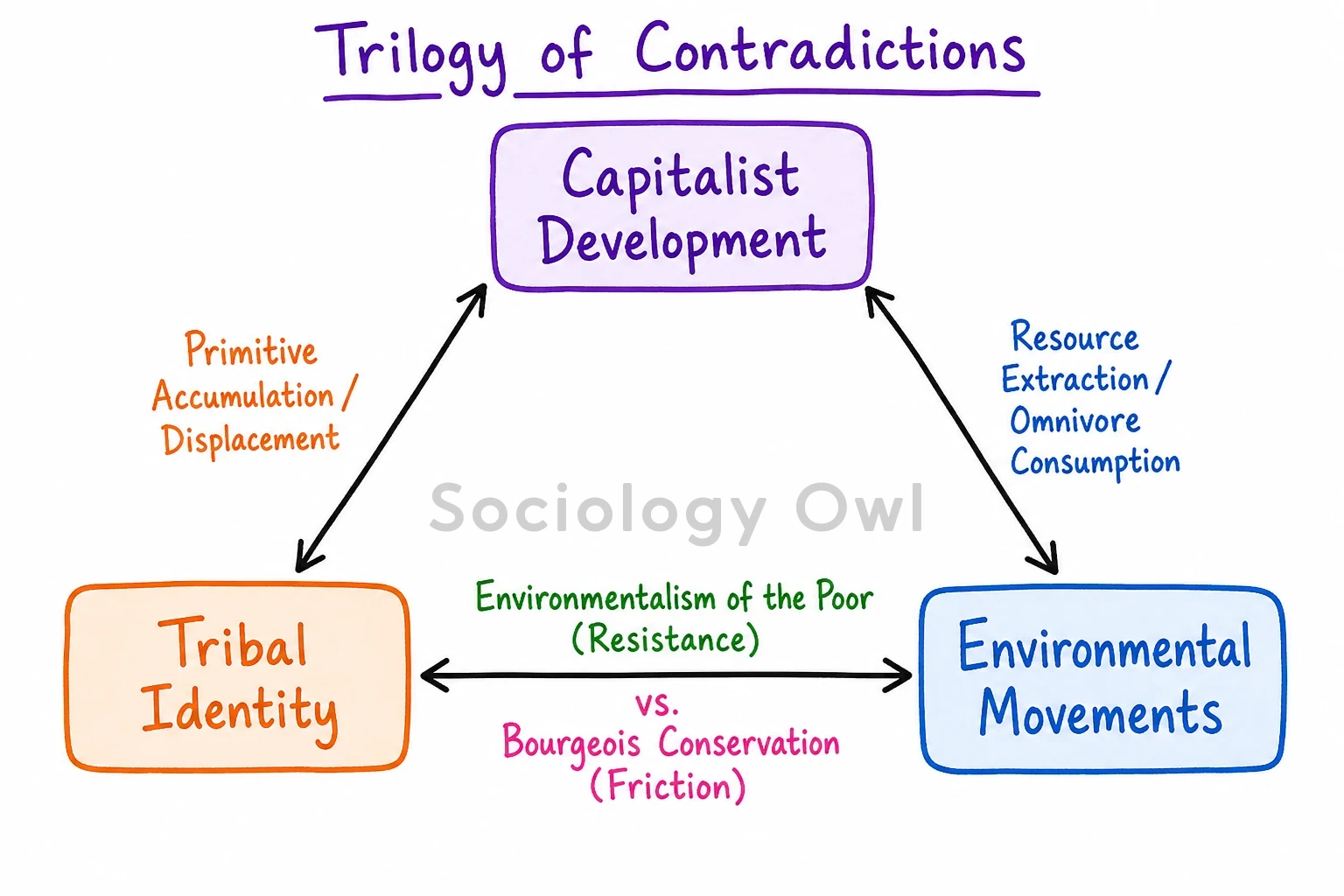
The interplay between environmental movements, development, and tribal identity constitutes the central fault line of India’s post-colonial political economy. It highlights the structural contradictions between capitalist growth, ecological sustainability, and indigenous survival.

Development versus Tribal Identity

  • A.R. Desai argues that India’s capitalist path of development structurally necessitates the expropriation of tribal resources through “primitive accumulation.”
  • Walter Fernandes highlights this disproportionate burden: tribals constitute ~8% of the population but over 40% of those displaced by development projects.
  • Virginius Xaxa notes that this alienation from land and forests paradoxically crystallized a pan-tribal political identity, often leading to Retribalization as communities assert distinct roots to resist marginalization.

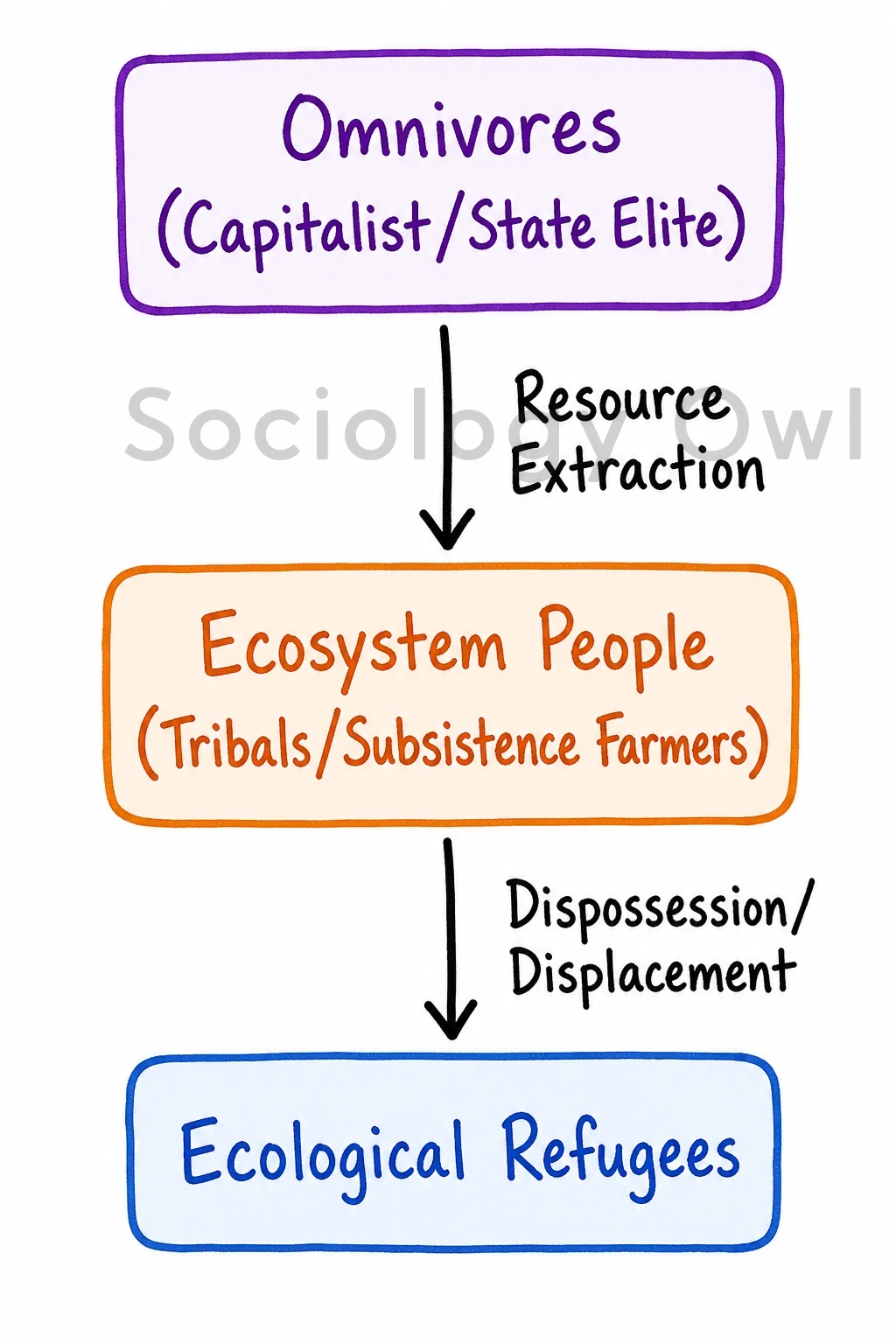
Regarding tribal identity and environmental resistance, Madhav Gadgil and Ramachandra Guha, in Ecology and Equity, conceptualize this conflict as one between urban-industrial “Omnivores” and tribal “Ecosystem People.” Extractive development turns tribals into “ecological refugees,” sparking an “environmentalism of the poor.” Amita Baviskar, in In the Belly of the River, demonstrates how Bhilala tribals during the Narmada Bachao Andolan mobilized their indigenous identity to fight the dam, proving that grassroots environmentalism is fundamentally about cultural survival and identity defense.

The friction between conservation and tribes shows that the trilogy is not always harmonious. Amita Baviskar critiques “Bourgeois Environmentalism,” where urban-centric conservation (e.g., Tiger Reserves) views tribals as encroachers. This “authoritarian conservation” leads to “green displacement,” attacking tribal identity just as brutally as industrial development.

The Dongria Kondh’s resistance against Vedanta’s bauxite mining in the Niyamgiri Hills perfectly encapsulates this trilogy: corporate development versus ecological degradation versus tribal spiritual identity. Institutional interventions like the Forest Rights Act (FRA), 2006 and PESA, 1996 attempt to reconcile these tensions by legally recognizing tribes as custodians of the environment.

Conclusion

Resolving this trilogy requires moving beyond extractive state capitalism. As B.K. Roy Burman observes, tribes possess a symbiotic relationship with their land. Tribal identity must therefore be embraced not as an obstacle to development, but as an epistemological guide to achieving true ecological and social balance.

Q. Analyse the trilogy between environmental movement, development and tribal identity. Read More »

Q. Discuss the changes taking place in the industrial class structure in India.

Q. Discuss the changes taking place in the industrial class structure in India.

UPSC Sociology 2024 Paper 2

Model Answer:

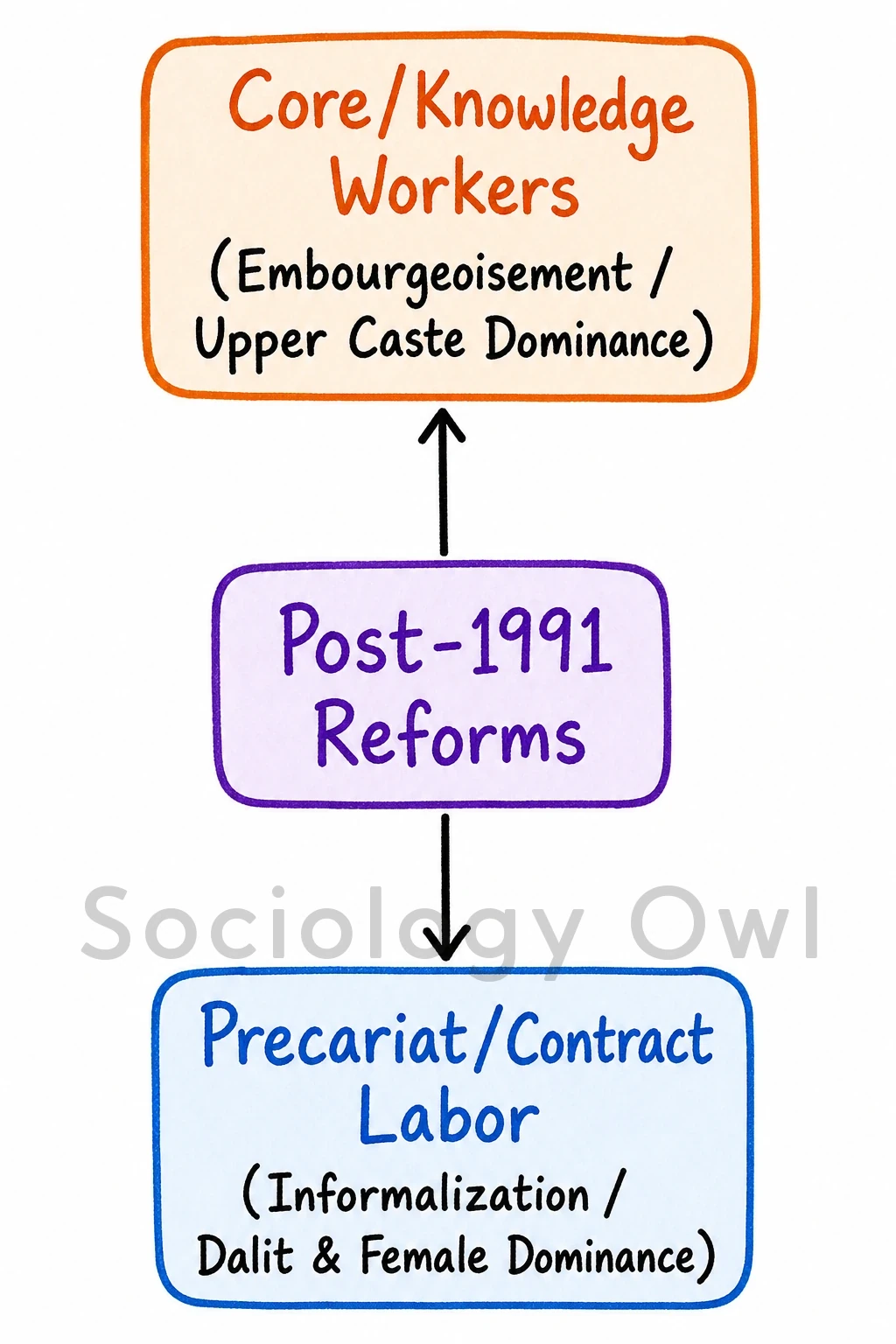
Historically, Mark Holmstrom termed India’s organized industrial sector a protected “citadel.” Post-1991 reforms breached this wall, transforming secure unionized labor into a deeply fragmented workforce.

Structural Shifts in the Industrial Class

  • Informalization and the Precariat: Jan Breman highlights the rise of “footloose labor,” aligning with Guy Standing’s Precariat—a modern contractual class lacking basic social security.
  • Caste-Class Nexus: As observed by Jonathan Parry, upper castes dominate secure managerial roles, while Dalits and Adivasis overwhelmingly constitute the casual labor pool.
  • Class Bifurcation: Highly skilled knowledge workers undergo Embourgeoisement (adopting middle-class lifestyles), whereas deskilled contract workers suffer diminished collective bargaining power (E.A. Ramaswamy).
  • Feminization of Casual Labor: Export-oriented industries increasingly employ women as cheap, “docile” labor, reflecting a dual capitalist-patriarchal exploitation.

The institutionalization of the Gig Economy and the New Labour Codes (2020) legally formalize this casualization, leading to contemporary industrial frictions, such as the recent unrests at Foxconn.

Conclusion

India’s industrial class structure has transitioned from classic Marxist exploitation to systemic precarity. While liberalization expanded the industrial base, its workforce remains heavily fractured along caste, gender, and contractual vulnerabilities.

Q. Discuss the changes taking place in the industrial class structure in India. Read More »

Q. What is sustainable development? How can sustainability be achieved in India where livelihood needs conflict with environmental protection?

Q. What is sustainable development? How can sustainability be achieved in India where livelihood needs conflict with environmental protection?

UPSC Sociology 2024 Paper 2

Model Answer:

Sustainable development, defined by the Brundtland Commission as meeting present needs without compromising future generations, is not just an ecological issue in India but a profound crisis of social equity. In India’s biomass-based subsistence economy, development often pits environmental conservation against the basic livelihoods of marginalized communities.

Sociological Analysis of the Conflict

The livelihood-environment conflict in India is rooted in unequal resource distribution and power dynamics:

  • Environmentalism of the Poor: Ramachandra Guha divides Indian society into “Omnivores” (urban/capitalist elite), “Ecosystem People” (tribals/peasants dependent on nature), and “Ecological Refugees” (those displaced by development). The conflict is essentially Omnivores exploiting resources at the direct cost of Ecosystem People.
  • Bourgeois Environmentalism: Amita Baviskar highlights how the urban middle-class vision of a pristine environment (e.g., exclusive national parks or slum clearances) routinely criminalizes and displaces the livelihoods of the rural and urban poor.
  • Marxist Perspective: A.R. Desai asserts that the post-independence, state-led capitalist development model commodified nature, resulting in the structural marginalization of tribes through primitive accumulation.

Pathways to Achieving Sustainability in India

Balancing ecology and livelihood requires the structural democratization of resource management:

  • Institutional Decentralization: Legislations like the Forest Rights Act (FRA), 2006 reconcile this conflict by recognizing the historical rights of forest-dwellers, shifting the paradigm from “conservation against people” to “conservation by people.”
  • Feminist Environmentalism: Contrasting Vandana Shiva’s spiritual eco-feminism, Bina Agarwal argues that women’s connection to nature is rooted in their material reality (gathering fuel, fodder). Sustainability requires integrating women into resource governance.
  • Ideological Shift: Blending Traditional Ecological Knowledge (TEK) with Mahatma Gandhi’s principle of Sarvodaya (welfare of all) counters ecologically destructive modern industrialism.

Instances of subaltern environmentalism, such as the Niyamgiri Hills movement (Dongria Kondh tribe vs. mining interests) and the Hasdeo Arand protests, perfectly illustrate this clash, emphasizing that true sustainability demands indigenous consent and community-led conservation models.

Conclusion

Sustainability in India cannot be achieved through top-down, coercive “fortress conservation.” It necessitates an eco-socialist framework where the poorest are empowered and recognized not as enemies of the environment, but as its primary custodians.

Q. What is sustainable development? How can sustainability be achieved in India where livelihood needs conflict with environmental protection? Read More »

Q. Identify different forms of inequalities associated with agrarian social structure in India.

Q. Identify different forms of inequalities associated with agrarian social structure in India.

UPSC Sociology 2024 Paper 2

Model Answer:

Agrarian Social Structure and Inequalities

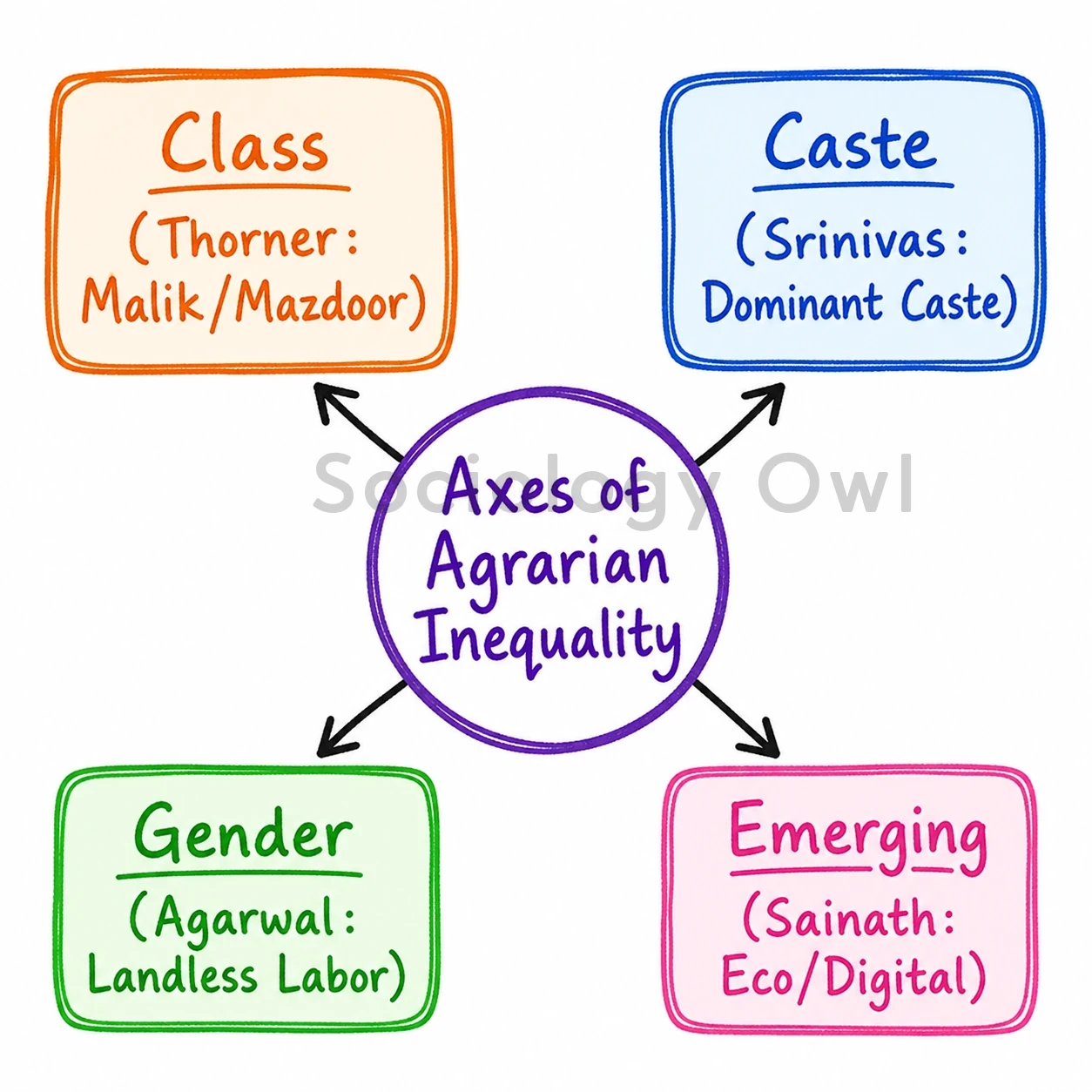
The agrarian social structure refers to the institutional framework of agricultural production and the resulting social relations. Daniel Thorner conceptualized this structure through property relations, classifying agrarian classes into Maliks (landlords), Kisans (working peasants), and Mazdoors (landless laborers), immediately highlighting the inherent structural inequalities.

Historically, as Andre Béteille noted, agrarian India featured “cumulative inequality,” where upper castes exclusively monopolized land, wealth, and political power. While modern democratic forces are shifting this toward “dispersed inequality,” Dalits overwhelmingly remain landless agricultural laborers.

M.N. Srinivas conceptualized that agrarian inequalities are sustained by Dominant Castes (e.g., Jats, Kammas). They leverage their numerical strength and land ownership to exert localized political and socio-economic dominance over lower castes.

Using a Marxist perspective, A.R. Desai argued that state-led land reforms actually fostered a new class of rural capitalists, deepening class divides. Furthermore, Jan Breman highlights how traditional patronage has devolved into pure capitalist exploitation of unorganized rural labor.

Bina Agarwal, in A Field of One’s Own, emphasizes that patriarchal inheritance norms exclude women from land titles. Despite the contemporary “Feminization of Agriculture”, women perform the majority of farm labor but lack land ownership and access to institutional credit.

Today, traditional disparities are exacerbated by the Digital Divide and Ecological Inequality. As highlighted by P. Sainath, marginal farmers are disproportionately vulnerable to climate change and debt traps, culminating in rural distress. This reflects the complex Mode of Production Debate—Indian agriculture remains an unequal hybrid of semi-feudal legacies and ruthless capitalist market forces.

Conclusion

Agrarian inequalities have mutated from traditional caste-based hierarchies to complex capitalist divides. Dismantling this structure requires systemic interventions, notably Land Reforms 2.0 to secure tenancy and women’s land rights, thereby empowering the subaltern classes toward an egalitarian rural society.

Q. Identify different forms of inequalities associated with agrarian social structure in India. Read More »

Q. What, according to you, are the factors responsible for the continuance of caste system in India? Explain.

Q. What, according to you, are the factors responsible for the continuance of caste system in India? Explain.

UPSC Sociology 2024 Paper 2

Model Answer:

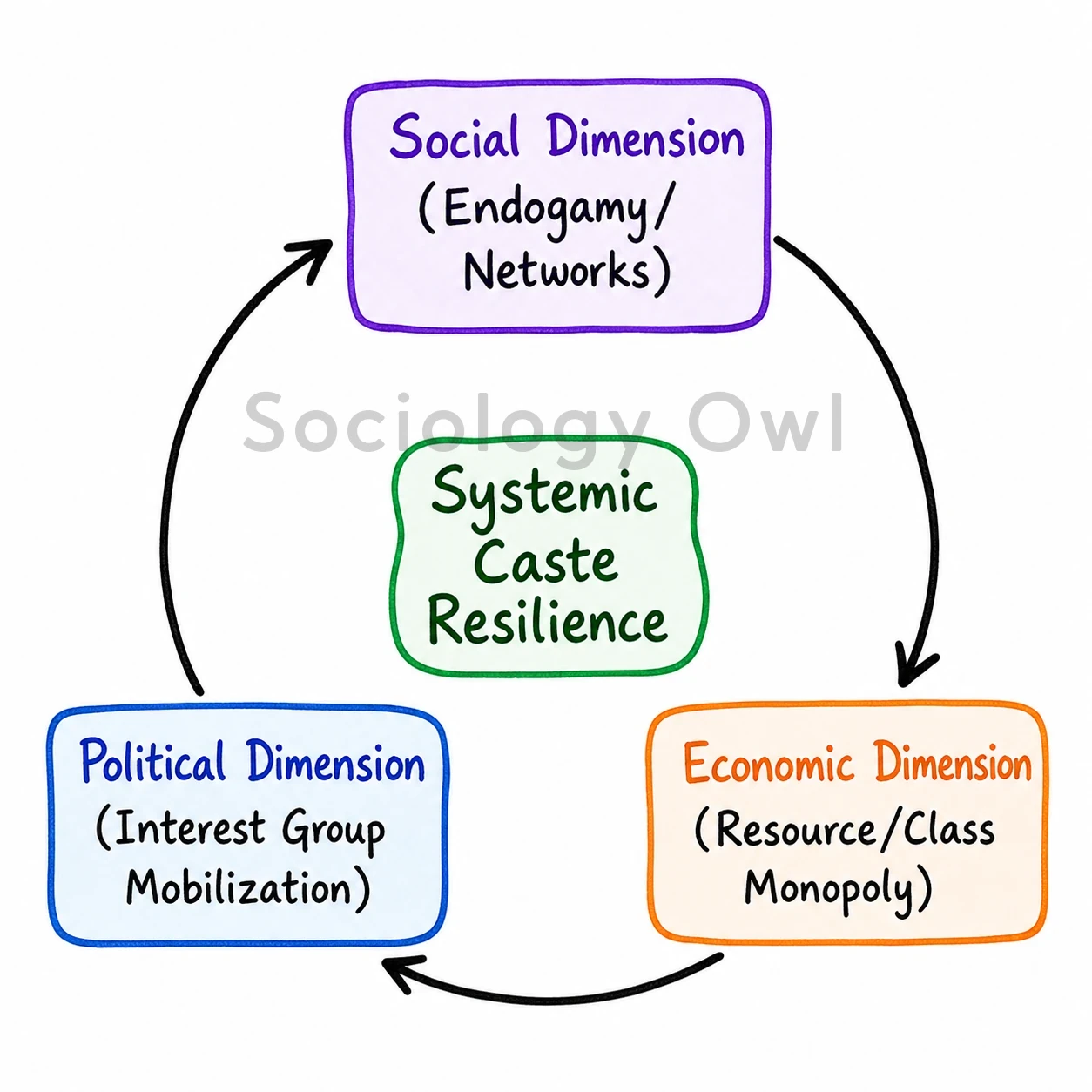
While its traditional ritual framework weakens, caste’s structural resilience persists in modern India. As Dipankar Gupta observes, caste has morphed from a system of hierarchy to one of difference and identity.

Factors Sustaining the Caste System

  • Politicization of Caste: Rajni Kothari argues that democratic politics transforms castes into competing interest groups, sustained by “Vote Bank Politics” (M.N. Srinivas).
  • Ethnicization: C.J. Fuller notes castes now compete as ethnic groups for secular resources, replacing traditional Jajmani interdependence.
  • Economic Nexus: From a Marxist lens, A.R. Desai highlights how modern capitalism utilizes caste networks, trapping lower castes in the informal sector and sustaining a rigid Caste-Class nexus.
  • Endogamy: Marriage restrictions preserve inherited wealth and social capital among dominant groups, reinforcing distinct boundaries (G.S. Ghurye).

Affirmative action has fueled the “Substantivization of Caste” (M.N. Srinivas), visible in recent dominant caste agitations (e.g., Marathas) seeking OBC status to counter agrarian distress. Furthermore, technology facilitates “Digital Endogamy” through caste-filtered matrimonial websites.

Conclusion

Caste persists not merely as a ritual order but as a modern tool of power. As B.R. Ambedkar diagnosed, it remains a deeply entrenched “division of labourers.” Eradicating its contemporary resilience requires the annihilation of endogamy and structural material inequalities.

Q. What, according to you, are the factors responsible for the continuance of caste system in India? Explain. Read More »

Q. Why is the study of marriage important in Sociology? Analyse the implications of changing marriage patterns for Indian society.

Q. Why is the study of marriage important in Sociology? Analyse the implications of changing marriage patterns for Indian society.

UPSC Sociology 2024 Paper 2

Model Answer:

In the Indian context, studying marriage is vital to decoding the complexities of kinship, caste, and patriarchy. Indologist K.M. Kapadia defines traditional Hindu marriage not as a civil contract, but as a Sanskara (sacrament) fulfilling Dharma (duty), Praja (progeny), and Rati (pleasure).

Sociological Importance of Studying Marriage in India

  • Caste Reproduction: B.R. Ambedkar argued that Endogamy is the sole characteristic peculiar to caste; studying marriage explains how social stratification continually reproduces itself.
  • Kinship Mapping: Iravati Karve demonstrated how diverse marriage rules (Northern village Exogamy vs. Southern cross-cousin unions) dictate regional social structures.
  • Patriarchal Control: Leela Dube utilized the “Seed and Earth” metaphor to illustrate how marriage legally and culturally regulates female sexuality and labor.
  • Structural Alliance: Louis Dumont highlighted that Indian marriage is primarily an alliance structurally binding two kin groups, rather than a mere union of individuals.

Implications of Changing Marriage Patterns

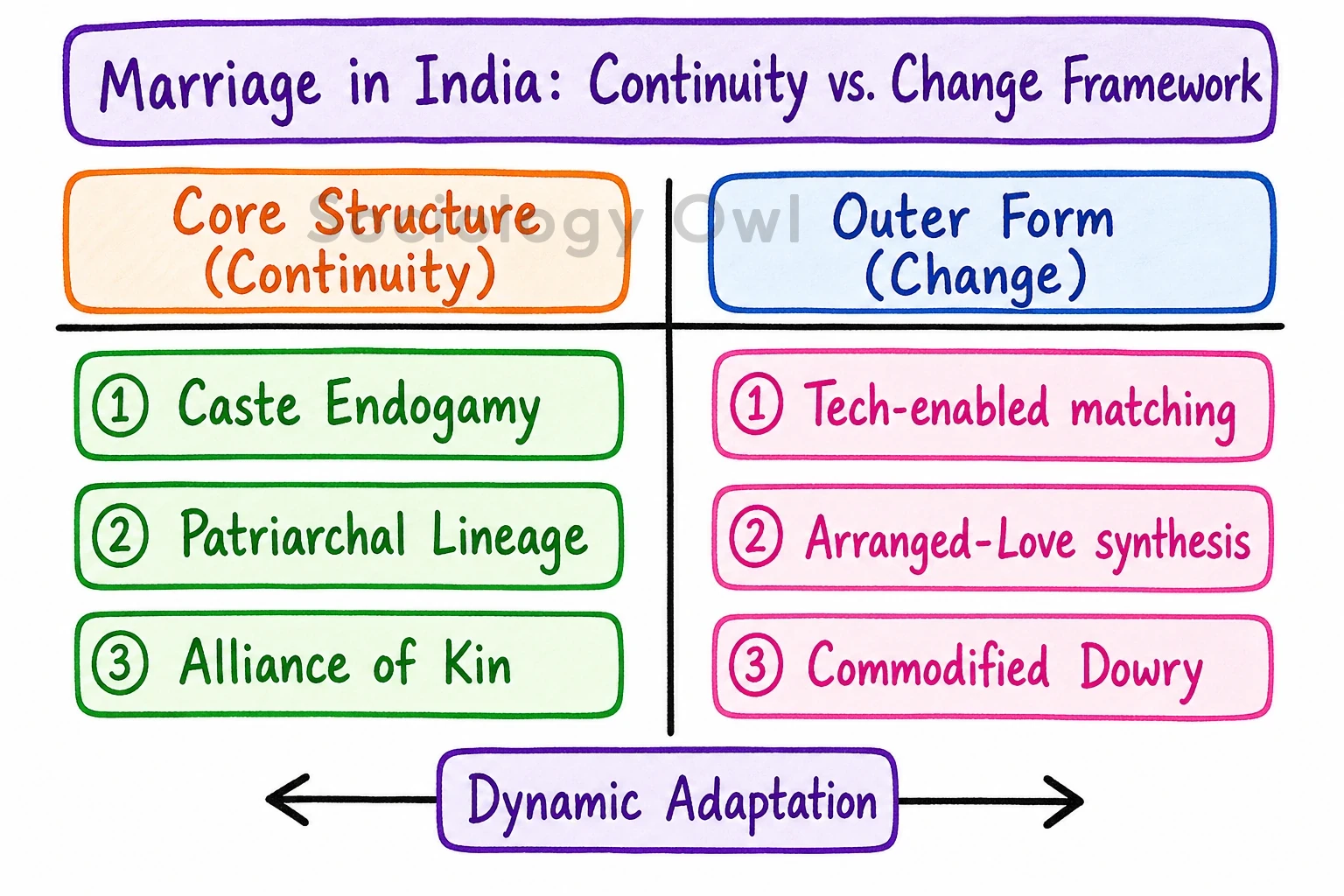
Viewing changes through a Continuity and Change framework reveals nuanced sociological shifts:

  • Negotiated Agency: Rather than a simple rise in “love marriages,” Patricia Uberoi identifies the emergence of “arranged love marriages,” representing a negotiation between individual agency and traditional family approval.
  • Modernization of Dowry: Dowry has not declined; instead, via Sanskritization (M.N. Srinivas), it has spread to lower castes and non-Hindu communities, morphing into a commodified, consumerist transaction (Sylvia Vatuk).
  • Technological Endogamy: While mate selection has moved online, Janaki Abraham observes that matrimonial websites paradoxically reinforce traditional boundaries by utilizing modern technology to filter for caste, class, and gotra.

The recent Supriyo v. Union of India case regarding same-sex unions signifies a normative shift from traditional, reproduction-centric alliances toward Companionate Marriage, challenging rigid heteronormative kinship structures.

Conclusion

As A.M. Shah notes, institutions like Indian marriage are not disintegrating under modernization. Rather, they exhibit profound resilience, dynamically adapting their outer forms (mate selection, age) while largely maintaining core structural functions like caste endogamy and class reproduction.

Q. Why is the study of marriage important in Sociology? Analyse the implications of changing marriage patterns for Indian society. Read More »

Q. What are the different forms of untouchability still practised in India? Discuss with suitable illustrations.

Q. What are the different forms of untouchability still practised in India? Discuss with suitable illustrations.

UPSC Sociology 2024 Paper 2

Model Answer:

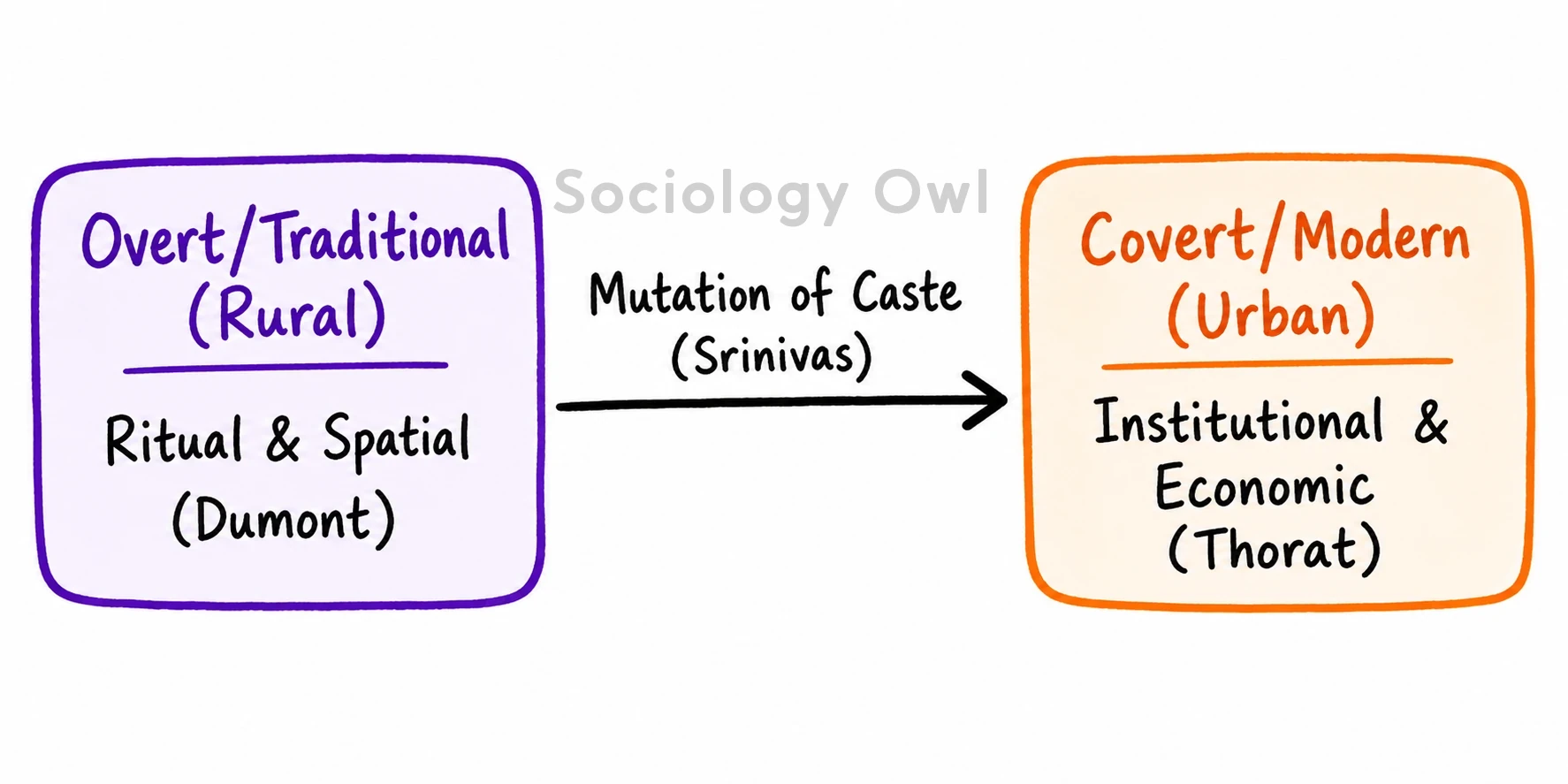
Despite constitutional abolition under Article 17, untouchability persists as “institutionalized exclusion” (Sukhadeo Thorat). It manifests as modern stigma and systemic denial of equal rights, adapting to contemporary socio-economic realities.

Sociological Forms of Untouchability

  • Ritual and Commensal: Rooted in Louis Dumont’s concept of purity and pollution. The ActionAid study (Ghanshyam Shah) documents the enduring two-tumbler system and denial of temple entry in rural India.
  • Spatial Segregation: Gopal Guru highlights how Dalit settlements (Cheris) remain forcibly relegated to village peripheries, physically manifesting social distance.
  • Economic and Institutional: Beyond manual scavenging, Sukhadeo Thorat exposes modern exclusion through discriminatory private-sector hiring against Dalit candidates despite identical qualifications.

Untouchability has mutated into covert forms. Urban Dalits face systemic denial of rental housing. In elite universities, it manifests as covert peer alienation, proving M.N. Srinivas’s thesis that caste constantly finds “new avatars” in modern India.

Conclusion

While overt rural untouchability declines, covert urban exclusion persists as caste transforms into rival “discrete categories” (Dipankar Gupta). Eradicating it requires moving beyond legal enforcement to the ideological Annihilation of Caste, as envisioned by Dr. B.R. Ambedkar.

Q. What are the different forms of untouchability still practised in India? Discuss with suitable illustrations. Read More »