Model Answer:
In the Indian context, studying marriage is vital to decoding the complexities of kinship, caste, and patriarchy. Indologist K.M. Kapadia defines traditional Hindu marriage not as a civil contract, but as a Sanskara (sacrament) fulfilling Dharma (duty), Praja (progeny), and Rati (pleasure).
Sociological Importance of Studying Marriage in India
- Caste Reproduction: B.R. Ambedkar argued that Endogamy is the sole characteristic peculiar to caste; studying marriage explains how social stratification continually reproduces itself.
- Kinship Mapping: Iravati Karve demonstrated how diverse marriage rules (Northern village Exogamy vs. Southern cross-cousin unions) dictate regional social structures.
- Patriarchal Control: Leela Dube utilized the “Seed and Earth” metaphor to illustrate how marriage legally and culturally regulates female sexuality and labor.
- Structural Alliance: Louis Dumont highlighted that Indian marriage is primarily an alliance structurally binding two kin groups, rather than a mere union of individuals.
Implications of Changing Marriage Patterns
Viewing changes through a Continuity and Change framework reveals nuanced sociological shifts:
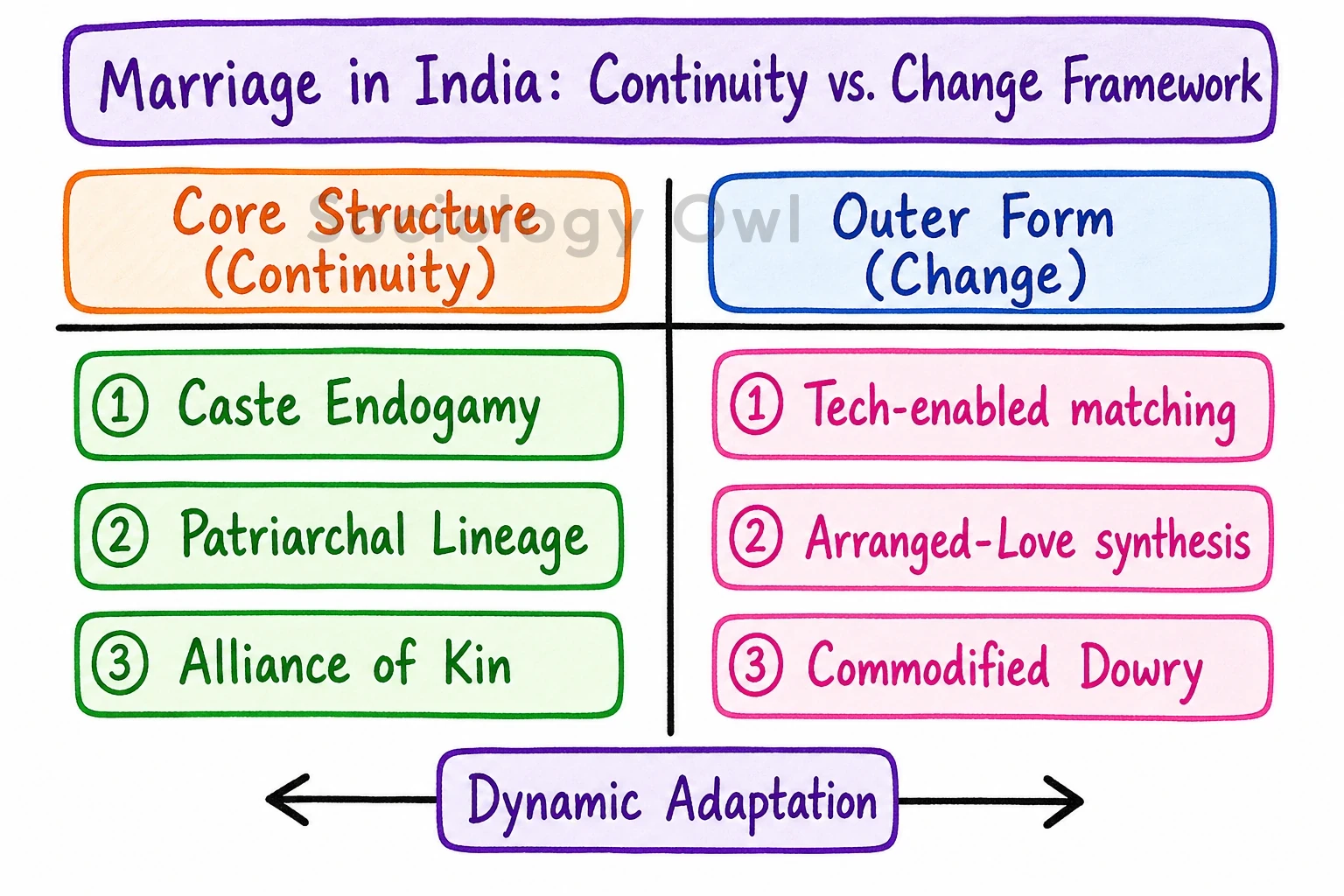
- Negotiated Agency: Rather than a simple rise in “love marriages,” Patricia Uberoi identifies the emergence of “arranged love marriages,” representing a negotiation between individual agency and traditional family approval.
- Modernization of Dowry: Dowry has not declined; instead, via Sanskritization (M.N. Srinivas), it has spread to lower castes and non-Hindu communities, morphing into a commodified, consumerist transaction (Sylvia Vatuk).
- Technological Endogamy: While mate selection has moved online, Janaki Abraham observes that matrimonial websites paradoxically reinforce traditional boundaries by utilizing modern technology to filter for caste, class, and gotra.
The recent Supriyo v. Union of India case regarding same-sex unions signifies a normative shift from traditional, reproduction-centric alliances toward Companionate Marriage, challenging rigid heteronormative kinship structures.
Conclusion
As A.M. Shah notes, institutions like Indian marriage are not disintegrating under modernization. Rather, they exhibit profound resilience, dynamically adapting their outer forms (mate selection, age) while largely maintaining core structural functions like caste endogamy and class reproduction.