Model Answer:
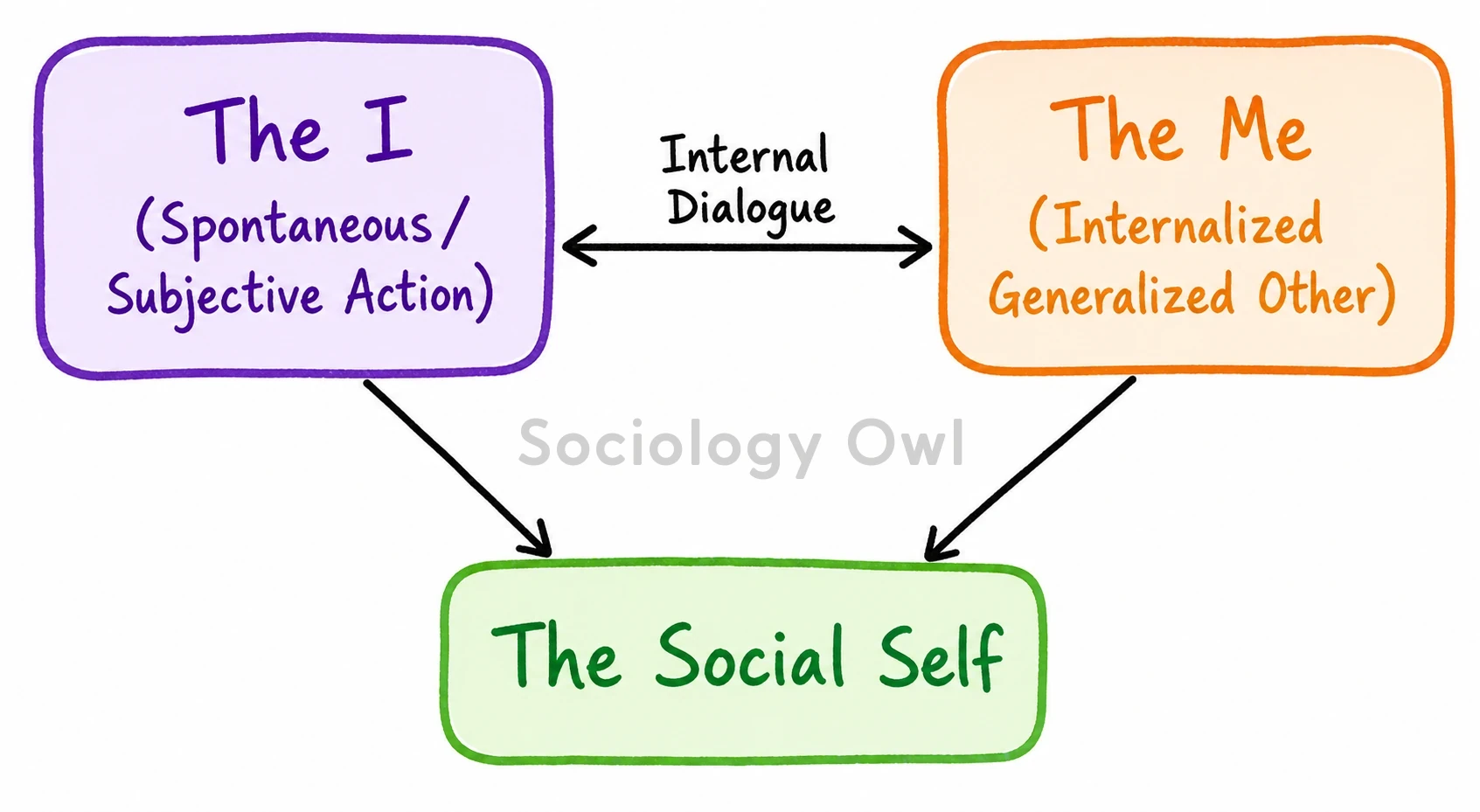
Rooted in the Chicago School of Symbolic Interactionism, G.H. Mead advanced C.H. Cooley’s “Looking Glass Self” in Mind, Self, and Society to explain how societal norms are internalized into human consciousness.
Mechanism of Self-Formation
The “Self” is not innate but emerges through sequential social role-taking:
- Preparatory Stage: Meaningless behavioral imitation of immediate others.
- Play Stage: Role-taking of specific individuals (e.g., playing a teacher).
- Game Stage: Internalizing the “Generalized Other”—the organized expectations, attitudes, and rules of the entire community.
The Dialectic of “I” and “Me”
Internalizing the “Generalized Other” constitutes the “Me” (the objectively socialized self). True selfhood develops via a continuous internal dialogue between the socially regulated “Me” and the subjective, spontaneous “I”.
Social media algorithms and “cancel culture” act as a global “Digital Generalized Other”, where individuals reflexively self-regulate their virtual identities anticipating widespread public reaction.
Conclusion
While Marxists critique Mead for ignoring how macro-structural power dynamics shape the “Generalized Other”, his work remains phenomenally influential, directly inspiring Erving Goffman’s theories of Impression Management.