Model Answer:
India is shifting from a rural-urban dichotomy to a Rural-Urban Continuum (M.S.A. Rao). Beyond the statutory 31.1% (Census 2011), India is witnessing massive “hidden urbanization,” reflecting profound socio-demographic changes.
Trends in Urban Settlement Growth
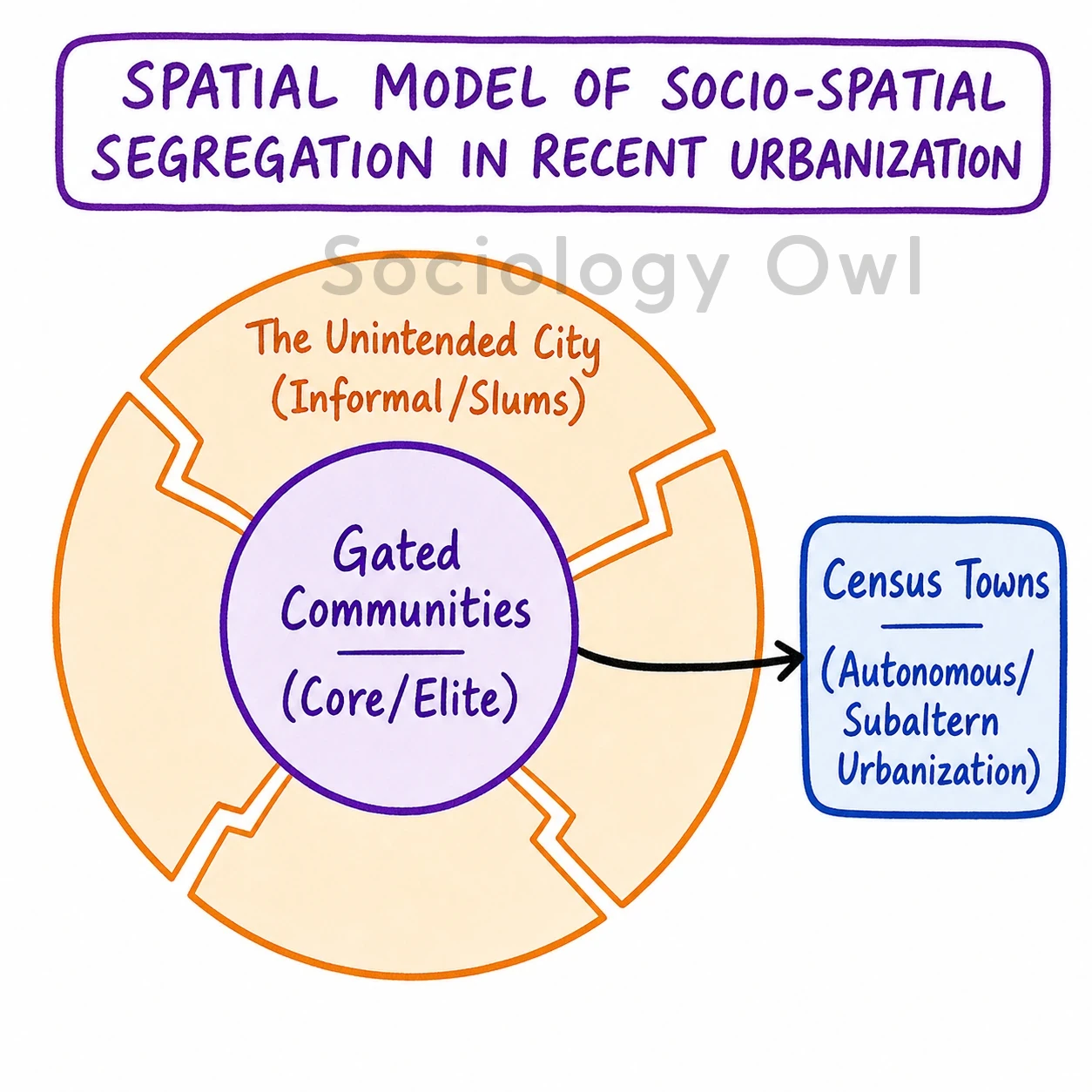
- Subaltern Urbanization: Partha Mukhopadhyay notes the recent explosion of “Census Towns.” These are administratively rural but demographically urban settlements growing autonomously, independent of state planning.
- Exclusionary Urbanization: Urban renewal pushes the urban poor to peripheries while elites capture core spaces (Amitabh Kundu). Mumbai’s gentrified mill lands exemplify this spatial segregation.
- The “Unintended City”: Ashis Nandy describes how slums and informal settlements grow parallel to planned spaces, housing marginalized migrants who service the elite but remain ignored in city planning.
- Privatized Spatial Segregation: Sanjay Srivastava highlights the rise of Gated Communities (e.g., Gurugram), reflecting the new middle-class desire for insulated urban spaces.
The emergence of polycentric urban corridors (e.g., the NCR or Mumbai-Pune expressway) illustrates the creation of hybrid peri-urban spaces, rapidly replacing traditional agrarian structures with capitalist urbanism.
Conclusion
Recent urban growth presents a sociological paradox: it functions as an engine of economic growth yet spatially exacerbates the caste-class nexus. Policymaking must shift from merely engineering “Smart Cities” to fostering socially “Inclusive Cities.”