Model Answer:
Sustainable development requires meeting present needs without compromising future generations. Sociologically, however, it is a contested struggle over Jal, Jungle, and Zameen. A.R. Desai argues that India’s post-independence capitalist development inherently breeds ecological degradation and inequality, making sustainability fundamentally a question of social justice.
Sociological Debates on Sustainable Development
Achieving sustainability in India requires addressing inherent structural inequalities:
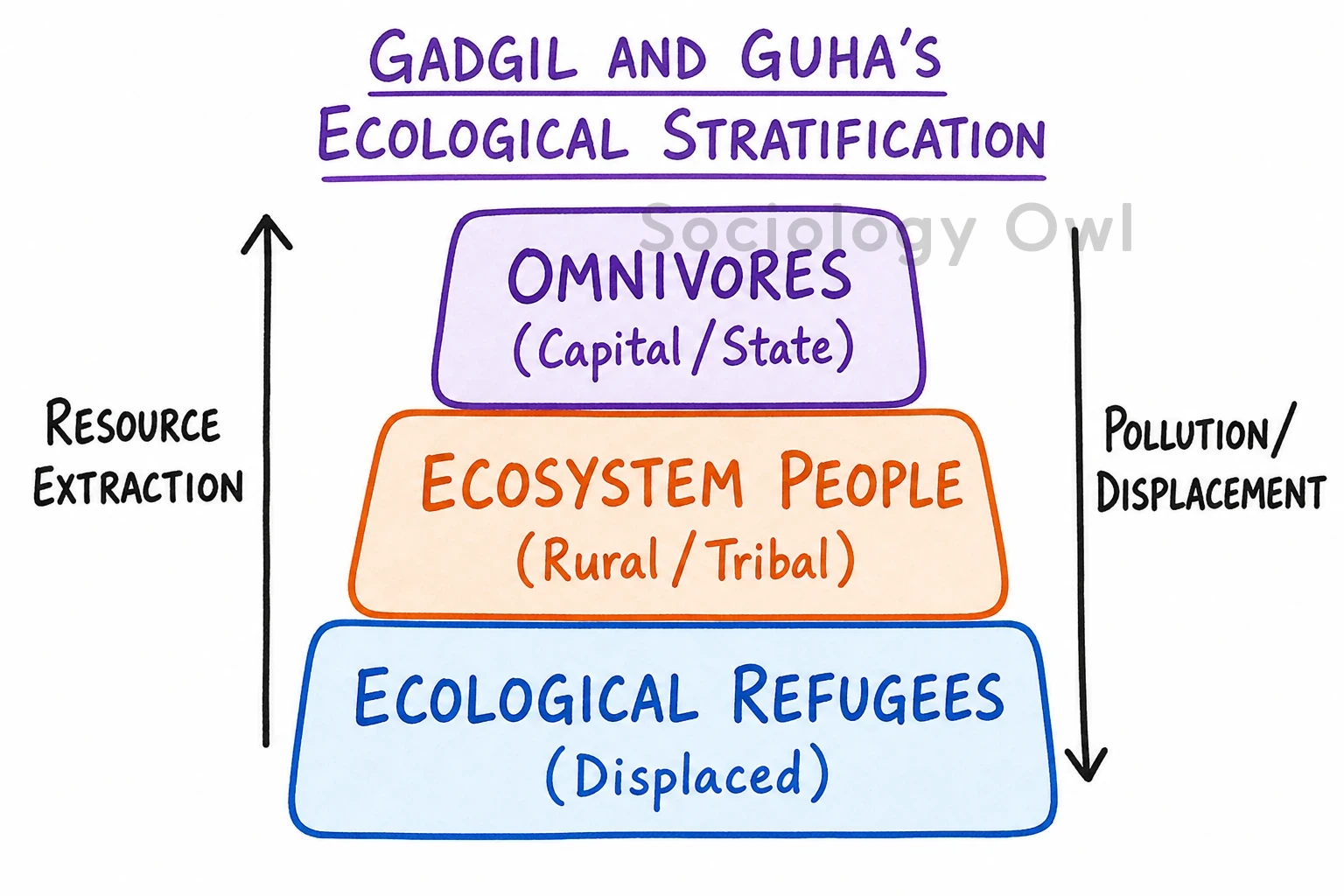
- Ecological Stratification: In Ecology and Equity, Madhav Gadgil and Ramachandra Guha argue that sustainable development is impossible unless the unchecked consumption of “Omnivores” (urban capitalists) is curtailed to protect “Ecosystem People” (tribals and rural poor) from becoming ecological refugees.
- Feminist Environmentalism: Vandana Shiva, in Staying Alive, highlights “Maldevelopment”, arguing that Western capitalist models are inherently patriarchal and anti-nature, disproportionately harming women.
Major Environmental Issues
- Urban Ecology and Class Conflicts: Amita Baviskar introduces “Bourgeois Environmentalism” to explain how middle-class demands for “clean” cities often result in slum demolitions, evicting the urban poor and destroying livelihoods under the guise of beautification.
- Development-Induced Displacement: As Walter Fernandes notes, Adivasis constitute over 40% of displaced populations despite being only 8% of the demography. This highlights a severe class-caste nexus in environmental degradation.
- Gender and Caste Vulnerability: Bina Agarwal emphasizes that environmental depletion disproportionately increases the labor burden on rural women (collecting fuel and fodder) and pushes marginalized castes into ecologically fragile, disaster-prone zones.
Sustainability requires structural empowerment rather than mere technological fixes:
- Decentralization and Rights: Democratizing governance through the Forest Rights Act (FRA, 2006) and PESA shifts power to the Gram Sabha.
- Social Movements: Ramachandra Guha identifies the “Environmentalism of the poor”, visible when the Dongria Kondh tribe successfully resisted Vedanta’s mining in Niyamgiri, illustrating grassroots assertion over ecological governance.
Conclusion
In a highly stratified society like India, ecological sustainability is inextricably linked to social equity. As Amartya Sen posits, viewing development as “freedom” dictates that true sustainability is achieved only when marginalized communities transition from passive victims of ecological decay to active decision-makers in resource management.