Model Answer:
The shift from feudal to capitalist work organization reflects a transition in Karl Marx’s Mode of Production, fundamentally altering both the forces and relations of production.
Differing Principles of Work Organization
Relations of Production: Feudalism utilized extra-economic coercion (religion, military) binding serfs to land (Marc Bloch). Conversely, capitalism relies on commodified wage labor between the bourgeoisie and proletariat (Marx).
Division of Labor: Feudal work was holistic, fostering Mechanical Solidarity (Émile Durkheim) and Gemeinschaft (Ferdinand Tönnies). Capitalist production demands complex specialization (driving Organic Solidarity) but inevitably causes worker Alienation.
Authority & Control: Feudalism operated on paternalistic Traditional Authority (Max Weber). Capitalism relies on Formal Rationality and scientific management, leading to the systematic “deskilling” of labor (Harry Braverman).
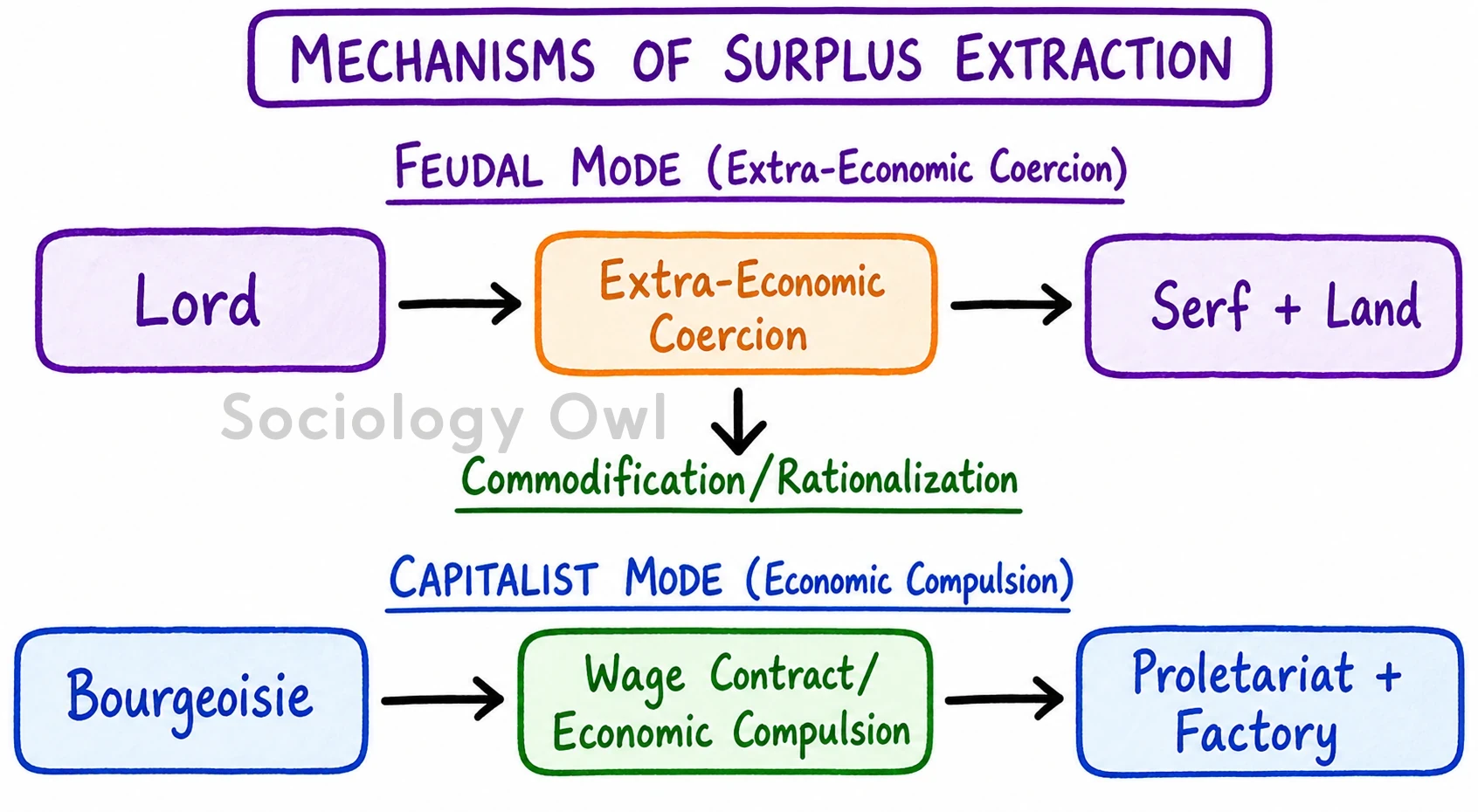
Today’s gig economy exhibits “Techno-feudalism” (Yanis Varoufakis), where Big Tech platforms act as “digital lords” extracting rent from precarious “digital serfs,” blending historical exploitation models.
Conclusion
While capitalism revolutionized productive efficiency, it merely replaced feudal social bondage with pure economic compulsion, demonstrating that work organization perpetually dictates the underlying fabric of human relations.