Model Answer:
Sustainable development, defined by the Brundtland Commission as meeting present needs without compromising future generations, is not just an ecological issue in India but a profound crisis of social equity. In India’s biomass-based subsistence economy, development often pits environmental conservation against the basic livelihoods of marginalized communities.
Sociological Analysis of the Conflict
The livelihood-environment conflict in India is rooted in unequal resource distribution and power dynamics:
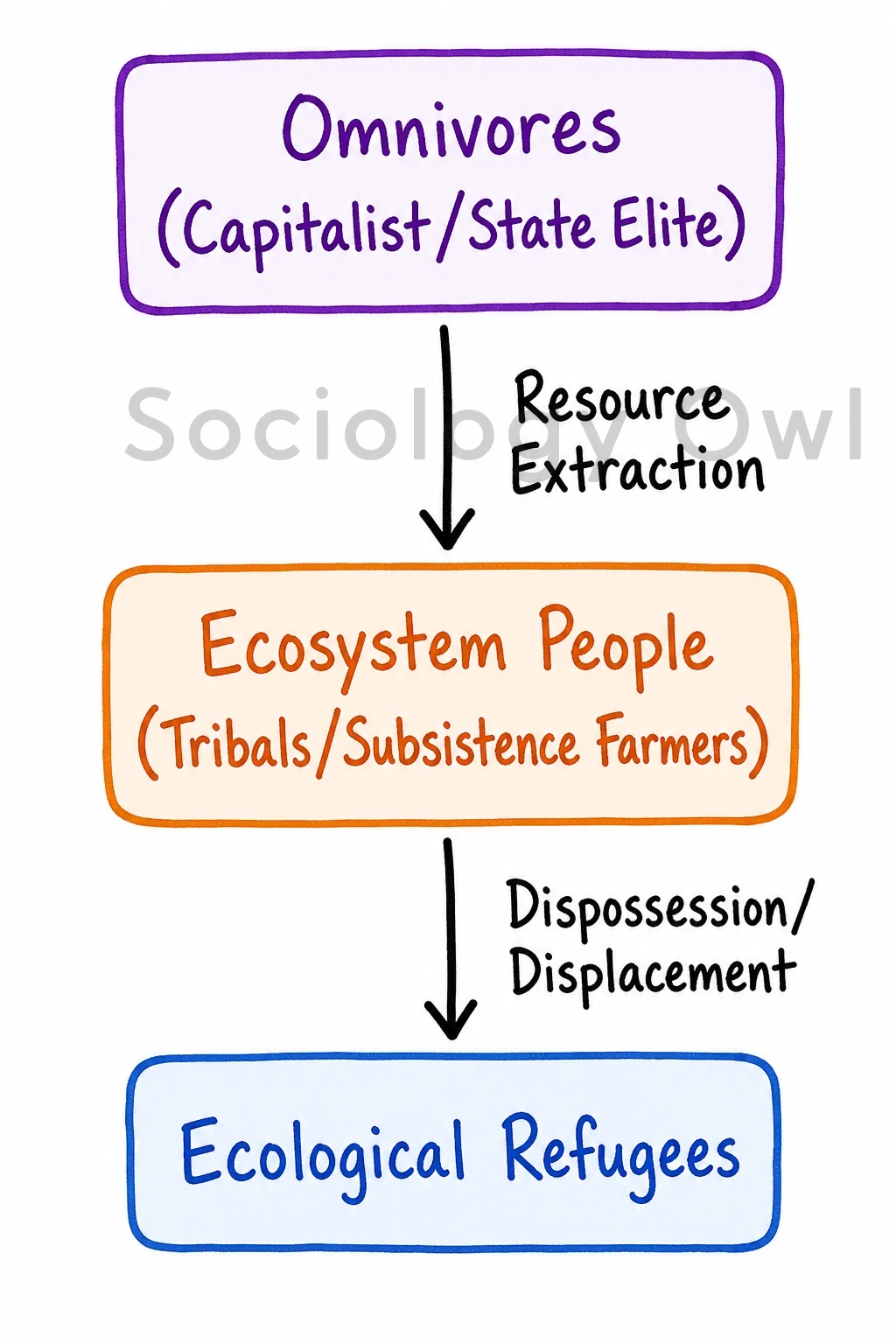
- Environmentalism of the Poor: Ramachandra Guha divides Indian society into “Omnivores” (urban/capitalist elite), “Ecosystem People” (tribals/peasants dependent on nature), and “Ecological Refugees” (those displaced by development). The conflict is essentially Omnivores exploiting resources at the direct cost of Ecosystem People.
- Bourgeois Environmentalism: Amita Baviskar highlights how the urban middle-class vision of a pristine environment (e.g., exclusive national parks or slum clearances) routinely criminalizes and displaces the livelihoods of the rural and urban poor.
- Marxist Perspective: A.R. Desai asserts that the post-independence, state-led capitalist development model commodified nature, resulting in the structural marginalization of tribes through primitive accumulation.
Pathways to Achieving Sustainability in India
Balancing ecology and livelihood requires the structural democratization of resource management:
- Institutional Decentralization: Legislations like the Forest Rights Act (FRA), 2006 reconcile this conflict by recognizing the historical rights of forest-dwellers, shifting the paradigm from “conservation against people” to “conservation by people.”
- Feminist Environmentalism: Contrasting Vandana Shiva’s spiritual eco-feminism, Bina Agarwal argues that women’s connection to nature is rooted in their material reality (gathering fuel, fodder). Sustainability requires integrating women into resource governance.
- Ideological Shift: Blending Traditional Ecological Knowledge (TEK) with Mahatma Gandhi’s principle of Sarvodaya (welfare of all) counters ecologically destructive modern industrialism.
Instances of subaltern environmentalism, such as the Niyamgiri Hills movement (Dongria Kondh tribe vs. mining interests) and the Hasdeo Arand protests, perfectly illustrate this clash, emphasizing that true sustainability demands indigenous consent and community-led conservation models.
Conclusion
Sustainability in India cannot be achieved through top-down, coercive “fortress conservation.” It necessitates an eco-socialist framework where the poorest are empowered and recognized not as enemies of the environment, but as its primary custodians.