Model Answer:
Max Weber’s The Protestant Ethic and the Spirit of Capitalism is often described by scholars like Albert Salomon as a “dialogue with the ghost of Karl Marx.” It offers a fundamental critique of Marx’s Historical Materialism, demonstrating how non-material ideological forces can drive profound economic transformations.
Weber’s Critique of Marxist Economic Determinism
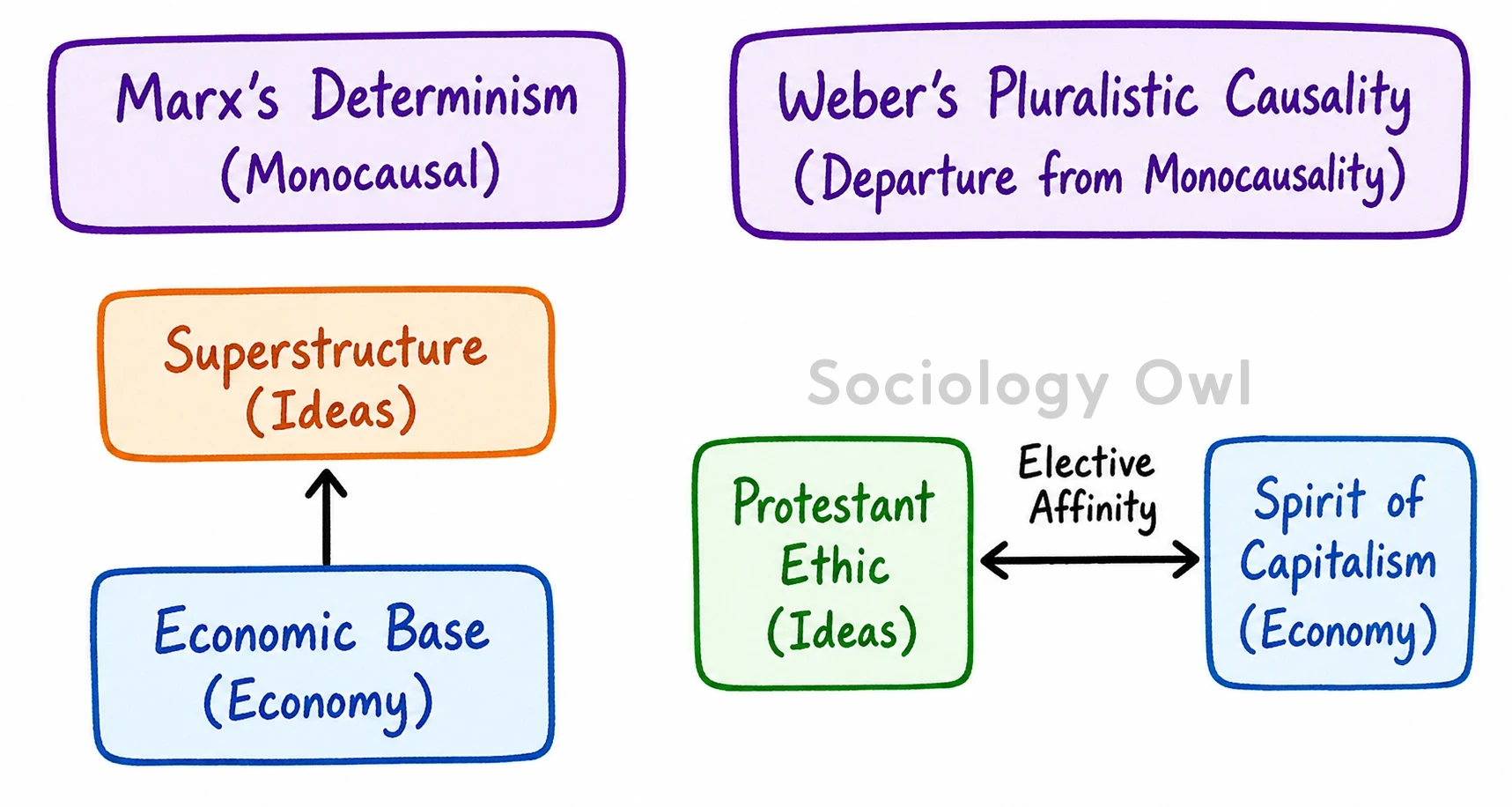
Inverting the Base-Superstructure Model: While Marx argued that the economic “base” strictly determines the ideological “superstructure,” Weber demonstrated that ideas can shape economies. He highlighted how Calvinism fostered the Spirit of Capitalism.
Elective Affinity over Strict Causality: Rejecting mechanical determinism, Weber proposed an Elective Affinity (Wahlverwandtschaft) between the Doctrine of Predestination and modern capitalism. The anxiety of salvation was resolved through Inner-worldly asceticism—treating rational labor and wealth accumulation as a religious “calling.”
Pluralistic Causality: Weber rejected Marxist monocausality. He explicitly clarified that his goal was not to replace a “one-sided materialistic” explanation of history with an equally flawed “one-sided spiritualistic” one, but to show their interplay via Social Action.
Critiques and Theoretical Extensions
Materialist Pushback: R.H. Tawney countered Weber, arguing that the technological and economic foundations of capitalism preceded Protestantism, which merely adapted to existing material realities.
Alternative Cultural Origins: Werner Sombart argued that the Jewish ethic, rather than Protestantism, was the true catalyst for capitalist development.
Neo-Marxist Critique: Immanuel Wallerstein argued that capitalism emerged not from religious ethics, but from historical colonialism and structural exploitation of the Global South.
Shared Structural Pessimism: Despite debating its origins, both thinkers despised capitalism’s outcomes. Marx condemned Alienation, while Weber warned of a secularized, bureaucratic “Iron Cage of Rationality.”
Weber’s framework remains vital today. Sociologist Tu Weiming utilized it to explain the rapid rise of the “Asian Tigers,” attributing their success to a Confucian Work Ethic. Furthermore, modern “hustle culture” in Silicon Valley mirrors a hyper-rationalized, secularized descendant of Weber’s Protestant ethic.
Conclusion
Weber provided a necessary corrective to crude economic determinism. By establishing that cultural meanings shape economic structures, he permanently cemented the sociological axiom that while material realities are crucial, ideas frequently act as the “switchmen of history.”