Model Answer:
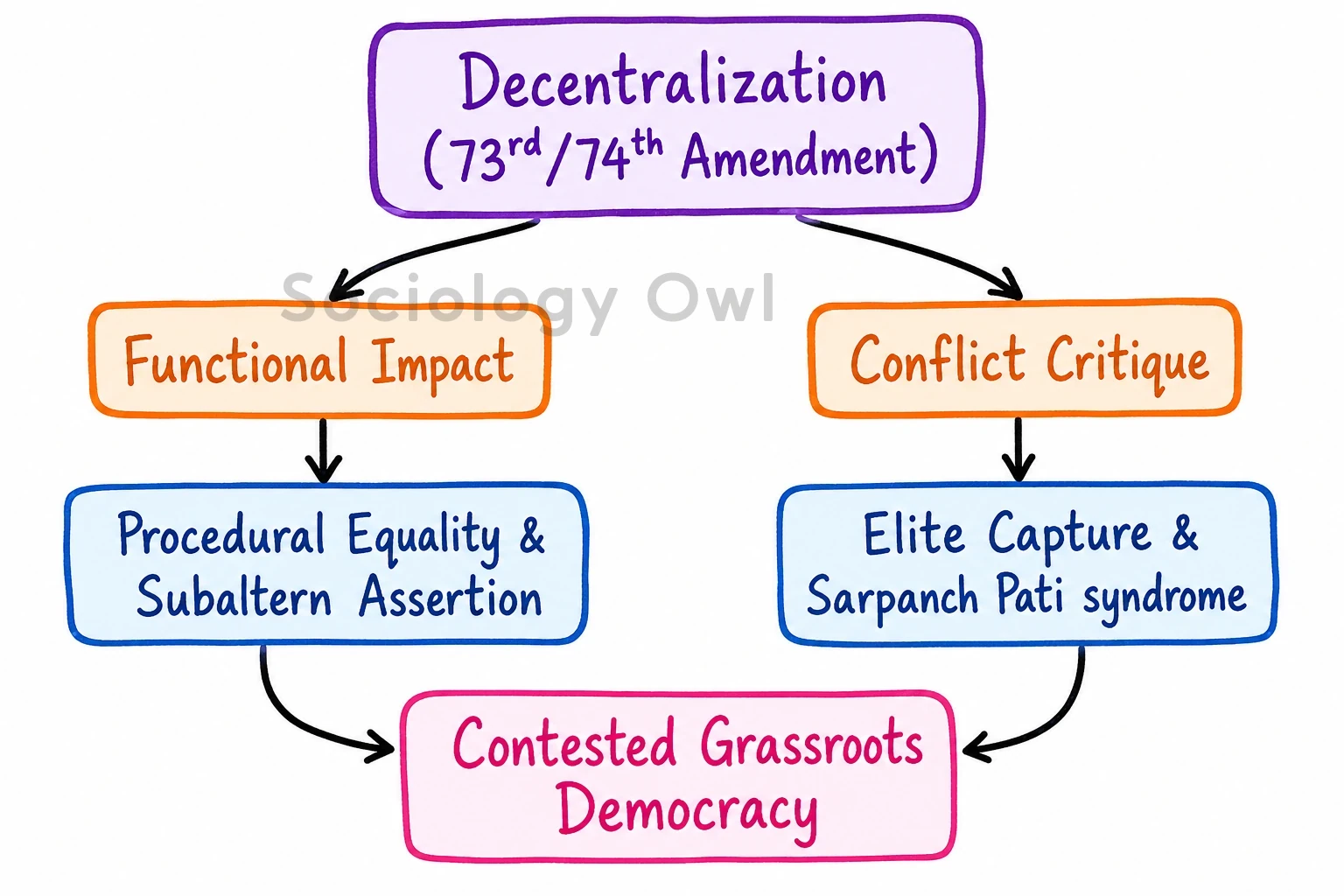
Decentralization of power refers to the devolution of administrative, financial, and political authority to the grassroots. Institutionalized via the 73rd and 74th Amendments, it catalyzed a structural transformation in India, shifting the locus of power from traditional caste hierarchies to statutory, democratic institutions.
Democratization of the Social Structure
- Shift in Power Dynamics: Andre Beteille, in his study of Sripuram, observed that decentralization shifted power away from traditional Caste Panchayats to secular Gram Panchayats, slowly replacing substantive hierarchy with procedural equality.
- Modernization of Tradition: Yogendra Singh notes that local self-governance exemplifies the Modernization of Indian Tradition, where traditional village bodies adapt to democratic, egalitarian processes.
Subaltern Empowerment and Gender Dynamics
- The Subaltern Critique: While Mahatma Gandhi romanticized Gram Swaraj (village self-rule), B.R. Ambedkar warned that Indian villages were “dens of ignorance and communalism.” Decentralization mandated power-sharing through reservations, acting as a catalyst for Dalit and Adivasi political assertion.
- The Conflict Perspective: Conversely, M.N. Srinivas demonstrated how the Dominant Caste utilizes numerical strength and land ownership to capture Panchayats. Marxist sociologist A.R. Desai argued that this caste-class nexus often decentralizes exploitation rather than power, empowering the “rural bourgeoisie.”
- Negotiating Patriarchy: Women’s reservation initially faced pushback via the “Sarpanch Pati” syndrome (husbands wielding actual proxy power). However, Bina Agarwal highlights that sustained participation eventually creates genuine female agency, reorienting rural priorities toward water, sanitation, and health.
The Kudumbashree model in Kerala proves how integrating women’s Self-Help Groups (SHGs) with local Panchayats dismantles traditional class-gender hierarchies. Furthermore, scholars like Gopal Guru note the rising political socialization of Dalit Sarpanches in Tamil Nadu, marking deep grassroots democratization despite instances of violent upper-caste backlash.
Conclusion
While democratic decentralization continuously navigates the complex fault lines of India’s entrenched social stratification, it has initiated an irreversible democratization of the rural matrix. It remains a vital tool for transforming the Indian village from an arena of rigid hierarchy to a nursery of participatory democracy.