2026 Sociology Paper 1

Q. ‘Data without theory is blind and theory without data is empty.’ Comment.

Q. ‘Data without theory is blind and theory without data is empty.’ Comment.

UPSC Sociology 2026 Paper 1

Model Answer:

Derived from Kantian epistemology, this aphorism highlights the dialectical, non-hierarchical interdependence between empirical observation and conceptual abstraction in establishing rigorous sociological knowledge.

Interdependence of Empirical Data and Theoretical Frameworks

  • Data without Theory is Blind (Abstracted Empiricism): Bare facts cannot interpret themselves. As C. Wright Mills argued, gathering isolated data without a theoretical framework results in aimless fact-collecting devoid of structural explanation.
  • Theory as a Cognitive Filter: Theoretical models dictate what data to observe, classify, and prioritize, transforming chaotic social reality into analytically coherent and measurable sociological categories.
  • Theory without Data is Empty (Grand Theory): Abstract formulations detached from empirical testing degenerate into speculative philosophy, epitomized by Talcott Parsons’ overly abstract systems that lacked empirical grounding.
  • Empirical Data as Theory Generator: Beyond testing hypotheses, data actively reshapes theory; Robert K. Merton noted that unexpected empirical anomalies (the serendipity pattern) frequently stimulate new theoretical departures.
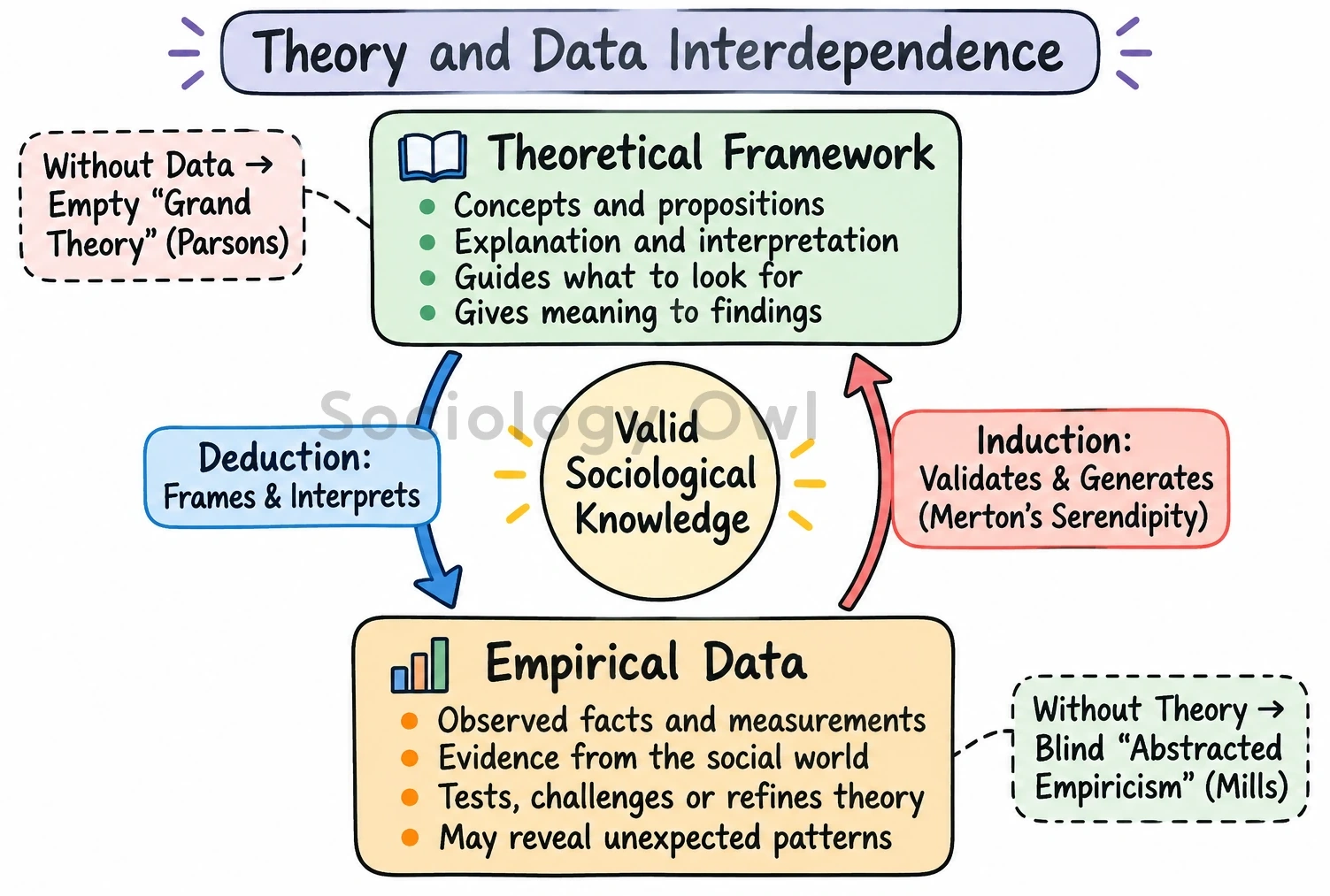
  • Inductive-Deductive Cyclical Synthesis: Sociology advances neither by pure deduction nor pure induction, but through a continuous spiral where data grounds concepts and concepts illuminate data (Grounded Theory).
  • Classical Demonstration: In Suicide, Émile Durkheim demonstrated that raw demographic statistics acquired scientific meaning only when integrated with theoretical constructs of social integration and moral regulation.

Sociological knowledge advances only when robust theoretical frameworks animate empirical data, transforming raw facts into meaningful sociological explanations.

Q. ‘Data without theory is blind and theory without data is empty.’ Comment. Read More »
Q. Differentiate between social hierarchy and social exclusion and substantiate your answer with reference to the caste system.

Q. Differentiate between social hierarchy and social exclusion and substantiate your answer with reference to the caste system.

UPSC Sociology 2026 Paper 1

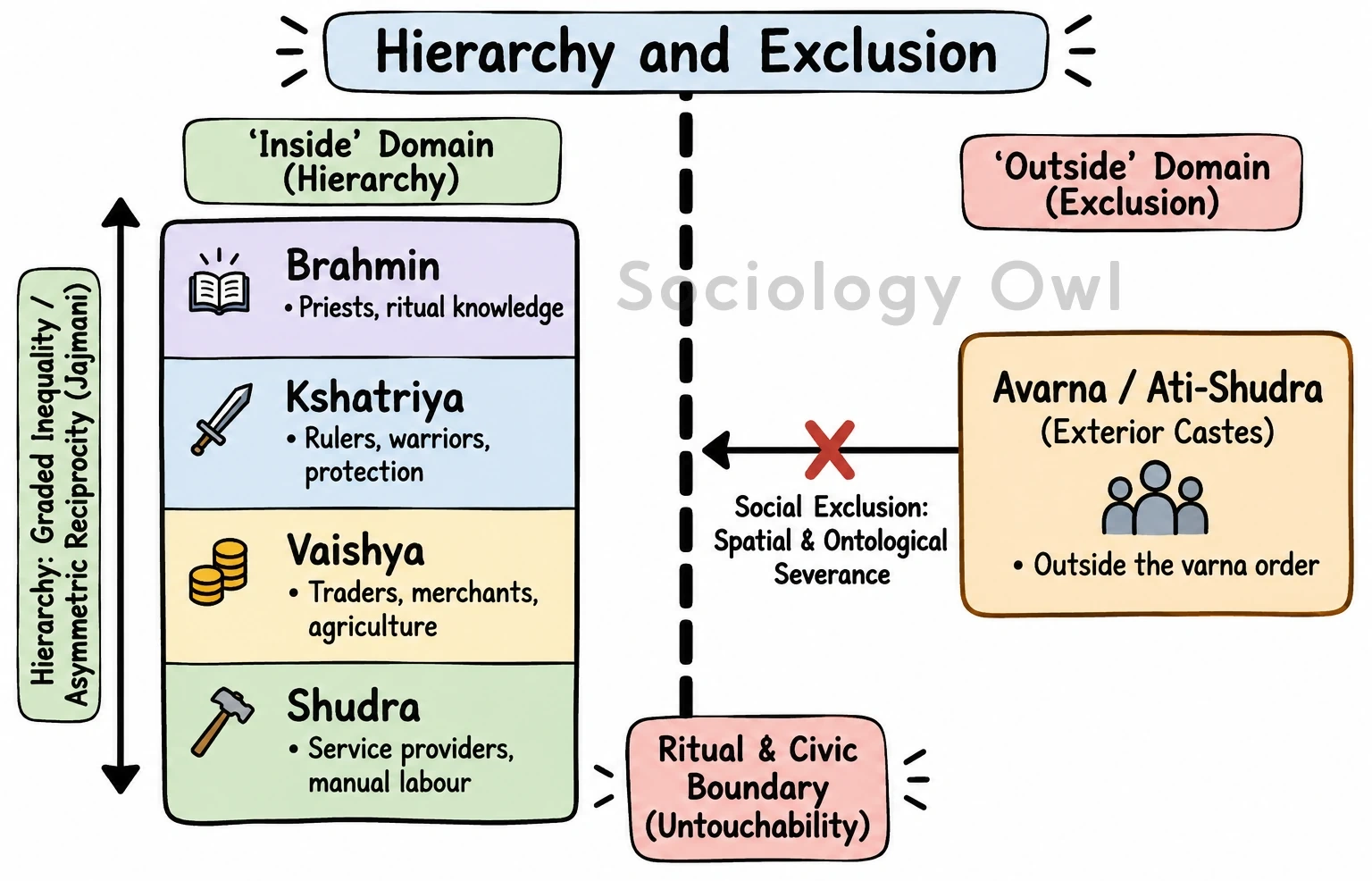
Social hierarchy denotes the vertical, asymmetrical ranking of groups within an interconnected social whole, whereas social exclusion represents the structural process of boundary-drawing, detachment, and systemic denial from mainstream societal participation.

Conceptual Divergence: Social Hierarchy versus Social Exclusion

  • Structural Nexus (Inclusion vs. Severance): Hierarchy integrates unequal groups into a shared functional or ideological framework; exclusion detaches individuals and groups, severing the relational bonds of full social citizenship.
  • Spatial & Relational Demarcation: Hierarchy is vertical, organizing strata through ranked positions; exclusion operates on an inside–outside axis, creating horizontal barriers of social closure.
  • Systemic Interdependence: Hierarchy relies on asymmetric reciprocity and graded legitimacy; exclusion thrives on enforced isolation, systemic invisibilization, and complete resource deprivation (Amartya Sen).
  • Trajectory of Redressal: Hierarchy generates contestations over status mobility and redistribution; exclusion demands recognition, access to civil spheres, and the restoration of ontological human dignity.

Substantiating the Dichotomy through the Caste Matrix

  • Varna Ranking vs. The Avarna Boundary: Within the Chaturvarna framework, Louis Dumont in Homo Hierarchicus locates status based on relative purity and pollution; conversely, social exclusion banishes Ati-Shudras (Dalits) outside the ritual matrix altogether as “exterior castes.”
  • Economic Reciprocity vs. Enforced Segregation: Hierarchy is maintained through occupational interdependence such as the traditional Jajmani system; exclusion manifests through spatial apartheid, forcefully exiling Dalit settlements to village peripheries.
  • Graded Inequality vs. Untouchability: B.R. Ambedkar argued that caste is an architecture of graded inequality (hierarchy); however, the practice of untouchability is a punitive instrument of structural exclusion, stripping groups of basic civic and human agency.
  • Relative Mobility vs. Absolute Closure: While intermediary castes negotiate relative rank through M.N. Srinivas’s Sanskritization, excluded groups face absolute epistemic and bodily barricades, historically enforced through bans on public water commons, temple entry, and education.

While hierarchy organizes unequal social participation, exclusion denies belonging altogether; caste uniquely institutionalizes both through graded inequality and untouchability.

Q. Differentiate between social hierarchy and social exclusion and substantiate your answer with reference to the caste system. Read More »

Q. Describe the impact of capitalist mode of production on society.

Q. Describe the impact of capitalist mode of production on society.

UPSC Sociology 2026 Paper 1

Model Answer:

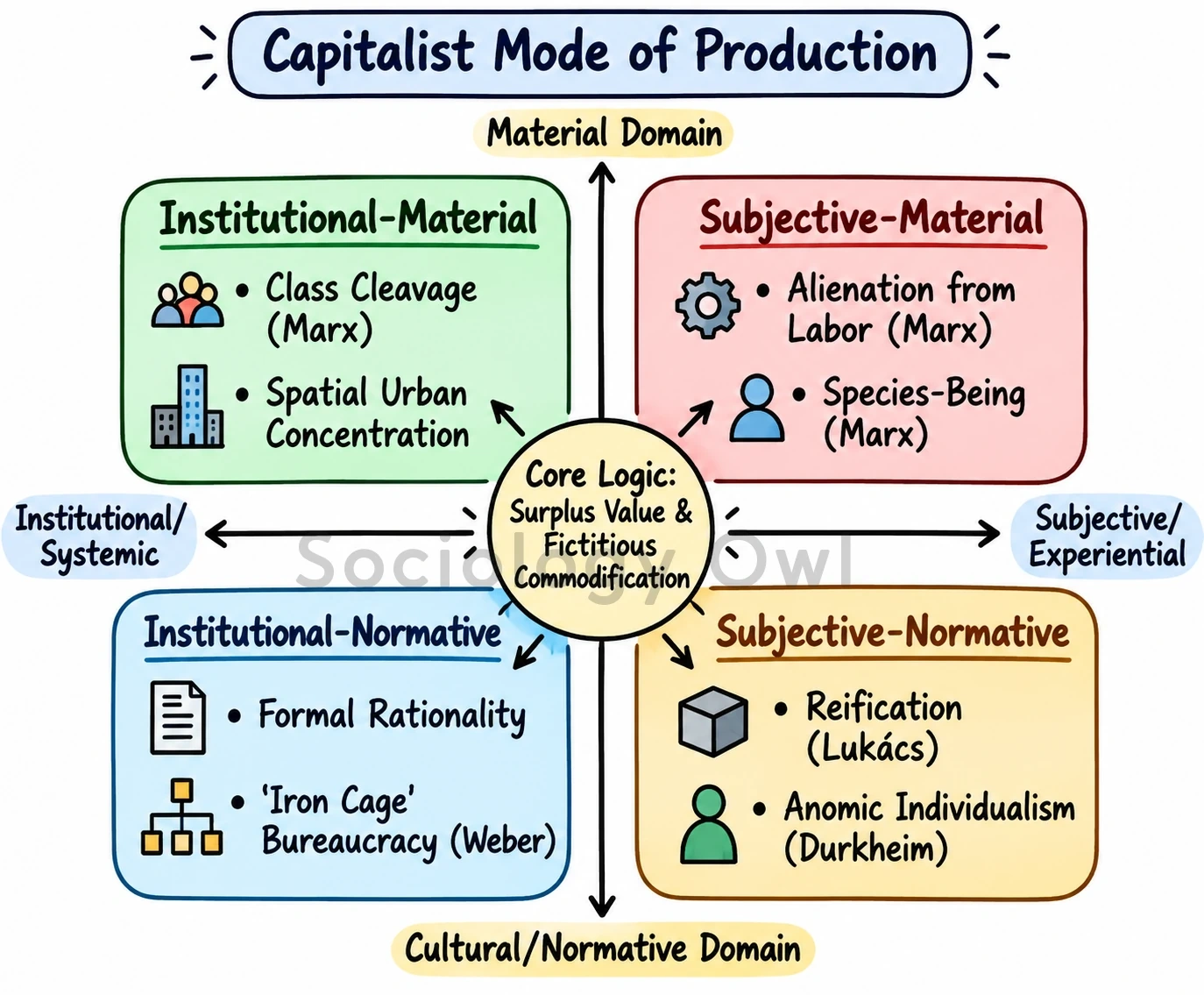
The capitalist mode of production (CMP) refers to a socio-economic system driven by private ownership of the means of production, generalized commodity exchange, and the extraction of surplus value from wage labor.

Structural and Institutional Transformations

  • Class Polarization and Stratification: Karl Marx argued that CMP simplifies complex stratification into two antagonistic classes—the bourgeoisie and the proletariat—widening wealth inequality through systematic capital accumulation.
  • Commodification of Social Life: As Karl Polanyi demonstrated in The Great Transformation, capitalism turns land, labor, and money into fictitious commodities, dis-embedding economic transactions from traditional kinship and moral ties.
  • Restructuring of Family and Gender: Friedrich Engels in The Origin of the Family, Private Property and the State highlighted how industrial capitalism separated home from workplace, privatized domestic labor, and consolidated patriarchal property inheritance.
  • Bureaucratization and Formal Rationality: Max Weber showed that capitalist expansion demands predictable, calculable administration, driving pervasive rationalization and trapping modern society within a bureaucratic iron cage.
  • Spatial Reorganization and Urbanization: CMP dismantled agrarian communities, creating dense, segregated industrial metropolises designed around logistics, labor concentration, and capital circulation.

Psycho-Social and Cultural Consequences

  • Pervasive Alienation (Entfremdung): Under wage labor, workers experience profound estrangement from the product, the act of production, fellow human beings, and their intrinsic creative potential or species-being.
  • Reification and Commodity Fetishism: Georg Lukács observed that market logic objectifies social reality, making human social relationships appear as immutable, natural relations between things.
  • Erosion of Collective Solidarity: The shift toward hyper-individualistic, instrumental relations dissolves community integration, precipitating what Émile Durkheim categorized as anomic strain.
  • Manufactured Consciousness and Consumerism: Critical theorists like Theodor Adorno noted that late capitalism deploys a culture industry to commodify art and leisure, neutralizing political dissent through pacifying consumer desires.

The capitalist mode of production fundamentally restructured human society, liberating productive capacities while systematically commodifying social relations, labor, and human consciousness.

Q. Describe the impact of capitalist mode of production on society. Read More »

Q. Explain in brief the relationship between social movement, collective action and revolution in bringing about social and political changes.

Q. Explain in brief the relationship between social movement, collective action and revolution in bringing about social and political changes.

UPSC Sociology 2026 Paper 1

Model Answer:

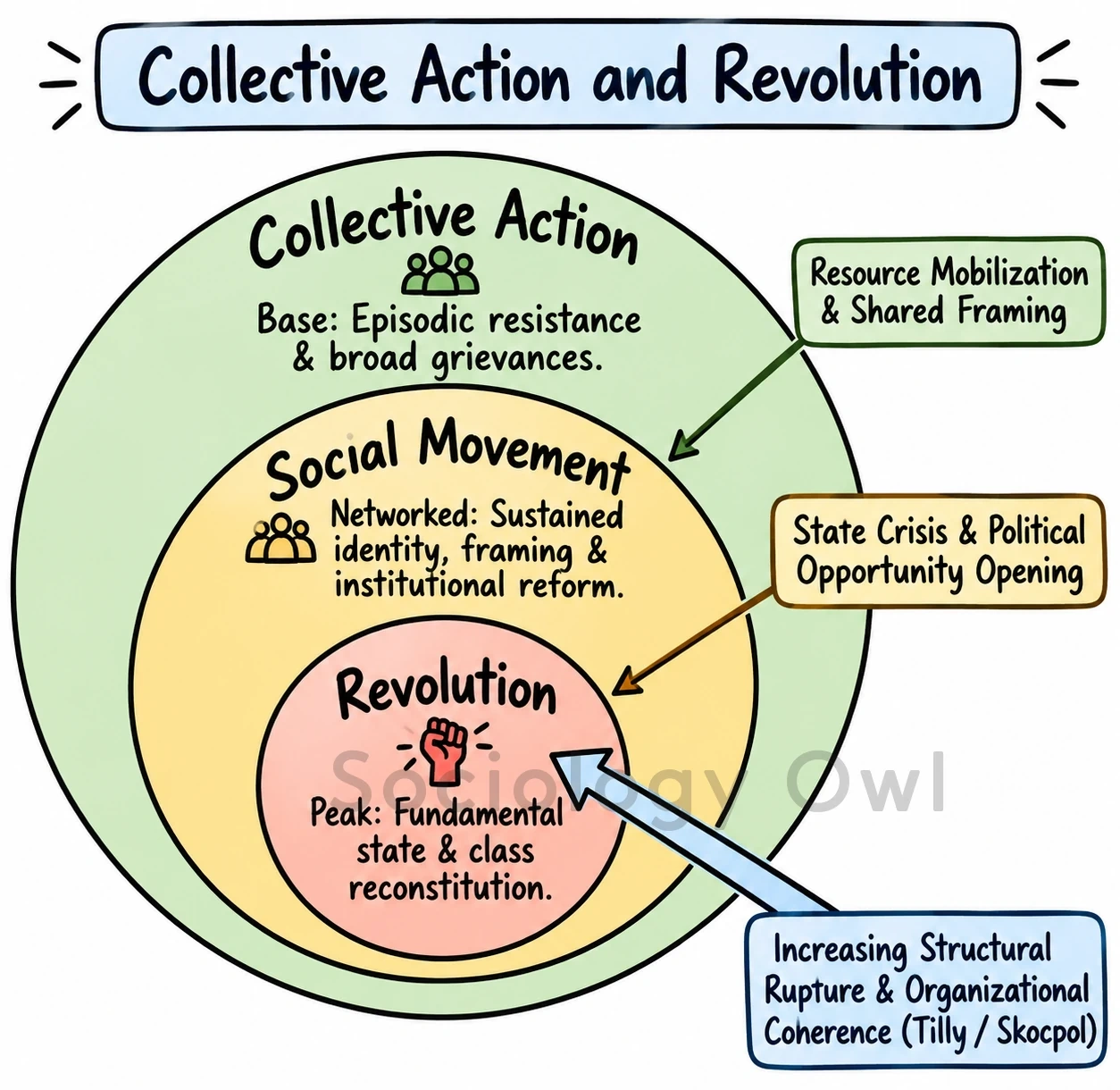
Collective action, social movements, and revolutions form an escalating, nested continuum of agency, varying in duration, organizational coherence, and structural intent to alter existing power dynamics.

Nexus of Contention in Driving Socio-Political Change

  • Nested Continuum: Charles Tilly conceptualizes collective action as the foundational genus; when sustained by collective identity and strategy, it crystallizes into a social movement, which may climax into a revolution.
  • Scale of Structural Rupture: Collective action triggers episodic resistance, social movements drive incremental legislative reforms, while revolutions execute rapid, fundamental transformations of state and class structures (Theda Skocpol).
  • Ideological Framing and Escalation: Sporadic collective grievances transform into sustained movements via shared cognitive framing; when counter-hegemony successfully challenges state legitimacy (Antonio Gramsci), contention escalates toward revolutionary confrontation.
  • Political Opportunity Structures: As Doug McAdam argues, collective protests need resources to institutionalize into movements, but only severe political vulnerability and state crises allow movements to cross the threshold into revolution.
  • Institutional Mediation: Social movements act as a mediating bridge; when institutional channels absorb movement demands, change is reformist, but institutional rigidity often radicalizes collective mobilization into revolutionary overthrow.
  • Cumulative Outcomes: Collective actions alter immediate public consciousness, social movements secure institutionalized civil-political rights, and revolutions comprehensively reconstitute the societal mode of production and governance.

Together, they form an escalating continuum through which episodic popular contention matures into sustained movements and structural revolutionary transformations.

Q. Explain in brief the relationship between social movement, collective action and revolution in bringing about social and political changes. Read More »

Q. Although sociology, as a subject of study, overarches all disciplines in social sciences yet it maintains its distinctiveness. Comment.

Q. Although sociology, as a subject of study, overarches all disciplines in social sciences yet it maintains its distinctiveness. Comment.

UPSC Sociology 2026 Paper 1

Model Answer:

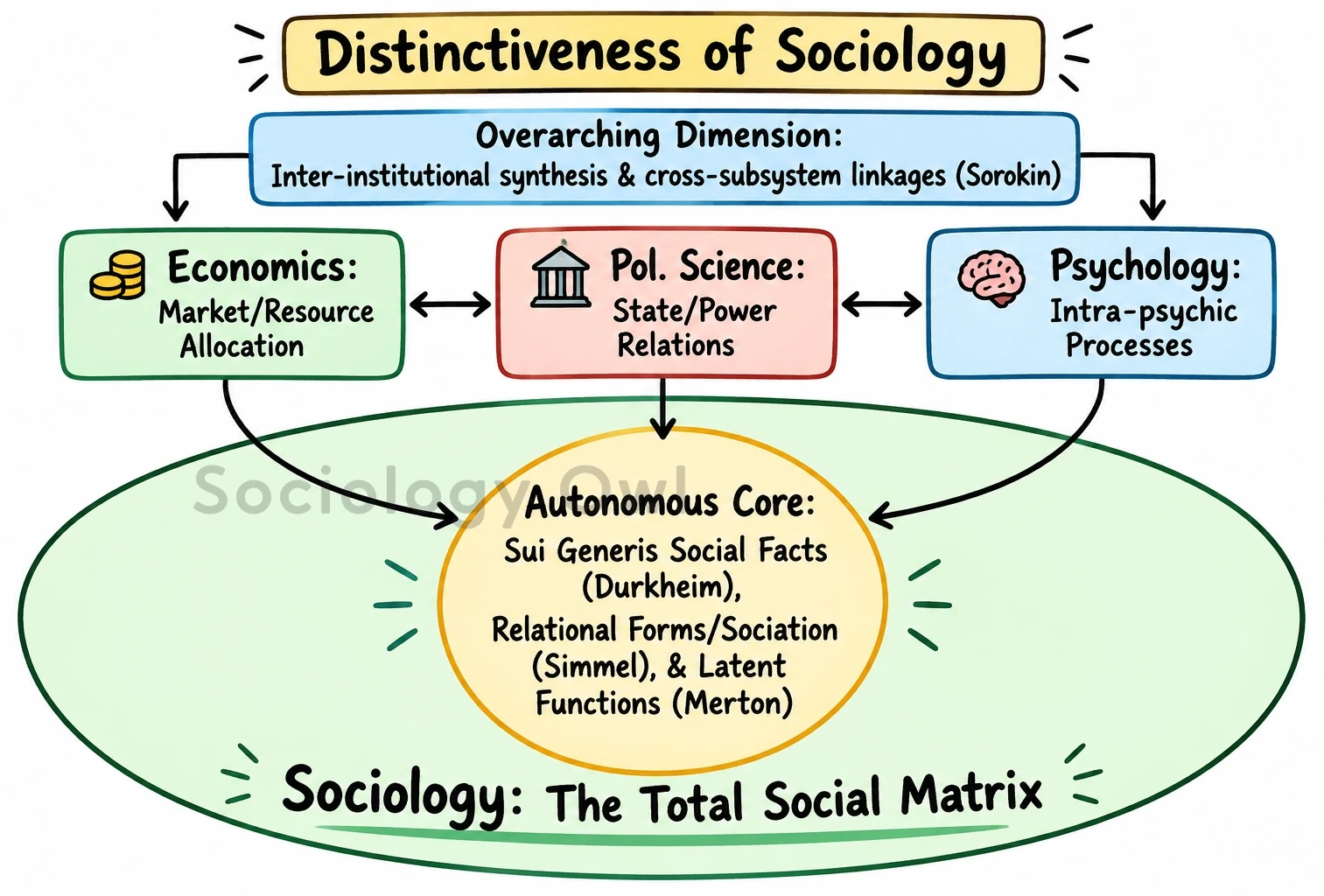
Sociology functions as a synthetic discipline overarching all social fields, yet preserves an autonomous disciplinary core by examining the social matrix that underpins and connects all specialized human activities.

Overarching Scope and Methodological Distinctiveness

  • Holistic Synthesis vs. Segmental Focus: Specialized disciplines isolate specific subsystems—economics abstracts markets and political science analyzes statecraft. Sociology studies these within the total institutional complex as an overarching, generalizing science (Pitirim Sorokin).
  • Sui Generis Reality: Unlike psychology’s reduction of phenomena to internal mental states, sociology investigates emergent social facts that exist externally to the individual and exercise coercive power (Émile Durkheim).
  • The Sociological Imagination: It uniquely bridges historical trajectories with personal biographies, demonstrating how private troubles reflect systemic structural ruptures (C. Wright Mills).
  • Primacy of ‘Sociation’: It interrogates the relational geometry of interaction and social action itself, rather than merely analyzing transactional or institutional outcomes (Georg Simmel).
  • Unmasking Latent Realities: While allied disciplines often presume rational agency, sociology specializes in diagnosing unintended consequences, hidden dysfunctions, and latent functions (Robert K. Merton).
  • Epistemic Reflexivity: Sociology uniquely interrogates the taken-for-granted, common-sense premises that other social sciences uncritically adopt as baseline empirical data.

Sociology thus transcends specialized social sciences not by replacing them, but by providing the overarching, critical framework that decodes their interconnections.

Q. Although sociology, as a subject of study, overarches all disciplines in social sciences yet it maintains its distinctiveness. Comment. Read More »

Q. Discuss the role of geographical factors in social change and development.

Q. Discuss the role of geographical factors in social change and development.

UPSC Sociology 2026 Paper 1

Model Answer:

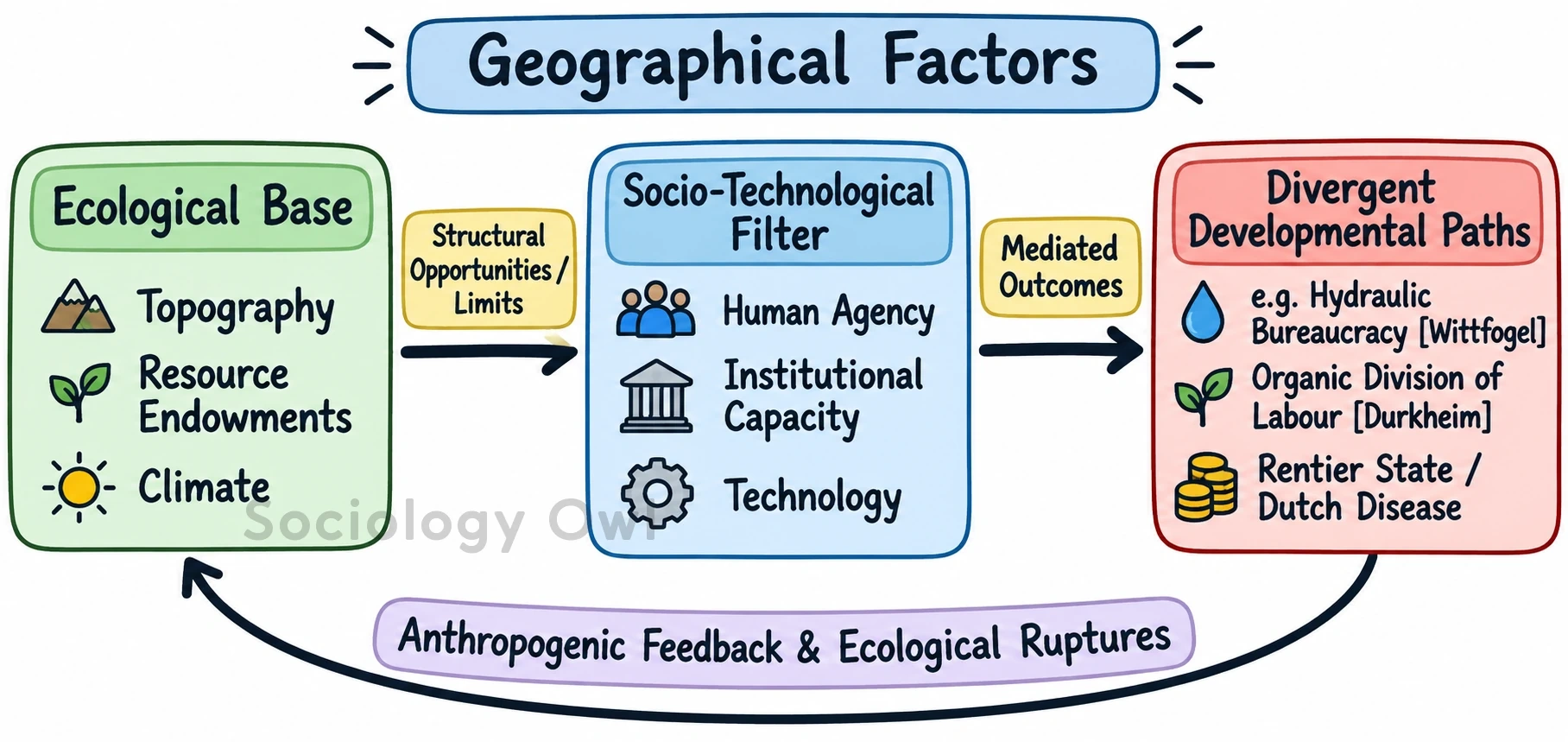
Geographical factors—encompassing topography, climate, and resource endowments—act as foundational ecological parameters that structurally constrain, direct, and stimulate societal evolution and developmental trajectories.

Geographical Dynamics in Social Transformation

  • Agrarian Surplus and Complexity: Jared Diamond demonstrates how geographic luck, continental axes, and domesticable biodiversity historically governed the uneven onset of sedentary agriculture and technological development.
  • Morphology and Division of Labour: Émile Durkheim noted that physical terrain and spatial distribution (material density) shape communicative interaction (moral density), driving structural evolution from mechanical to organic solidarity.
  • State Formation and Bureaucracy: Karl Wittfogel’s hydraulic thesis illustrated how arid ecologies necessitating centralized water management spurred the rise of agro-managerial, centralized political regimes.
  • Developmental Distortions: Geographic mineral abundance can either catalyze industrial growth or induce the resource curse, resulting in rentier economies, enclave development, and institutional decay.
  • Exogenous Shocks and Mobility: Ecological ruptures—such as desertification and natural hazards—induce rapid social reorganization, accelerating rural-to-urban distress migration and reshaping local demographic structures.
  • Possibilism over Determinism: Geography defines boundaries rather than rigid outcomes; human agency, culture, and technological innovations consistently mediate and overcome ecological limitations.

Ultimately, geography provides the foundational canvas, but human technology and cultural agency actively mediate its developmental consequences.

Q. Discuss the role of geographical factors in social change and development. Read More »

Q. Critically examine the position of women in the informal economy.

Q. Critically examine the position of women in the informal economy.

UPSC Sociology 2026 Paper 1

Model Answer:

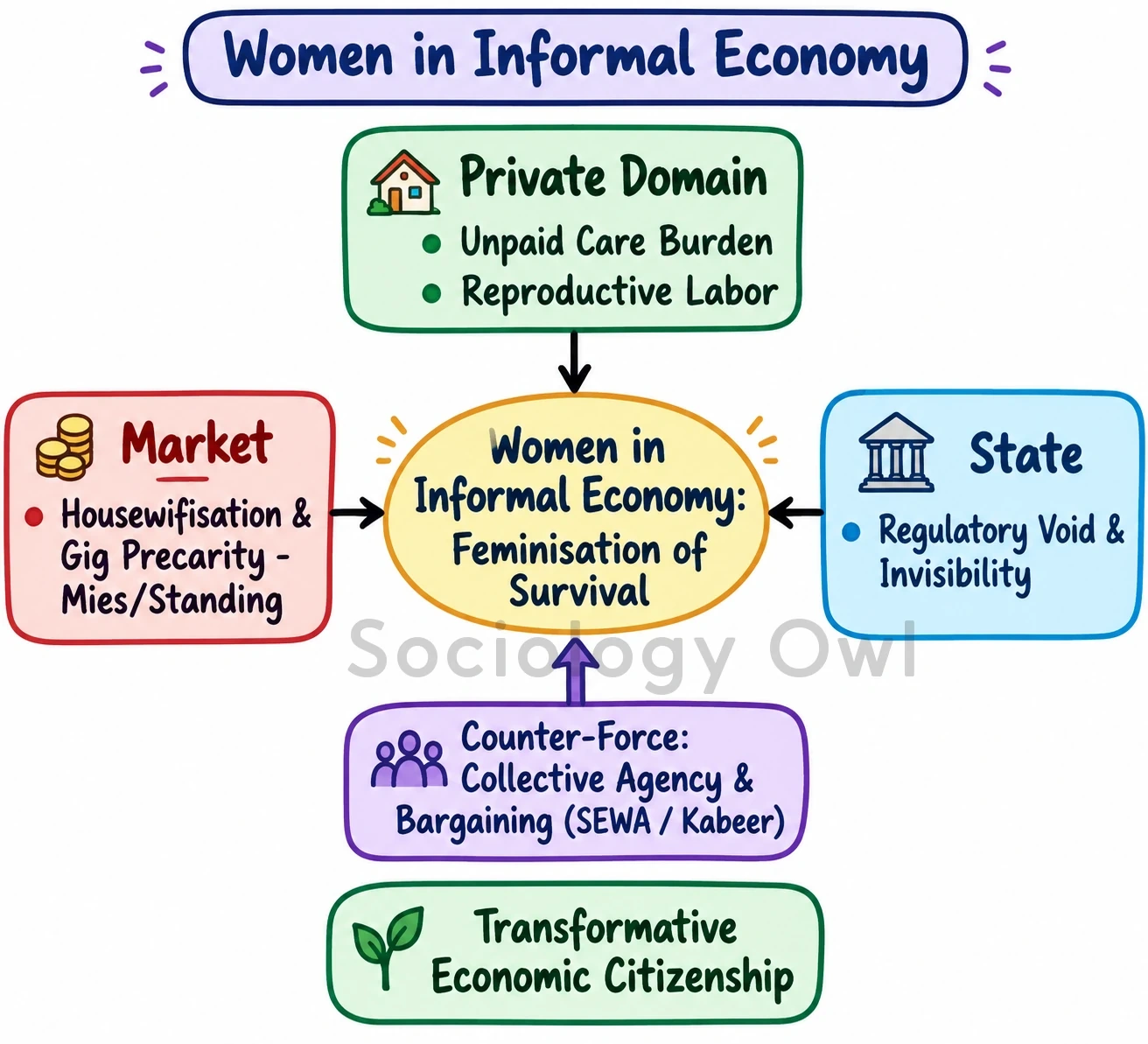
The informal economy absorbs the vast majority of female labor globally, reflecting a “feminisation of survival” where women remain disproportionately concentrated in the most precarious, low-yielding, and unregulated economic niches.

Dimensions of Female Labor in the Informal Economy

  • Housewifisation and Devaluation: Maria Mies argues that capitalist production frames home-based, subcontracted female labor as supplementary “housework,” naturalising depressed wages, piece-rate systems, and extreme self-exploitation.
  • Continuum of Unpaid Care: Informal occupations—such as domestic work and street vending—are structural extensions of unpaid reproductive roles, entrenching gender stereotypes without reconfiguring the domestic division of labor.
  • Public Patriarchal Subordination: Aligning with Sylvia Walby’s public patriarchy framework, market informality exposes women to structural exploitation via acute wage discrimination, occupational segregation, and complete absence of maternity or health protection.
  • Invisibility and Legal Alienation: Operating beyond the ambit of formal labor legislation, female informal workers lack institutional grievance mechanisms, compounding vulnerability to arbitrary dismissal, debt bondage, and workplace harassment.
  • The Platformised Precariat: The rise of gig platforms in domestic and personal care sectors generates a feminised precariat (Guy Standing), trading apparent flexibility for algorithmic surveillance and extreme economic insecurity.
  • Subversive Collective Agency: Concurrently, Naila Kabeer notes that informal earnings can enhance intra-household bargaining autonomy; grassroots mobilisations like SEWA successfully transform survivalist work into unionised collective bargaining power.

Women’s informal work paradoxically bridges survival and subjugation, requiring transformative social protection and formal recognition of their economic citizenship.

Q. Critically examine the position of women in the informal economy. Read More »

Q. In what ways do class and caste intersect and overlap in shaping social structure ?

Q. In what ways do class and caste intersect and overlap in shaping social structure ?

UPSC Sociology 2026 Paper 1

Model Answer:

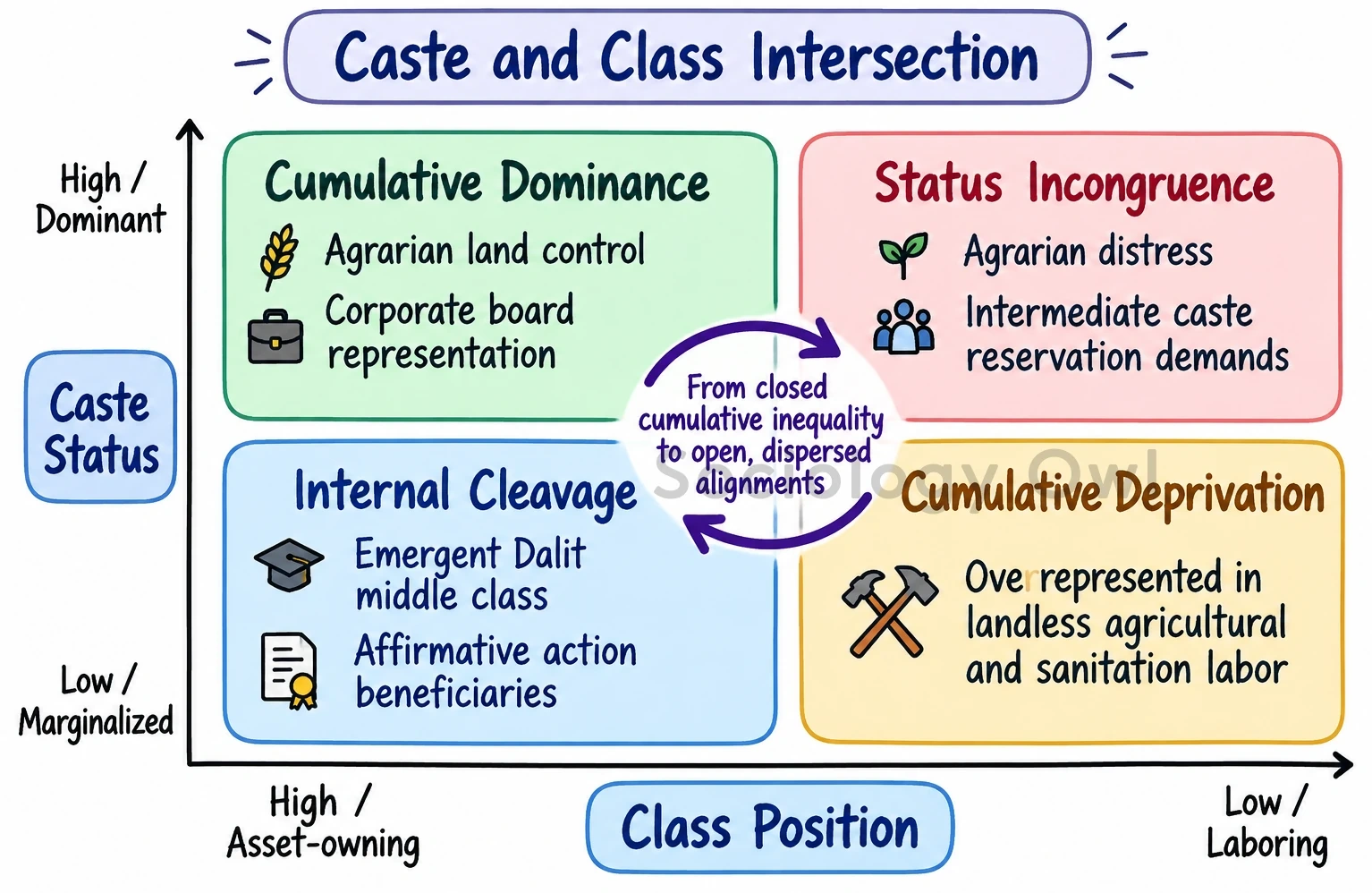
Caste (ascription-based, closed status group) and class (achievement-based, economic position) are not mutually exclusive systems; they continuously reconstitute each other, shaping the complex architecture of social stratification.

Dimensions of Caste-Class Intersection in Social Structure

  • Cumulative to Dispersed Inequalities: André Béteille demonstrated that while ritual status, wealth, and power traditionally converged into cumulative inequalities, modern democratization has dispersed them, even as substantial structural overlaps endure.
  • Agrarian Class Relations: Agrarian hierarchies directly mirror caste stratification; land ownership and surplus extraction remain concentrated among dominant castes, while landless agricultural tenant-laborers remain overwhelmingly marginalized castes.
  • Labor Market Segmentation: Modern capitalist markets mobilize traditional social capital; low-end, precarious, and sanitation labor remains structurally caste-coded, whereas upper-caste networks disproportionately monopolize corporate and managerial capital.
  • Intra-Caste Class Differentiation: State welfare and affirmative action have birthed a distinct “Dalit middle class,” creating cross-cutting economic cleavages that fracture monolithic caste solidarity from within.
  • Marital Alliances and Homogamy: The institution of endogamy increasingly functions as caste-based class homogamy, where class compatibility operates as a secondary filter within rigid caste boundaries.
  • Political Mobilization for Economic Ends: Dominant intermediate agrarian castes frequently leverage primordial caste networks to demand state-mediated class concessions, such as affirmative action quotas, to offset agrarian distress.

Caste and class operate not as parallel structures, but as co-constitutive systems reproducing durable social inequalities.

Q. In what ways do class and caste intersect and overlap in shaping social structure ? Read More »