2026 Sociology Paper 1

Q. How does Max Weber’s ‘theory of authority’ shape bureaucracy ? Analyse.

Q. How does Max Weber’s ‘theory of authority’ shape bureaucracy ? Analyse.

UPSC Sociology 2026 Paper 1

Model Answer:

In Economy and Society, Max Weber conceptualises authority as legitimate domination (Herrschaft). Modern bureaucracy emerges as the purest organisational manifestation of rational-legal authority, anchored in belief in the procedural legality of enacted rules.

Rational-Legal Authority as the Matrix of Bureaucracy
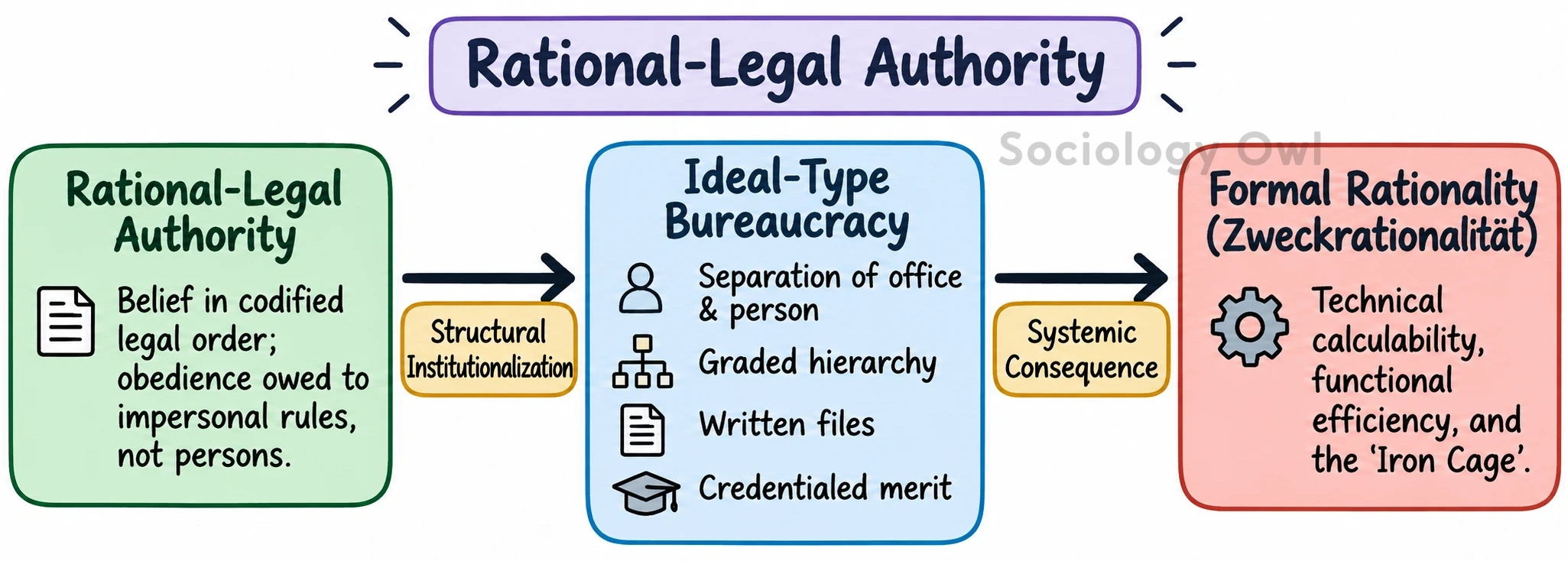
  • Rule-Bound Legitimacy: Power resides not in individuals, but in formally enacted, abstract laws. Administrative action is valid only because it adheres strictly to codified, predictable procedures.
  • Separation of Office and Incumbent: Rational legality decouples official jurisdictional duties from the person. Officials do not own their positions, resources, or the means of administration, preventing patrimonial corruption.
  • Sphere of Legal Competence: Authority is distributed as fixed official duties demarcated by impersonal statutes, establishing clear vertical lines of graded hierarchy, continuous supervision, and functional specialization.
  • Technical Qualification and Merit: Authority demands professionalised competence rather than charismatic favour or hereditary privilege; recruitment proceeds strictly via impersonal, competitive examinations and credentialed expertise.
  • Management by the ‘File’: Administrative operations rely exhaustively on written documents and records (Büro), institutionalising institutional memory and eliminating individual arbitrariness.
  • Supremacy of Formal Rationality: Authority prioritises instrumental calculability (Zweckrationalität), driving the administrative apparatus toward functional efficiency, formal egalitarianism, and Weber’s metaphorical iron cage.

Thus, rational-legal authority institutionalises impersonal domination, transforming administrative power into calculable, rule-bound, and structurally predictable bureaucratic organisation.

Q. How does Max Weber’s ‘theory of authority’ shape bureaucracy ? Analyse. Read More »
Q. In what way the concept of ‘patriarchal bargain’ be applied to the institution of marriage ? Comment.

Q. In what way the concept of ‘patriarchal bargain’ be applied to the institution of marriage ? Comment.

UPSC Sociology 2026 Paper 1

Model Answer:

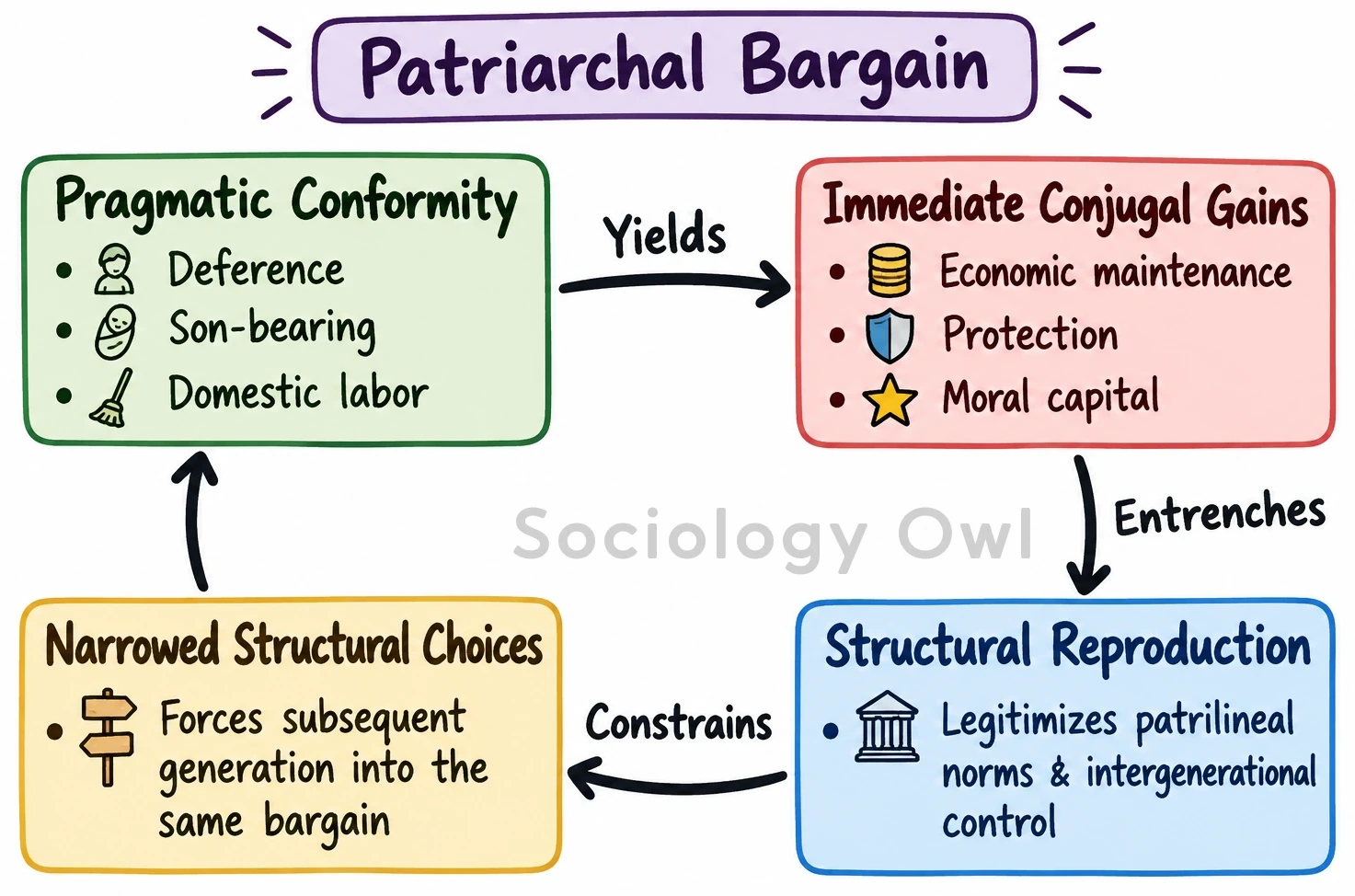
Coined by Deniz Kandiyoti, the patriarchal bargain describes the pragmatic strategies women deploy within patriarchal constraints to maximize security, influence, or autonomy by conforming to existing gender hierarchies.

Manifestations of Patriarchal Bargain in Conjugal Relations

  • Economic Security vs. Subordination: In patrilineal settings, women trade autonomy and unpaid domestic labor for lifelong economic maintenance and social legitimacy, accepting male headship to mitigate financial vulnerability.
  • Reproductive Bargaining and Son Preference: Bearing male heirs acts as a vital bargaining chip; a young wife secures conjugal leverage, elevated household status, and insurance against abandonment by fulfilling patriarchal kinship demands.
  • Intergenerational Power Cycle: Subordinate young brides endure control by mothers-in-law, actively buying into the system with the calculated expectation of wielding reciprocal domestic power over future daughters-in-law.
  • Modesty as Protective Capital: Strict adherence to norms of chastity, wifely deference, or seclusion (purdah) is leveraged as moral capital to prevent domestic abuse and preserve conjugal reputation.
  • Renunciation of Property Claims: Women often surrender formal natal inheritance rights to brothers to secure an emergency fallback kinship network in case of marital breakdown.
  • Compensatory Second Shift: Dual-earner wives often voluntarily undertake disproportionate care work to pacify masculine anxieties, trading extra domestic labor to maintain marital equilibrium.

Patriarchal bargains in marriage maximize short-term individual security while structurally entrenching institutionalized gender inequality across generations.

Q. In what way the concept of ‘patriarchal bargain’ be applied to the institution of marriage ? Comment. Read More »

Q. Explain the concept of ‘definition of the situation’ and its significance in sociology.

Q. Explain the concept of ‘definition of the situation’ and its significance in sociology.

UPSC Sociology 2026 Paper 1

Model Answer:

Formulated by W.I. Thomas and Dorothy Swaine Thomas in The Child in America (1928), the definition of the situation asserts that subjective interpretations of context precede and determine social action.

Conceptual Meaning and Sociological Significance

  • Subjective Mediation: Rejects deterministic stimulus-response models; human action is mediated by deliberation, wherein individuals assess circumstances before deciding how to act.
  • The Thomas Theorem: Expressed through the maxim, “If men define situations as real, they are real in their consequences,” highlighting that perceived realities generate concrete social outcomes.
  • Foundation of Symbolic Interactionism: Provided foundational scaffolding for Herbert Blumer and G.H. Mead, establishing that macro-structures are sustained only through ongoing, micro-level interpretive consensus.
  • Self-Fulfilling Prophecy: Directly influenced Robert K. Merton, who illustrated how an initially false definition (e.g., bank insolvency or ethnic prejudice) produces behaviors that make the misconception real.
  • Sociology of Deviance: Underpins Howard Becker’s Labeling Theory, showing that deviance is not an inherent property of an act, but a consequence of societal definitions applied to it.
  • Dramaturgical Negotiation: Informed Erving Goffman’s dramaturgical approach, where actors engage in impression management to foster and protect a shared “working consensus” of reality.

The concept decisively establishes subjective meaning-making as an autonomous, consequential driver of objective social structure and action.

Q. Explain the concept of ‘definition of the situation’ and its significance in sociology. Read More »

Q. The major challenge for sociology researchers is to analyze social reality objectively. Critically analyze.

Q. The major challenge for sociology researchers is to analyze social reality objectively. Critically analyze.

UPSC Sociology 2026 Paper 1

Model Answer:

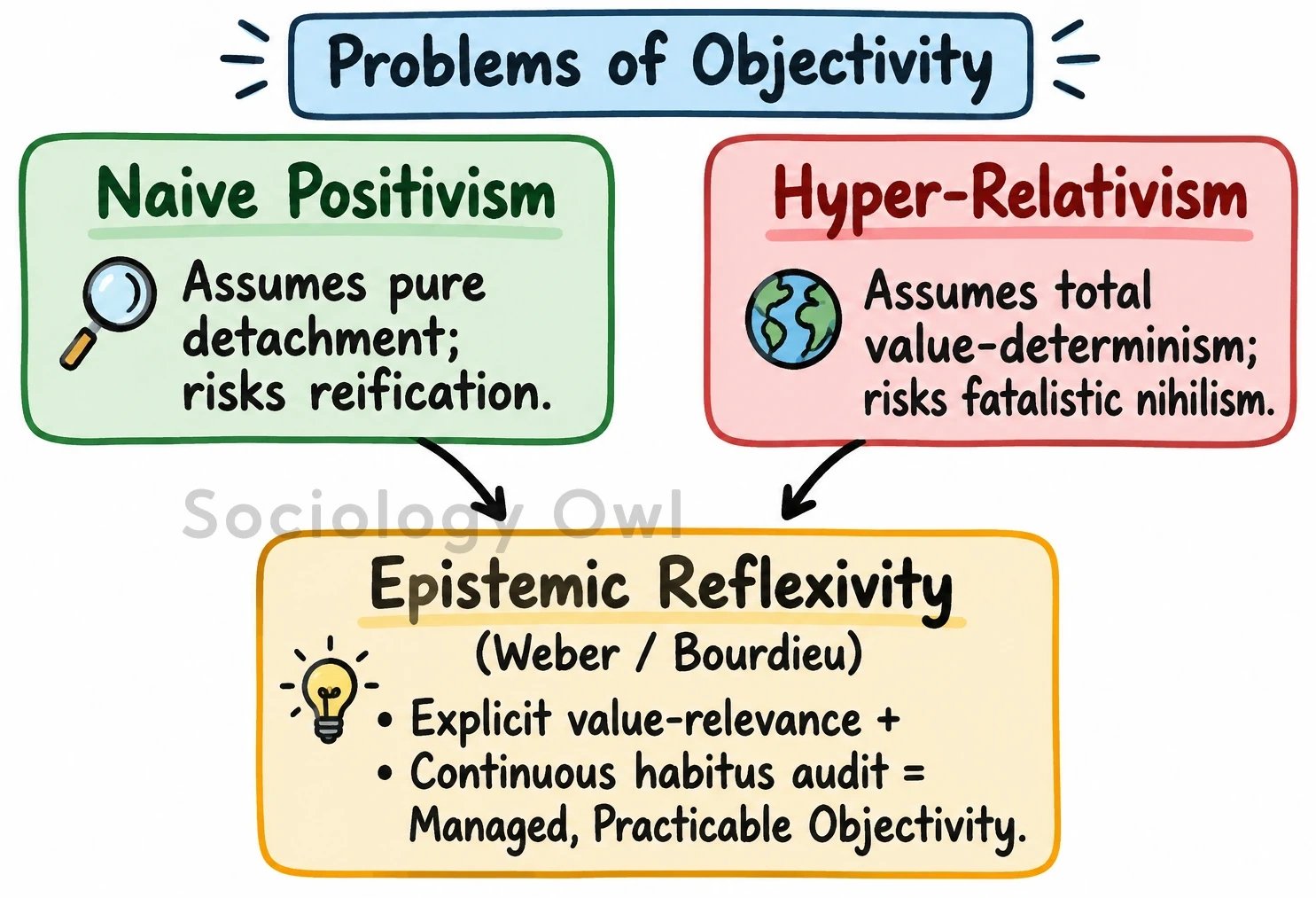
Objectivity—the pursuit of value-neutral empirical truth—remains sociology’s central methodological paradox because the researcher is an intrinsic participant within the very social fabric they seek to investigate.

Dilemmas in Capturing Objective Social Reality

  • Ontological Entanglement: Unlike inanimate natural phenomena, human subjects possess consciousness and assign meaning to actions, rendering pure external detachment conceptually inadequate, as Max Weber highlighted through Verstehen.
  • Value-Infiltration Across Research Phases: While value-freedom may be attempted during data collection, values inevitably dictate problem choice and hypothesis formulation (value-relevance), limiting absolute neutrality.
  • The Myth of Detached Neutrality: Gunnar Myrdal argued that total objectivity is a chimera; unstated biases are far more distortive than explicit, acknowledged presuppositions.
  • Positivist Reductionism: Emulating the natural sciences risks treating fluid social processes as static things, committing what Peter Berger and Thomas Luckmann call reification of socially constructed reality.
  • Ideological Hegemony: Critical theorists argue that institutionalized sociological research often uncritically adopts ruling-class categories, masking systemic power dynamics under the guise of “objective” science.
  • The Reflexive Solution: Rather than pursuing unattainable neutrality, Pierre Bourdieu proposed epistemic reflexivity, where researchers systematically interrogate their own social position, field biases, and academic habitus.


Objectivity in sociology is not absolute detachment, but conscious methodological reflexivity that rigorously recognizes and manages researcher subjectivity.

Q. The major challenge for sociology researchers is to analyze social reality objectively. Critically analyze. Read More »

Q. ‘The methods of sociology are inadequate in understanding the complex social phenomena’. Discuss.

Q. ‘The methods of sociology are inadequate in understanding the complex social phenomena’. Discuss.

UPSC Sociology 2026 Paper 1

Model Answer:

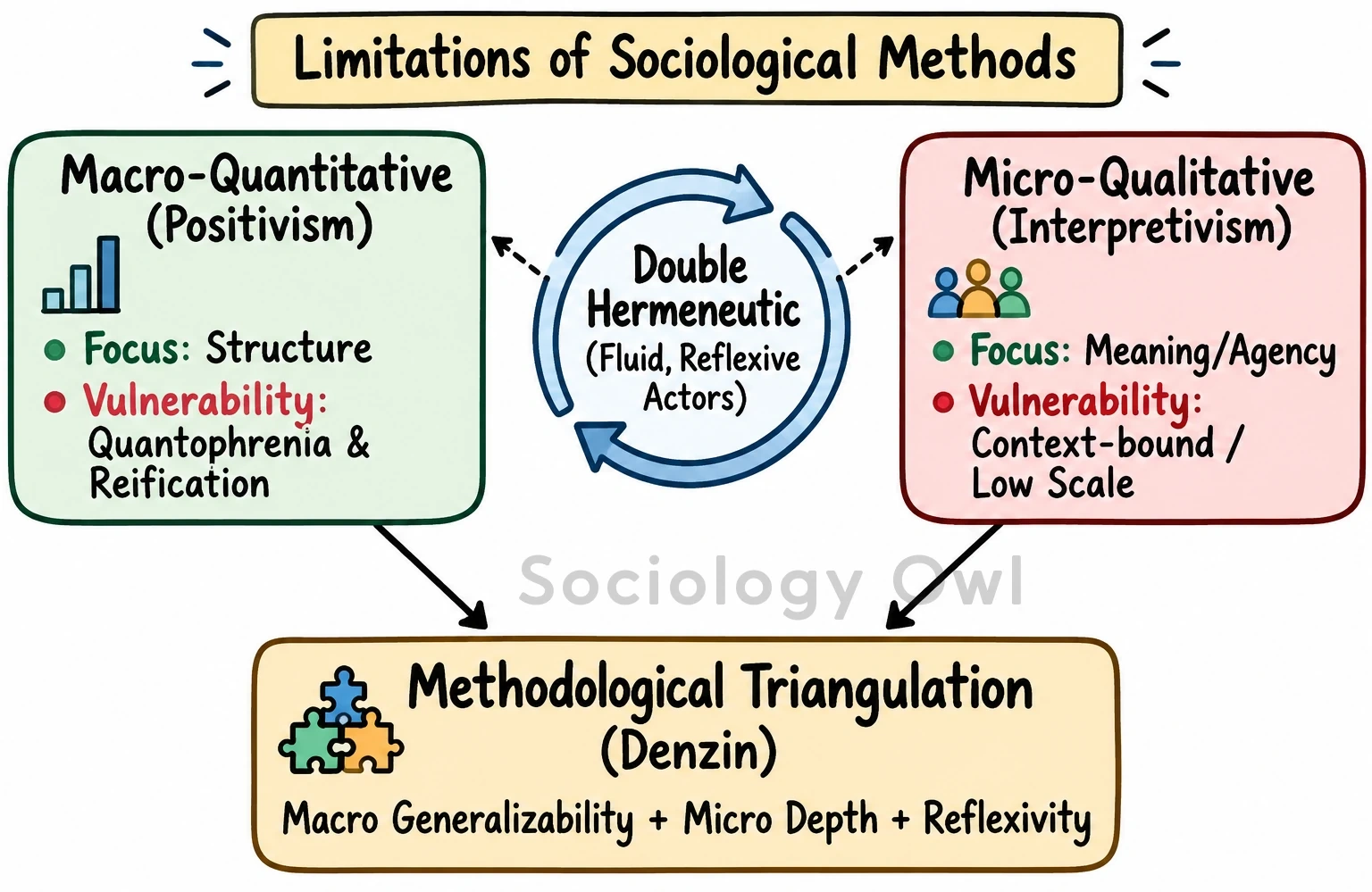
Sociology faces an ontological paradox: investigating fluid, self-interpreting human actors and intricate social structures using research instruments derived largely from either natural science models or interpretive frameworks.

Methodological Dilemmas in Capturing Social Complexity

  • Quantophrenia and Positivist Reductionism: Statistical surveys and quantitative indicators frequently reify dynamic social life, compressing nuanced human experiences into rigid variables, a flaw Pitirim Sorokin termed “quantophrenia.”
  • The Double Hermeneutic: Unlike inert natural matter, social actors reflexively absorb, interpret, and alter their behavior based on sociological findings, creating what Anthony Giddens identified as an inherently moving, unstable target of inquiry.
  • Micro-Macro Epistemic Schism: Sociological methods remain structurally bifurcated; deep immersion methods like ethnography sacrifice representative generalizability, whereas macro-surveys overlook individual meaning, agency, and context.
  • Observer Effect and Reflexive Limits: The presence of the sociologist inevitably distorts natural settings (Hawthorne effect), while absolute Value Freedom, as cautioned by Max Weber, remains compromised by unconscious investigator biases.
  • Fragmentation of Late Modernity: Postmodernists like Jean-François Lyotard argue that conventional universal methodologies and metanarratives are incapable of mapping increasingly non-linear, hyper-fragmented, and pluralistic contemporary realities.
  • Pragmatic Triangulation as Counter-Strategy: Rather than absolute inadequacy, methods evolve; Norman Denzin’s framework of methodological triangulation demonstrates that combining qualitative depth with quantitative rigor substantially bridges this explanatory deficit.

Sociological methods are not inherently inadequate, but require continual reflexivity and triangulation to navigate human society’s evolving complexity.

Q. ‘The methods of sociology are inadequate in understanding the complex social phenomena’. Discuss. Read More »

Q. Evaluate the socio-economic impacts of migration on rural households.

Q. Evaluate the socio-economic impacts of migration on rural households.

UPSC Sociology 2026 Paper 1

Model Answer:

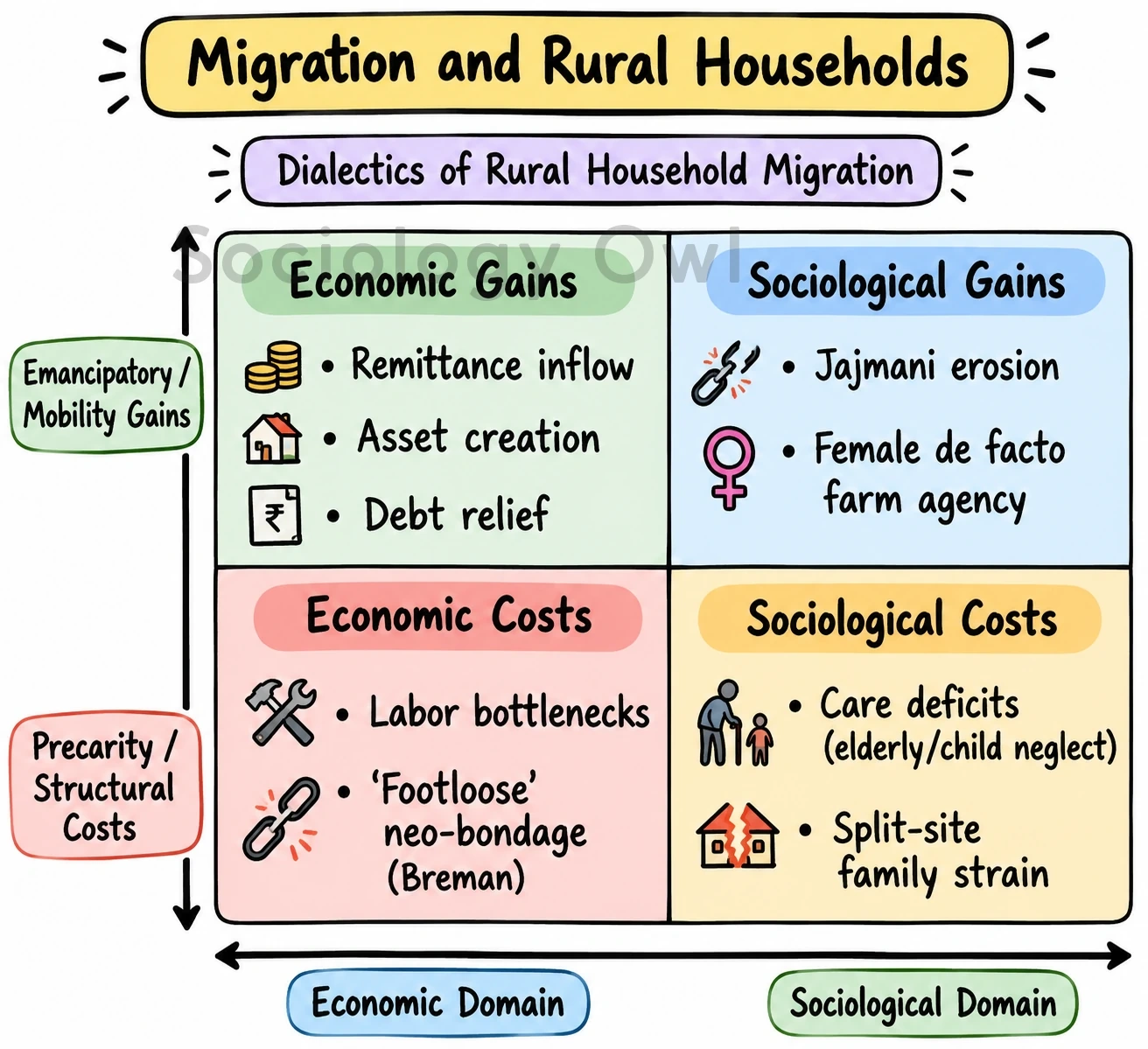
Migration functions as a vital household livelihood strategy, operating simultaneously as a mechanism for socio-economic mobility and a symptom of rural agrarian distress.

Economic Transformations and Household Precarity

  • Remittance Economy and Asset Formation: Financial transfers enhance rural household consumption, debt repayment, and investments in housing and education, stabilizing subsistence levels against agricultural shocks.
  • De-agrarianization and Farm Management: Male out-migration causes seasonal labor deficits, escalating farm wages and often leading to agricultural fallowing or forced capital-intensive mechanization.
  • Intra-Village Inequality: As Michael Lipton observes, migration often deepens rural class polarization; well-endowed households access lucrative formal migration, while marginal households remain trapped in precarious survivalist mobility.
  • Circuits of Indebtedness: For marginalized castes, Jan Breman highlights that circular migration fosters “footloose labour,” wherein advances from labor contractors trap households in cycles of neo-bondage rather than asset creation.

Sociological Reconfigurations: Gender, Caste, and Kinship

  • Feminization of Agriculture: Male absence transfers farm management to women, enhancing de facto decision-making agency while disproportionately intensifying their unpaid labor and reproductive burdens.
  • Disruption of Agrarian Hierarchies: Urban earnings liberate lower-caste households from traditional jajmani dependencies and local upper-caste patron-client control, eroding traditional village dominance.
  • The Rural Care Deficit: Selective out-migration leaves elderly dependents and children isolated, straining traditional filial safety nets and generating acute emotional precarity.
  • Restructuring Family Morphology: The traditional joint family fragments into split-site households, renegotiating patriarchal surveillance and altering kinship obligations across geographical distances.

Migration functions as an engine of rural household mobility, simultaneously generating remittances while deepening structural care deficits and precarity.

Q. Evaluate the socio-economic impacts of migration on rural households. Read More »

Q. Elaborate major sociological theories of power. How do power elite shape the political process in modern societies ?

Q. Elaborate major sociological theories of power. How do power elite shape the political process in modern societies ?

UPSC Sociology 2026 Paper 1

Model Answer:

Sociologically, power is the structural capacity to enforce decisions, command compliance, and shape social realities, spanning zero-sum domination, collective facilities, and pervasive institutional control.

Major Sociological Perspectives on Power

  • Zero-Sum Coercive Model: Max Weber conceptualises power (Macht) as the capacity to realise one’s will against resistance, which becomes stable domination when institutionalised as legitimate authority (Herrschaft).
  • Class-Domination Perspective: Karl Marx grounds power in the economic base; ownership of the forces of production enables the ruling class to instrumentalise the state for surplus extraction.
  • Variable-Sum Functionalist Model: Talcott Parsons views power as a positive-sum circulating resource within the polity, functioning like money to facilitate collective goal attainment.
  • Pluralist Model: Robert Dahl posits that power in modern polyarchies is dispersed across competing interest groups, preventing monopolistic political dominance.
  • Discursive and Capillary Power: Michel Foucault rejects top-down state-centric views, demonstrating that power is omnipresent, relational, and embedded in everyday institutional power-knowledge regimes.

Mechanisms of Political Control by the Power Elite

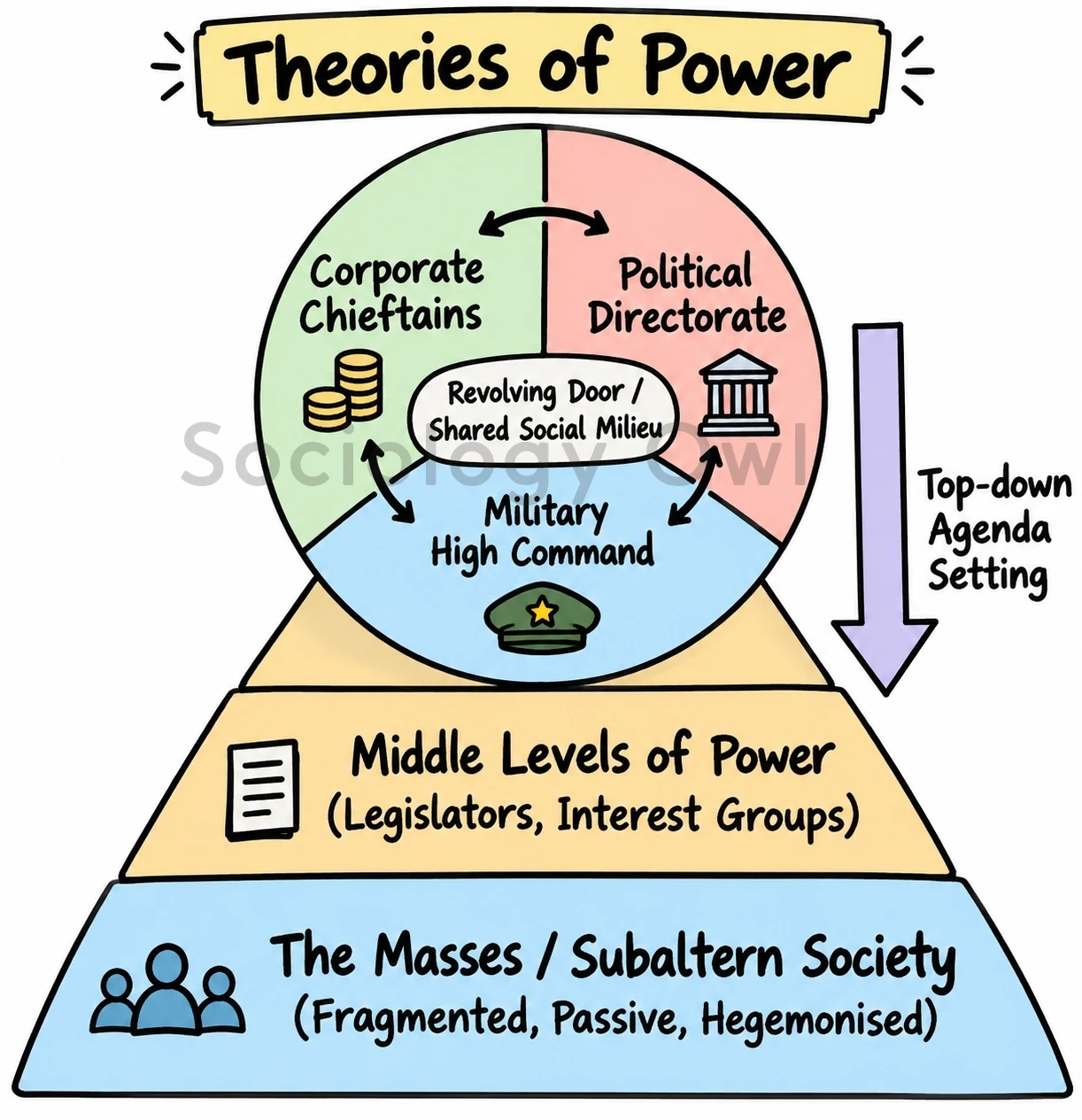
  • Institutional Interlocking: C. Wright Mills in The Power Elite argues that corporate directors, high-ranking politicians, and military leaders share a common social background, fusing into a cohesive decision-making triumvirate.
  • The “Revolving Door” Dynamic: Elite actors transition seamlessly between corporate boardrooms, regulatory agencies, and cabinet positions, systematically shaping industrial policy to elite interests.
  • Agenda Setting and Non-Decision Making: Peter Bachrach and Morton Baratz show that elites exercise power by suppressing anti-capitalist or redistributive issues from entering legislative discourse.
  • Electoral Financing and Lobbying: Concentrated corporate wealth dictates electoral outcomes through campaign contributions and think tanks, functionally filtering legislative priorities before citizens vote.
  • Cultural and Media Hegemony: Media ownership allows the elite to manufacture ideological consensus (Antonio Gramsci), depoliticising subaltern classes by framing elite interests as universal societal goals.

The power elite subtly subvert formal democracy, rendering political processes instruments of concentrated institutional dominance rather than popular sovereignty.

Q. Elaborate major sociological theories of power. How do power elite shape the political process in modern societies ? Read More »

Q. How does Emile Durkheim conceptualize religion as a ‘social fact’ ? Explain.

Q. How does Emile Durkheim conceptualize religion as a ‘social fact’ ? Explain.

UPSC Sociology 2026 Paper 1

Model Answer:

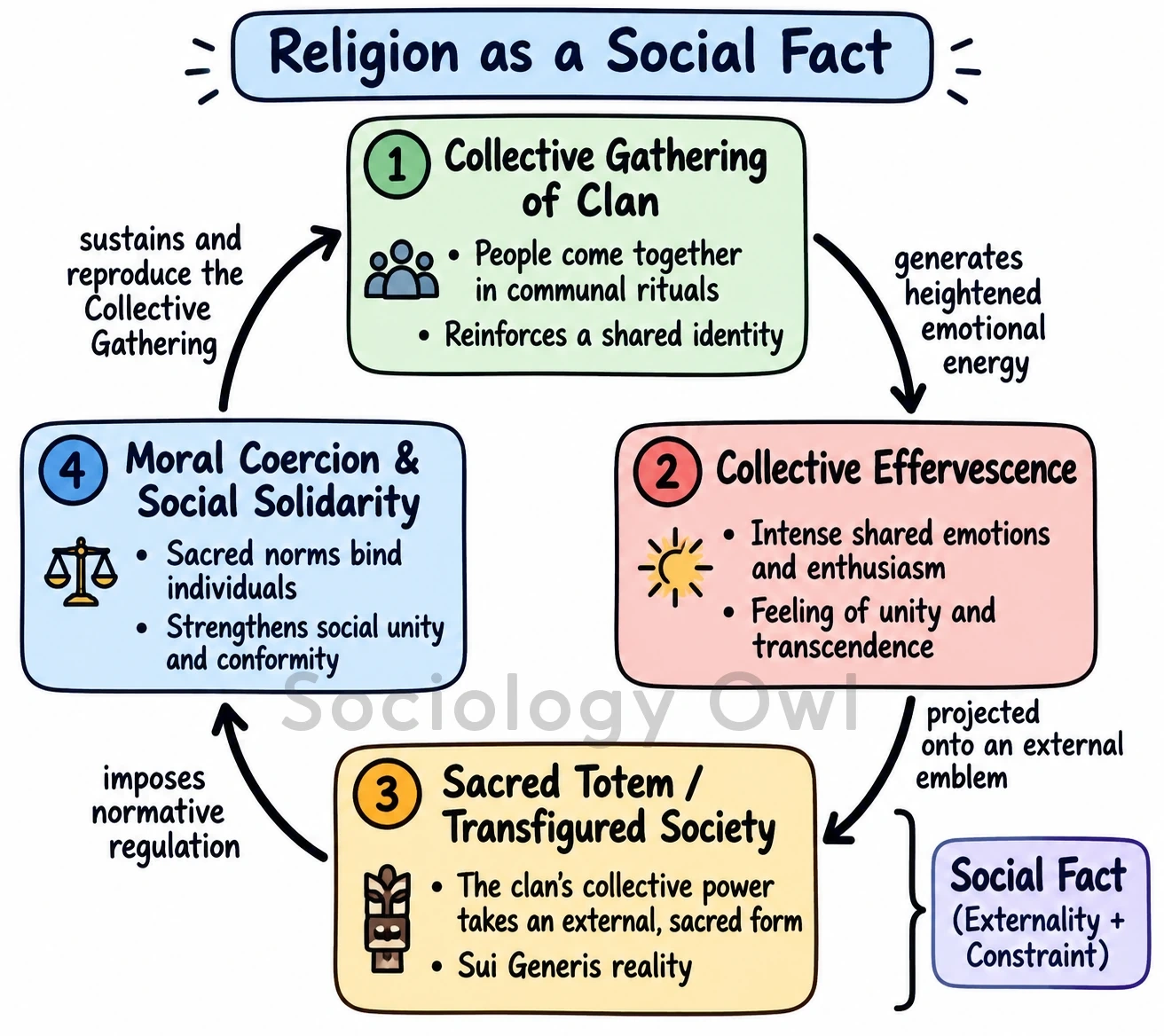
In The Elementary Forms of the Religious Life, Emile Durkheim conceptualizes religion not as divine revelation or psychological illusion, but as a social fact—an objective, observable reality characterized by externality, coercive power, and a collective existence sui generis.

Durkheim’s Conceptualization of Religion as a Social Fact

  • Externality and Pre-existence: Religious dogmas, rites, and symbols exist prior to the individual, transmitted across generations through socialization rather than personal invention.
  • Moral Constraint and Coercion: Prescriptions, taboos, and ethical codes exert moral force over the individual, disciplining egoistic impulses to maintain normative order.
  • The Sacred-Profane Dichotomy: Society categorizes the universe into the sacred (extraordinary, revered) and the profane (mundane, utilitarian), reflecting social valuations rather than intrinsic material properties.
  • Society Worshiping Itself: Analyzing Australian Arunta totemism, Durkheim argues the sacred totem simultaneously represents the clan and the deity; God is simply society transfigured.
  • Collective Effervescence: Religious fervor is generated during collective gatherings, where heightened emotional energy suspends individuality and reinforces the collective consciousness.
  • Institutionalization into a Church: Unlike magic, which remains an individual transaction, religion inherently creates a single moral community bound by shared beliefs and institutionalized practices.


Ultimately, Durkheim establishes that religious reality is social reality, functioning as society’s vital symbolic mechanism for self-preservation and collective solidarity.

Q. How does Emile Durkheim conceptualize religion as a ‘social fact’ ? Explain. Read More »

Q. Is ‘interpretativism’ more effective than ‘positivism’ in analysing social reality ? Discuss.

Q. Is ‘interpretativism’ more effective than ‘positivism’ in analysing social reality ? Discuss.

UPSC Sociology 2026 Paper 1

Model Answer:

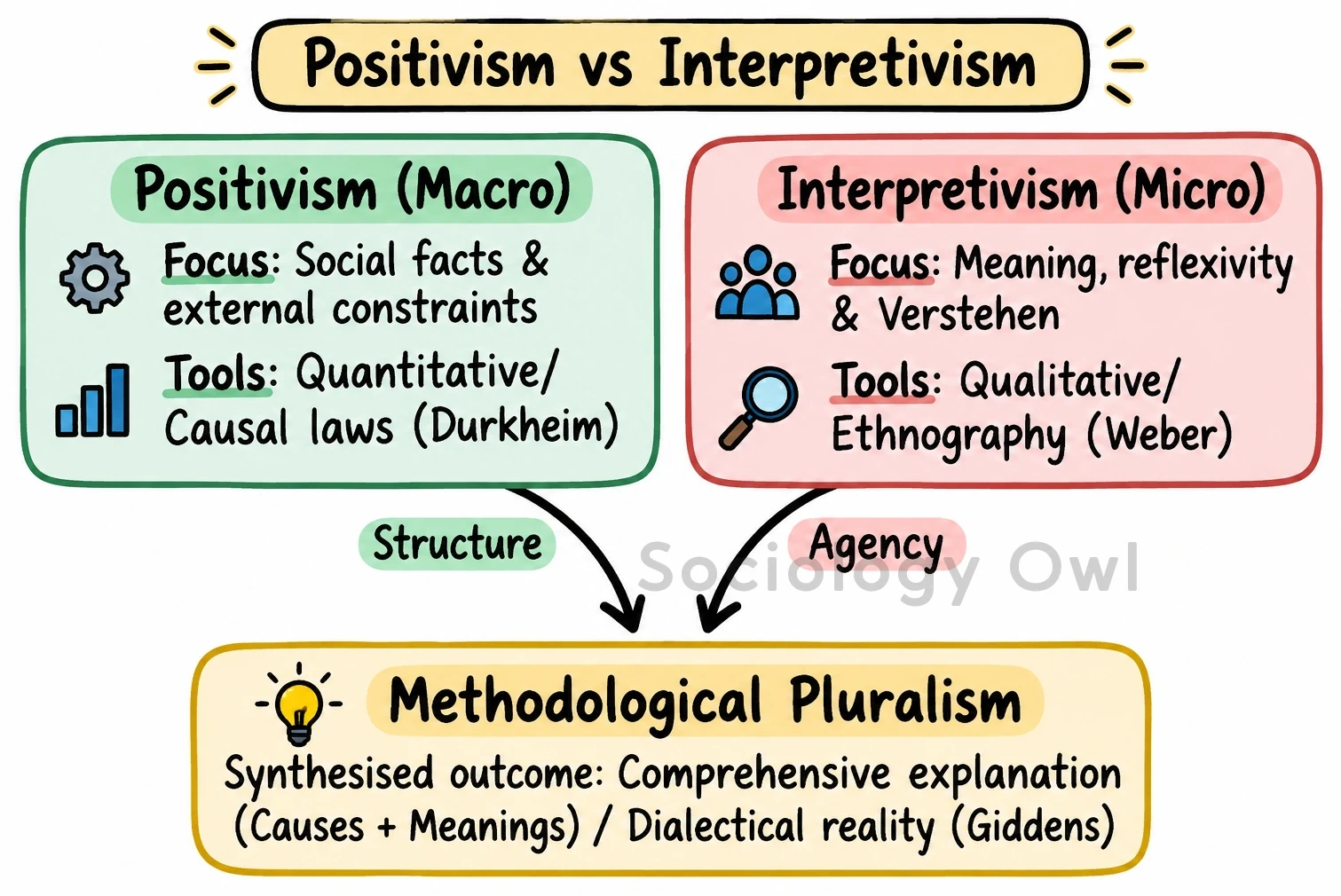
The debate between positivism and interpretivism stems from divergent ontologies: whether society is an objective, law-governed system or an intersubjectively constructed web of human meanings.

Epistemological Superiority of Interpretivism

  • Internal Meaning vs External Causation: Unlike inert natural matter, human behaviour is driven by conscious motives; Max Weber argues that sociology must prioritize Verstehen (interpretative understanding) over pure statistical correlation.
  • The Double Hermeneutic: Anthony Giddens emphasizes that social actors reflexively interpret their environment; interpretivism treats humans as active agents rather than passive cultural dopes responding mechanically to structural stimuli.
  • Anti-Reification of Institutions: Peter Berger and Thomas Luckmann demonstrate that social structures are fluid social constructs; interpretivism avoids the positivist fallacy of treating human institutions as immutable natural facts.
  • Capturing the Life-World: Alfred Schutz highlights the importance of the intersubjective life-world (Lebenswelt), uncovering common-sense typifications and micro-realities that macro-level surveys systematically miss.
  • Symbolic Mediation: Symbolic interactionists like Herbert Blumer show that human action is mediated by continuous interpretive processes, rendering deterministic stimulus-response models inadequate for social reality.
  • Ecological Validity: Qualitative methods (e.g., participant observation) preserve natural contexts, capturing lived experiences and unexpected nuances that artificial, standardized indicators flatten.

Structural Blind Spots and Positivism’s Indispensability

  • The Voluntaristic Trap: By overemphasizing micro-meanings, interpretivism risks subjective reductionism, ignoring pervasive macro-coercive structures like class, caste, and global capitalism.
  • Structural Constraints: Émile Durkheim demonstrated in Suicide that social facts exert sui generis external constraints, revealing macro-level causal regularities that micro-interpretive accounts cannot explain.
  • Methodological Relativism: Lacking standardized instruments of verification, interpretivist accounts suffer from low replicability and high vulnerability to researcher bias.
  • Policy and Scalability: State planning, redistributive welfare, and demographic tracking require generalizable, aggregated quantitative data that interpretivist ethnographies cannot generate at scale.
  • Masking False Consciousness: Interpretivism relies heavily on actors’ stated perceptions, often failing to pierce ideological mystification or systemic power asymmetries that actors take for granted.

Neither paradigm holds absolute superiority; robust sociology demands methodological pluralism, synthesising structural regularities with subjective meanings.

Q. Is ‘interpretativism’ more effective than ‘positivism’ in analysing social reality ? Discuss. Read More »

Q. Discuss the relationship between religion and science in modern society. Do they necessarily remain in conflict ?

Q. Discuss the relationship between religion and science in modern society. Do they necessarily remain in conflict ?

UPSC Sociology 2026 Paper 1

Model Answer:

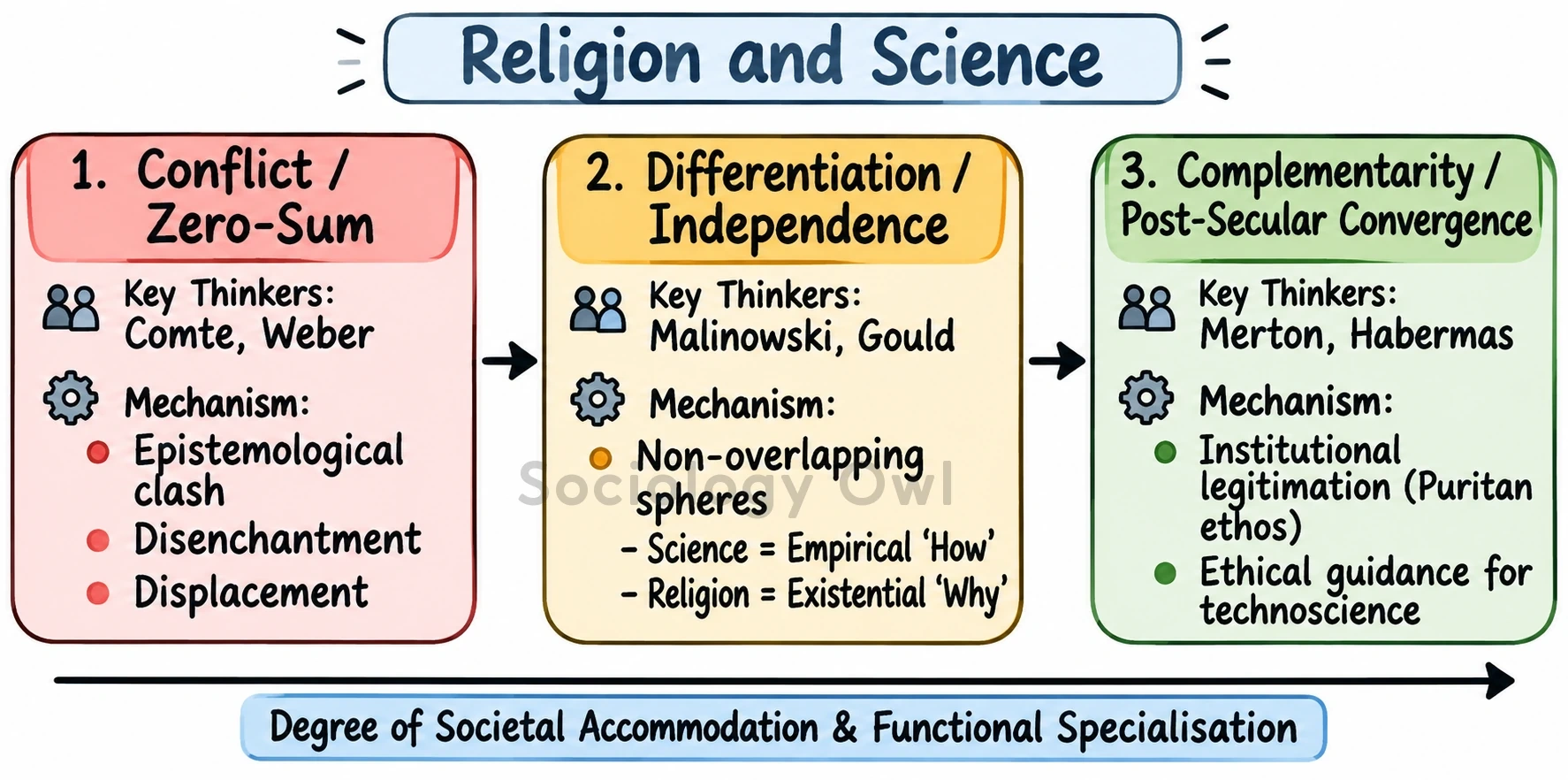
Religion and science represent two fundamental ways of making sense of reality—one grounded in transcendent faith and existential meaning, the other in empirical observation and falsifiability. While early modern thought posited their relationship as an irreconcilable zero-sum conflict, contemporary sociology views their interaction as a nuanced continuum ranging from institutional tension to mutual accommodation.

The Conflict Thesis: Epistemological and Structural Friction

  • Disenchantment of the World: Max Weber argued that the advance of scientific rationalisation produces entzauberung (disenchantment), progressively stripping nature of magical and sacred qualities in favour of technical calculability.
  • Evolutionary Displacement: Positivists like Auguste Comte conceptualised social evolution through the law of three stages, asserting that the scientific-positive epoch inevitably replaces theological orthodoxy.
  • Epistemological Incommensurability: Science operates on institutionalised scepticism, fallibility, and empirical verification, which fundamentally clashes with religion’s reliance on revelation, dogma, and the inviolability of the sacred.
  • Contestation Over Plausibility Structures: As Peter Berger observed, scientific hegemony fractures the singular sacred canopy, transforming religious truth from an objective societal given into a privatised, contested cognitive choice.
  • Jurisdictional Clashes: Recurrent public disputes over evolutionary biology, reproductive technologies, and stem-cell research demonstrate persistent friction where scientific capability breaches traditional theological moral boundaries.

Beyond Conflict: Differentiation, Complementarity, and Convergence

  • Non-Overlapping Magisteria: Sociologists and philosophers note that conflict arises only when boundaries blur; functionally, science explains how the material universe works, whereas religion interprets why humans exist within it.
  • Institutional Symbiosis: In Science, Technology and Society in Seventeenth-Century England, Robert K. Merton demonstrated that the ascetic Puritan ethos historically legitimated and accelerated the institutionalisation of modern empirical science.
  • Functional Differentiation: Bronislaw Malinowski emphasised that rational-empirical knowledge and sacred rituals satisfy distinct human imperatives; science provides practical mastery over the environment, while religion manages existential anxiety, theodicy, and tragedy.
  • Cognitive Compartmentalisation: Modern individuals seamlessly practice selective rationalisation, deploying scientific methodologies in the technocratic sphere while maintaining orthodox religious affiliations for personal identity and community solidarity.
  • Post-Secular Reflexivity: Jürgen Habermas suggests that in a post-secular society, unbridled scientism requires the normative, ethical vocabulary of religious traditions to guide contentious dilemmas surrounding artificial intelligence and genetic engineering.

Rather than an inevitable conflict, modern society witnesses functional differentiation, where science provides instrumental mastery and religion addresses ultimate meaning.

Q. Discuss the relationship between religion and science in modern society. Do they necessarily remain in conflict ? Read More »