2026 Sociology Paper 2

Q. According to you, which social reform had long-lasting impact on a specific section of society? Support your answer with suitable example.

Q. According to you, which social reform had long-lasting impact on a specific section of society? Support your answer with suitable example.

UPSC Sociology 2026 Paper 2

Model Answer:

Social reforms in India fundamentally transitioned marginalized groups from ritual subjugation to egalitarian citizenship. The most enduring among these was Dr. B.R. Ambedkar’s rights-based social reform movement targeting the Depressed Classes (Dalits), crystallised historically through the Mahad Satyagraha (1927).

Transformative Impact of Ambedkarite Reforms on Dalits: The Mahad Legacy
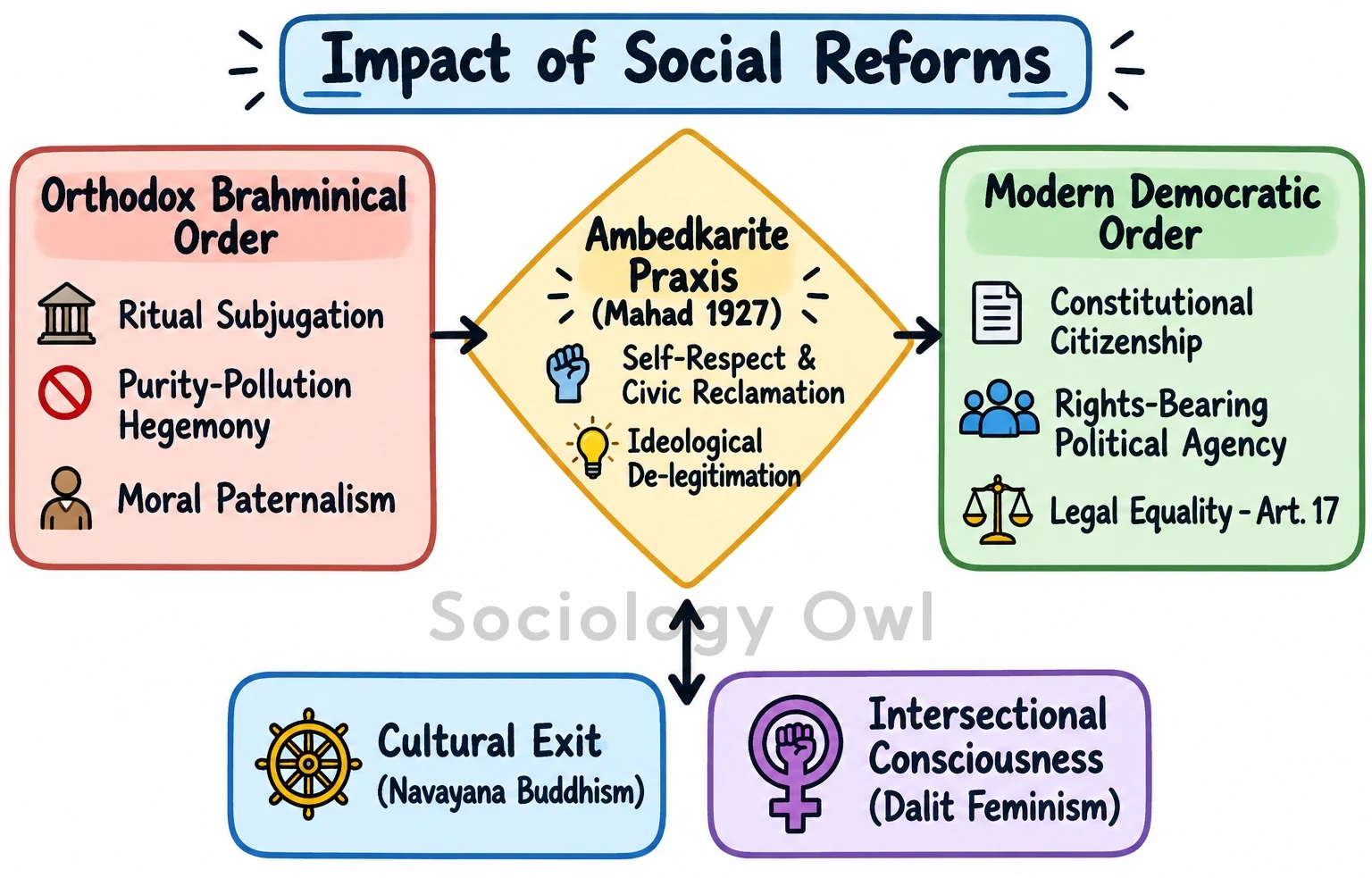
  • Reclaiming Civic Space: By asserting the right to draw water from the public Chawdar Tank, the movement shattered the orthodox spatial segregation governed by the purity-pollution binary (Louis Dumont).
  • Agency over Paternalism: It decisively supplanted Gandhian moral benevolence (Harijan upliftment) with self-respect, self-help, and an autonomous, rights-bearing political agency.
  • Ideological De-legitimation: The symbolic burning of the Manusmriti struck at the metaphysical roots of caste hierarchy, attacking the ideological legitimacy of graded inequality.
  • Constitutional Institutionalisation: Agitational reform transformed directly into formal governance, laying the groundwork for Article 17 (abolition of untouchability) and institutionalized compensatory discrimination.
  • Cultural Counter-Hegemony: It laid the trajectory for the 1956 conversion to Navayana Buddhism, providing Dalits with an institutional exit from the Brahminical symbolic order.
  • Emergence of Dalit Feminism: It galvanized lower-caste women to discard caste-coded markers of servility and embrace education, cultivating an intersectional consciousness (Sharmila Rege).

Ambedkarite reform permanently transformed Dalits from passive, ritually excluded subjects into an assertive, self-determining constitutional collective.
Q. According to you, which social reform had long-lasting impact on a specific section of society? Support your answer with suitable example. Read More »

Q. In the context of women’s movements and laws do you think that matriarchy is the need of the hour? Discuss in detail.

Q. In the context of women’s movements and laws do you think that matriarchy is the need of the hour? Discuss in detail.

UPSC Sociology 2026 Paper 2

Model Answer:

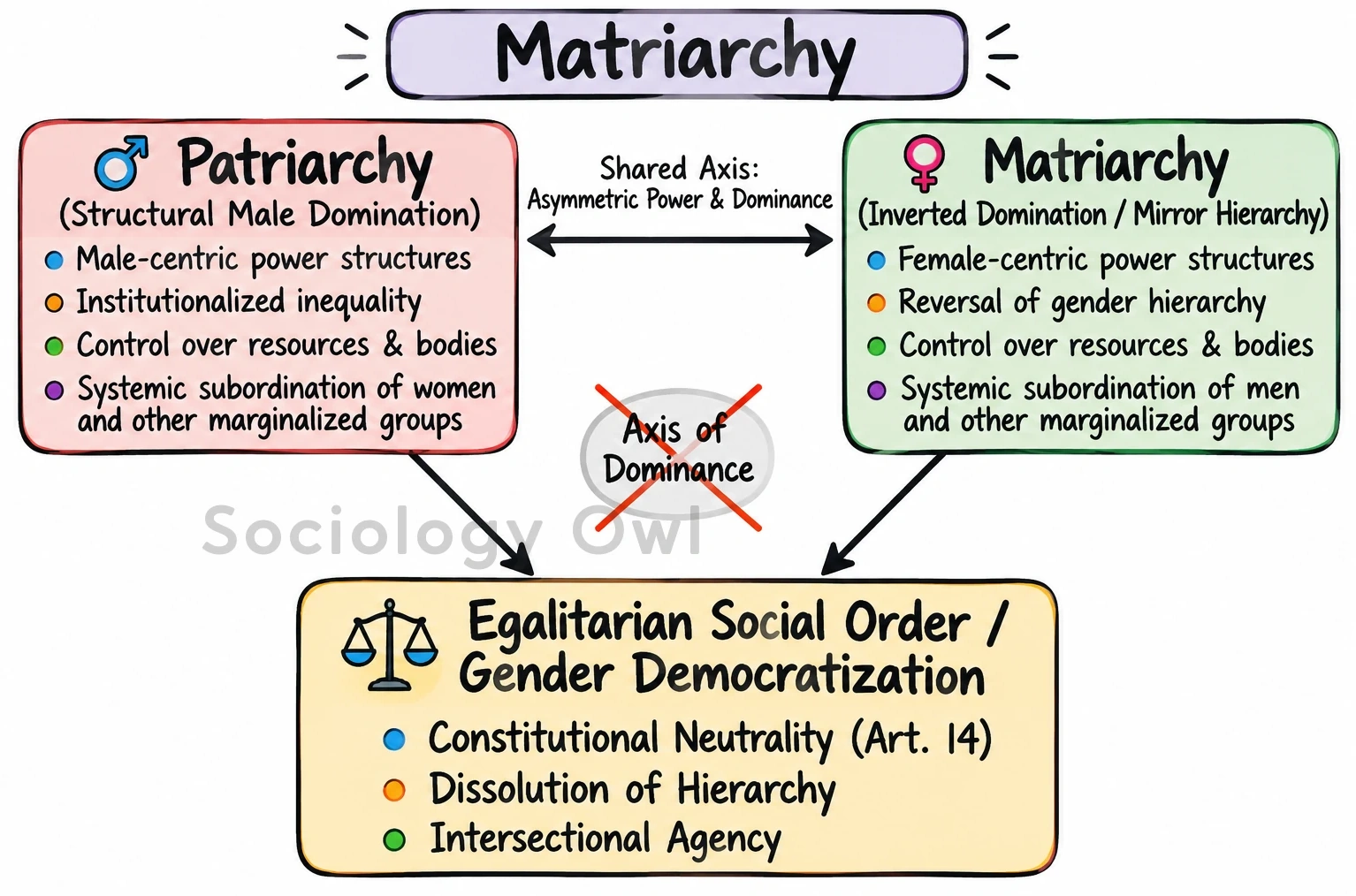
Matriarchy implies systemic female dominance. However, Indian women’s movements and progressive legal reforms fundamentally pursue an egalitarian gender order, aiming to eradicate structural hierarchy rather than invert patriarchal domination.

Deconstructing Matriarchy: Equality Over Inverted Domination

  • Anthropological Reality vs. Myth: As Leela Dube observed, matriliny is not matriarchy; even among the Khasi, Tiplut Nongbri highlights that maternal uncles hold authority, proving female descent rarely equates to female political dominance.
  • Philosophical Goal of Women’s Movements: As documented by Neera Desai, women’s struggles in India reject hegemonic control altogether, seeking female agency, bodily autonomy, and freedom from violence rather than female supremacy over men.
  • Constitutional and Legal Ethos: Landmark reforms like the Hindu Succession (Amendment) Act, 2005 and workplace protection laws operationalize gender neutrality and constitutional equality under Article 14, not gynocentric dominance.
  • Perpetuation of Hierarchical Logic: Substituting matriarchy for patriarchy merely preserves the grammar of domination; true emancipation lies in dissolving power asymmetries across domestic and public spheres.
  • Intersectional Complexities: Indian society experiences cross-cutting hierarchies of caste, tribe, and class; matriarchy cannot resolve Dalit or Adivasi women’s marginalization without dismantling wider socioeconomic structures.
  • Substantive Equality as the True Need: The genuine need of the hour is gender democratization, involving equitable distribution of unpaid care work, universal social security, and non-discriminatory institutional representation.

The need is not matriarchy, but dismantling gender hierarchies to build an egalitarian, inclusive, and democratized social order.

Q. In the context of women’s movements and laws do you think that matriarchy is the need of the hour? Discuss in detail. Read More »

Q. Discuss the debates on the concepts ‘duty’ and ‘worship’ while understanding religion in India.

Q. Discuss the debates on the concepts ‘duty’ and ‘worship’ while understanding religion in India.

UPSC Sociology 2026 Paper 2

Model Answer:

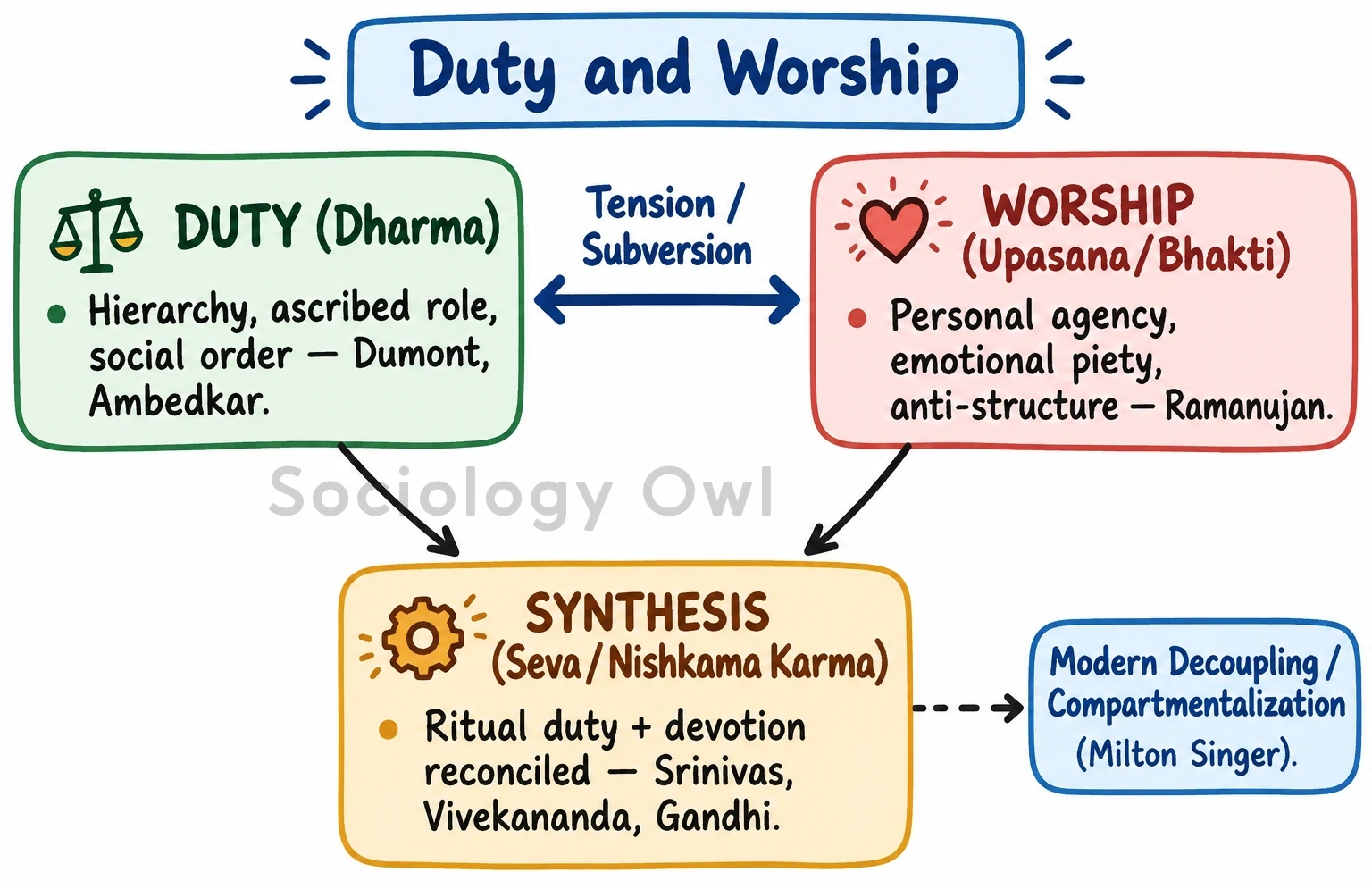
In Indian sociology, religion extends beyond personal belief, navigating a complex tension between Dharma (structural-moral duty) and Upasana/Bhakti (devotional worship and ritualism).

Debates on Duty and Worship in the Sociology of Indian Religion

  • Cosmic Order versus Devotion: Louis Dumont observed that classical Hinduism prioritizes svadharma (caste-bound duty) over individual worship, subordinating personal religiosity to the hierarchical preservation of cosmic order (Rta).
  • Bhakti as Subversion of Hereditary Duty: Thinkers like A.K. Ramanujan highlight that Bhakti movements democratized religion by rejecting caste-ascribed duties, replacing Brahminical orthopraxy with unmediated, egalitarian personal worship.
  • Structural-Functional Integration: M.N. Srinivas in Religion and Society among the Coorgs demonstrated that ritual worship (puja) and ancestral rites actively reinforce kinship duties, harmonizing personal devotion with collective solidarity.
  • Subaltern and Dalit Critique: B.R. Ambedkar argued that sacred ‘duty’ was engineered to legitimize graded inequality, advocating a transition from ritual worship to universal ethical morality (Dhamma).
  • Modern Ethical Synthesis: Reformers like Swami Vivekananda and Mahatma Gandhi redefined worship by merging it with duty, popularizing Seva (selfless service) and Nishkama Karma as the highest forms of religious devotion.
  • Contemporary Compartmentalization: In modern India, Milton Singer noted that while devotional worship proliferates through commodified, ostentatious rituals, it increasingly operates decoupled from traditional social and civic duties.

While duty traditionally enforces structural hierarchy, worship continuously offers transformative avenues for individual agency, ethical renewal, and social resistance.

Q. Discuss the debates on the concepts ‘duty’ and ‘worship’ while understanding religion in India. Read More »

Q. How does the concept ‘secular’ go beyond any religion in plural society like India? Analyse.

Q. How does the concept ‘secular’ go beyond any religion in plural society like India? Analyse.

UPSC Sociology 2026 Paper 2

Model Answer:

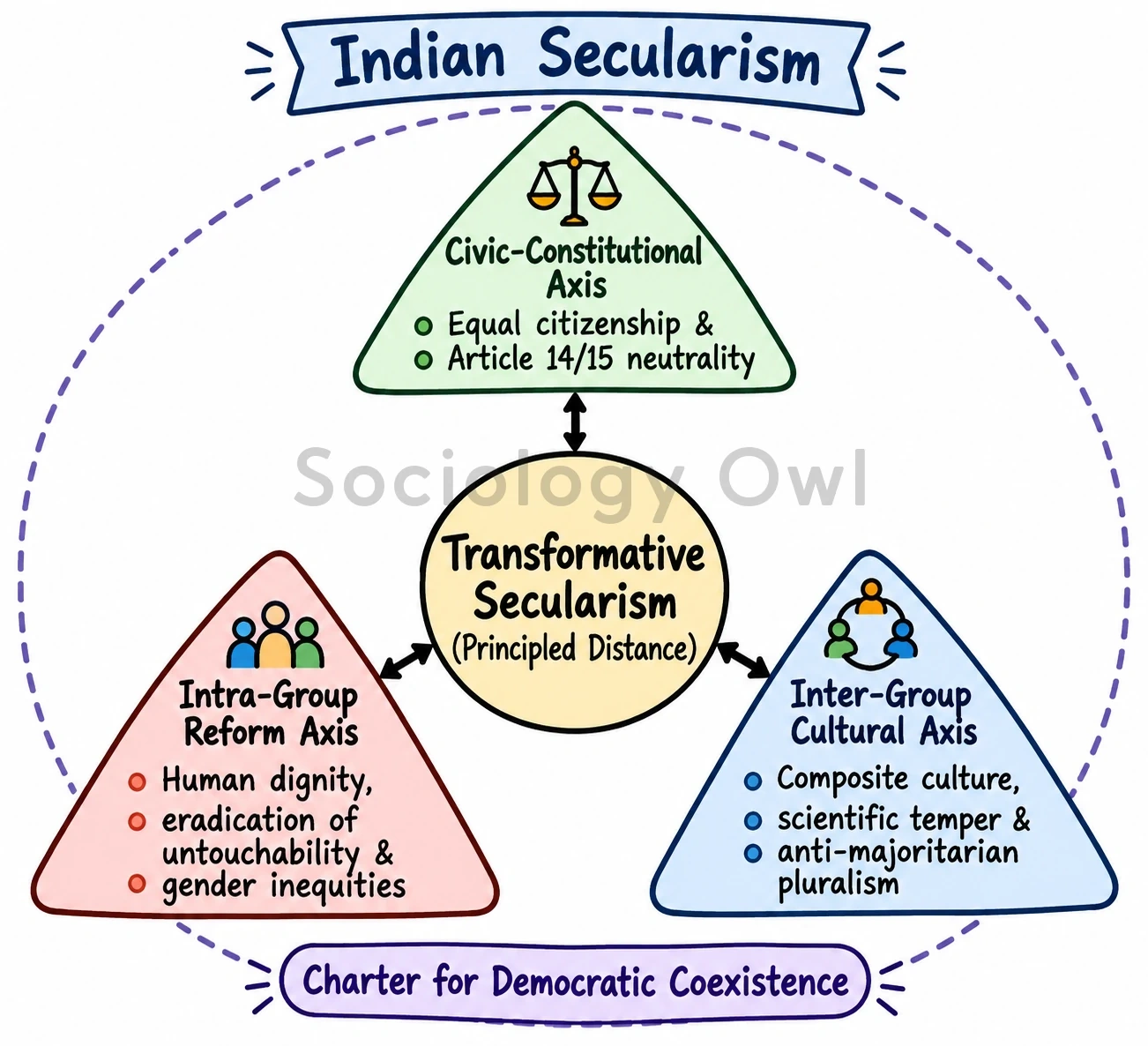
In India’s plural matrix, secularism is not merely the Western doctrine of church-state separation, but a transformative vision of social justice, constitutional morality, and universal citizenship.

Dimensions of ‘Secular’ Transcending Religious Boundaries


  • Universality of Citizenship: It grounds civic membership in equal constitutional rights (Articles 14 and 15), delinking political agency and civil entitlements from primordial or faith-based identities.
  • Social Emancipation and Reform: It empowers the state to dismantle intra-religious inequalities, such as caste-based untouchability and gender discrimination, prioritizing individual human dignity over religious dogma.
  • Principled Distance: As Rajeev Bhargava conceptualizes, state intervention or non-intervention is guided by non-sectarian commitments to liberty and equality, rather than strict theological neutrality.
  • Cultivation of Public Reason: By championing a scientific temper (Article 51A(h)), secularism fosters critical inquiry and civic rationality, liberating the public sphere from metaphysical orthodoxy.
  • Nurturing Composite Culture: It validates syncretic traditions and shared everyday spaces, transcending rigid theological boundaries to sustain India’s historic civilizational pluralism.
  • Counterweight to Majoritarianism: It acts as an institutional bulwark against cultural homogenization, securing plural lifeworlds and democratic rights for diverse socio-cultural minorities.

Thus, Indian secularism operates as a broader charter for democratic coexistence, prioritizing human dignity and egalitarian justice over theological dictates.

Q. How does the concept ‘secular’ go beyond any religion in plural society like India? Analyse. Read More »

Q. Indological approach, advocated by G. S. Ghurye, focuses on the study of Indian society through Indian texts. How can Indological approach be useful in the study of other society? Comment in detail.

Q. Indological approach, advocated by G. S. Ghurye, focuses on the study of Indian society through Indian texts. How can Indological approach be useful in the study of other society? Comment in detail.

UPSC Sociology 2026 Paper 2

Model Answer:

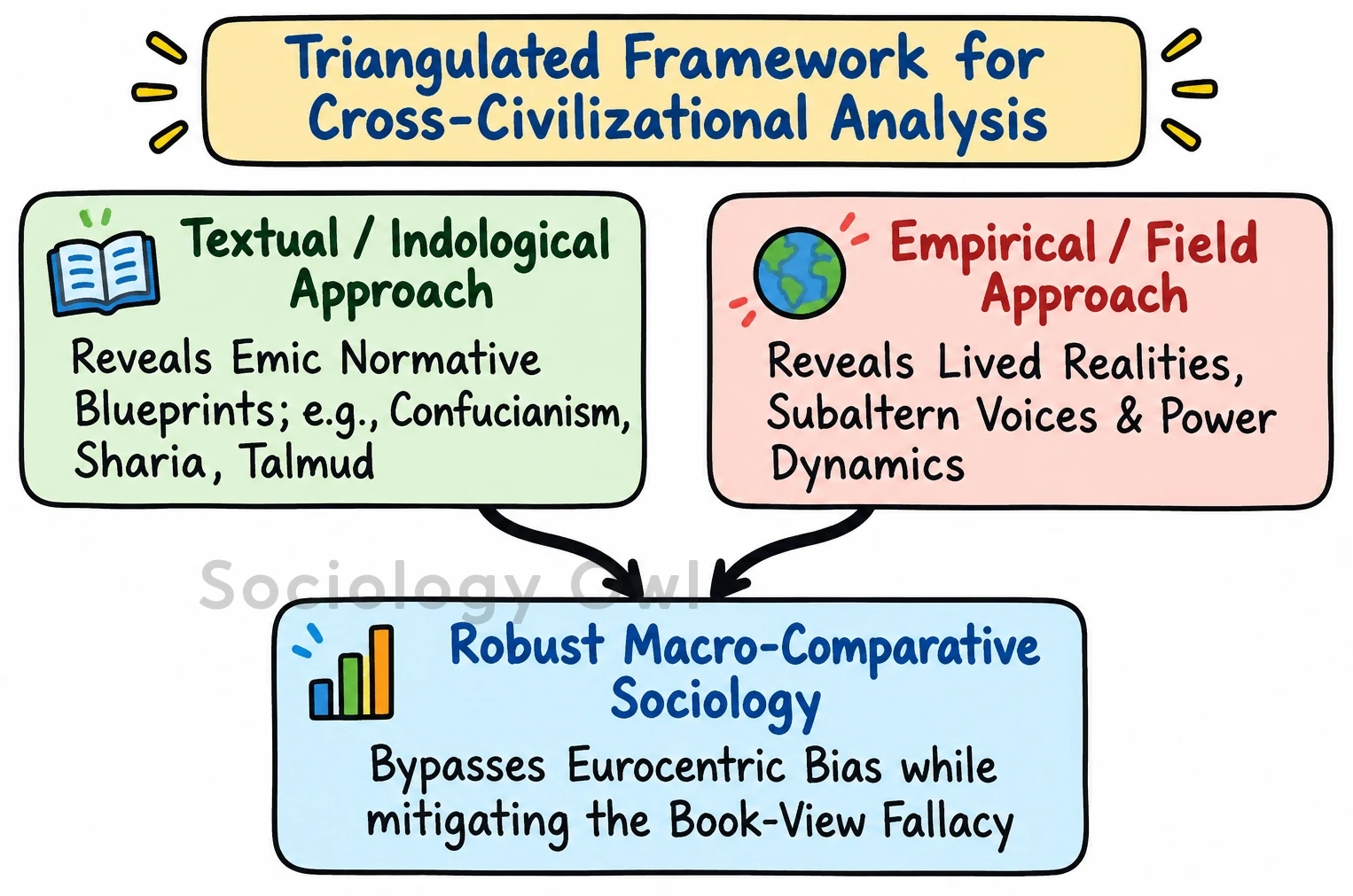
The Indological approach, pioneered by G. S. Ghurye, utilizes endogenous classical texts, linguistics, and scripture to examine social institutions and civilizational continuity. Beyond the Indian subcontinent, this textual-hermeneutic method provides a vital framework for deciphering the normative architectures of diverse global societies.

Epistemological Utility in Studying Other Societies

  • De-centering Eurocentric Universalism: Applying indigenous textual analysis to non-Western societies—such as Sinology in China or Quranic hermeneutics in West Asia—counters Western ethnocentrism by evaluating societies through their own intellectual and conceptual traditions.
  • Accessing the “Emic” Worldview: Sacred and classical texts reveal the internal ethical codes and collective consciousness (Weltanschauung) of a people, mirroring Max Weber’s interpretative project of understanding social action through the actor’s cultural meanings.
  • Tracing Civilizational Continuity: Textual inquiry explains how ancient value systems influence modern structures, such as Confucian classics (Analects) continuously shaping contemporary East Asian family structures, statecraft, and corporate collectivism.
  • Deciphering Legal and Normative Systems: In societies where positive law is historically intertwined with religious doctrines, such as Islamic jurisprudence (Fiqh) or Jewish rabbinic law (Talmud), texts remain indispensable for analyzing contemporary personal laws and morality.
  • Enabling Macro-Comparative Sociology: As demonstrated by Louis Dumont, rigorous comparative sociology requires analyzing the civilizational texts of societies to juxtapose their foundational ideologies, such as Western egalitarian individualism versus non-Western hierarchical collectivism.

Methodological Caveats and Reflexivity

  • The “Book-View” Fallacy: As M. N. Srinivas observed, textual analysis risks conflating ideal normative prescriptions with lived empirical reality, obscuring local variations and informal power dynamics.
  • Hegemonic and Elite Bias: Canonical literature across civilizations—whether European clerical writings or Chinese literati records—systematically reflects elite male dominance, often rendering subaltern classes, folk traditions, and women invisible.

Textual approaches illuminate foundational cultural codes globally, provided they are dynamically triangulated with empirical, field-level social realities.

Q. Indological approach, advocated by G. S. Ghurye, focuses on the study of Indian society through Indian texts. How can Indological approach be useful in the study of other society? Comment in detail. Read More »

Q. Examine how Indian Nationalism was a result of ‘Akhand Bharat’/Indian Subcontinent’s socio-cultural and political consciousness.

Q. Examine how Indian Nationalism was a result of ‘Akhand Bharat’/Indian Subcontinent’s socio-cultural and political consciousness.

UPSC Sociology 2026 Paper 2

Model Answer:

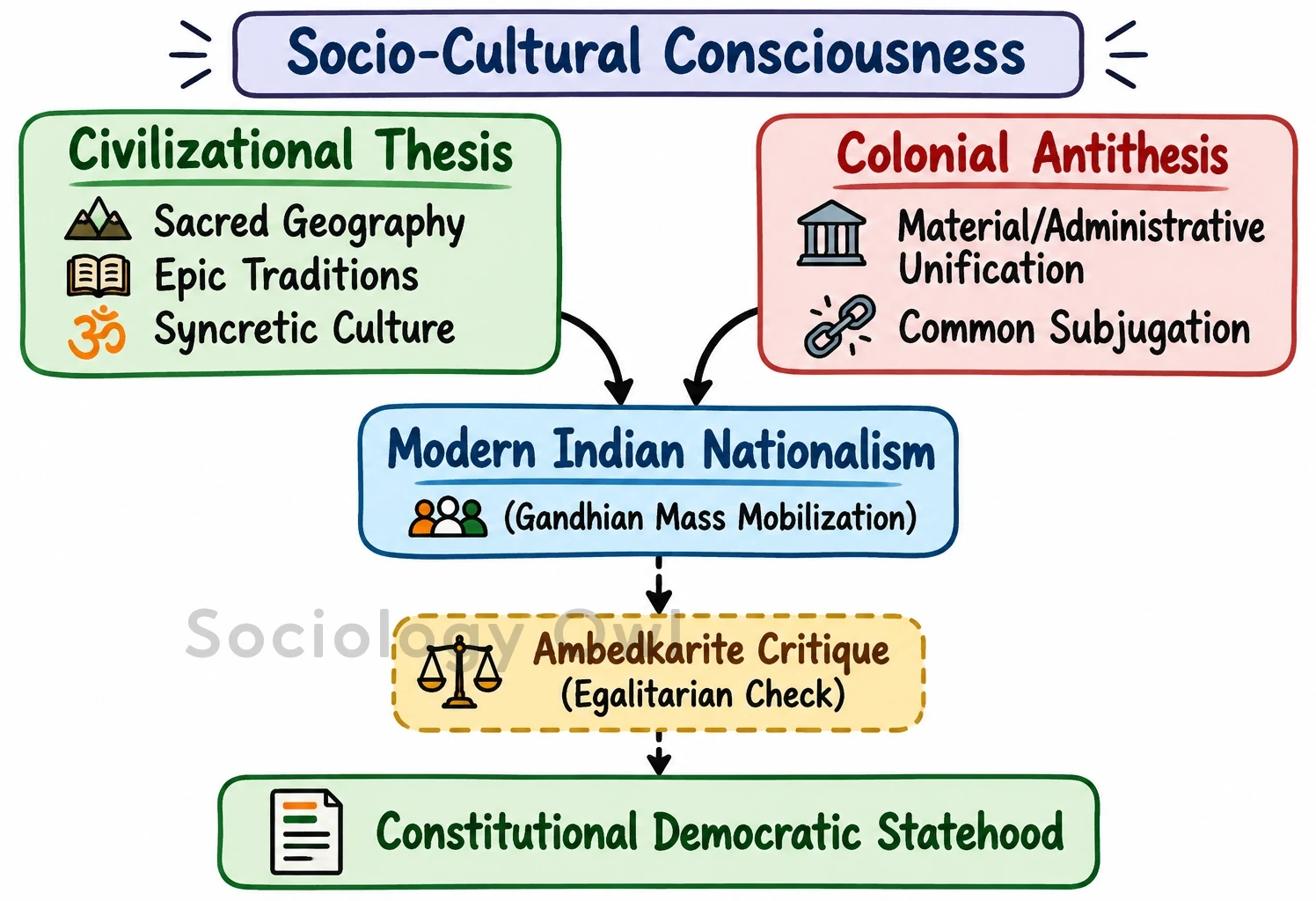
Indian nationalism was neither an exclusively modern colonial construct nor a mere derivative discourse; it evolved as the modern political articulation of an enduring civilizational, socio-cultural, and territorial consciousness embedded within the subcontinent.

Socio-Cultural Bedrock: Civilizational Foundations of National Identity

  • Sacred Geography and Geopiety: As Radhakamal Mukerjee noted, pilgrimage networks (Tirtha-yatra) and sacred geographies delineated a shared territorial imagination, transforming the physical subcontinent into a culturally unified landscape.
  • Normative Cultural Matrix: Shared epic traditions (Ramayana and Mahabharata) and a common philosophical ethos cut across linguistic, ethnic, and dynastic boundaries, fostering an intuitive pan-Indian civilizational consciousness.
  • Composite Syncretism: The subcontinental space witnessed continuous social intermixing; the Bhakti and Sufi movements decentralized orthodoxies and created a composite Ganga-Jamuni tehzeeb, strengthening trans-regional socio-cultural interdependence.
  • Institutional and Structural Commonality: M.N. Srinivas highlighted that despite localized diversities, structural idioms such as village social organization and the caste-peasant continuum created an overarching pan-Indian social reality.

Transformation into Modern Political Consciousness and its Contestations

  • Spiritual Sovereignty Preceding Politics: Partha Chatterjee argues that anti-colonial nationalism first carved out its sovereignty in the “inner” cultural and spiritual domain before launching political claims against the colonial state.
  • Dialectical Anti-Colonial Mobilization: A.R. Desai emphasized that while pre-existing cultural affinity provided the raw material, modern political nationalism crystallized through material integration, railways, unified law, and resistance to colonial economic exploitation.
  • Gandhian Synthesis of Cultural Idioms: Mahatma Gandhi translated latent civilizational ethics—such as Ahimsa and Swaraj—into tools of mass political consciousness, uniting fragmented social groups into a collective national movement.
  • Internal Critiques and Pluralities: Thinkers like B.R. Ambedkar cautioned that civilizational consciousness often masked structural hierarchies, necessitating that modern political nationalism be reconstructed on constitutional morality rather than uncritical revivalism.

Indian nationalism synthesized an ancient civilizational consciousness with modern democratic aspirations, transforming cultural commonality into robust constitutional statehood.

Q. Examine how Indian Nationalism was a result of ‘Akhand Bharat’/Indian Subcontinent’s socio-cultural and political consciousness. Read More »

Q. How does A. R. Desai argue that Indian social classes must be studied through the colonial mode of production? Elucidate.

Q. How does A. R. Desai argue that Indian social classes must be studied through the colonial mode of production? Elucidate.

UPSC Sociology 2026 Paper 2

Model Answer:

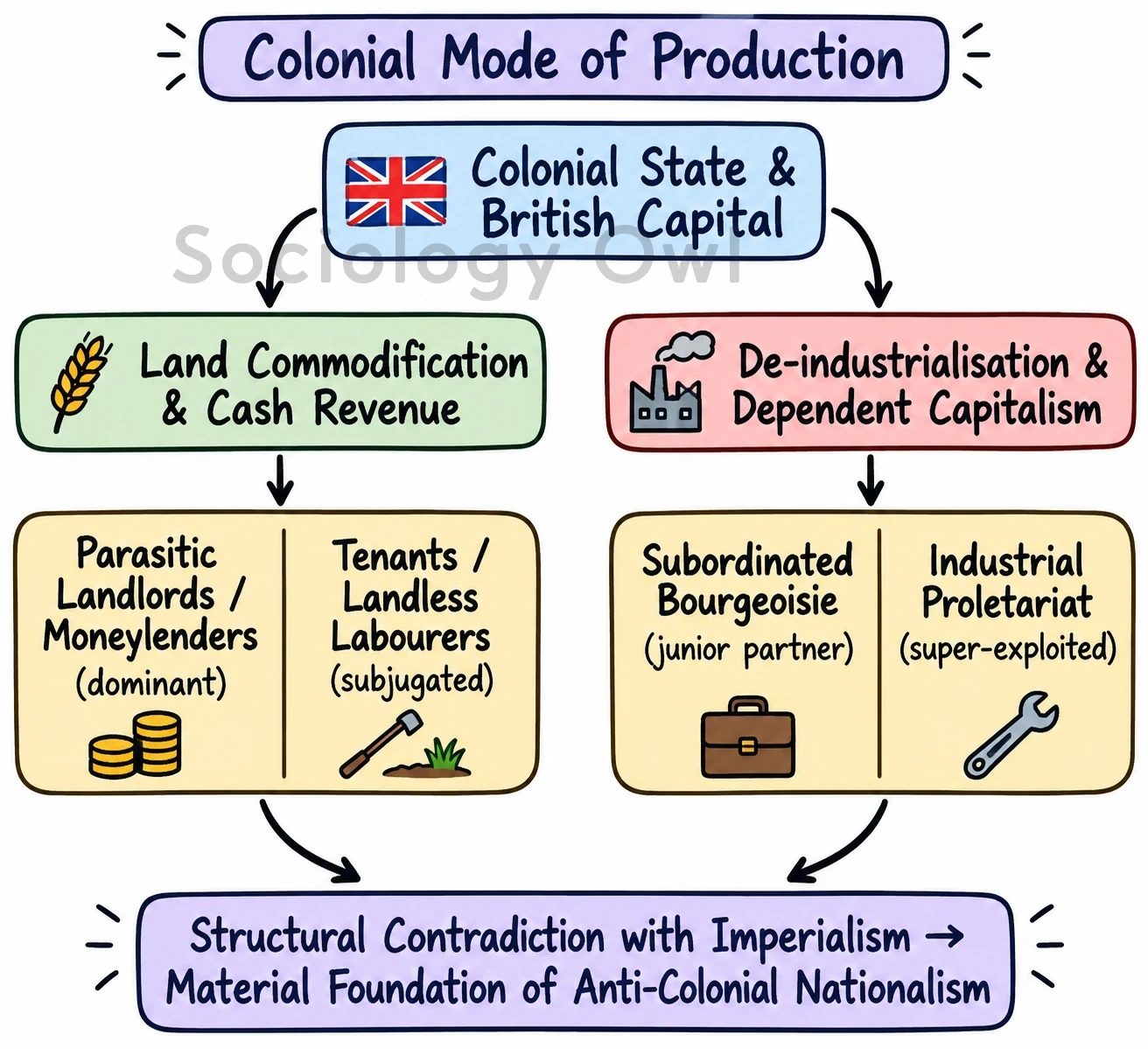
In Social Background of Indian Nationalism, A. R. Desai uses a historical-materialist framework, arguing that modern Indian social classes are dialectical products of colonial capitalism rather than organic outgrowths of indigenous feudalism.

Desai’s Analysis of Class Formation via Colonial Production

  • Commodification of Land: Colonial revenue settlements (Zamindari and Ryotwari) transformed land into private property, replacing traditional communal usufruct rights with contractual market relations.
  • Agrarian Class Polarisation: The imposition of cash revenue and commercial agriculture generated an unprecedented agrarian hierarchy—parasitic absentee landlords, rich usurious moneylenders, insecure tenants, and landless agricultural labourers.
  • De-industrialisation and Proletarianisation: The influx of British machine-made goods shattered traditional urban and village handicrafts, forcibly ruralising ruined artisans into unfree farm labourers.
  • Emergence of Subordinated Bourgeoisie: Indigenous industrial and commercial capitalists developed as junior, constrained partners within imperial trade networks rather than an independent, classic European bourgeoisie.
  • Genesis of Modern Industrial Proletariat: Colonial infrastructural projects like railways, plantations, and early textile mills birthed a modern working class subjected to super-exploitation without welfare protections.
  • Material Basis of Nationalism: The structural contradictions between the material interests of these emerging classes and colonial expropriation formed the fundamental engine of the anti-imperialist movement.

Desai thus demonstrates that Indian social stratification transformed fundamentally from traditional caste status to an exploitative, colonial-capitalist class structure.

Q. How does A. R. Desai argue that Indian social classes must be studied through the colonial mode of production? Elucidate. Read More »

Q. Examine the challenges of applying micro-level village studies to macro-level village structure of Indian society.

Q. Examine the challenges of applying micro-level village studies to macro-level village structure of Indian society.

UPSC Sociology 2026 Paper 2

Model Answer:

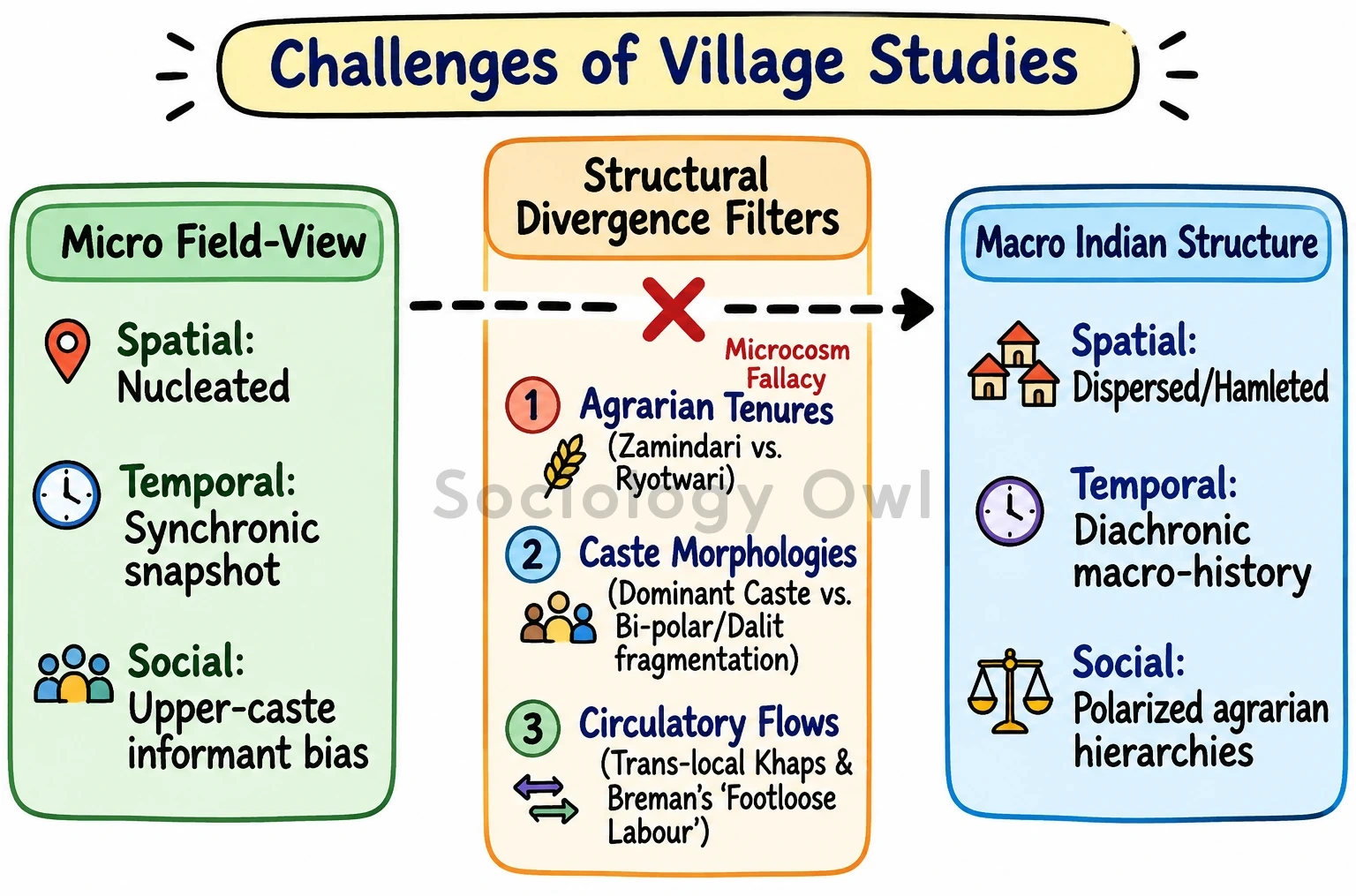
Post-Independence village studies established an empirical field-view countering colonial myths of the “isolated republic.” However, projecting these atomized, localized ethnographies onto the macro-structural canvas of Indian society poses serious methodological and analytical dilemmas.

Epistemological and Methodological Impediments

  • The Microcosm Fallacy: Early monographs uncritically borrowed Robert Redfield’s concept of the Little Community, falsely assuming a single village mirrors the civilizational macrocosm. A nucleated settlement in Uttar Pradesh cannot reflect the dispersed homesteads (desam) of Kerala or tribal hamlets of the Northeast.
  • Agrarian and Tenurial Divergence: Historical trajectories generated distinct structural matrices. As Andre Beteille noted, agrarian hierarchies under Eastern Zamindari systems created deep polarities between non-cultivating rentiers and unfree tenants, unreplicable in Western India’s Ryotwari peasant tracts.
  • Synchronic Blind Spots: Intensive participant observation captures an ethnographic snapshot in time, often missing diachronic, macro-historical forces such as colonial de-industrialization, planned development, and uneven market integration.
  • Subjective Investigator Bias: Intensive village studies were frequently skewed by the social location of informants—predominantly upper-caste, landowning males—thereby obscuring the macro-realities of systemic Dalit exploitation and subaltern resistance.

Structural and Contemporary Divergences

  • Asymmetry of Caste Formations: M.N. Srinivas’s concept of the Dominant Caste, grounded in Rampura, fails in regions lacking numerically preponderant intermediate landholders, such as bi-polar caste settings or fragmented Dalit-majority villages.
  • Neglect of Trans-Local Networks: Traditional ethnographies often underestimated multi-village kinship loops (khap networks), trade corridors, and pilgrimage circuits that B.R. Chauhan highlighted as structural bridges between local and regional systems.
  • De-peasantisation and Fluidity: Contemporary village life cannot be mapped via self-contained spatial boundaries. Rural-urban continuums, state welfare penetration, and Jan Breman’s “footloose labour” involving circular migration have eroded territorial insularity into fluid regional networks.

Micro-studies illuminate lived social depth, but macro-validity necessitates synthesizing ethnographic specificity with structural, historical, and regional political economy.

Q. Examine the challenges of applying micro-level village studies to macro-level village structure of Indian society. Read More »

Q. When land reform was a paradigm shift, then what type of land reforms would you recommend to make India a more equitable society?

Q. When land reform was a paradigm shift, then what type of land reforms would you recommend to make India a more equitable society?

UPSC Sociology 2026 Paper 2

Model Answer:

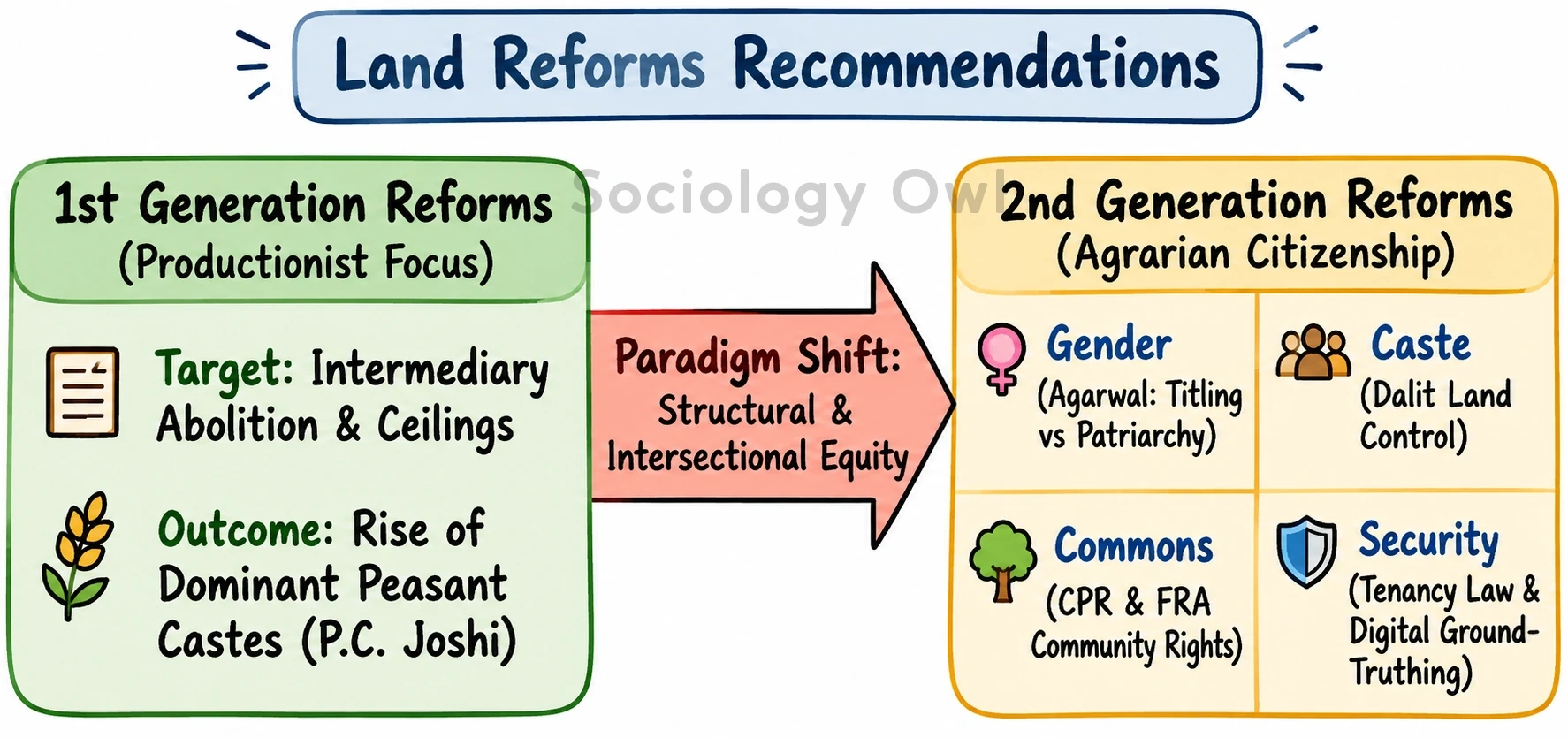
While first-generation land reforms dismantled feudal intermediaries, P.C. Joshi noted they left structural redistribution unfinished. Contemporary agrarian reform must pivot toward correcting deeply entrenched caste, gender, and institutional asymmetries.

Reimagining Land Reforms for Agrarian Equity

  • Gendered Titling: Institutionalise joint and sole land titles for women, operationalising Bina Agarwal’s thesis that independent land rights reduce domestic violence and dismantle patriarchal dependency.
  • Caste-Centric Redistribution: Allocate ceiling-surplus, state-owned wastelands, and village commons exclusively to landless Dalits, directly disrupting the entrenched caste-class nexus in rural agrarian structures.
  • Formalisation of Tenancy: Legalise and secure agricultural tenancy agreements using frameworks like the Model Land Leasing Act, providing informal leaseholders access to institutional credit, subsidies, and crop insurance.
  • Community Forest Titling: Expedite the implementation of the Forest Rights Act (FRA), 2006, vesting genuine ownership of community forest resources in Adivasi Gram Sabhas against corporate alienation.
  • Equity-Centric Digital Titling: Conduct democratic ground-truthing alongside schemes like SVAMITVA to prevent digital land grabs and the erasure of unregistered customary rights by dominant lineages.
  • Protection of Common Property Resources (CPRs): Legally insulate village grazing lands and commons from diversion, safeguarding the subsistence base of landless pastoralists and marginal peasants.

Second-generation land reforms must transcend mere redistribution, actively dismantling caste-patriarchy structures to democratise rural citizenship and economic dignity.

Q. When land reform was a paradigm shift, then what type of land reforms would you recommend to make India a more equitable society? Read More »

Q. Explain the emergence of middle class in agrarian society in India. What have been the socio-structural implications of the emergence of this middle class?

Q. Explain the emergence of middle class in agrarian society in India. What have been the socio-structural implications of the emergence of this middle class?

UPSC Sociology 2026 Paper 2

Model Answer:

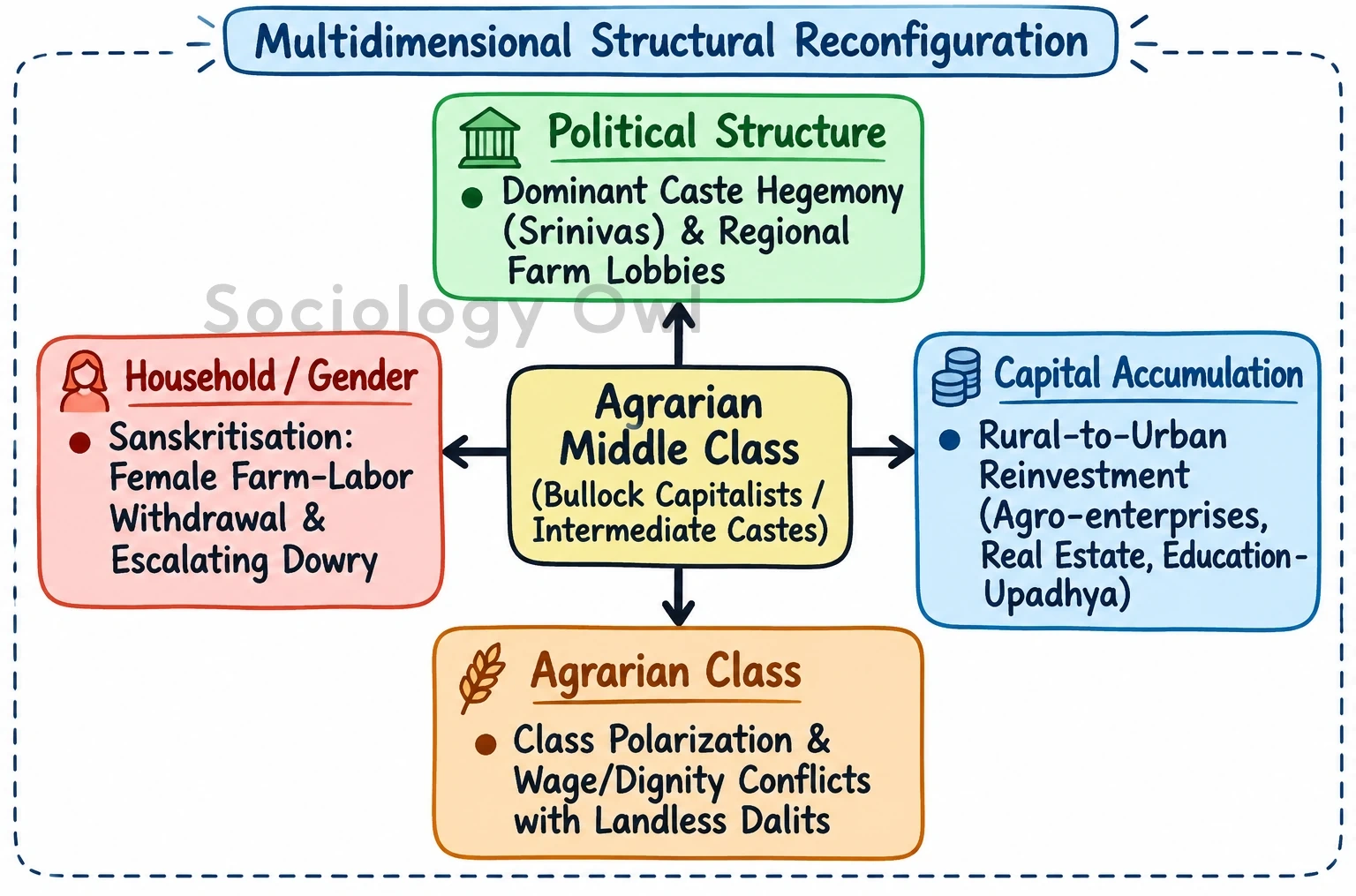
Post-independence land reforms and the Green Revolution dismantled traditional semi-feudal agrarian hierarchies. This catalyzed the rise of an enterprising, self-cultivating intermediate stratum, famously conceptualized by Lloyd and Susanne Rudolph as bullock capitalists.

Genesis and Drivers of the Agrarian Middle Class

  • Tenancy Reforms: The abolition of intermediaries conferred proprietary ownership on erstwhile tenants drawn predominantly from intermediate, middle-ranking castes.
  • Technological Modernization: The Green Revolution favored medium-sized holdings, enabling peasants with family labor and capital to maximize yields through mechanized inputs.
  • State Subsidies and Price Support: State-backed credit institutions, cheap power, fertilizer subsidies, and the Minimum Support Price (MSP) regime cushioned middle farmers against free-market volatility.
  • Peasant Differentiation: As argued by Utsa Patnaik, generalized commercialization triggered class polarization, shifting upper-middle peasants into a commercially oriented agrarian bourgeoisie.
  • Democratic Enfranchisement: Universal adult suffrage enabled demographically dense peasant communities to convert numerical strength into economic concessions and institutional leverage.

Socio-Structural Implications on Indian Society

  • Ascendance of Dominant Castes: Intermediate peasant castes (e.g., Jats, Marathas, Patidars, Kammas) translated landownership into socio-political dominance, replacing traditional upper-caste hegemony (M.N. Srinivas).
  • Deepening Agrarian Labor Conflict: The class divide widened between middle-class landholders and landless Dalit agricultural laborers, fueling structural conflict over wages, dignity, and farm-labor casualization.
  • Rise of Agrarian Politics: The emergence of powerful non-party farm lobbies (e.g., Bharatiya Kisan Union) and regional political formations decentralized India’s federal dynamic.
  • Diversification into Non-Farm Economy: As observed by Carol Upadhya, agrarian surplus was actively reinvested into agro-processing, petty trading, real estate, and private educational enterprises, blurring rural-urban binaries.
  • Patriarchal Retrenchment: Upward economic mobility fostered Sanskritisation, causing the withdrawal of women from manual farm labor and escalating hypergamy and dowry practices.

This intermediate agrarian class restructured rural power dynamics, cementing caste-capital linkages that continue to dictate regional political economy today.

Q. Explain the emergence of middle class in agrarian society in India. What have been the socio-structural implications of the emergence of this middle class? Read More »