2026 Sociology Paper 2

Q. In what respect is M. N. Srinivas’ study of Indian village society based on structural and functional perspective? Analyse.

Q. In what respect is M. N. Srinivas’ study of Indian village society based on structural and functional perspective? Analyse.

UPSC Sociology 2026 Paper 2

Model Answer:

Influenced by A.R. Radcliffe-Brown, M.N. Srinivas pioneered the field-view tradition in India, analyzing the village not as a static, isolated relic, but as an integrated, functioning social system maintained in dynamic equilibrium.

Structural-Functional Dimensions of Srinivas’s Village Study
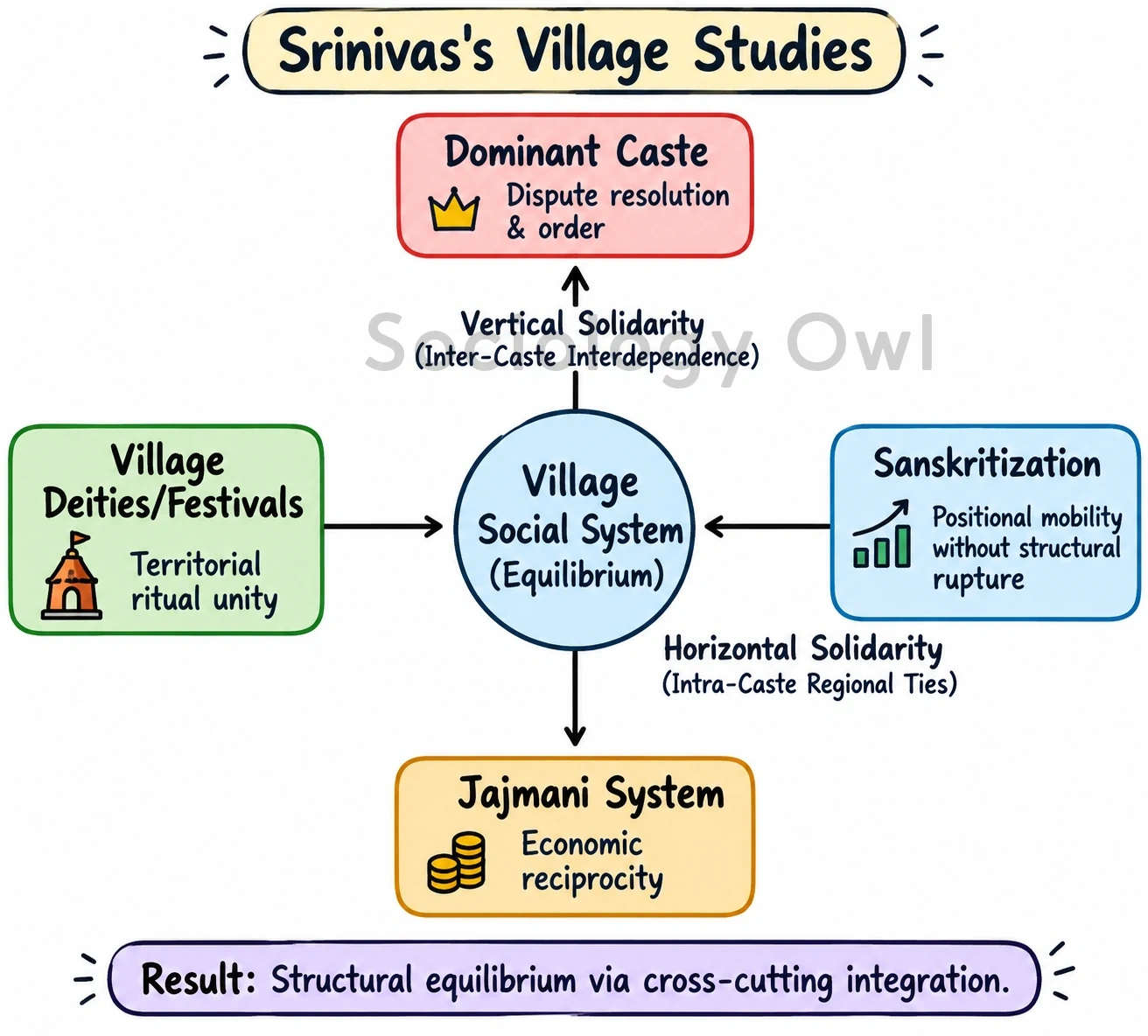
  • Vertical Solidarity vs. Horizontal Ties: In The Remembered Village, he demonstrated that despite ritual hierarchy, distinct castes in Rampur were integrated through village-level vertical unity, cross-cutting the divisive external horizontal solidarity of endogamous caste networks.
  • Economic and Occupational Interdependence: He framed the Jajmani system as a network of reciprocal, hereditary patron-client obligations, highlighting its role in maintaining socio-economic stability and systemic integration.
  • Maintenance of Order via Dominant Caste: Conceptualized the dominant caste (e.g., Okkaligas) as a structural mechanism for informal dispute resolution, local administration, and preserving social equilibrium.
  • Positional Mobility without Structural Rupture: Formulated Sanskritization as a functional adjustment mechanism that facilitates positional change for lower castes while preserving the foundational structure of the caste system.
  • Ritual Reinforcement of Village Cohesion: Documented how collective rituals, village festivals, and worship of local deities acted as collective mechanisms that reinforced social cohesion and territorial boundaries.
  • Functionalist Blindspots: Critics like Louis Dumont and Marxist scholars observed that this emphasis on unity and functional consensus tended to understate asymmetric power, coercion, and structural caste violence.

Srinivas effectively established the village as an interdependent, living social structure, though his functionalist lens somewhat understated inherent caste conflicts.
Q. In what respect is M. N. Srinivas’ study of Indian village society based on structural and functional perspective? Analyse. Read More »

Q. How have the women’s movements made the presence of women in every moment felt and more women participation in various fields? Discuss.

Q. How have the women’s movements made the presence of women in every moment felt and more women participation in various fields? Discuss.

UPSC Sociology 2026 Paper 2

Model Answer:

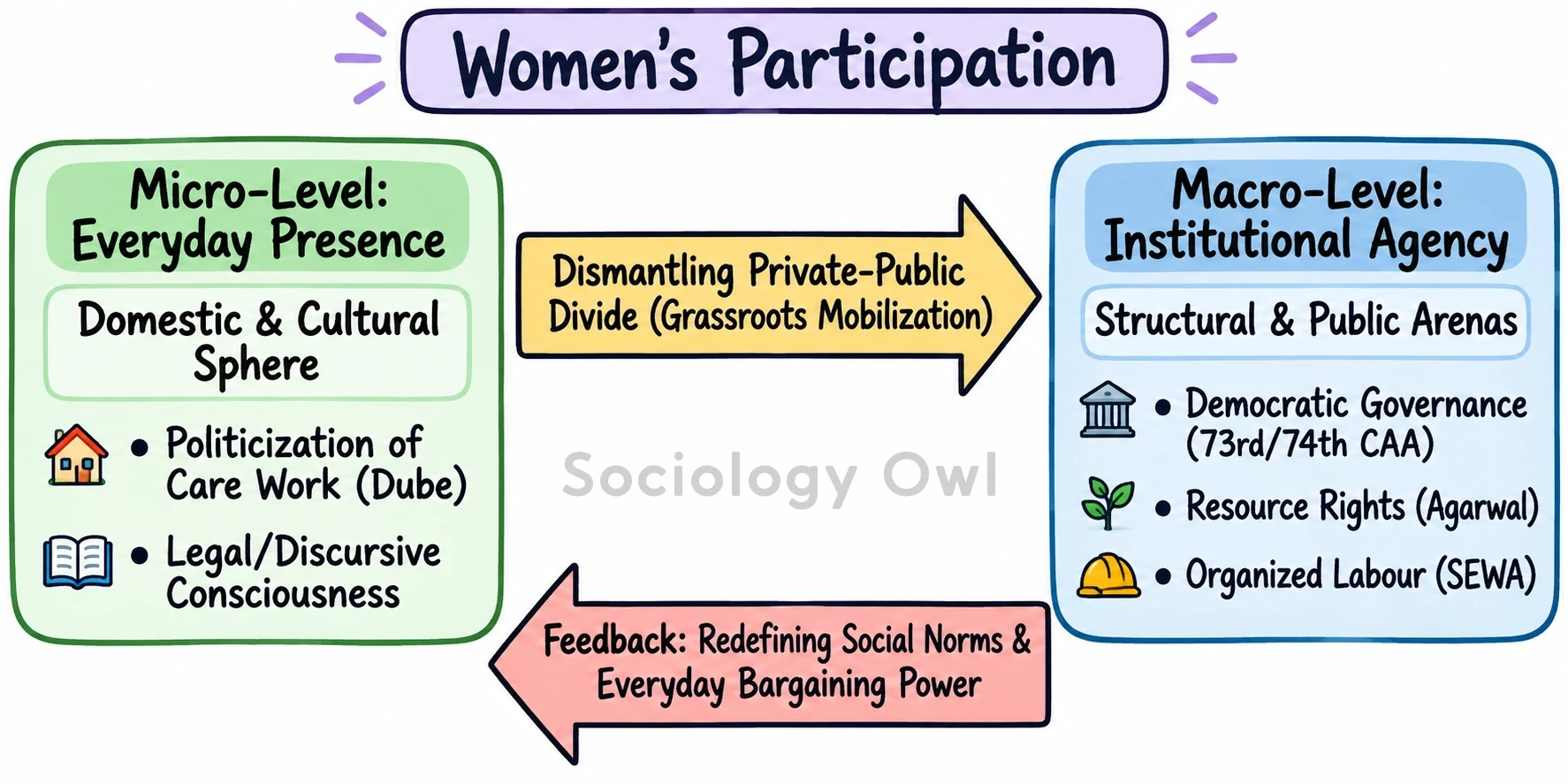
Indian women’s movements have evolved from colonial-era reformism to autonomous, intersectional mobilizations, dismantling the traditional private-public divide and establishing women as conscious, proactive agents in restructuring everyday social life.

Making Presence Felt: Subverting Everyday Spaces and Discourse

  • Politicizing the Domestic Realm: As Leela Dube highlighted in her studies on gender socialization, domestic subordination was historically naturalized; feminist campaigns around domestic violence, unpaid care work, and reproductive autonomy directly challenged this private patriarchy.
  • Transforming Legal Consciousness: Grassroots agitations—from the anti-rape agitations post-Mathura case to campaigns against dowry—radically reoriented jurisprudence, culminating in legislations like the Protection of Women from Domestic Violence Act (PWDVA) and the POSH Act.
  • Cultural and Linguistic Assertion: Counter-hegemonic cultural practices, through protest poetry, street theatre, and Dalit feminist literature, disrupted Brahminical and patriarchal vocabularies, making feminine lived experiences central to public debate.

Expanding Substantive Agency Across Institutional Fields

  • Local Democratic Governance: Sustained political advocacy paved the way for the 73rd and 74th Constitutional Amendments, propelling over a million women into formal politics through Panchayati Raj and challenging village-level patriarchal hegemonies.
  • Agrarian and Resource Struggles: From Chipko to anti-mining resistance, women positioned themselves at the vanguard of environmental movements. As Bina Agarwal notes, mobilizing for collective rights over land, common property resources, and forests redefined women’s economic bargaining power.
  • Unionizing the Informal Economy: Collectives like the Self-Employed Women’s Association (SEWA) and state-level collectives like Kudumbashree transformed vulnerable informal workers into organized, credit-worthy economic agents capable of institutional bargaining.
  • Intersectional Subaltern Mobilization: Autonomous Dalit and Adivasi women’s forums challenged monolithic upper-caste feminist narratives, ensuring that margins of caste, class, and ethnicity drive mainstream civil society and academic discourse.

By dismantling the private-public divide, women’s movements have structurally reconfigured Indian democracy, transforming marginality into decisive socio-political agency.

Q. How have the women’s movements made the presence of women in every moment felt and more women participation in various fields? Discuss. Read More »

Q. Examine the process of formalisation of informal sector to safeguard the interests of marginalised sections of the society.

Q. Examine the process of formalisation of informal sector to safeguard the interests of marginalised sections of the society.

UPSC Sociology 2026 Paper 2

Model Answer:

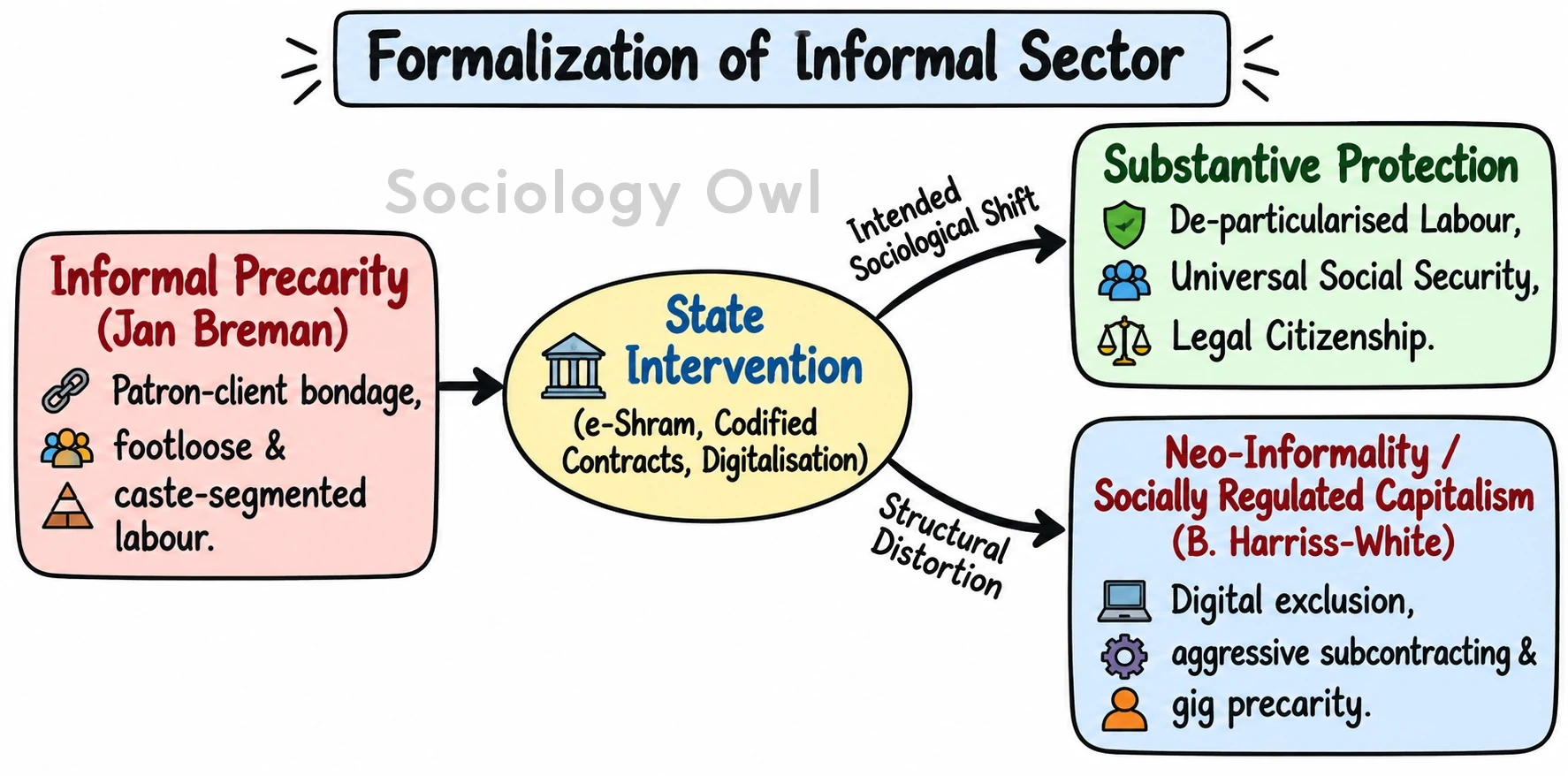
In India, where over 90% of the workforce operates informally, marginalized sections (SCs, STs, women, and migrants) bear the brunt of precarious, unprotected labor. Formalisation seeks to dismantle these caste- and gender-segmented exploitative arrangements through institutionalized legal, financial, and social protections.

Evaluating Formalisation: Safeguards and Sociological Realities

  • De-particularisation of Labour: Codified contracts and statutory minimum wages erode traditional patron-client dependencies and caste-based debt-bondage, transforming Jan Breman’s “footloose labour” into legally recognized citizens.
  • Universalizing Social Security: Platforms like the e-Shram portal provide institutional visibility, facilitating portable safety nets (insurance, pensions) essential for seasonal, circular migrant workers.
  • Disrupting Exploitative Credit: Transition to formal banking minimizes dependence on usurious informal moneylenders, enhancing the economic agency of marginalized petty producers.
  • Gendering the Labour Matrix: Registering domestic and home-based work legitimizes feminized survivalist activities, challenging patriarchal devaluation of women’s labor.
  • The Pitfall of Digital Exclusion: Complex biometric and paperwork requirements systematically disenfranchise illiterate, resource-poor Adivasis and Dalits, producing new forms of bureaucratic marginalization.
  • Repackaging Informality: Without structural transformation, top-down formalisation forces firms into aggressive subcontracting, cementing what Barbara Harriss-White terms “socially regulated capitalism” via neo-informal gig and contractual labor.

Formalisation must transcend mere digital registration to guarantee substantive welfare, dismantling entrenched caste-gender inequalities within India’s labour market.

Q. Examine the process of formalisation of informal sector to safeguard the interests of marginalised sections of the society. Read More »

Q. Give a sociological explanation of violence against women in India. What suggestions would you give to mitigate these violences?

Q. Give a sociological explanation of violence against women in India. What suggestions would you give to mitigate these violences?

UPSC Sociology 2026 Paper 2

Model Answer:

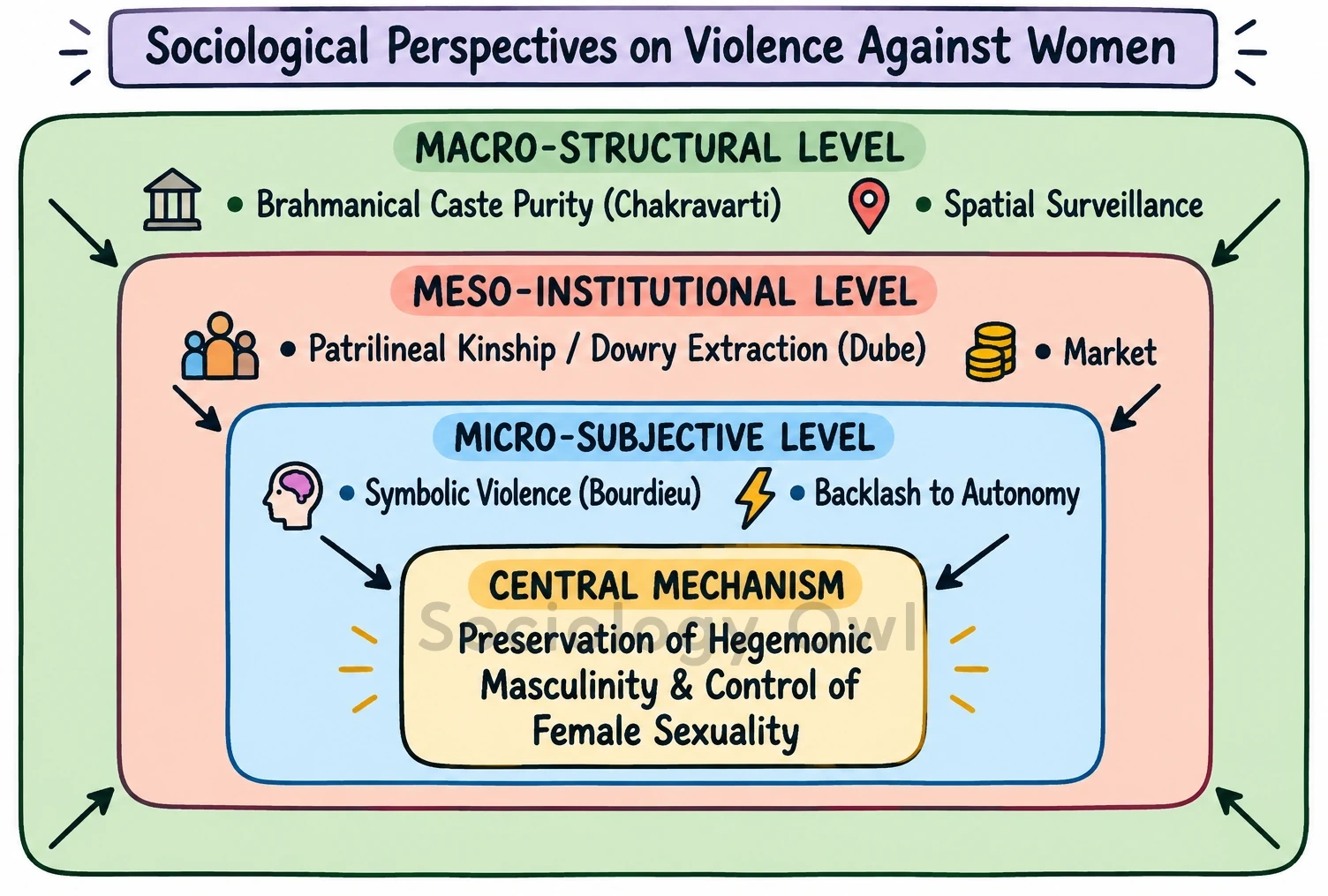
In India, violence against women is not an aberrant, individual pathology but a structural instrument used to enforce patriarchal dominance, police female sexuality, and reproduce unequal caste and class hierarchies.

Sociological Explanations of Violence Against Women

  • Brahmanical Patriarchy and Caste Hegemony: Uma Chakravarti demonstrates that sexual violence against subaltern women is systemic, weaponized by dominant castes to maintain ritual purity, enforce caste hierarchy, and punish collective assertion.
  • Patrilineal Kinship and Structural Vulnerability: Leela Dube highlights how patrilocal and patrilineal systems treat women as transferable property, rendering the private household the primary site of domestic abuse, female foeticide, and unpaid emotional subjugation.
  • Commodification and the Political Economy of Dowry: Rapid capitalist transition has intensified consumerism, transforming marriage into an extortionate transaction where women face dowry harassment and custodial deaths due to asymmetric economic bargaining power.
  • Spatial Hegemony and Surveillance: As shown by Shilpa Phadke et al. in Why Loiter?, the constant threat of public violence serves as an informal mechanism to restrict women’s spatial mobility under the pretext of familial “honour” and safety.
  • Backlash Against Female Autonomy: Rising female labour force participation and political assertion destabilize traditional male breadwinner status, triggering compensatory violence from men seeking to reclaim hegemonic masculinity.
  • Symbolic Violence and Socialization: Applying Pierre Bourdieu’s framework, violence is culturally normalized through internalised gender roles, causing victims to endure everyday abuse as an immutable domestic duty (chhoti-moti baatein).

Multi-Dimensional Strategies for Mitigation

  • Transforming Masculinity through Socialization: Restructure primary socialization via school curricula to dismantle toxic entitlements, desegregate domestic labor, and cultivate relational empathy among young boys.
  • Intersectional Legal Implementation: Reorient institutions enforcing the Protection of Women from Domestic Violence Act (PWDVA) and the SC/ST (PoA) Act from patriarchal conciliation toward prompt, survivor-centric justice.
  • Dismantling Spatial Segregation: Move away from paternalistic protectionism by redesigning inclusive, well-lit urban public spaces that institutionalize women’s unconditional “right to the city.”
  • Material Independence and Asset Ownership: Incentivize independent land, housing, and property titles for women, eliminating the structural poverty and economic dependence that traps them in abusive conjugal units.
  • Community-Led Accountability: Empower grassroots networks, such as Mahila Panchayats and Self-Help Groups, to act as localized surveillance systems that de-privatize domestic violence and provide immediate institutional backing.

Ending gender violence requires dismantling deep-seated patriarchal structures, eradicating caste-gender hierarchies, and institutionalizing women’s unconditional autonomy across India.

Q. Give a sociological explanation of violence against women in India. What suggestions would you give to mitigate these violences? Read More »

Q. Urbanisation in Independent India has been characterized by over-urbanization and rural push. Explain with demographic and sociological dimensions.

Q. Urbanisation in Independent India has been characterized by over-urbanization and rural push. Explain with demographic and sociological dimensions.

UPSC Sociology 2026 Paper 2

Model Answer:

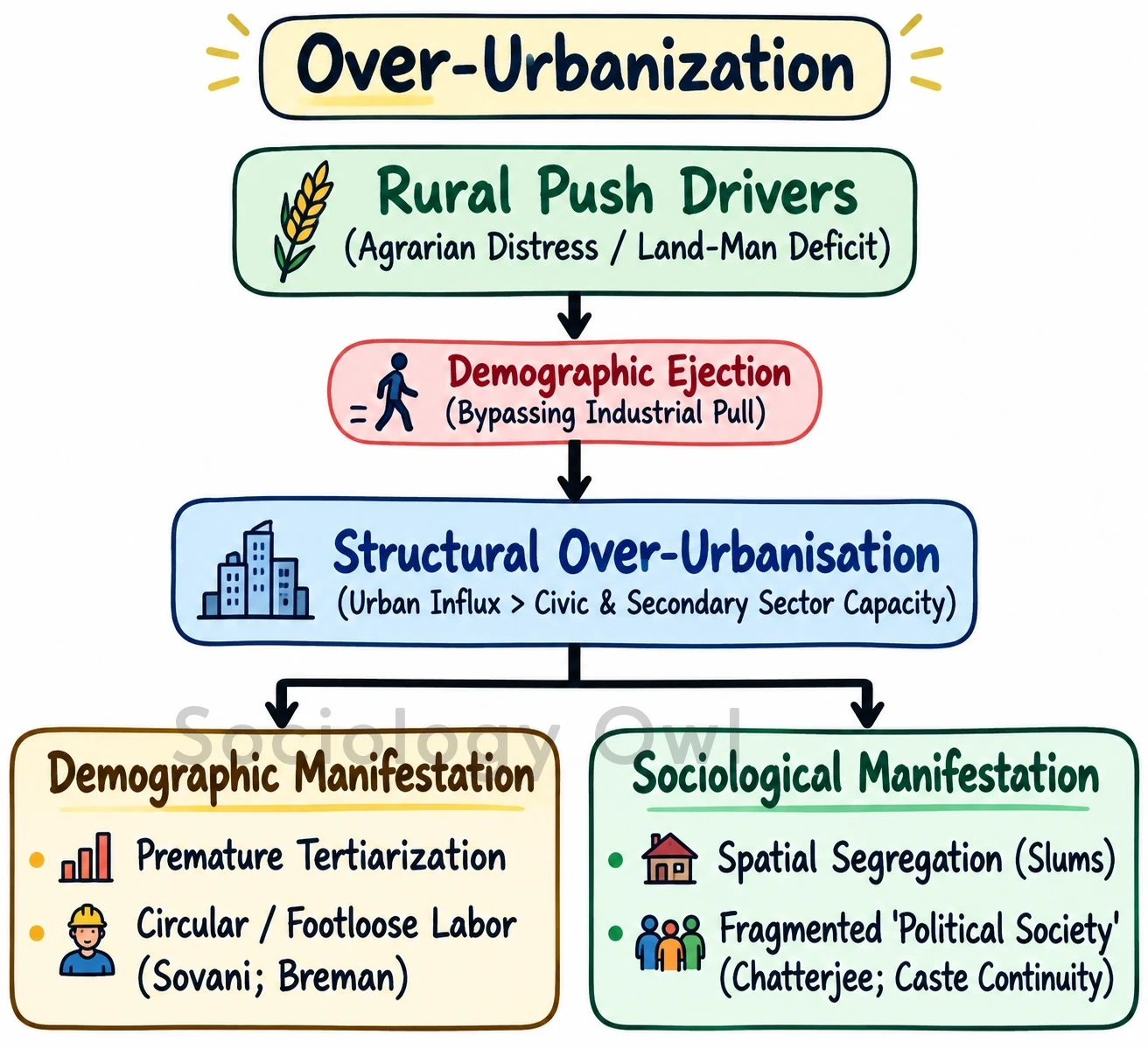
Urbanisation in post-colonial India diverged significantly from the Western trajectory: rather than being driven by industrial dynamic pull, it has been largely propelled by agrarian stagnation, creating over-urbanisation—a condition where urban demographic growth outstrips industrialisation, civic infrastructure, and formal employment capacity.

Demographic Dimensions of Over-Urbanization and Rural Push

  • Top-Heavy Urban Primacy: Growth is skewed toward Class-I metropolitan centres rather than medium towns, concentrating population density without regional demographic diffusion.
  • Premature Tertiarization: Demographic influx bypasses the secondary industrial sector, shifting directly from low-yield agriculture to precarious, informal urban services, validating N.V. Sovani’s critique of premature urban growth.
  • Agrarian Surplus Ejection: Decreasing land-man ratios, unviable landholdings, and mechanization expel surplus labor, converting rural demographic pressure into urban distress.
  • Footloose and Circular Demography: As noted by Jan Breman, rural push produces seasonal, floating migrant streams that oscillate between village and city without permanent urban absorption.
  • Skewed Spatial Sex Ratios: Male-selective working-age migration creates sex-ratio imbalances in metropolitan receiving zones while leaving skewed dependency ratios in rural sending regions.

Sociological Dimensions: Stratification and Exclusion

  • Slumification and Spatial Marginality: The structural inability to house push-migrants spawns expansive informal settlements, producing exclusionary, segmented cityscapes marked by deep environmental deficits.
  • Urban Reproduction of Caste: Marginalized castes escaping rural feudal ties enter the lowest rungs of urban informal labor, exchanging traditional dependence for urban gig and sanitation precarity.
  • Fragmented Civic Citizenship: Migrant laborers occupy what Partha Chatterjee terms political society, depending on tenuous political patronage rather than secure rights and social protections.
  • Feminization of Agrarian Labor: Male out-migration leaves rural women managing agricultural labor and household survival, without holding formal land titles or credit access.
  • Alienation and Breakdown of Solidarity: Migrants face the dissolution of traditional rural community safety nets without gaining entry into modern institutional support systems, heightening psychosocial insecurity.

Rectifying India’s distorted urbanization demands revitalizing the agrarian economy alongside building inclusive, decentralized, and socially absorptive urban infrastructure.

Q. Urbanisation in Independent India has been characterized by over-urbanization and rural push. Explain with demographic and sociological dimensions. Read More »

Q. Why was the category of ‘criminal tribe’ created by law during the colonial period in India? Discuss its implications.

Q. Why was the category of ‘criminal tribe’ created by law during the colonial period in India? Discuss its implications.

UPSC Sociology 2026 Paper 2

Model Answer:

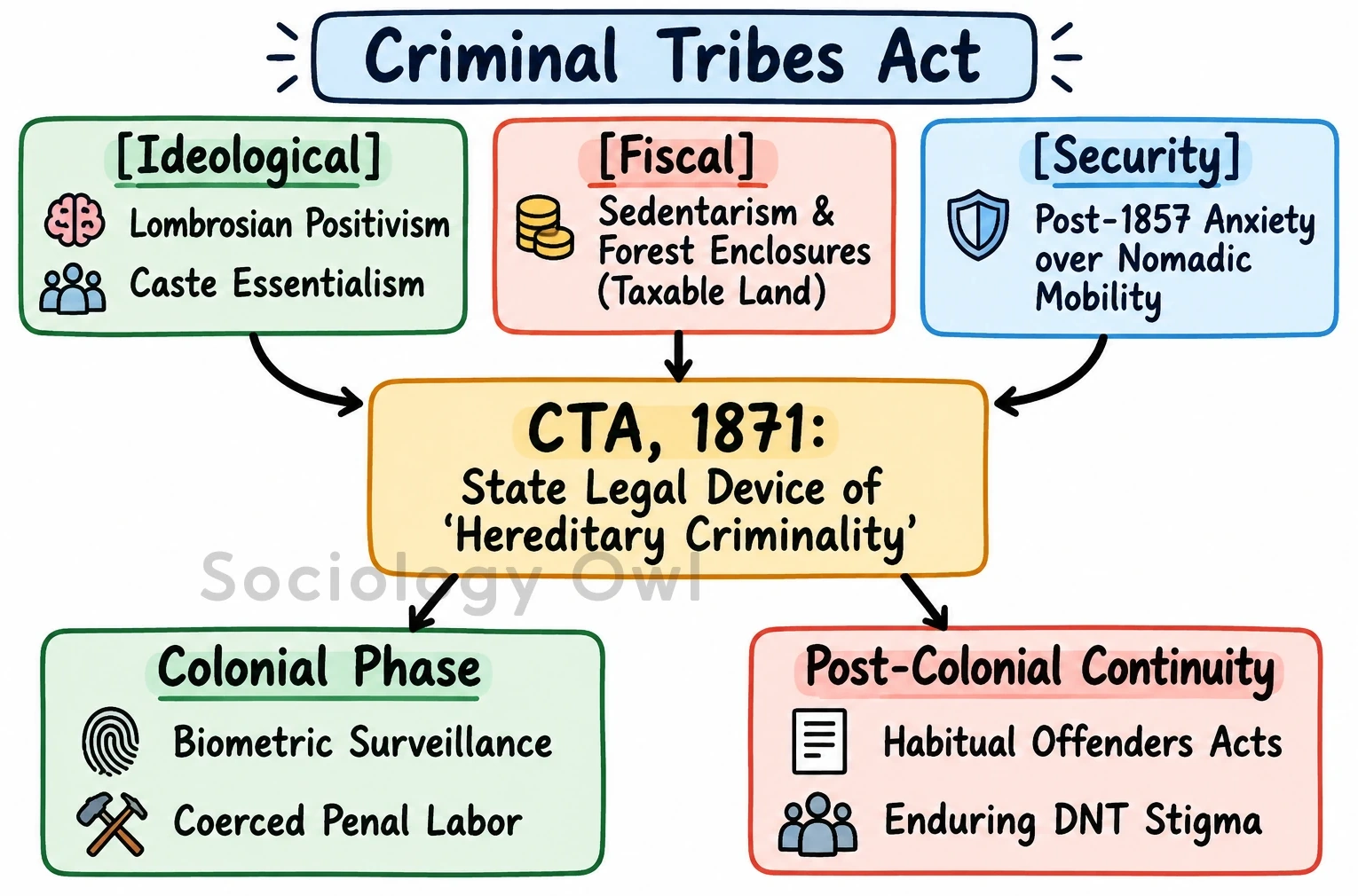
The Criminal Tribes Act (CTA), 1871 codified the colonial construct of hereditary crime, institutionalizing an epistemological fusion of European positivist criminology with caste-based occupational determinism to control non-sedentary communities.

Raison d’Être of the Colonial Classification

  • Colonial Sedentarism: British rule equated civilization and revenue extraction with settled agriculture; itinerant communities resisted fiscal extraction and spatial mapping (Nicholas Dirks).
  • Positivist Caste Essentialism: Administrators transposed biological theories of born criminals onto the Indian caste system, viewing criminality as an inborn, hereditary caste trade (Sanjay Nigam).
  • Ecological Dispossession: Forest Acts and the expansion of private property criminalized traditional hunting, pastoralism, and foraging, pushing displaced communities into survivalist offences (Meena Radhakrishna).
  • Security Paranoia: Following the 1857 uprising, mobile and wandering populations were viewed as unpredictable conduits for rebellion requiring stringent surveillance.

Sociological and Structural Implications

  • Institutionalized Surveillance: Mandated biometric tracking, spatial internment, and daily roll-calls that systematically dismantled community autonomy and civil liberties.
  • Coerced Penal Labor: Stigmatized tribes were funneled into forced, underpaid labor regimes in factories and canal colonies, often supervised by the Salvation Army.
  • The Living Legacy of DNTs: Though repealed in 1952, its replacement by Habitual Offenders Acts preserved structural police brutality, enduring social stigma, and institutional marginality for De-notified Tribes.

Decolonizing justice requires dismantling this historical trauma, transforming De-notified Tribes from perpetual administrative suspects into constitutionally empowered citizens.

Q. Why was the category of ‘criminal tribe’ created by law during the colonial period in India? Discuss its implications. Read More »

Q. How has colonial rule transformed Indian society? If it (Indian society) had not undergone colonial rule, then what type of Indian society would have been there? Elaborate.

Q. How has colonial rule transformed Indian society? If it (Indian society) had not undergone colonial rule, then what type of Indian society would have been there? Elaborate.

UPSC Sociology 2026 Paper 2

Model Answer:

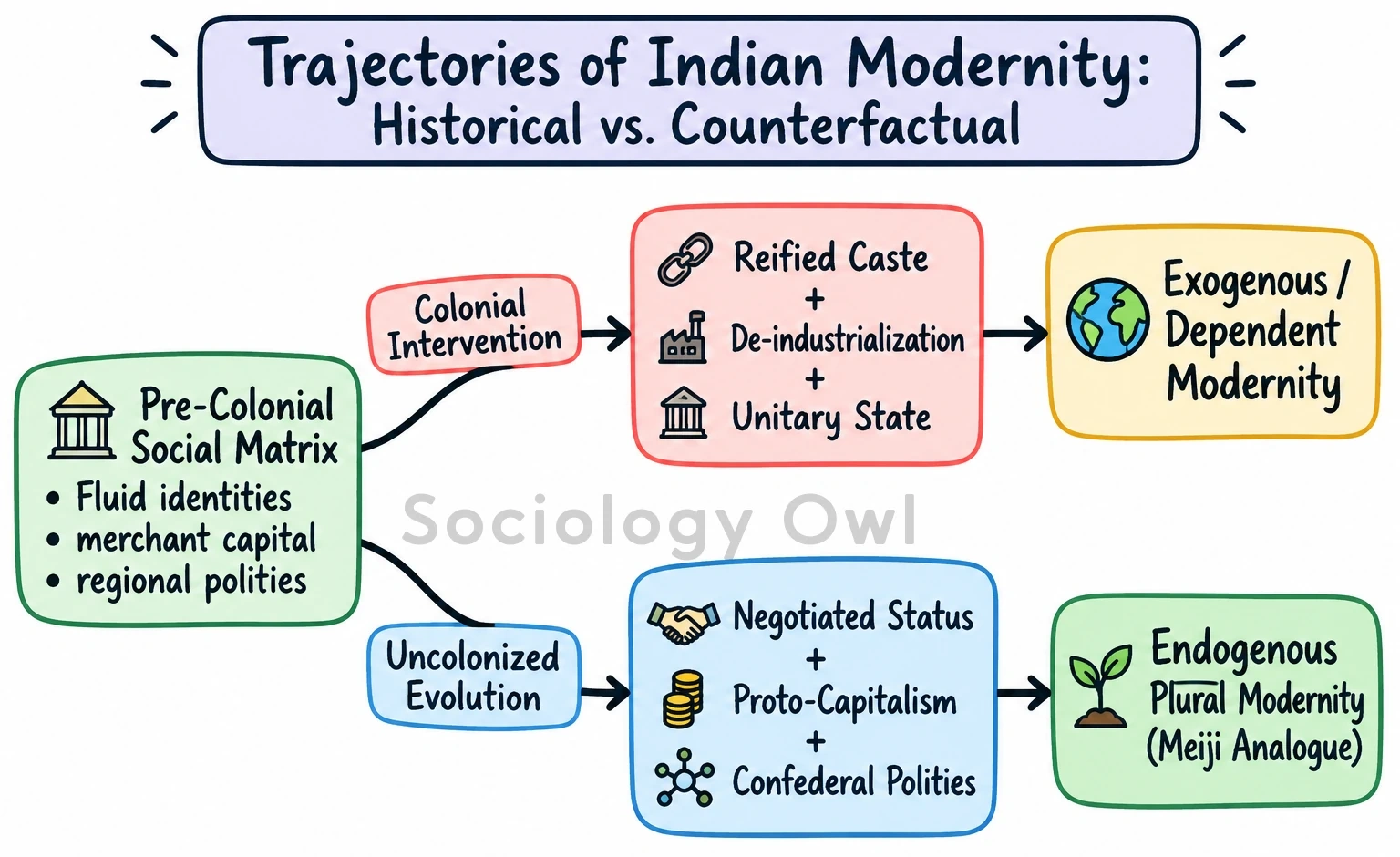
Colonial rule acted as an exogenous catalyst that fundamentally ruptured India’s civilizational matrix, replacing fluid, localized social institutions with codified, bureaucratic, and modern structures.

Multidimensional Transformation Under Colonial Rule

  • Reification of Caste: Colonial ethnographic exercises and decennial censuses transformed fluid social identities into a rigid, pan-Indian hierarchy, crystallizing what Nicholas Dirks terms the “invention of caste.”
  • Agrarian Class Restructuring: Formal land revenue settlements commodified land, dismantling the traditional jajmani moral economy and creating polarized agrarian strata of absentee landlords, sharecroppers, and landless laborers.
  • De-industrialization and Ruralization: Destruction of indigenous artisanal industries forced urban craftspeople into agriculture, skewing the occupational structure and creating structural underdevelopment.
  • Legal and Bureaucratic Rationalization: The introduction of uniform penal codes and rational-legal institutions replaced customary community jurisprudence, giving rise to an overdeveloped state apparatus.
  • Emergence of a Westernized Intelligentsia: English education produced a modern middle class (M.N. Srinivas) that spearheaded both socio-religious reform movements and anti-colonial nationalism.
  • Institutionalization of Communalism: Administrative policies such as separate electorates and community-based enumeration hardened religious boundaries, institutionalizing competitive communal politics.

Counterfactual Trajectory: An Uncolonized Indian Society

  • Endogenous Modernization: As Yogendra Singh notes regarding orthogenetic change, India possessed intrinsic modernizing capacities; social transition would likely have mirrored Meiji-era Japan’s state-directed, culturally rooted adaptation.
  • Organic Proto-Industrialization: Thriving pre-colonial mercantile centers in Bengal, Awadh, and Gujarat could have transitioned into indigenous manufacturing capitalism without the systemic drain of wealth.
  • Fluid Status Hierarchies: Absent colonial codification and judicial freezing of custom, caste dynamics would have remained flexible, negotiated through local political dominance and devotional Bhakti-Sufi contestations.
  • Confederal Political Evolution: Rather than a centralized unitary state, India may have evolved into a pluralistic confederation of regional linguistic polities (Maratha, Sikh, or regional successor states).
  • Vernacular Epistemology: Traditional knowledge systems and scientific traditions would have integrated into higher education naturally, preventing intellectual dependency on Western hegemony.

Colonialism forced exogenous modernization; uncolonized India would have evolved an endogenous, pluralistic modernity anchored in organic socio-economic transformations.

Q. How has colonial rule transformed Indian society? If it (Indian society) had not undergone colonial rule, then what type of Indian society would have been there? Elaborate. Read More »

Q. Where would you locate the tribal community in the Varna system of India? Discuss.

Q. Where would you locate the tribal community in the Varna system of India? Discuss.

UPSC Sociology 2026 Paper 2

Model Answer:

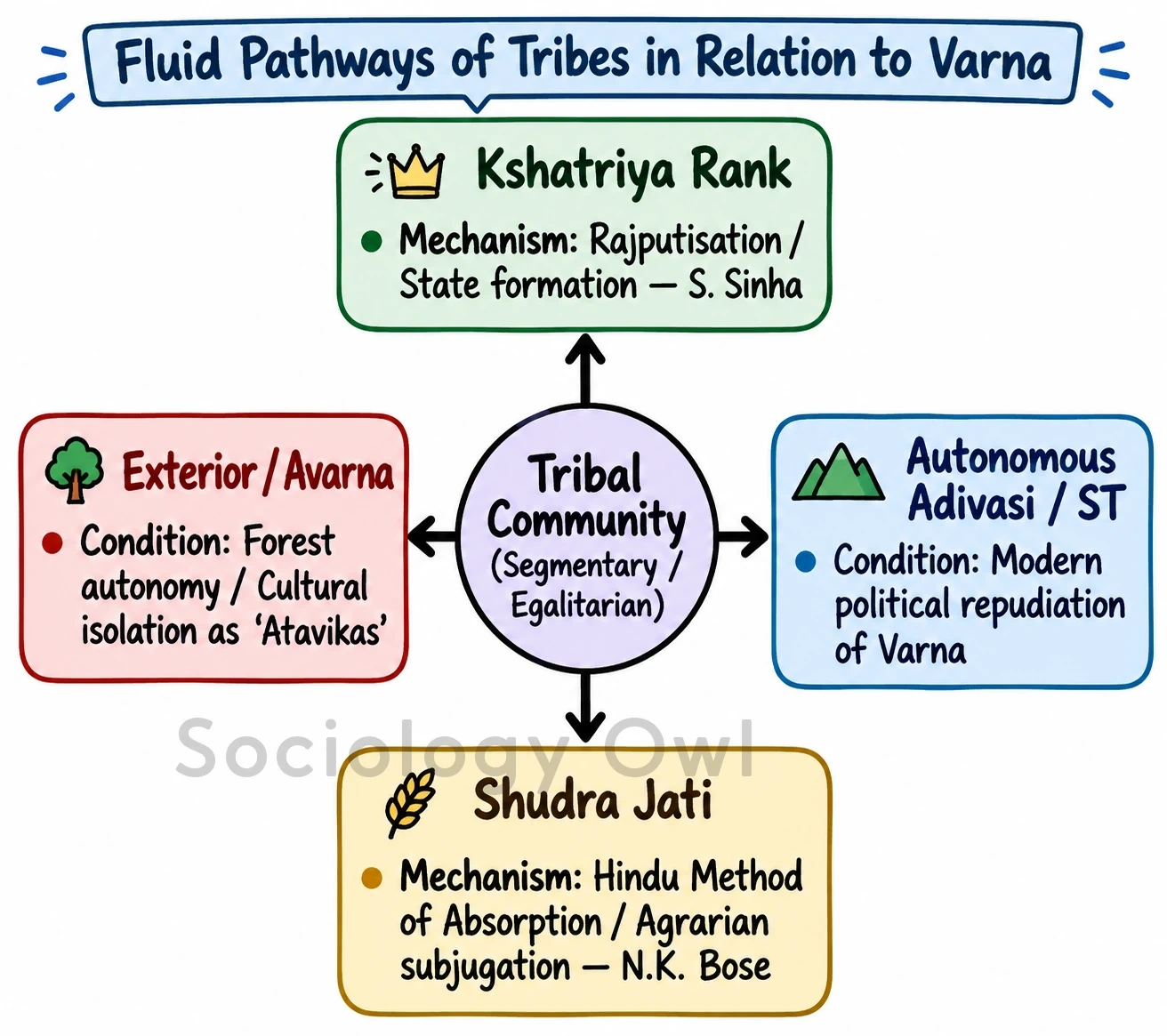
Textually, tribes existed outside the four-fold Chaturvarna scheme as exterior groups (Avarna), yet historically they maintained dynamic, porous relationships with mainstream society, resisting any static structural categorization.

Locating Tribes within the Varna Matrix

  • Exteriority (Avarna Status): Classical Brahmanical texts relegated forest-dwelling communities (Atavikas) outside the ritual hierarchy, treating them as autonomous, unranked mlecchas operating beyond ritual pollution-purity codes.
  • Absorption into Lower Strata: N.K. Bose articulated the Hindu method of tribal absorption, showing how economically subdued tribes were gradually integrated into local agrarian economies as subordinate peasant or service-providing Shudra jatis.
  • Upward Mobility via Kshatriyaisation: Elite segments of powerful tribes (e.g., Gonds, Bhils) successfully claimed Kshatriya status through state-building and Brahmanical patronage, conceptualized by Surajit Sinha as Rajputisation.
  • The Tribe-Caste Continuum: F.G. Bailey argued against rigid placement, demonstrating that tribes occupy intermediate, shifting positions along a tribe-caste continuum based on land control and political cohesion.
  • The “Backward Hindus” Formulation: G.S. Ghurye in The Scheduled Tribes rejected external categorization, arguing that tribes are imperfectly integrated groups belonging intrinsically within the broader Hindu fold.
  • Conscious Repudiation of Varna: Contemporary constitutional categorization as Scheduled Tribes and the rise of Adivasi consciousness actively reject Varna assimilation, asserting distinct indigenous identities.

Rather than occupying a fixed Varna rank, tribes occupy fluid positions along a continuum of historical absorption and political autonomy.

Q. Where would you locate the tribal community in the Varna system of India? Discuss. Read More »