Prelims Solution

Q. Consider the following multiplication problem : (PQ)×3=RQQ, where P, Q and R are different digits and R≠ 0.

Q. Consider the following multiplication problem :
(PQ)×3=RQQ, where P, Q and R are different digits and R≠ 0.

What is the value of (P+R)÷Q?
(a) 1
(b) 2
(c) 5
(d) Cannot be determined due to insufficient data
Correct Answer: (b) 2

Question from UPSC Prelims 2021 CSAT Paper

Explanation : 

Problem: Find (PQ) × 3 = RQQ, where P, Q, and R are distinct digits and R ≠ 0

Step 1: Express the Equation
(10P + Q) × 3 = 100R + 10Q + Q
30P + 3Q = 100R + 11Q
30P = 100R + 8Q
15P = 50R + 4Q

Step 2: Analyze the Equation
15P – 50R = 4Q
15P ≡ 50R (mod 4)

Step 3: Find the Values
Case 1: P = 8, R = 2
15 × 8 = 120 = 50 × 2 + 4Q
120 = 100 + 4Q
4Q = 20
Q = 5

Verification:
85 × 3 = 255
This confirms P = 8, R = 2, Q = 5 are distinct digits and R ≠ 0

Step 4: Calculate (P + R)/Q
(8 + 2)/5 = 10/5 = 2

Final Answer: 2

Q. Consider the following multiplication problem : (PQ)×3=RQQ, where P, Q and R are different digits and R≠ 0. Read More »

Q. Consider the following addition problem : 3P+4P+PP+PP=PQ2; where P, Q and R are different digits.

Q. Consider the following addition problem : 3P+4P+PP+PP=PQ2; where P, Q and R are different digits.

What is the arithmetic mean of all such possible sums?

(a) 102
(b) 120
(c) 202
(d) 220
Correct Answer: (c) 202

Question from UPSC Prelims 2021 CSAT Paper

Explanation : 

3P + 4P + PP + PP = RQ2

Breaking it down:
(30 + P) + (40 + P) + (10P + P) + (10P + P) = 100R + 10Q + 2

Simplifying:
24P + 70 = 100R + 10Q + 2

Further Breaking Down:
20P + 70 + 4P = 100R + 10Q + 2

Finding Value of P:
– Unit digit is 2
– Must come from 4 × P
– Therefore, P must be 3 or 8

Case 1 (P = 3):
24P + 70 = (24 × 3) + 70
= 72 + 70
= 142

Case 2 (P = 8):
24P + 70 = (24 × 8) + 70
= 192 + 70
= 262

Arithmetic Mean:
(142 + 262) ÷ 2 = 202

Answer: 202

Q. Consider the following addition problem : 3P+4P+PP+PP=PQ2; where P, Q and R are different digits. Read More »

Q. In an objective type test of 90 questions, 5 marks are allotted for every correct answer and 2 marks are deducted for every wrong answer. After attempting all the 90 questions, a student got a total of 387 marks. What is the number of incorrect response ?

Q. In an objective type test of 90 questions, 5 marks are allotted for every correct answer and 2 marks are deducted for every wrong answer. After attempting all the 90 questions, a student got a total of 387 marks. What is the number of incorrect response ?

(a) 9
(b) 13
(c) 27
(d) 43
Correct Answer: (a) 9

Question from UPSC Prelims 2021 CSAT Paper

Explanation : 

Objective type test of 90 questions

Given Information:
Total questions = 90
Marks for correct answer = +5
Marks for incorrect answer = -2
Total marks obtained = 387

Let’s solve:
x = number of correct answers
y = number of incorrect answers

Equation 1 (Total Questions):
x + y = 90

Equation 2 (Total Marks):
5x – 2y = 387

Solving the System of Equations:
From Equation 1: x + y = 90
x = 90 – y
Substitute in Equation 2:
5(90 – y) – 2y = 387
450 – 5y – 2y = 387
450 – 7y = 387
-7y = -63
y = 9

Therefore: Incorrect answers = 9
Correct answers = 81 (90 – 9)
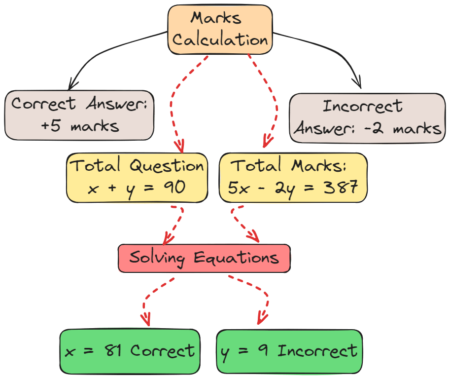
objective type test of 90 questions

Q. In an objective type test of 90 questions, 5 marks are allotted for every correct answer and 2 marks are deducted for every wrong answer. After attempting all the 90 questions, a student got a total of 387 marks. What is the number of incorrect response ? Read More »

Q. A person P asks one of his three friends X as to how much money he had. X replied, “If Y given me Rs. 40, then Y will have half of as much as Z, but if Z gives me Rs. 40, then three of us will have equal amount.” What is the total amount of money that X, Y and Z have ?

Q. A person P asks one of his three friends X as to how much money he had. X replied, “If Y given me Rs. 40, then Y will have half of as much as Z, but if Z gives me Rs. 40, then three of us will have equal amount.” What is the total amount of money that X, Y and Z have ?

(a) Rs. 420
(b) Rs. 360
(c) Rs. 300
(d) Rs. 270
Correct Answer: (b) Rs. 360

Question from UPSC Prelims 2021 CSAT Paper

Explanation : 

A person p asks one of his three friends

Initial Conditions:
X has x rupees
Y has y rupees
Z has z rupees

Statement 1 – If Y gives X Rs. 40:
Y’s new amount = Half of Z’s amount
Equation: y – 40 = (1/2)z

Statement 2 – If Z gives X Rs. 40:
All three will have equal amounts
Equation: x + 40 = y = z – 40

Solving the Equations:
1. From first equation: y – 40 = (1/2)z
Therefore: 2y – 80 = z

2. From second equation: x + 40 = y = z – 40
Substituting z: x + 40 = y = (2y – 80) – 40
x + 40 = y = 2y – 120
Therefore: y = 120

Final Values:
X has Rs. 80
Y has Rs. 120
Z has Rs. 160

Q. A person P asks one of his three friends X as to how much money he had. X replied, “If Y given me Rs. 40, then Y will have half of as much as Z, but if Z gives me Rs. 40, then three of us will have equal amount.” What is the total amount of money that X, Y and Z have ? Read More »

Q. Jay and Vijay spent an equal amount of money to buy some pens and special pencils of the same quality from the same store. If Jay bought 3 pens and 5 pencils, and Vijay bought 2 pens and 7 pencils, then which one of the following is correct ?

Q. Jay and Vijay spent an equal amount of money to buy some pens and special pencils of the same quality from the same store. If Jay bought 3 pens and 5 pencils, and Vijay bought 2 pens and 7 pencils, then which one of the following is correct ?

(a) A pencil costs more than a pen.
(b) The price of a pencil is equal to that of a pen
(c) The price of a pen is two times the price of a pencil
(d) The price of a pen is three times the price of a pencil
Correct Answer: (c) The price of a pen is two times the price of a pencil

Question from UPSC Prelims 2021 CSAT Paper

Explanation : 

Jay and Vijay spent an equal amount of money

Let’s say the price of a pen is x and the price of a pencil is y.

Since Jay and Vijay spent an equal amount of money, we can write an equation to represent this: 3x + 5y = 2x + 7y.

Solving this equation for x and y, we get: 3x + 5y = 2x + 7y
3x – 2x = 7y – 5y ; x = 2y

This means that the price of a pen is two times the price of a pencil. So the correct answer is © The price of a pen is two times the price of a pencil.
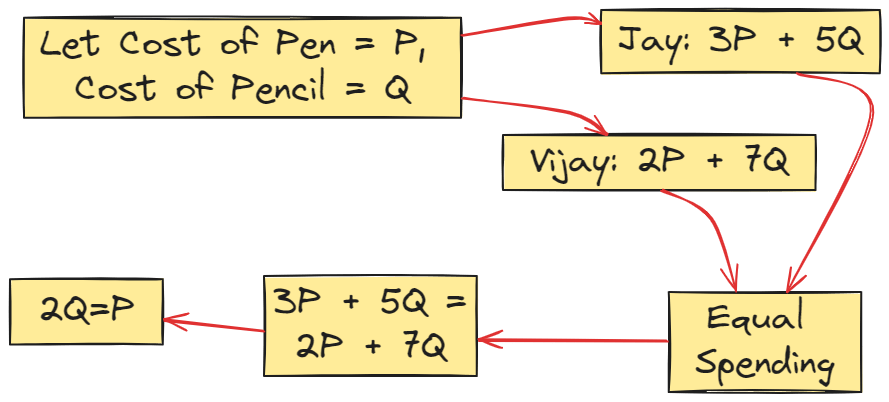
Jay and Vijay

Q. Jay and Vijay spent an equal amount of money to buy some pens and special pencils of the same quality from the same store. If Jay bought 3 pens and 5 pencils, and Vijay bought 2 pens and 7 pencils, then which one of the following is correct ? Read More »

Q. An amount of money was distributed among A, B and c in the ratio p : q : r.

Q. An amount of money was distributed among A, B and C in the ratio p : q : r.

Consider the following statements :
1. A gets the maximum share if p is greater than (q+r).
2. C gets the minimum share if r is less than (p+q).
Which of the above statements is/are correct ?
(a) 1 only
(b) 2 only
(c) Both 1 and 2
(d) Neither 1 nor 2
Correct Answer: (a) 1 only

Question from UPSC Prelims 2021 CSAT Paper

Explanation : 

Amount of money was distributed among a b and c

Ratio of distribution of money among A, B, and C is p : q : r.

Considering statement 1:
If p > (q + r), then p is definitely the largest number.
So, A must have got the maximum share. Hence, statement 1 is correct.

Considering statement 2:
If r < (p + q), then r may or may not be the smallest number.
For example, 5 < (2 + 4)
So, C may or may not have got the minimum share. Hence, statement 2 is incorrect.
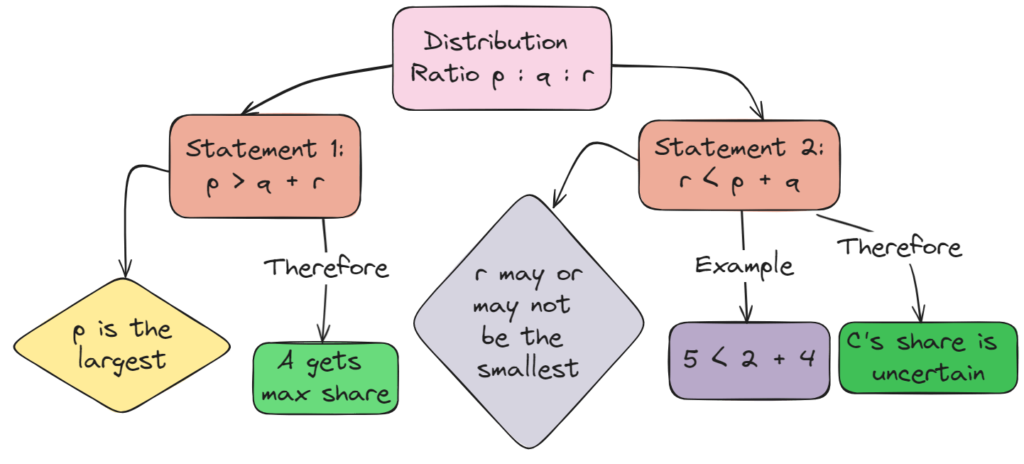
money was distributed

Q. An amount of money was distributed among A, B and c in the ratio p : q : r. Read More »

Q. There are 6 persons arranged in a row. Another person has to shake hands with 3 of them so that he should not shake hands with two consecutive persons. In how many distinct possible combinations can the handshakes take place?

Q. There are 6 persons arranged in a row. Another person has to shake hands with 3 of them so that he should not shake hands with two consecutive persons. In how many distinct possible combinations can the handshakes take place?

(a) 3
(b) 4
(c) 5
(d) 6
Correct Answer: (b) 4

Question from UPSC Prelims 2021 CSAT Paper

Explanation : 

6 Person in a row handshake combinations

Let’s consider the 6 persons in a row as A, B, C, D, E, and F. The person can shake hands with 3 of them in the following distinct combinations:

  1. A C E
  2. A C F
  3. A D F
  4. B D F

In each of these combinations, the person does not shake hands with two consecutive persons. So there are a total of 4 distinct possible combinations for the handshakes to take place, and the correct answer is (b) 4.
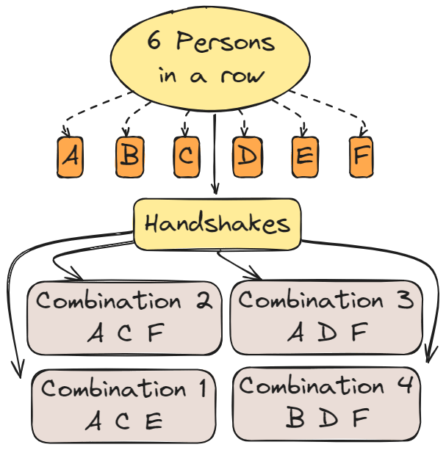
There are 6 persons arranged in a row

Q. There are 6 persons arranged in a row. Another person has to shake hands with 3 of them so that he should not shake hands with two consecutive persons. In how many distinct possible combinations can the handshakes take place? Read More »

Q. A cubical vessel of side 1 m is filled completely with water. How many millilitres of water is contained in it (neglect thickness of the vessel) ?

Q. A cubical vessel of side 1 m is filled completely with water. How many millilitres of water is contained in it (neglect thickness of the vessel) ?

(a) 1000
(b) 10000
(c) 100000
(d) 1000000
Correct Answer: (d) 1000000

Question from UPSC Prelims 2021 CSAT Paper

Explanation : 

Cubical vessel of side 1 m

Calculating Volume of a Cube
Side length = 1 meter
Volume formula = side length³
Volume = 1 × 1 × 1 = 1 cubic meter

Converting to Milliliters:
1 cubic meter = 1000 liters
1 liter = 1000 milliliters

Final Calculation:
Total milliliters = 1000 × 1000
= 1,000,000 milliliters

Answer: (d) 1,000,000 milliliters

Q. A cubical vessel of side 1 m is filled completely with water. How many millilitres of water is contained in it (neglect thickness of the vessel) ? Read More »

Q. Consider the following statements : 1. The sum of 5 consecutive integers can be 100.

Q. Consider the following statements :
1. The sum of 5 consecutive integers can be 100.
2. The product of three consecutive natural numbers can be equal to their sum.

which of the above statements is/are correct?
(a) 1 only
(b) 2 only
(c) Both 1 and 2
(d) Neither 1 nor 2
Correct Answer: (c) Both 1 and 2

Question from UPSC Prelims 2021 CSAT Paper

Explanation : 

Sum & Product of Consecutive Integers

Problem Part 1 – Five Consecutive Integers
Let’s say the first integer is x.
The next four numbers are: x+1, x+2, x+3, and x+4
The sum of these five numbers is 5x + 10
If this sum equals 100, then:
5x + 10 = 100
Solving for x: x = 18
Therefore, the five consecutive integers are: 18, 19, 20, 21, 22

Problem Part 2 – Numbers 1, 2, and 3
Sum: 1 + 2 + 3 = 6
Product: 1 × 2 × 3 = 6

Conclusion:
Both statements are correct since:
1. We found five consecutive integers that sum to 100
2. For numbers 1, 2, and 3, their sum equals their product
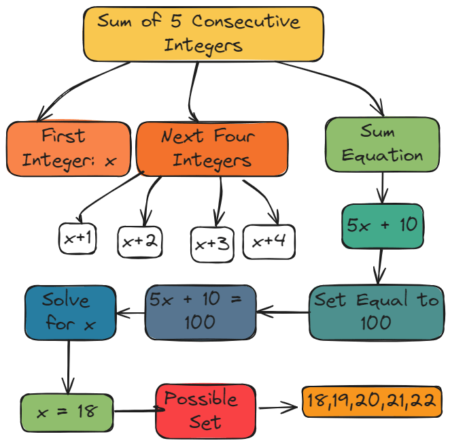
Sum of 5 Consecutive Integers

Q. Consider the following statements : 1. The sum of 5 consecutive integers can be 100. Read More »

Q. Using 2, 2, 3, 3, 3 as digits, how many distinct numbers greater than 30000 can be formed?

Q. Using 2, 2, 3, 3, 3 as digits, how many distinct numbers greater than 30000 can be formed?

(a) 3
(b) 6
(c) 9
(d) 12
Correct Answer: (b) 6

Question from UPSC Prelims 2021 CSAT Paper

Explanation : 

Numbers greater than 30000, using 22333 as digits

Given:
– Digits available: 2,2,3,3,3 (two 2’s and three 3’s)
– Number must be > 30000
– First digit must be 3

Step 1: Organize possible cases
Case 1: First two digits are 33
Remaining digits: 2,2,3
Possible arrangements:
1. 33223
2. 33232
3. 33322

Case 2: First digit 3, second digit 2
Remaining digits: 2,3,3
Possible arrangements:
4. 32233
5. 32323
6. 32332

Step 2: List all numbers in ascending order
1. 32233
2. 32323
3. 32332
4. 33223
5. 33232
6. 33322

Answer: 6 distinct numbers can be formed (Option b is correct)

Q. Using 2, 2, 3, 3, 3 as digits, how many distinct numbers greater than 30000 can be formed? Read More »