Prelims Solution

Q. A boy plays with a ball, and he drops if from a height of 1.5 m.

Q. A boy plays with a ball, and he drops if from a height of 1.5 m.

Every time the ball hits the ground, it bounces back to attain a height 4/5th of the previous height. The ball does not bounce further if the previous height is less than 50 cm. What is the number of times the ball hits the ground before the ball stops bouncing?

(a) 4
(b) 5
(c) 6
(d) 7
Correct Answer: (b) 5

Question from UPSC Prelims 2021 CSAT Paper

Explanation : 

A boy plays with a ball

Starting height = 1.5 meters
Bounce ratio = 4/5 (ball reaches 4/5th of previous height)
Stop condition = height < 0.5 meters (50 cm)

Height Calculations:

1. Initial Drop: 1.5 meters

2. First Bounce:
Height = 1.5 × 4/5 = 1.2 meters

3. Second Bounce:
Height = 1.2 × 4/5 = 0.96 meters

4. Third Bounce:
Height = 0.96 × 4/5 = 0.768 meters

5. Fourth Bounce:
Height = 0.768 × 4/5 = 0.6144 meters

6. Fifth Bounce:
Height = 0.6144 × 4/5 = 0.49152 meters
(This is less than 50 cm, so ball stops)

Result:
– Ball hits ground 5 times before stopping
– Final height (0.49152 m) is below stopping condition (0.5 m)
– Answer: 5 bounces

Q. A boy plays with a ball, and he drops if from a height of 1.5 m. Read More »

Q. A student appeared in 6 papers. The maximum marks are the same for each paper. His marks in these papers are in the proportion 5 : 6 : 7 : 8 : 9 : 10. Overall he scored 60%. In how many number of papers did he score less than 60% of the maximum marks?

Q. A student appeared in 6 papers. The maximum marks are the same for each paper. His marks in these papers are in the proportion 5 : 6 : 7 : 8 : 9 : 10. Overall he scored 60%. In how many number of papers did he score less than 60% of the maximum marks?

(a) 2
(b) 3
(c) 4
(d) 5
Correct Answer: (b) 3

Question from UPSC Prelims 2021 CSAT Paper

Explanation : 

A student appeared in 6 papers

– Total marks per subject = 100
– Total subjects = 6
– Total possible marks = 600
– Overall score = 60% = 360 marks
– Marks distribution pattern: 5x, 6x, 7x, 8x, 9x, 10x

Step 1: Form equation
5x + 6x + 7x + 8x + 9x + 10x = 360
45x = 360

Step 2: Solve for x
x = 360/45 = 8

Step 3: Calculate marks in each subject
Subject 1: 5x = 5 × 8 = 40 marks
Subject 2: 6x = 6 × 8 = 48 marks
Subject 3: 7x = 7 × 8 = 56 marks
Subject 4: 8x = 8 × 8 = 64 marks
Subject 5: 9x = 9 × 8 = 72 marks
Subject 6: 10x = 10 × 8 = 80 marks

Step 4: Count subjects below 60%
60% of 100 = 60 marks
Subjects below 60 marks:
1. 40 marks
2. 48 marks
3. 56 marks

Therefore: Student scored less than 60% in 3 subjects.
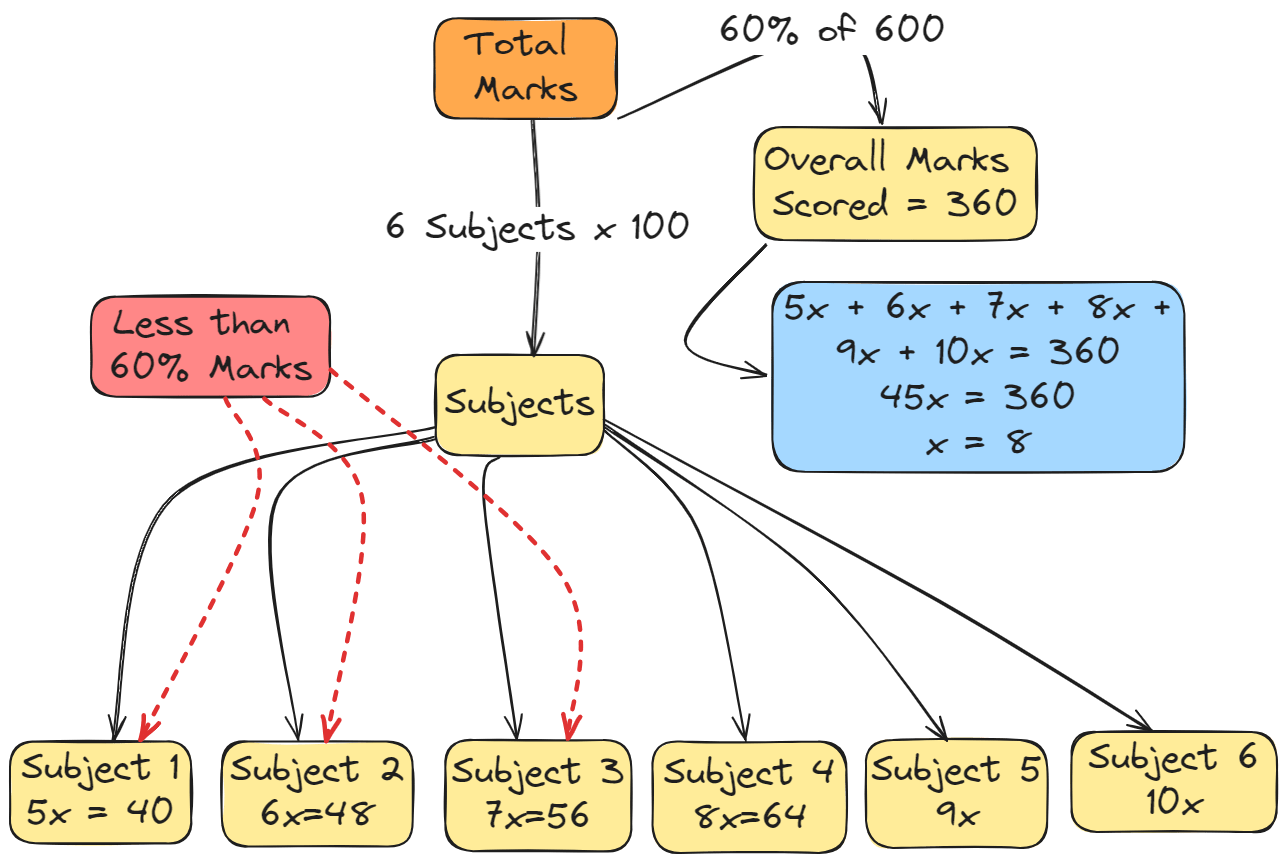
Students Paper Scores Analysis

Q. A student appeared in 6 papers. The maximum marks are the same for each paper. His marks in these papers are in the proportion 5 : 6 : 7 : 8 : 9 : 10. Overall he scored 60%. In how many number of papers did he score less than 60% of the maximum marks? Read More »

Q. There are two Classes A and B having 25 and 30 students respectively. In Class-A the highest score is 21 and lowest score is 17. In Class-B the highest score is 30 and lowest score is 22. Four students are shifted from Class-A to Class-B.

Q. There are two Classes A and B having 25 and 30 students respectively. In Class-A the highest score is 21 and lowest score is 17. In Class-B the highest score is 30 and lowest score is 22. Four students are shifted from Class-A to Class-B.

Consider the following statements:
1. The average score of Class-B will definitely decrease.
2. The average score of Class-A will definitely increase.
Which of the above statements is/are correct?
(a) 1 only
(b) 2 only
(c) Both 1 and 2
(d) Neither 1 nor 2
Correct Answer: (a) 1 only

Question from UPSC Prelims 2021 CSAT Paper

Explanation :

There are two classes a and b

Class A (Initial):
– Total students: 25
– Highest score: 21
– Lowest score: 17
– Four students will be shifted out

Class B (Initial):
– Total students: 30
– Highest score: 30
– Lowest score: 22
– Will receive four students from Class A

Analysis:

1. Effect on Class B’s Average:
– Initial students: 30
– New total: 34 students
– All incoming students have scores ≤ 21
– All original students have scores ≥ 22
– Therefore, adding any four students from Class A will definitely lower Class B’s average

2. Effect on Class A’s Average:
– Initial students: 25
– New total: 21 students
– Cannot determine if average will increase because:

  • If highest scoring students (around 21) are shifted out → average will decrease
  • If lowest scoring students (around 17) are shifted out → average will increase
  • Without knowing which students are shifted, change in average is uncertain

Conclusion:
– Class B’s average will definitely decrease
– Class A’s average could increase or decrease depending on which students are shifted

Q. There are two Classes A and B having 25 and 30 students respectively. In Class-A the highest score is 21 and lowest score is 17. In Class-B the highest score is 30 and lowest score is 22. Four students are shifted from Class-A to Class-B. Read More »

Q.  Consider all 3-digit numbers (without repetition of digits) obtained using three non-zero digits) obtained using three non-zero digits which are multiples of 3. Let S be their sum.

Q.  Consider all 3-digit numbers (without repetition of digits) obtained using three non-zero digits) obtained using three non-zero digits which are multiples of 3. Let S be their sum.

Which of the following is/are correct?
1. S is always divisible by 74.
2. S is always divisible by 9.
Select the correct answer using the code given below:
(a) 1 only
(b) 2 only
(c) Both 1 and 2
(d) Neither 1 nor 2
Correct Answer: (c) Both 1 and 2

Question from UPSC Prelims 2021 CSAT Paper

Explanation:

Sum of 3-Digit Numbers with Digits 3, 6, and 9

Given Digits: 3, 6, 9

Step 1: List all possible 3-digit combinations (without repetition)
1. 369
2. 396
3. 639
4. 693
5. 936
6. 963

Step 2: Calculate sum (S)
369 + 396 + 639 + 693 + 936 + 963 = 3996

Step 3: Verify divisibility by 74
3996 ÷ 74 = 54
Therefore, 3996 is divisible by 74

Step 4: Verify divisibility by 9
3996 ÷ 9 = 444
Therefore, 3996 is divisible by 9
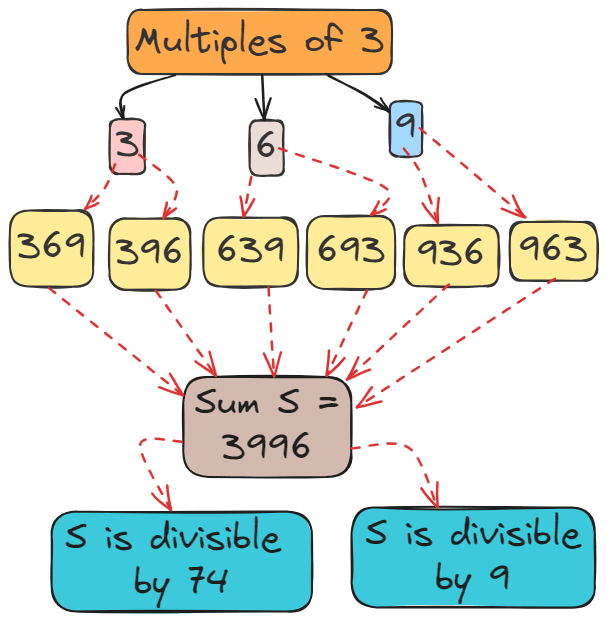
s is always divisible by 74

Q.  Consider all 3-digit numbers (without repetition of digits) obtained using three non-zero digits) obtained using three non-zero digits which are multiples of 3. Let S be their sum. Read More »

Q. How many zeroes are there at the end of the following product? 

Q. How many zeroes are there at the end of the following product?

1 x 5 x 10 x 15 x 20 x 25 x 30 x 35 x 40 x 45 x 50 x 55 x 60
(a) 10
(b) 12
(c) 14
(d) 15
Correct Answer: (a) 10

Question from UPSC Prelims 2020 CSAT Paper

Explanation : 

Number of zeroes at the end of product

1 × 5 × 10 × 15 × 20 × 25 × 30 × 35 × 40 × 45 × 50 × 55 × 60

= 1 × 5 × (5 × 2) × (5 × 3) × (5 × 2^2) × (5 × 5) × (5 × 3 × 2) × (5 × 7) × (5 × 2^3) × (5 × 9) × (5 × 5 × 2) × (5 × 11) × (5 × 2^2 × 3)

Here, number of 2s = 10
And number of 5s = 14
The lesser of the two will determine the number of zeros.
Hence, there will be 10 zeros at the end in the given expression.

Number of Zeroes in Product

Q. How many zeroes are there at the end of the following product?  Read More »

Q. If you have two straight sticks of length 7.5 feet and 3.25 feet, what is the minimum length can you measure?

Q. If you have two straight sticks of length 7.5 feet and 3.25 feet, what is the minimum length can you measure?

(a) 0.05 foot
(b) 0.25 foot
(c) 1 foot
(d) 3.25 feet

Correct Answer – (b) 0.25 foot.

Question from UPSC Prelims 2020 CSAT Paper

Model Answer:

If you have two straight sticks of length 7.5 feet and 3.25 feet

To find the minimum length that can be measured using two straight sticks of length 7.5 feet and 3.25 feet using the Highest Common Factor (HCF) method, we can first convert the lengths to inches:

7.5 feet = 90 inches
3.25 feet = 39 inches

Then, we can find the HCF of 90 and 39:

90 = 2 * 3 * 3 * 5
39 = 3 * 13

The common factor is 3, so the HCF is 3 inches.

Two Straight Sticks 7.5 & 3.25 Feet

Therefore, the minimum length that can be measured with these two sticks is 3 inches, which is equivalent to 0.25 feet.

Hence, the correct answer is (b) 0.25 foot.

Q. If you have two straight sticks of length 7.5 feet and 3.25 feet, what is the minimum length can you measure? Read More »

Q. As a result of 25% hike in the price of rice per kg, a person is able to purchase 6 kg less rice for Rs. 1,200. What Was the Original price of rice per kg?

Q. As a result of 25% hike in the price of rice per kg, a person is able to purchase 6 kg less rice for Rs. 1,200. What was the original price of rice per kg?

(a) Rs. 30
(b) Rs. 40
(c) Rs. 50
(d) Rs. 60
Correct Answer: (b) Rs. 40

Question from UPSC Prelims 2020 CSAT Paper

Explanation : 

As a result of 25 hike -> Finding original price of rice 

Given Information:
– Original price of rice = x rupees per kg
– Price increased by 25%
– New price = 1.25x rupees per kg
– Available money = Rs. 1,200
– Difference in quantity = 6 kg

Step 1: Calculate quantity before price hike
Original quantity = 1200/x kg

Step 2: Calculate quantity after price hike
New quantity = 1200/(1.25x) kg

Step 3: Set up equation using difference
1200/x – 1200/(1.25x) = 6

Step 4: Solve for x
1200/x – 960/x = 6
(1200 – 960)/x = 6
240/x = 6
x = 40

Therefore:
– Original price of rice = Rs. 40 per kg
– After 25% increase, new price = Rs. 50 per kg
– Original quantity = 1200/40 = 30 kg
– New quantity = 1200/50 = 24 kg
– Difference = 30 – 24 = 6 kg

Q. As a result of 25% hike in the price of rice per kg, a person is able to purchase 6 kg less rice for Rs. 1,200. What Was the Original price of rice per kg? Read More »

Statements: All cats are dogs. All cats are black.

Q. Two Statements are given followed by two Conclusions:

Statements: All cats are dogs. All cats are black.

Conclusion-l: All dogs are black.
Conclusion-ll: Some dogs are not black.

Which of the above Conclusions logically follows/follow from the two given Statements disregarding commonly known facts?
(a) Only Conclusion-l
(b) Only Conclusion-II
(c) Neither Conclusion-I nor Conclusion-II
(d) Both Conclusions-I and Conclusion-Il
Correct Answer: (c) Neither Conclusion-I nor Conclusion-II

Question from UPSC Prelims 2020 CSAT Paper

Explanation : 

All cats are dogs. All cats are black.

1. For Conclusion I – “All dogs are black”:
– While we know all cats are black and all cats are dogs
– We cannot conclude all dogs are black
– Because not all dogs may be cats
– Example: There could be dogs that are not cats, and these dogs could be any color

2. For Conclusion II – “Some dogs are not black”:
– We cannot conclude this either
– The statements give no information about dogs that are not cats
– Making any assumption about non-cat dogs would be illogical

Therefore:
Neither conclusion can be logically derived from the given statements. The statements only tell us about cats (that they are dogs and they are black) but give no complete information about dogs.

Correct Answer: Neither Conclusion-I nor Conclusion-II follows from the given statements.

Statements: All cats are dogs. All cats are black. Read More »

Q. A is 16th from the left end in a row or boys and V is 18th from the right end. Q is 11th from A towards the right and 3rd from V towards the right end. How many boys are there in the row? 

Q. A is 16th from the left end in a row or boys and V is 18th from the right end. Q is 11th from A towards the right and 3rd from V towards the right end. How many boys are there in the row?

(a) 40
(b) 41
(c) 42
(d) Cannot be determined due to insufficient data
Correct Answer: (b) 41

Question from UPSC Prelims 2020 CSAT Paper

Explanation : 

A is 16th from the left end in a row

Problem: Finding total number of boys in a row

Given:
– A is 16th from left end
– V is 18th from right end
– Q is 11th from A towards right
– Q is 3rd from V towards right

Solution:
1. Find Q’s position from left:
– A is 16th from left
– Q is 11th right of A
– So Q is 16 + 11 = 27th from left

2. Find Q’s position from right:
– V is 18th from right
– Q is 3rd right of V
– So Q is 18 – 3 = 15th from right

3. Calculate total boys:
– Q’s position from left = 27
– Q’s position from right = 15
– Total boys = Left position + Right position – 1
– Total = 27 + 15 – 1 = 41 (Subtract 1 because Q is counted twice)

Therefore, there are 41 boys in the row.

Q. A is 16th from the left end in a row or boys and V is 18th from the right end. Q is 11th from A towards the right and 3rd from V towards the right end. How many boys are there in the row?  Read More »

Q. How many pairs of natural numbers are there such that the difference of whose squares is 63? 

Q. How many pairs of natural numbers are there such that the difference of whose squares is 63?

(a) 3
(b) 4
(c) 5
(d) 2
Correct Answer: (a) 3

Question from UPSC Prelims 2020 CSAT Paper

Explanation :

Problem: Find pairs of numbers whose difference of squares is 63

Given:
– Two natural numbers x and y where x > y
– x² – y² = 63

Solution:
1. Factor the equation:
x² – y² = (x+y)(x-y) = 63

2. Find factors of 63:
63 = 1 × 63
63 = 3 × 21
63 = 7 × 9

3. For each factor pair (a,b):
x + y = larger number
x – y = smaller number

Solving:
x = (larger + smaller)/2
y = (larger – smaller)/2

4. Calculate pairs:
For 63,1:
x = (63 + 1)/2 = 32
y = (63 – 1)/2 = 31

For 21,3:
x = (21 + 3)/2 = 12
y = (21 – 3)/2 = 9

For 9,7:
x = (9 + 7)/2 = 8
y = (9 – 7)/2 = 1

Therefore, three pairs of numbers exist: (32,31), (12,9), and (8,1)

Q. How many pairs of natural numbers are there such that the difference of whose squares is 63?  Read More »