Prelims Solution

Q. A car travels from a place X to place Y at an average speed of v km/hr from y to X at an average speed of 2v km/hr, again from X to y at an average speed of 3v km/hr and again from y to x at an average speed of 4v km/hr. Then the average speed of the car for the entire journey

Q. A car travels from a place X to place Y at an average speed of v km/hr from y to X at an average speed of 2v km/hr, again from X to y at an average speed of 3v km/hr and again from y to x at an average speed of 4v km/hr. Then the average speed of the car for the entire journey

(a) Is less than v km/hr
(b) Lies between v and 2v km/hr
(c) Lies between 2v and 3v km/hr
(d) Lies between 3v and 4v km/hr
Correct Answer: (b) Lies between v and 2v km/hr

Question from UPSC Prelims 2020 CSAT Paper

Explanation : 

Car travels from place x to y

Given: Car travels from X to Y multiple times
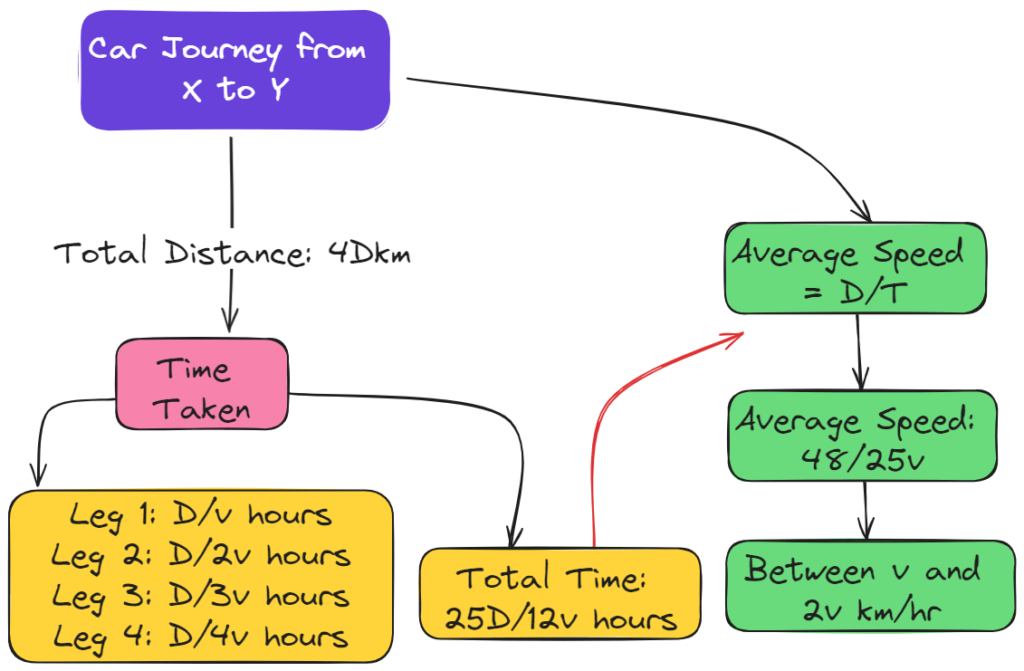
Distance: X to Y = D km
Total journey = 4 legs × D = 4D km

Time taken for each leg:
1. X to Y: D/v hours (speed = v)
2. Y to X: D/(2v) hours (speed = 2v)
3. X to Y: D/(3v) hours (speed = 3v)
4. Y to X: D/(4v) hours (speed = 4v)

Calculations:
1. Total Time = D/v + D/(2v) + D/(3v) + D/(4v)
= (12D + 6D + 4D + 3D)/(12v)
= 25D/(12v) hours

2. Average Speed = Total Distance/Total Time
= 4D/(25D/12v)
= (48/25)v km/hr
≈ 1.92v km/hr

Conclusion:
Since 48/25 is approximately 1.92:
v < (48/25)v < 2v

Therefore, answer is (b): Average speed lies between v and 2v km/hr.
Car travels from place x to y

Q. A car travels from a place X to place Y at an average speed of v km/hr from y to X at an average speed of 2v km/hr, again from X to y at an average speed of 3v km/hr and again from y to x at an average speed of 4v km/hr. Then the average speed of the car for the entire journey Read More »

Q. A person bought a car and sold it for Rs. 3, 00,000. If he incurred a loss of 20%, then how much did he spend to buy the car? 

Q. A person bought a car and sold it for Rs. 3, 00,000. If he incurred a loss of 20%, then how much did he spend to buy the car?

(a) Rs. 3,60,000
(b) Rs. 3,65,000
(c) Rs. 3,70,000
(d) Rs. 3,75,000
Correct Answer: (d) Rs. 3,75,000

Question from UPSC Prelims 2020 CSAT Paper

Explanation :

A person bought a car and sold it for 3 lakh

Given Information:
– Selling Price (SP) = Rs. 3,00,000
– Loss = 20%
– Therefore, SP = 80% of Cost Price

Solution:
1. Let Cost Price = x

2. We can write:
80% of x = 3,00,000
0.8x = 3,00,000

3. Solving for x:
x = 3,00,000/0.8
x = Rs. 3,75,000

Conclusion: The Cost Price of the car was Rs. 3,75,000. Therefore, answer is (d): Rs. 3,75,000

A person bought a car

Q. A person bought a car and sold it for Rs. 3, 00,000. If he incurred a loss of 20%, then how much did he spend to buy the car?  Read More »

Q. A sum of Rs. 2,500 is distributed among X, Y and Z in the ratio 

Q. A sum of Rs. 2,500 is distributed among X, Y and Z in the ratio

½: ¾: 5/6
What is the difference between the maximum share and the minimum share?
(a) Rs. 300
(b) Rs. 350
(c) Rs. 400
(d) Rs. 450
Correct Answer: (c) Rs. 400

Question from UPSC Prelims 2020 CSAT Paper

Explanation :

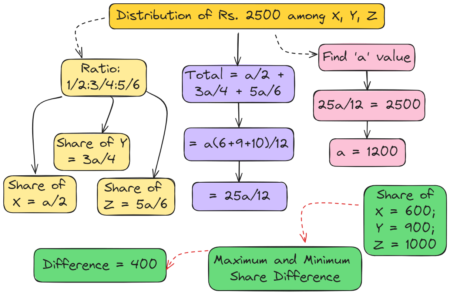
Sum of 2500 is distributed

Given Information:
Total Amount = 2500
Shares distribution:
– X gets a/2
– Y gets 3a/4
– Z gets 5a/6

Solution:
1. Total shares = a/2 + 3a/4 + 5a/6
= a(6 + 9 + 10)/12
= 25a/12

2. Since total is 2500:
25a/12 = 2500
a = 1200

3. Individual Shares:
X = a/2 = 1200/2 = 600
Y = 3a/4 = 3(1200)/4 = 900
Z = 5a/6 = 5(1200)/6 = 1000

4. Finding Difference:
Maximum share = 1000 (Z’s share)
Minimum share = 600 (X’s share)
Difference = 1000 – 600 = 400

Therefore, the difference between maximum and minimum share is 400.

Sum of 2500 among

Q. A sum of Rs. 2,500 is distributed among X, Y and Z in the ratio  Read More »

How many odd numbers are followed by the odd number in the above sequence?

Q. Consider the following sequence of numbers:
51473985726315863852243496

How many odd numbers are followed by the odd number in the above sequence?

(a) 5
(b) 6
(c) 7
(d) 8
Correct Answer: (b) 6

Question from UPSC Prelims 2020 CSAT Paper

Explanation : 

Let’s solve this step by step.

1) First, marking all odd numbers in the sequence:
5,1,4,7,3,9,8,5,7,2,6,3,1,5,8,6,3,8,5,2,2,4,3,4,9,6

2) Finding consecutive odd number pairs:
5,1 ✓
1,4
4,7
7,3 ✓
3,9 ✓
9,8
8,5
5,7 ✓
7,2
2,6
6,3
3,1 ✓
1,5 ✓
5,8
8,6
6,3
3,8
8,5
5,2
2,2
2,4
4,3
3,4
4,9
9,6

3) Count of pairs marked with ✓: 6

The answer is (b) 6.

How many odd numbers are followed by the odd number in the above sequence? Read More »

Q. Two Statements are given followed by two Conclusions:  Statements:  All numbers are divisible by 2. All numbers are divisible by 3. 

Q. Two Statements are given followed by two Conclusions:

Statements:
All numbers are divisible by 2.
All numbers are divisible by 3.

Conclusion-l
All numbers are divisible by 6.
Conclusion-II
All numbers are divisible by 4.

Which of the above Conclusions logically follows/follow from the two given Statements?
(a) Only Conclusion-l
(b) Only Conclusion-II
(c) Neither Conclusion-I nor conclusion-Il
(d) Both Conclusions-I and Conclusion-II
Correct Answer: (a) Only Conclusion-l

Question from UPSC Prelims 2020 CSAT Paper

Explanation : 

Conclusion-I: All numbers are divisible by 6

Analysis:

– The numbers are divisible by both 2 and 3
– 6 is the least common multiple (LCM) of 2 and 3
– Any number divisible by both 2 and 3 must be divisible by their LCM (6)
– Therefore, Conclusion-I is TRUE

Conclusion-II: All numbers are divisible by 4

Analysis:

– Just because a number is divisible by 2 and 3 doesn’t mean it’s divisible by 4
– Example: 6 is divisible by both 2 and 3, but not by 4
– Therefore, Conclusion-II is FALSE

Q. Two Statements are given followed by two Conclusions:  Statements:  All numbers are divisible by 2. All numbers are divisible by 3.  Read More »

Q. A man walks down the backside of his house straight 25 meters, then turns to the right and walks 50 meters again; then he turns towards left and again walks 25 meters. If his house faces to the East, what is his direction from the starting point? 

Q. A man walks down the backside of his house straight 25 meters, then turns to the right and walks 50 meters again; then he turns towards left and again walks 25 meters. If his house faces to the East, what is his direction from the starting point?

(a) South-East
(b) South-west
(c) North-East
(d) North-west
Correct Answer: (d) North-west

Question from UPSC Prelims 2020 CSAT Paper

Explanation : 

A man walks down the backside of his house

The man starts at the back of his house facing East. He then walks 25 meters straight down the backside of his house. Since he is walking away from the house and the house faces East, he is now facing West.

He then turns to his right and walks 50 meters. Since he was originally facing West and turned right, he is now facing North.

Finally, he turns left and walks another 25 meters. Since he was originally facing North and turned left, he is now facing West again.

So from his starting point at the back of his house, the man has walked in a rectangular path and ended up to the North-West of where he started. So the correct answer is (d) North-west.

Q. A man walks down the backside of his house straight 25 meters, then turns to the right and walks 50 meters again; then he turns towards left and again walks 25 meters. If his house faces to the East, what is his direction from the starting point?  Read More »

Q. Two Statements S1 and S2 are given below with regard to two numbers followed by a Question:  S1: Their product is 21.  S2: Their sum is 10. 

Q. Two Statements S1 and S2 are given below with regard to two numbers followed by a Question:

S1: Their product is 21.
S2: Their sum is 10.

Question: What are the two numbers?
Which one of the following is correct in respect of the above Statements and the Question?
(a) S1 alone is sufficient to answer the Question.
(b) S2 alone is sufficient to answer the Question.
(c) S1 and S2 together are sufficient to answer the Question, but neither S1 alone nor S2 alone is sufficient to answer the Question.
(d) S1 and S2 together are not sufficient to answer the Question.
Correct Answer: (c) S1 and S2 together are sufficient to answer the Question, but neither S1 alone nor S2 alone is sufficient to answer the Question.

Question from UPSC Prelims 2020 CSAT Paper

Explanation :

Product is 21 and Sum is 10

Statement S1: xy = 21
Statement S2: x + y = 10

Solution Steps:
1. From S1: y = 21/x

2. Substitute this in S2:
x + 21/x = 10

3. Solve for x:
Multiply both sides by x: x² + 21 = 10x
Rearrange: x² – 10x + 21 = 0
Factor: (x – 7)(x – 3) = 0
Therefore: x = 7 or x = 3

4. Find corresponding y values:
When x = 7: y = 21/7 = 3
When x = 3: y = 21/3 = 7

5. The two numbers are 3 and 7

Conclusion:
Neither statement alone is sufficient, but together they give us the unique solution. Therefore, answer is (c): S1 and S2 together are sufficient to answer the Question.

Q. Two Statements S1 and S2 are given below with regard to two numbers followed by a Question:  S1: Their product is 21.  S2: Their sum is 10.  Read More »

Question: If n is a unique natural number between 10 and 20, then what is n?

Q.Two Statements S1 and S2 are given below followed by a Question:

S1: n is a prime number.
S2: n leaves a remainder of 1 when divided by 4.

Question: If n is a unique natural number between 10 and 20, then what is n?

Which one of the following is correct in respect of the above the Statements and Question?
(a) S1 alone is sufficient to answer the Question.
(b) S2 alone is sufficient to answer the Question.
(c) S1 and S2 together are sufficient to answer the Question, but neither S1 alone nor S2 alone is sufficient to answer the Question.
(d) S1 and S2 together are not sufficient to answer the Question.
Correct Answer: (d) S1 and S2 together are not sufficient to answer the Question.

Question from UPSC Prelims 2020 CSAT Paper

Explanation : 

Analysis of Statement S2:
– When a number n is divided by 4, remainder is 1
– Such numbers can be written as: n = 4k + 1 (where k is an integer)
– Numbers between 10 and 20 that fit this pattern are: 11, 13, 15, 17, 19

Analysis of Statement S1:
– Number n must be prime
– From the above list, only 11 and 17 are prime numbers
– So S1 alone gives us two possibilities: n = 11 or n = 17

Combined Analysis:
– Both statements together still give us two possibilities
– Both 11 and 17:
Are prime numbers (satisfying S1)
Leave remainder 1 when divided by 4 (satisfying S2)

Conclusion:
Therefore, answer is (d): S1 and S2 together are not sufficient to determine a unique value of n.

Question: If n is a unique natural number between 10 and 20, then what is n? Read More »

S1: R is greater-than P as well as Q.  S2: S is not the largest one. 

Q. Two Statements S1 and S2 are given below with regard to four numbers P, Q, R and S followed by a Question:

S1: R is greater-than P as well as Q.
S2: S is not the largest one.

Among four numbers P, Q, R and S which one is the largest?
Which one of the following is correct in respect of the above Statements and the Question?
(a) S1 alone is sufficient to answer the Question.
(b) S2 alone is sufficient to answer the Question.
(c) S1 and S2 together are sufficient to answer the Question, but neither S1 alone nor S2 alone is sufficient to answer the Question.
(d) S1 and S2 together are not sufficient to answer the Question.
Correct Answer: (c) S1 and S2 together are sufficient to answer the Question, but neither S1 alone nor S2 alone is sufficient to answer the Question.

Question from UPSC Prelims 2020 CSAT Paper

Explanation : 

S1: R is greater than both P and Q

– This alone is not enough to determine the largest number
– R could be either largest or second largest

S2: S is not the largest number

– This alone is not enough to determine the largest number
– S could be second largest, third largest, or smallest

Combined Analysis:
When we use both statements together:
1. R is greater than P and Q (from S1)
2. S is not the largest (from S2)
3. Since R is greater than P and Q, and S cannot be largest, R must be the largest number

Conclusion:
Therefore, answer is (c): S1 and S2 together are sufficient to answer the Question, but neither S1 alone nor S2 alone is sufficient.

S1: R is greater-than P as well as Q.  S2: S is not the largest one.  Read More »

Q. A family of two generations consisting of six members P, Q, R, S, T and U has three males and three females.

Q. A family of two generations consisting of six members P, Q, R, S, T and U has three males and three females.

There are two married couples and two unmarried siblings. U is P ‘s daughter and Q is R ‘s mother – in – law. T is an unmarried male and S is a male. Which one of the following is correct?
(a) R is U’s husband.
(b) R is S’s wife.
(c) S is unmarried.
(d) None of the above
Correct Answer: (b) R is S’s wife.

Question from UPSC Prelims 2020 CSAT Paper

Explanation : 

A family of two generations consisting of 6 members

From the given information:
– U is P’s daughter
– Q is R’s mother-in-law
– T is an unmarried male
– S is a male
– There are two married couples in the family

Analysis:
1. Since Q is R’s mother-in-law, R must be married to one of Q’s children
2. We know T is unmarried and S is male
3. With two married couples and T being unmarried, S must be married
4. Since R is married to Q’s child and S is married, R must be S’s wife

Conclusion:
Therefore, R is S’s wife.

Q. A family of two generations consisting of six members P, Q, R, S, T and U has three males and three females. Read More »