Q. A simple mathematical operation in each number of the sequence 14, 18, 20, 24, 30, 32, results in a sequence with respect to prime numbers. Which one of the following is the next number in the sequence?
If we subtract 1 from each number in the original sequence, we get the following sequence:
13, 17, 19, 23, 29, 31
Notice that this is simply the sequence of prime numbers starting from 13.
The next prime number after 31 is 37. Therefore, the next number in the original sequence, which corresponds to the prime number 37 after subtracting 1, is:
Q. Let x, y be the volumes; m, n be the masses of two metallic cubes P and Q respectively. Each side of Q is two times that of P and mass of Q is two times that of P.
Let u =m/x and V=n/y. which one or the following is correct? (a) u = 4v (b) u = 2v (c) v=u (d) v = 4u Correct Answer: (a) u = 4v
Question from UPSC Prelims 2020 CSAT Paper
Explanation :
Let x y be the volumes …
Let’s solve this step by step.
1) Let’s say the side length of cube P is ‘a’ Then volume of P (x) = a³ Mass of P is m
2) For cube Q: Side length is 2a (given: each side of Q is two times that of P) Volume of Q (y) = (2a)³ = 8a³ Mass of Q (n) = 2m (given: mass of Q is two times that of P)
3) Now, let’s calculate u = m/x u = m/a³
4) Let’s calculate v = n/y v = 2m/(8a³) v = (2m)/(8a³) v = m/(4a³) v = (m/a³)/4 v = u/4
Q. Consider the following data: Girls’s Average marks in English = 9 Girls’s Average marks in Hindi = 8 Boys’s Average marks in English = 8 Boys’s Average marks in Hindi = 7 Overall Average marks in English = 8.8
What is the value of Overall Average marks in Hindi?
Q. Let A3BC and DE2F be four-digit numbers where each letter represents a different digit greater than 3. If the sum of the numbers is 15902, then what is the difference between the values of A and D?
(a) 1 (b) 2 (c) 3 (d) 4 Correct Answer: (c) 3
Question from UPSC Prelims 2020 CSAT Paper
Explanation :
Let a3bc and de2f be four digits
As per the given condition in the question, each letter represents a different digit greater than 3. So we can replace the letters with 4, 5, 6, 7, 8, or 9. A3BC + DE2F = 15902 Step 1: Unit digit If we add C & F, then we should get 12. Only then can we get 2 at the unit place in the sum (15902). So, C, F can be (4, 8) or (5, 7) Step 2: Tens digit We got a carry of 1 from 12. Now, we know that the tens digit of the sum, 15902 is 0. So, B + 2 = 9 Or B = 7 Hence, C, F cannot be (5, 7). They must be (4, 8). Step 3: Hundreds digit We got a carry of 1 from 10. Now, we know that the hundreds digit of the sum, 15902 is 9. So, E + 3 = 8 Or E = 8 – 3 = 5 Hence, we found that B =7, C = 4/8, E = 5 and F = 4/8 So, A/D = 6/9 So, difference between A and D = 9 – 6 = 3
Q. One page is torn from a booklet whose pages are numbered in the usual manner starting from the first page as 1. The sum of the numbers on the remaining pages is 195. The torn page contains which of the following numbers?
1) In a booklet, pages are numbered consecutively starting from 1. 2) When one page (which has numbers on both sides) is torn out, the sum of remaining numbers is 195. 3) Let’s say the last page number in the booklet is n.
4) Sum of all numbers from 1 to n = n(n+1)/2
5) When one page is torn out, it removes two consecutive numbers (front and back). Let’s call these numbers x and x+1.
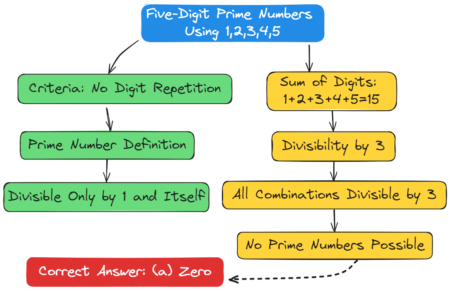
Q. How many 5 digit prime numbers can be obtained by using all the digits 1, 2, 3, 4 and 5 without repetition of digits?
(a) Zero (b) One (c) Nine (d) Ten Correct Answer: (a) Zero
Question from UPSC Prelims 2020 CSAT Paper
Explanation :
5 digit prime numbers
To determine how many five-digit prime numbers can be obtained by using all the digits 1, 2, 3, 4, and 5 without repetition, we can use the fact that a number is prime if and only if it is divisible only by 1 and itself.
Next, consider the sum of the digits of any five-digit number formed using these digits. The sum is 1 + 2 + 3 + 4 + 5 = 15, which is divisible by 3. Therefore, Zero is the answer.
1) For numbers 10-99 (excluding 100): Tens digits: Each digit (1 to 9) appears 10 times Sum of tens digits = (1+2+3+4+5+6+7+8+9) × 10 Sum of tens digits = 45 × 10 = 450
2) Units digits: Each digit (0 to 9) appears 9 times Sum of units digits = (0+1+2+3+4+5+6+7+8+9) × 9 Sum of units digits = 45 × 9 = 405
3) For number 100: Sum of its digits = 1 + 0 + 0 = 1
4) Total sum = Sum of tens digits + Sum of units digits + Sum of digits in 100 Total = 450 + 405 + 1 = 856
Therefore, the sum of all digits which appear in all the integers from 10 to 100 is 856. The answer is (b) 856.
