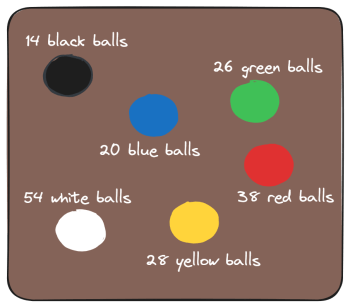
Q. A box contains 14 black balls, 20 blue balls, 26 green balls, 28 yellow balls, 38 red balls and 54 white balls.
Explanation :
Ball Drawing from Box with black, blue, green, yellow, red, white balls.
Statement 1 – Finding the Smallest Number n
To find the smallest number n such that any n balls drawn from the box randomly must contain one full group of at least one colour, we need to consider the worst-case scenario. That is, we draw all the balls except one from each colour. This means we draw 13 black balls, 19 blue balls, 25 green balls, 27 yellow balls, 37 red balls, and 53 white balls. The total number of balls drawn in this case is 174. If we draw one more ball, we are guaranteed to have a full group of at least one colour. Therefore, the smallest number n is 175.
Statement 2 – Finding the Smallest Number m
The smallest number m such that any m balls drawn from the box randomly must contain at least one ball of each colour is 167. This is because in the worst-case scenario, we can draw 166 balls without selecting a black ball (since black balls are the least in number). Once we have drawn these 166 balls, the next ball we draw will certainly be a black ball, ensuring that we have at least one ball of each colour. Therefore, m = 166 + 1 = 167.