Prelims Solution

Q. Consider the sequence ABC_ _ ABC_ DABBCD_ ABCD that follows a certain pattern. Which one of the following completes the sequence?

Q. Consider the sequence ABC_ _ ABC_ DABBCD_ ABCD that follows a certain pattern.
Which one of the following completes the sequence?

(a) DACB
(b) CDAB
(c) DCCA
(d) DDCA
Correct Answer: (d) DDCA

Question from UPSC Prelims 2023 CSAT

Explanation : 

The sequence follows the pattern where each group of 4 letters is a permutation of ABCD, where each letter appears once more than it did in the previous group.

In the first group, A appears once, B appears once, C appears once, and D does not appear.

In the second group, A appears twice, B appears twice, C does not appear, and D appears once.

In the third group, A appears once, B appears once, C appears once, and D appears twice.

Following this pattern, in the fourth group, A should appear twice, B should not appear, C should appear once, and D should appear twice.

Therefore, the correct answer is (d) DDCA.

Q. Consider the sequence ABC_ _ ABC_ DABBCD_ ABCD that follows a certain pattern. Which one of the following completes the sequence? Read More »

Q. Consider the following: I. A+B means A is neither smaller nor equal to B. II. A-B means A is not greater than B. III. A x B means A is not smaller than B. IV. A B means A is neither greater nor equal to B. V. AB means A is neither smaller nor greater than B.

Q. Consider the following:
I. A+B means A is neither smaller nor equal to B.
II. A-B means A is not greater than B.
III. A x B means A is not smaller than B.
IV. A B means A is neither greater nor equal to B.
V. AB means A is neither smaller nor greater than B.
Statement: PXQ, P-T, T÷R, R±S
Conclusion-1: Q±T
Conclusion-2: S+Q

Which one of the following is correct in respect of the above Statement and the Conclusions ?
(a) Only Conclusion-1 follows from the Statement.
(b) Only Conclusion-2 follows from the Statement.
(c) Both Conclusion-1 and Conclusion-2 follow from the Statement.
(d) Neither Conclusion-1 nor Conclusion-2 follows from the Statement.
Correct Answer: (b) Only Conclusion-2 follows from the Statement.

Question from UPSC Prelims 2023 CSAT

Explanation : 

From the given statement, we can interpret the following:

I. P is not smaller than Q (P≥Q)
II. P is not greater than T (P≤T)
III. T is not smaller than R (T≥R)
IV. R is neither greater nor equal to S (R<S)

Now, let’s analyze the conclusions:

Conclusion-1: Q is neither greater nor equal to T (Q<T). This conclusion does not follow from the statement because we know that P≥Q and P≤T, but we cannot determine the relationship between Q and T.

Conclusion-2: S is not smaller than Q (S≥Q). This conclusion follows from the statement. Since P≥Q, P≤T, T≥R, and R<S, we can infer that S≥Q.

Therefore, only Conclusion-2 follows from the statement. So, the correct answer is (b) Only Conclusion-2 follows from the Statement.

Q. Consider the following: I. A+B means A is neither smaller nor equal to B. II. A-B means A is not greater than B. III. A x B means A is not smaller than B. IV. A B means A is neither greater nor equal to B. V. AB means A is neither smaller nor greater than B. Read More »

Q. There are large number of silver coins D weighing 2 gm, 5 gm, 10 gm, 25 gm, 50 gm R each.

Q. There are large number of silver coins D weighing 2 gm, 5 gm, 10 gm, 25 gm, 50 gm R each.

Consider the following statements:
1. To buy 78 gm of coins one must buy at least 7 coins.
2. To weigh 78 gm using these coins one can use less than 7 coins.

Which of the statements given above is/are correct?
(a) 1 only
(b) 2 only
(c) Both 1 and 2
(d) Neither 1 nor 2
Correct Answer: (c) Both 1 and 2

Question from UPSC Prelims 2023 CSAT

Explanation : 

Minimum Number of Coins to Buy 78 gm

To buy 78 gm of coins, with the largest coin being 50 gm and the smallest coin being 2 gm, we need to find the minimum number of coins required.

If we try to use only one of each coin weight, the sum would be: 50 + 10 + 10 + 2 + 2 + 2 + 2 = 78

So, using one coin of each weight, we need to buy 7 coins to get a total of 78 gm.

To weigh 78 gm using these coins, one can use 5 coins of 50 gm, 25 gm, 10 gm, -5 gm, and -2 gm. This is done by placing the 50 gm, 25 gm, and 10 gm coins on one side of the balance and the -5 gm and -2 gm coins (which are actually 5 gm and 2 gm coins, but placed on the opposite side) on the other side.

Therefore, both statements are correct. The answer is (c) Both 1 and 2.
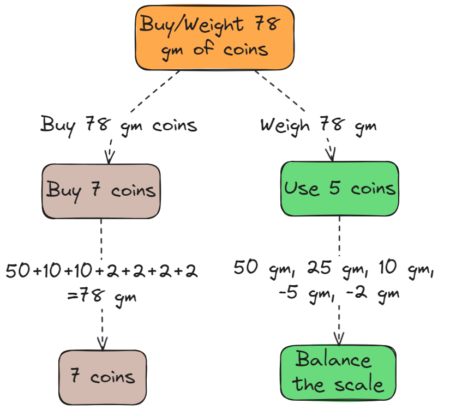
Buy-Weight 78 gm of coins

Q. There are large number of silver coins D weighing 2 gm, 5 gm, 10 gm, 25 gm, 50 gm R each. Read More »

Q. For five children with ages a

Q. For five children with ages a<b<c<d< e; any two successive ages differ by 2 years.

Question: What is the age of the youngest child?
Statement-1: The age of the eldest is 3 times the youngest.
Statement-2: The average age of the children is 8 years.

Which one of the following is correct in respect of the above Question and the Statements?
(a) The Question can be answered by using one of the Statements alone, but cannot. be answered using the other Statement alone.
(b) The Question can be answered by using either Statement alone.
(c) The Question can be answered by using both the Statements together, but cannot be answered using either Statement alone.
(d) The Question cannot be answered even by using both the Statements together.
Correct Answer: (b) The Question can be answered by using either Statement alone.

Question from UPSC Prelims 2023 CSAT

Explanation : 

Five Children’s Ages Analysis

Let’s consider each statement separately:

Statement-1: The age of the eldest is 3 times the youngest.
Since the ages of the children increase by 2 years successively, let’s denote the age of the youngest child as ‘a’. Then the ages of the other children would be a+2, a+4, a+6, and a+8. According to the statement, the age of the eldest child (a+8) is 3 times the age of the youngest child (a). This gives us the equation 3a = a+8. Solving this equation, we find that a = 4. Therefore, the age of the youngest child is 4 years old.

Statement-2: The average age of the children is 8 years.
The average age is the sum of the ages divided by the number of children. So, 5a+20 = 8*5. Solving this equation, we again find that a = 4. Therefore, the age of the youngest child is 4 years old.

In conclusion, each statement alone is enough to answer the question. Therefore, the correct answer is (b) The Question can be answered by using either Statement alone.

Q. For five children with ages a<b<c<d< e; any two successive ages differ by 2 years. Read More »

Q. In a party, 75 persons took tea, 60 persons took coffee and 15 persons took both tea and coffee. No one taking milk takes tea. Each person takes at least one drink.

Q. In a party, 75 persons took tea, 60 persons took coffee and 15 persons took both tea and coffee. No one taking milk takes tea. Each person takes at least one drink.

Question: How many persons attended the party?
Statement-1: 50 persons took milk.
Statement-2: Number of persons who attended the party is five times the number of persons who took milk only.
Which one of the following is correct in respect of the above Question and the Statements?

(a) The Question can be answered by using one of the Statements alone, but cannot be answered using the other Statement alone.
(b) The Question can be answered by using either Statement alone.
(c) The Question can be answered by using both the Statements together, but cannot be answered using either Statement alone.
(d) The Question cannot be answered even by using both the Statements together.
Correct Answer: (a) The Question can be answered by using one of the Statements alone, but cannot be answered using the other Statement alone.

Question from UPSC Prelims 2023 CSAT

Explanation : 

Given Information:

75 persons took tea.
60 persons took coffee.
15 persons took both tea and coffee.

Analysis of the Given Information:
The number of persons who took only tea = 75 – 15 = 60.
The number of persons who took only coffee = 60 – 15 = 45.
So, the total number of persons who took tea or coffee = 60 (only tea) + 45 (only coffee) + 15 (both) = 120.
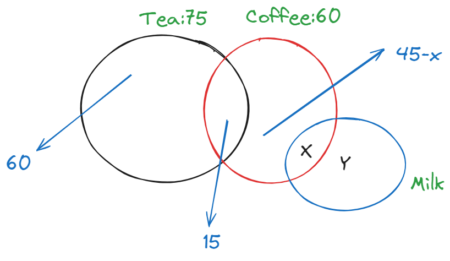
In a party 75 persons took tea

Statement-1: 50 persons took milk.

Since it’s given that no one taking milk takes tea, these 50 persons are distinct from the 120 persons who took tea or coffee.
However, this statement doesn’t provide the total number of persons attending the party since we don’t know if these 50 persons include those who took coffee, tea, or both.

Statement-2: Number of persons who attended the party is five times the number of persons who took milk only.

Let y be the number of persons who took only milk.
The total number of persons attending the party would then be 120 (those who took tea or coffee) + y.
According to the statement, this total is 5 times the number of persons who took only milk, which gives us the equation: 120 + y = 5y.
Solving this equation: 120 = 5y – y, 120 = 4y, y = 120 / 4, y = 30.
Therefore, the total number of persons attending the party is 120 + 30 = 150.

Conclusion:

Statement-1 alone is not sufficient to answer the question.
Statement-2 alone is sufficient to answer the question.

Q. In a party, 75 persons took tea, 60 persons took coffee and 15 persons took both tea and coffee. No one taking milk takes tea. Each person takes at least one drink. Read More »

Q. 40 children are standing in a circle and one of 5 them (say child-1) has a ring. The ring is passed clockwise. Child-1 passes on to child-2, child-2 passes on to child-4, child-4 passes on to child-7 and so on. After how many such changes (including child-1) will the ring be in the hands of child-1 again?

Q. 40 children are standing in a circle and one of 5 them (say child-1) has a ring. The ring is passed clockwise. Child-1 passes on to child-2, child-2 passes on to child-4, child-4 passes on to child-7 and so on. After how many such changes (including child-1) will the ring be in the hands of child-1 again?

(a) 14
(b) 15
(c) 16
(d) 17
Correct Answer: (b) 15

Question from UPSC Prelims 2023 CSAT

Explanation : 

Sequence of Passing the Ring

The ring is passed in the following sequence: 1, 2, 4, 7, 11, 16, 22, 29, 37, 6, 16, 27, 39, 12, 26, 1.

This sequence is formed by adding 1, 2, 3, 4, 5, 6, 7, 8, 9, 10, 11, 12, 13, 14, 15 to the position of the child respectively and taking modulo 40 (since there are 40 children in the circle).

For example, the ring is initially with child-1. We add 1 to it and get 2. So, the ring is passed to child-2. Then we add 2 to 2 and get 4. So, the ring is passed to child-4. And so on.

When we add 15 to 26, we get 41. But since there are only 40 children, we take modulo 40 to get 1. So, the ring is passed back to child-1.

Therefore, the ring is back with child-1 after 15 changes. Hence, the correct answer is (b) 15.
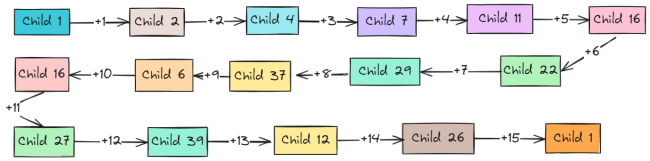
40 children are standing in a circle

Q. 40 children are standing in a circle and one of 5 them (say child-1) has a ring. The ring is passed clockwise. Child-1 passes on to child-2, child-2 passes on to child-4, child-4 passes on to child-7 and so on. After how many such changes (including child-1) will the ring be in the hands of child-1 again? Read More »

Q. There are three traffic signals. Each signal changes colour from green to red and then from red to green.

Q. There are three traffic signals. Each signal changes colour from green to red and then from red to green.

The first signal takes 25 seconds, the second signal takes 39 seconds and the third signal takes 60 seconds to change the colour from green to red. The durations for green and red colours are same. At 2:00 p.m, they together turn green. At what time will they change to green next, simultaneously?

(a) 4:00 p.m.
(b) 4:10 p.m.
(c) 4:20 p.m.
(d) 4:30 p.m.
Correct Answer: (b) 4:10 p.m.

Question from UPSC Prelims 2023 CSAT

Explanation : 

Synchronization of Traffic Signals

The time taken by each signal to complete a full cycle (green to red and back to green) is twice the time taken to change from green to red. So, the first signal takes 50 seconds, the second signal takes 78 seconds, and the third signal takes 120 seconds to complete a full cycle.

To find out when all three signals will be green simultaneously again, we need to find the least common multiple (LCM) of these three times.

The LCM of 50, 78, and 120 is 7800 seconds.

7800 seconds is equivalent to 2 hours and 10 minutes.

So, if all three signals were green at 2:00 p.m., they will all be green simultaneously again at 4:10 p.m.

Therefore, the correct answer is (b) 4:10 p.m.
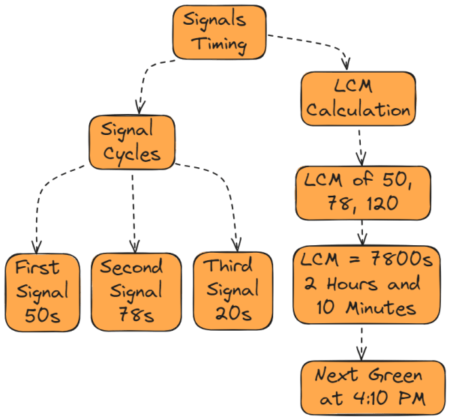
Traffic Signal Timing

Q. There are three traffic signals. Each signal changes colour from green to red and then from red to green. Read More »

Q. What is the number of selections of 10 consecutive things out of 12 things in a circle taken in the clockwise direction?

Q. What is the number of selections of 10 consecutive things out of 12 things in a circle taken in the clockwise direction?

(a) 3
(b) 11
(c) 12
(d) 66
Correct Answer: (c) 12

Question from UPSC Prelims 2023 CSAT

Explanation : 

10 Consecutive Selections in a Circle

When you select 10 out of 12 things in a circle, you are actually selecting a starting point and then counting the next 9 things in the clockwise direction.

Since there are 12 things in the circle, there are 12 possible starting points. Therefore, there are 12 different ways to select 10 consecutive things out of 12 things in a circle taken in the clockwise direction.

Q. What is the number of selections of 10 consecutive things out of 12 things in a circle taken in the clockwise direction? Read More »

Q. A principal P becomes Q in 1 year when compounded half-yearly with R% annual rate of interest. If the same principal P becomes Q in 1 year when compounded annually with S% annual rate of interest, then which one of the following is correct?

Q. A principal P becomes Q in 1 year when compounded half-yearly with R% annual rate of interest. If the same principal P becomes Q in 1 year when compounded annually with S% annual rate of interest, then which one of the following is correct?

(a) R=S
(b) R>S
(c) R<S
(d) R≤S
Correct Answer: (c) R<S

Question from UPSC Prelims 2023 CSAT

Explanation : 

Principal P becomes Q in 1 year. Compounded half-yearly at R% and annually at S%.

When interest is compounded half-yearly, it means that the interest is calculated twice in a year. This results in a higher amount at the end of the year compared to when the interest is compounded annually.

To understand this, let’s take an example. Suppose the principal amount is ₹1000, the annual interest rate is 10%, and the interest is compounded half-yearly.

After the first 6 months, the amount will be ₹1000 + ₹1000*(10/2)/100 = ₹1050.

After the next 6 months, the amount will be ₹1050 + ₹1050*(10/2)/100 = ₹1102.5.

So, at the end of the year, the amount is ₹1102.5 when the interest is compounded half-yearly.

Now, if the same principal amount is compounded annually, the amount at the end of the year will be ₹1000 + ₹1000*10/100 = ₹1100.

So, even though the annual interest rate is the same, the amount at the end of the year is higher when the interest is compounded half-yearly.

Therefore, for the same principal P to become Q in 1 year, the annual interest rate R% when compounded half-yearly has to be less than the annual interest rate S% when compounded annually. Hence, R<S.

Q. A principal P becomes Q in 1 year when compounded half-yearly with R% annual rate of interest. If the same principal P becomes Q in 1 year when compounded annually with S% annual rate of interest, then which one of the following is correct? Read More »

Q. Choose the group which is different from the others: (d) 83, 89, 91, 97

Q. Choose the group which is different from the others:

(a) 17, 37, 47, 97
(b) 31, 41, 53, 67
(c) 71, 73, 79, 83
(d) 83, 89, 91, 97
Correct Answer: (d) 83, 89, 91, 97

Question from UPSC Prelims 2023 CSAT

Explanation : 

All the numbers in options (a), (b), and (c) are prime numbers. However, in option (d), 91 is not a prime number, so it is different from the others.

Q. Choose the group which is different from the others: (d) 83, 89, 91, 97 Read More »