Prelims Solution

Q. Six persons A, B, C, D, E and F are sitting equidistant from each other around a circular table (facing the centre of the table).

Q. Six persons A, B, C, D, E and F are sitting equidistant from each other around a circular table (facing the centre of the table).

Consider the Question and two Statements given below:
Question: Who is sitting on the immediate left of A?
Statement-1: B is sitting opposite to C and D is sitting opposite to E.
Statement-2 : F is sitting on the immediate left of B.

Which one of the following is correct in respect of the Question and the Statements?
a. Statement-1 alone is sufficient to answer the Question
b. Statement-2 alone is sufficient to answer the Question
c. Both Statement-1 and Statement-2 are sufficient to answer the Question
d. Both Statement-1 and Statement-2 are not sufficient to answer the Question
Correct Answer: d. Both Statement-1 and Statement-2 are not sufficient to answer the Question

Question from UPSC Prelims 2022 CSAT Paper

Explanation : 
To determine who is sitting on the immediate left of A, we need to analyze the given statements.

Statement-1: B is sitting opposite to C and D is sitting opposite to E.
From this statement, we can deduce the following seating arrangement (clockwise):
B is opposite to C.
D is opposite to E.
However, this statement does not provide any information about the position of A or who is sitting on the immediate left of A. So, Statement-1 alone is not sufficient to answer the question.

Statement-2: F is sitting on the immediate left of B.
This statement gives us information about the position of F in relation to B, but it does not provide any information about the position of A. So, Statement-2 alone is not sufficient to answer the question.

Combining Statement-1 and Statement-2:
We know the following:
B is opposite to C.
D is opposite to E.
F is sitting on the immediate left of B.
However, even after combining both statements, we still do not have enough information to determine who is sitting on the immediate left of A.

Thus, the correct answer is:
d. Both Statement-1 and Statement-2 are not sufficient to answer the Question.

Q. Six persons A, B, C, D, E and F are sitting equidistant from each other around a circular table (facing the centre of the table). Read More »

Q. A person X wants to distribute some pens among six children A, B, C, D, E and F. Suppose A gets twice the number of pens received by B, three times that of C, four times that of D, five times that of E and six times that of F.

Q. A person X wants to distribute some pens among six children A, B, C, D, E and F. Suppose A gets twice the number of pens received by B, three times that of C, four times that of D, five times that of E and six times that of F.

What is the minimum number of pens X should buy so that the number of pens each one gets is an even number?
a. 147
b. 150
c.  294
d. 300
Correct Answer: c. 294

Question from UPSC Prelims 2022 CSAT Paper

Explanation : 

Person X wants to distribute some pens.

Let the number of pens received by B, C, D, E, and F be represented by b, c, d, e, and f respectively. According to the problem, A gets twice the number of pens received by B, three times that of C, four times that of D, five times that of E, and six times that of F. We can write these relationships as:

A = 2b
A = 3c
A = 4d
A = 5e
A = 6f

Now, we want to find the minimum number of pens X should buy so that each child gets an even number of pens. To do this, we can find the least common multiple (LCM) of 2, 3, 4, 5, and 6. The LCM is the smallest number that is a multiple of all these numbers.

LCM(2, 3, 4, 5, 6) = 60

So, A must receive at least 60 pens to satisfy the conditions.

Using the relationships above, we can find the number of pens for each child:

A = 60
B = A/2 = 60/2 = 30
C = A/3 = 60/3 = 20
D = A/4 = 60/4 = 15
E = A/5 = 60/5 = 12
F = A/6 = 60/6 = 10

However, we need to make sure that all the children receive an even number of pens. The only odd number of pens is given to D, so we must adjust the number of pens for A to make sure D also gets an even number of pens.

If we increase A to 120 pens (the next multiple of 60), we can calculate the new numbers of pens for each child:

A = 120
B = A/2 = 120/2 = 60
C = A/3 = 120/3 = 40
D = A/4 = 120/4 = 30
E = A/5 = 120/5 = 24
F = A/6 = 120/6 = 20

Now all the children have an even number of pens. The minimum number of pens X should buy is:

Total pens = A + B + C + D + E + F
Total pens = 120 + 60 + 40 + 30 + 24 + 20
Total pens = 294

So, the correct answer is c. 294.

Q. A person X wants to distribute some pens among six children A, B, C, D, E and F. Suppose A gets twice the number of pens received by B, three times that of C, four times that of D, five times that of E and six times that of F. Read More »

Q. A man started from home at 14:30 hours and drove to village, arriving there when the village clock indicated 15:15 hours. After staying for 25 minutes, he drove back by a different route of length 1.25 times the first route at a rate twice as fast reaching home at 16:00 hours. As compared to the clock at home, the village clock is

Q. A man started from home at 14:30 hours and drove to village, arriving there when the village clock indicated 15:15 hours. After staying for 25 minutes, he drove back by a different route of length 1.25 times the first route at a rate twice as fast reaching home at 16:00 hours. As compared to the clock at home, the village clock is

a. 10 minutes slow
b. 5 minutes slow
c. 10 minutes fast
d. 5 minutes fast
Correct Answer: d. 5 minutes fast

Question from UPSC Prelims 2022 CSAT Paper

Explanation : 
Let’s break down the given information and solve the problem step by step:

The man started from home at 14:30 hours and arrived at the village when the village clock indicated 15:15 hours.

He stayed in the village for 25 minutes.
He drove back home by a different route, which was 1.25 times the first route, and at a rate twice as fast as the first route.
He reached home at 16:00 hours.
First, we need to calculate the time taken for each part of the trip:

Total time taken by the man to come back home: 16:00 – 14:30 = 1.5 hours = 90 minutes
Out of which he stayed in the village for 25 minutes.
So, his total traveling time = 90 – 25 = 65 minutes

Let’s denote the time taken for the first route as 100 units. Since the return route was 1.25 times the initial route, the time taken would have increased by 25%. So, the time taken for the second route would be 125 units.

But it is also given that while returning he drove twice as fast, which means the time taken must have been halved. So, the time taken while returning is 62.5 units.

Therefore, the total traveling time can be represented as:

100 units (first route) + 62.5 units (second route) = 65 minutes
162.5 units = 65 minutes

Now, we can find out the actual time taken for the first route:
100 units = (65/162.5) × 100 = 40 minutes

So, the man took 40 minutes to reach the village. The actual time at that moment was:
14:30 (start time) + 40 minutes (travel time) = 15:10 hours
Comparing the village clock with the actual time:
15:15 (village clock) – 15:10 (actual time) = 5 minutes

Hence, the village clock is 5 minutes fast. The correct answer is: d. 5 minutes fast

Q. A man started from home at 14:30 hours and drove to village, arriving there when the village clock indicated 15:15 hours. After staying for 25 minutes, he drove back by a different route of length 1.25 times the first route at a rate twice as fast reaching home at 16:00 hours. As compared to the clock at home, the village clock is Read More »

Q. What is the value of X in the sequence 2, 12, 36, 80, 150, X?

Q. What is the value of X in the sequence 2, 12, 36, 80, 150, X?

a. 248
b. 252
c. 258
d. 262
Correct Answer: b. 252

Question from UPSC Prelims 2022 CSAT Paper

Explanation : 
2, 12, 36, 80, 150, X

Consider the differences between consecutive terms:

12 – 2 = 10
36 – 12 = 24
80 – 36 = 44
150 – 80 = 70

Now let’s examine the differences between these differences:

24 – 10 = 14
44 – 24 = 20
70 – 44 = 26

We see that the differences between the differences are increasing by 6 each time. Therefore, to find the next difference between consecutive terms, we can add 6 to the last difference between differences:

26 + 6 = 32

Now we can add this difference to the last difference between consecutive terms in the original sequence:

70 + 32 = 102

Finally, to find the value of X, we can add this difference to the last term in the original sequence:

150 + 102 = 252

Thus, the value of X is 252 (option b).

Q. What is the value of X in the sequence 2, 12, 36, 80, 150, X? Read More »

Q. Two candidates X and Y contested an election. 80% of voters cast their vote and there were no invalid votes. There was no NOTA (None of the above) option. X got 56% of the votes cast and won by 1440 votes. What is the total number of voters in the voters list?

Q. Two candidates X and Y contested an election. 80% of voters cast their vote and there were no invalid votes. There was no NOTA (None of the above) option. X got 56% of the votes cast and won by 1440 votes. What is the total number of voters in the voters list?

a. 15000
b. 12000
c. 9600
d. 5000
Correct Answer: a. 15000

Question from UPSC Prelims 2022 CSAT Paper

Explanation : 

Two candidates X and Y contested an election

Let’s assume the total number of voters in the voter list as “T”.

80% of the voters cast their votes which means the total number of votes cast is (80/100) x T = 0.8T.

Now, we know that X got 56% of the votes cast, which means X got 0.56 x 0.8T = 0.448T votes.

Let’s assume Y got “y” votes. Since there were no invalid votes, the total number of votes cast is the sum of votes received by X and Y, i.e., 0.448T + y = 0.8T.

Solving for y, we get y = 0.352T.

Now, we know that X won by 1440 votes. This means X got 1440 more votes than Y. So, we can write an equation as:

0.448T – 0.352T = 1440

Simplifying the equation, we get 0.096T = 1440, which implies T = 15000.

Therefore, the total number of voters in the voter list is 15000, option (a) is the correct answer.

Two candidates X Y contested election

Q. Two candidates X and Y contested an election. 80% of voters cast their vote and there were no invalid votes. There was no NOTA (None of the above) option. X got 56% of the votes cast and won by 1440 votes. What is the total number of voters in the voters list? Read More »

Q. Consider the Question and two Statements given below in respect of three cities P, Q and R in a State:

Q. Consider the Question and two Statements given below in respect of three cities P, Q and R in a State:

Question: How far is city P from city Q?

Statement-1: City Q is 18 km from city R.
Statement-2: City P is 43 km from city R.
Which one of the following is correct in respect of the Question and the Statements?
a.    Statement-1 alone is sufficient to answer the Question
b.   Statement-2 alone is sufficient to answer the Question
c.    Both Statement-1 and Statement-2 arc sufficient to answer the Question
d.   Both Statement-1 and Statement-2 are not sufficient to answer the Question
Correct Answer: d.   Both Statement-1 and Statement-2 are not sufficient to answer the Question

Question from UPSC Prelims 2022 CSAT Paper

Explanation : 

How far is city P from city Q?

Correct Answer: d.   Both Statement-1 and Statement-2 are not sufficient to answer the Question

This is because we do not know the relationship between the distances of city P from city Q and city R.

The distance between city P and city Q could be anywhere from 25 km (43 km – 18 km) to 61 km (43 km + 18 km), depending on whether cities P, Q and R are in a straight line or not. So we need more information to determine the exact distance between city P and city Q.

Q. Consider the Question and two Statements given below in respect of three cities P, Q and R in a State: Read More »

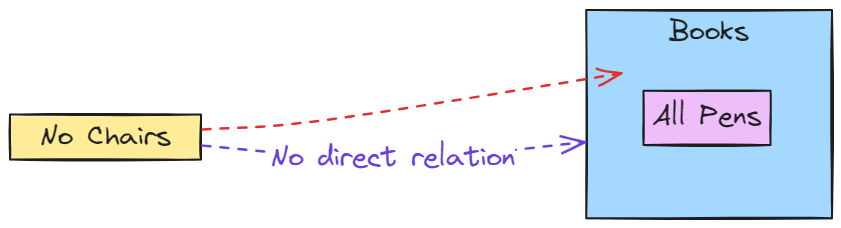
Q. Statement-1 : All pens are books. Statement-2 : No chair is a pen.

Q. Statement-1 : All pens are books.
Statement-2 : No chair is a pen.

Conclusion-I : All chairs are books.
Conclusion-II : Some chairs are pens.
Conclusion-III : All books are chairs.
Conclusion-IV : No chair is a book.

Which one of the following is correct?
a. Only Conclusion-I
b. Only Conclusion-II
c. Both Conclusion-III and Conclusion-IV
d. None of the Conclusions follows
Correct Answer: d. None of the Conclusions follows

Question from UPSC Prelims 2022 CSAT Paper

Explanation : 

All pens are books

Conclusion-I: All chairs are books.
Conclusion-III : All books are chairs.
The books that are pen can never be a chair. Hence, Conclusion-I and III are not true.
Conclusion-II : Some chairs are pens.
Statement 2 says No chair is a pen. So Conclusion-II is incorrect.
Conclusion-IV: No chair is a book. Here no direct relation is given between the chair and the book. so this statement is not accurately true.
Hence, the correct answer is an option(4) i.e., None of the Conclusions follows.

Q. Statement-1 : All pens are books. Statement-2 : No chair is a pen. Read More »

Q. P, Q, R, S, T and U are six members of a family. R is the spouse of Q. U is the mother of T and S is the daughter of U. P’s daughter is T and R’s son is P. There are two couples in the family.

Q. P, Q, R, S, T and U are six members of a family. R is the spouse of Q. U is the mother of T and S is the daughter of U. P’s daughter is T and R’s son is P. There are two couples in the family.

Which one of the following is correct?
a. Q is the grandfather of T
b. Q is the grandmother of T
c. R is the mother of P
d. T is the granddaughter of Q
Correct Answer: d. T is the granddaughter of Q

Question from UPSC Prelims 2022 CSAT Paper

Explanation : 
From the information given in the question, we can deduce that Q is the grandmother of T. So the correct answer is b. Q is the grandmother of T.

Here’s how we can figure it out: R is the spouse of Q and P’s daughter is T. Since R’s son is P thus d. T is the granddaughter of Q

Q. P, Q, R, S, T and U are six members of a family. R is the spouse of Q. U is the mother of T and S is the daughter of U. P’s daughter is T and R’s son is P. There are two couples in the family. Read More »

Q. Two friends X and Y start running and they run together for 50 m in the same direction and reach a point. X turns right and runs 60 m, while Y turns left and runs 40 m. Then X turns left and runs 50 m and stops, while Y .turns right and runs 50 m and then stops. How far are the two friends from each other now?

Q. Two friends X and Y start running and they run together for 50 m in the same direction and reach a point. X turns right and runs 60 m, while Y turns left and runs 40 m. Then X turns left and runs 50 m and stops, while Y .turns right and runs 50 m and then stops. How far are the two friends from each other now?

a. 100 m
b. 90 m
c. 60 m
d. 50 m
Correct Answer: a. 100 m

Question from UPSC Prelims 2022 CSAT Paper

Explanation : 

Two friends X and Y start running

After running together for 50 meters in the same direction and reaching a point, X turns right and runs 60 meters while Y turns left and runs 40 meters.

This means that they are now 100 meters apart from each other on a straight line (60 + 40 = 100).

Then X turns left and runs 50 meters and stops while Y turns right and runs 50 meters and then stops.

Since both X and Y ran in the same direction for the same distance (50 meters), their distance from each other remains unchanged at 100 meters.

Two friends X and Y start running

Q. Two friends X and Y start running and they run together for 50 m in the same direction and reach a point. X turns right and runs 60 m, while Y turns left and runs 40 m. Then X turns left and runs 50 m and stops, while Y .turns right and runs 50 m and then stops. How far are the two friends from each other now? Read More »

Q. If the order of the letters in the English alphabet is reversed and each letter represents the letter whose position it occupies, then which one of the following represents ‘LUCKNOW?

Q. If the order of the letters in the English alphabet is reversed and each letter represents the letter whose position it occupies, then which one of the following represents ‘LUCKNOW?

a. OGXPMLD
b. OGXQMLE
c.  OFXPMLE
d. OFXPMLD
Correct Answer: d. OFXPMLD

Question from UPSC Prelims 2022 CSAT Paper

Explanation : 

Deciphering the representation of ‘LUCKNOW’ after reversing the order of English alphabet letters.

The English alphabet has 26 letters. If we assign a numerical value to each letter based on its position in the alphabet (A=1, B=2, C=3 and so on), then we can find the reverse of each letter by subtracting its value from 27. This is because when the order of the alphabet is reversed, the first letter (A) becomes the last (Z), the second letter (B) becomes the second last (Y) and so on.

For example: L is the 12th letter in the alphabet. To find its reverse, we subtract its value from 27: 27-12=15. The 15th letter in the alphabet is O. So L becomes O when reversed.

Using this method we can find that: L -> O U -> F C -> X K -> P N -> M O -> L W -> D

So LUCKNOW becomes OFXPMLD when reversed using this method.

Q. If the order of the letters in the English alphabet is reversed and each letter represents the letter whose position it occupies, then which one of the following represents ‘LUCKNOW? Read More »