Model Answer:
George Herbert Mead, influenced by Pragmatism and Social Behaviorism, revolutionized sociology by shifting focus from macro-structural determinism to micro-level individual agency. His lectures, compiled posthumously in Mind, Self, and Society (1934), laid the foundational framework for Symbolic Interactionism, a term later coined by his student Herbert Blumer.
Core Contributions to Symbolic Interactionism
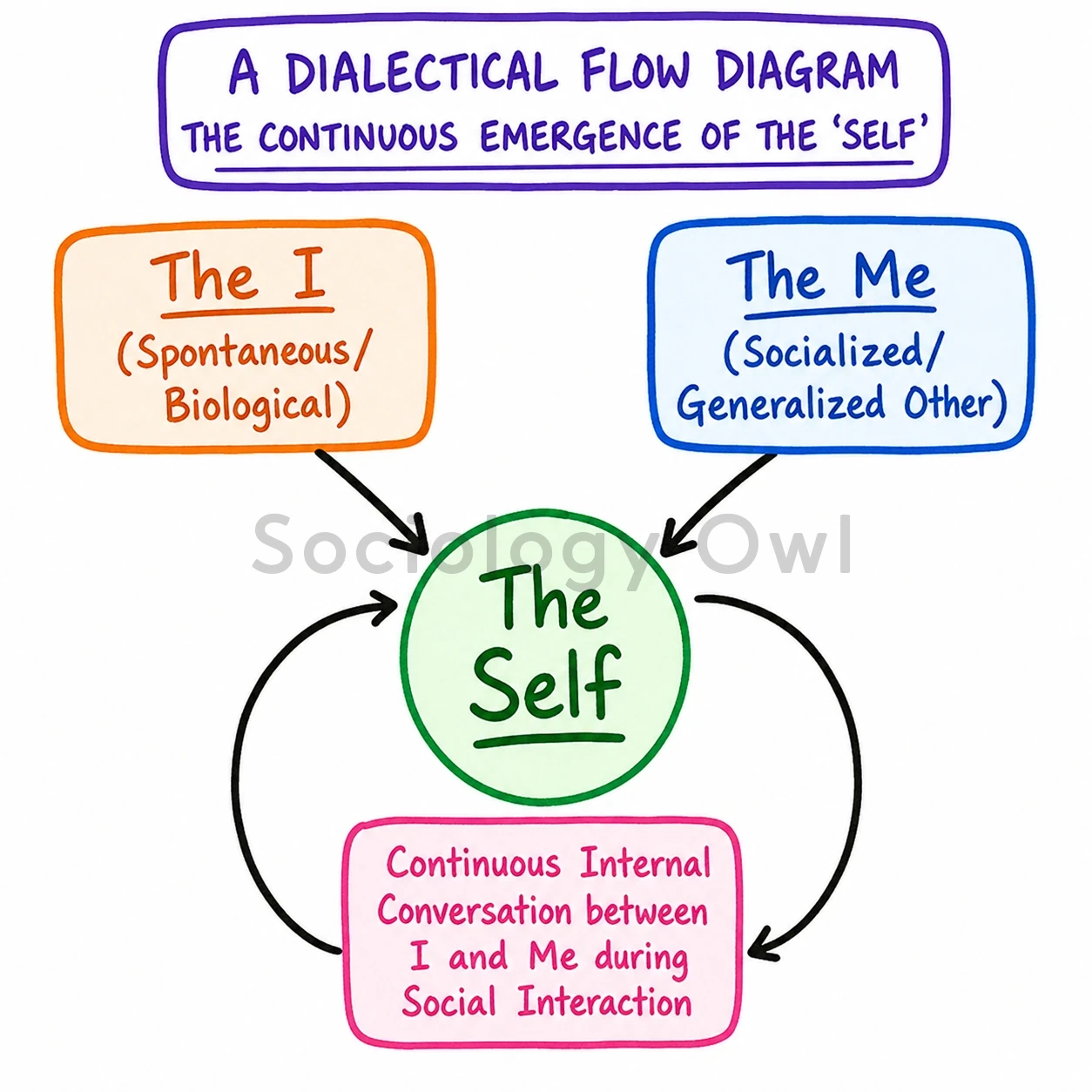
- The Dialectic of Self (“I” and “Me”): Mead argued the self emerges strictly through social interaction. The “I” represents the spontaneous, impulsive, and biological aspect of the individual. The “Me” represents the socialized self, formed by internalizing the attitudes and expectations of society.
- Stages of Self-Development: Mead mapped how cognitive self-awareness evolves:
- Preparatory Stage: Simple, meaningless imitation of others.
- Play Stage: Role-taking of specific Significant Others (e.g., parents, teachers).
- Game Stage: Understanding complex social rules and internalizing the Generalized Other (the broader cultural norms of society as a whole).
- Role of Symbols and Language: Humans uniquely use shared symbols to communicate. Language enables individuals to mentally “take the role of the other,” a concept that effectively operationalized Charles Horton Cooley’s “Looking Glass Self”.
Critique
- Marxist/Structuralist: Critics argue Mead completely ignores macro-structures like class inequality and institutional power. The Generalized Other falsely assumes a societal consensus that does not exist in stratified societies.
- Feminist: The internalized Generalized Other often represents a patriarchal standard, neglecting how gendered power dynamics constrain the “Me”.
- Post-Modernist: Thinkers like Michel Foucault argue that symbols and language are not merely neutral tools of interaction, but instruments of surveillance and power.
Mead’s dialectic of the self perfectly explains digital identity creation. On social media, the “Me” is the meticulously curated digital avatar shaped by algorithmic expectations and peer validation (likes), while the “I” is the spontaneous, authentic user reacting behind the screen.
Conclusion
While limited by its neglect of macro-structures, Mead’s profound micro-sociological insights restored agency to the individual. His conceptualization of human interaction remains foundational, having directly inspired later paradigms like Erving Goffman’s “Dramaturgical Analysis” and Howard Becker’s “Labeling Theory”.