Model Answer:
Durkheim and Merton: Anomie Theory
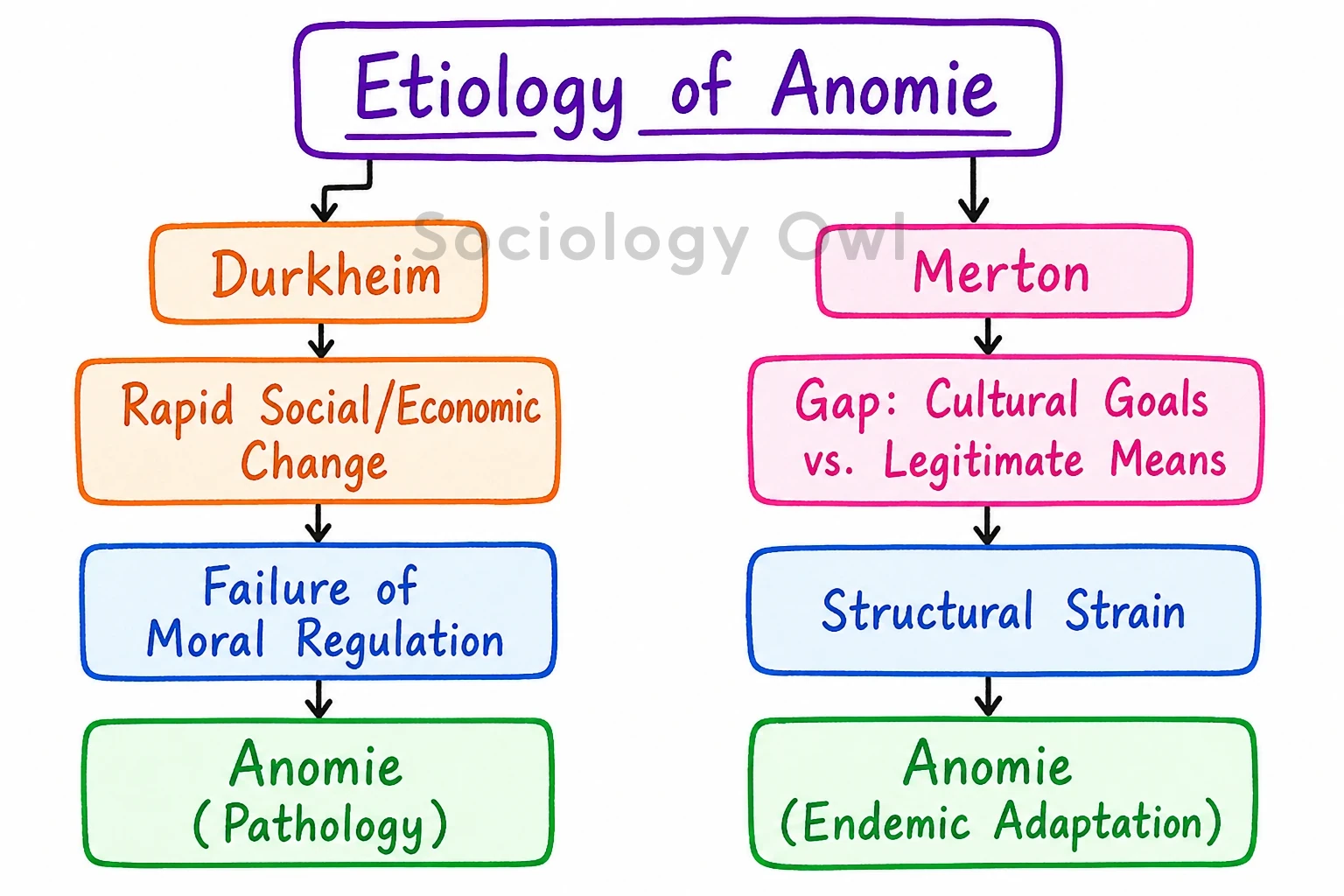
Originating from the Greek anomos (without law), anomie denotes a breakdown of social norms. Émile Durkheim viewed it as a macro-level pathology emerging during Europe’s transition to industrial capitalism, whereas Robert K. Merton normalized it as a structural byproduct of stable, functioning societies.
In The Division of Labor in Society, Durkheim framed anomie as an “abnormal form” arising from uncoordinated specialized roles during rapid industrialization. In Suicide, he identified “anomic suicide,” which peaks during sudden economic booms or busts because society’s moral regulatory power over infinite individual desires temporarily fails, leading to meaninglessness.
Contextualized by the Great Depression, Merton’s Strain Theory shifted focus from psychological defects to structural flaws. He argued anomie arises from a disjuncture between culturally prescribed goals (the “American Dream”) and institutionalized legitimate means. Individuals navigate this strain via five adaptations: conformity, innovation (using illegitimate means for cultural goals), ritualism, retreatism, and rebellion.
Critical Examination
While foundational, both frameworks face significant sociological critiques:
- Subcultural Critique: Albert Cohen argues Merton overly focuses on individual, utilitarian crime, ignoring non-utilitarian group deviance driven by Status Frustration.
- Illegitimate Means: Cloward and Ohlin expand Merton’s theory by noting that not everyone has equal access to crime (Differential Illegitimate Opportunity).
- Marxist Critique: In The New Criminology, Taylor, Walton, and Young criticize Merton for ignoring white-collar crime and the bourgeoisie’s power to dictate “cultural goals.”
- Interactionist Critique: Howard Becker’s Labeling Theory contends both theorists accept official crime statistics unreflectively, ignoring how authorities socially construct deviance.
Durkheim’s anomie explains the psychological distress during the COVID-19 pandemic or Sri Lanka’s economic collapse, where sudden disruptions caused moral deregulation. Merton’s anomie explains modern Jamtara cybercrimes in India, where unemployed youth internalize global wealth goals but, lacking legitimate means, resort to criminal “innovation.”
Conclusion
While Durkheim sought to cure anomie via occupational guilds and Merton exposed it as capitalism’s structural strain, both revolutionized sociology. By establishing deviance not as an individual moral failing but as a systemic phenomenon, their frameworks remain indispensable for analyzing modern structural crises.