Model Answers
Q: Discuss different forms of kinship system in India.
Question asked in UPSC Sociology 2021 Paper 2. Download our app for last 20 year question with model answers.
Model Answer:
Types of Kinship
Kinship denotes socially recognised relations based on blood, marriage and adoption. In India, it is a primary principle of social organisation, shaping family, caste, inheritance, and even politics, and therefore displays multiple distinct forms across regions, castes and tribes.
1. Forms by descent and residence
• Patrilineal–patrilocal system:
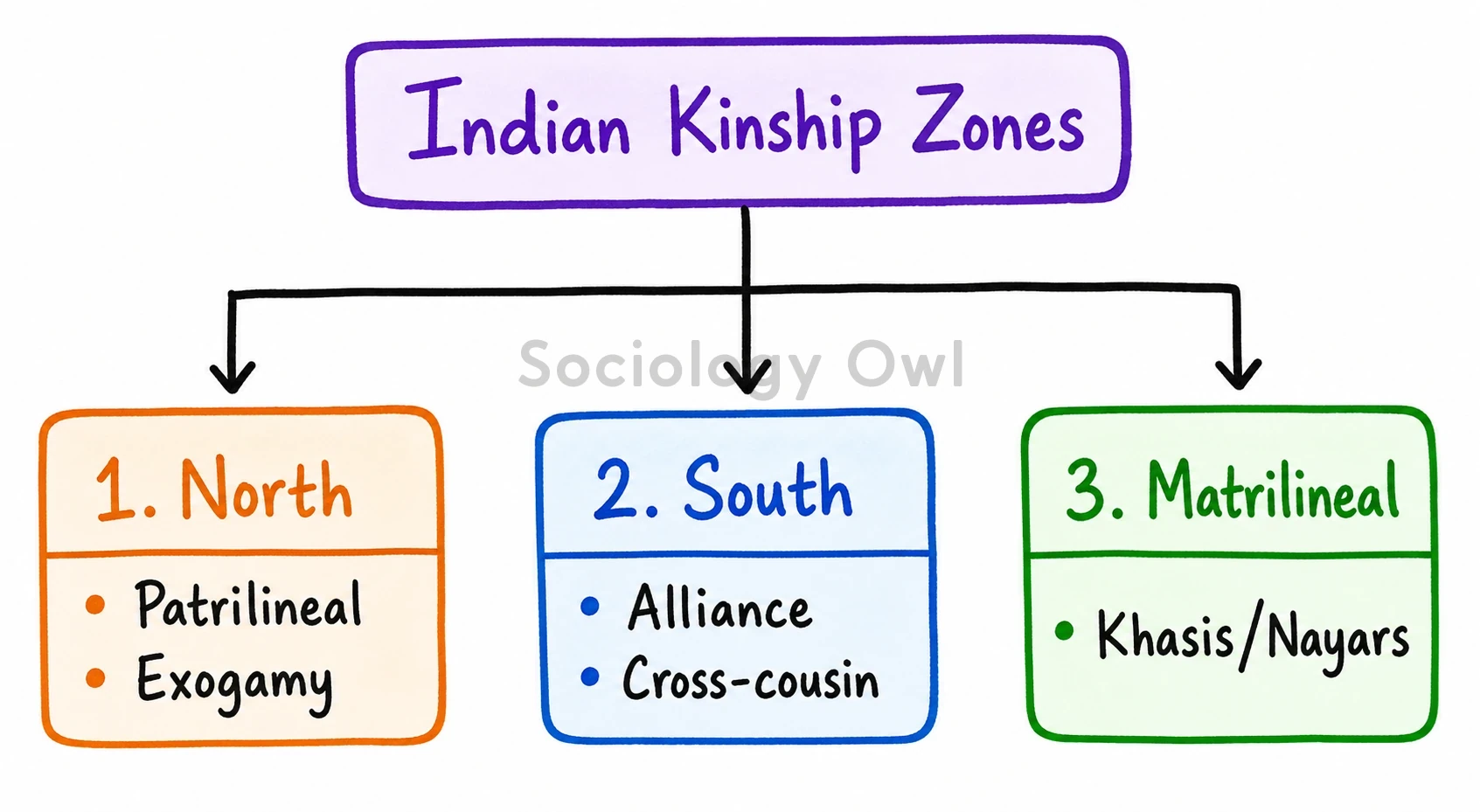
Predominant among Hindus and many Muslims and Sikhs; descent, surname and property pass through male line; bride moves to husband’s home. G.S. Ghurye and A.M. Shah show how this sustains joint families and corporate lineages (gotra, vansh).
• Matrilineal–matrilocal / avunculocal system:
Found among Nayar of Kerala, Khasi and Garo (studied by Kathleen Gough, Irawati Karve). Descent and property follow the female line; residence is often with mother’s brother, creating a distinction between genitor (husband) and social father (maternal uncle).
• Bilateral tendencies:
Some tribes (e.g., among Santals) and urban middle classes show bilateral reckoning of kin, with weaker lineage solidarity but strong conjugal ties.
2. Regional kinship systems (Irawati Karve’s classification)
• Northern kinship system:
– Strongly patrilineal, patrilocal, caste-endogamous and village-exogamous.
– Strict prohibition of cousin marriage; gotra/sapinda exogamy.
– Practices of hypergamy among Rajputs and upper castes (Karve, Ghurye).
– Kinship underlies biradari councils and supports M.N. Srinivas’s “dominant caste” politics.
• Southern (Dravidian) kinship system:
– Patrilineal but with preference for cross-cousin and uncle–niece marriages (Louis Dumont).
– Local endogamy; no rigid village exogamy.
– Bifurcate-merging terminology (mother’s sister = mother; father’s brother = father) reflects merging of certain kin categories.
• Central and Western India:
– Transitional forms combining northern prohibitions with some acceptance of cross-cousin marriage (e.g., among Marathas).
– Greater flexibility in marriage circles and residence.
• Eastern India (Bengal–Assam):
– Patrilineal, but relatively more bilateral sentiments and weaker hypergamy.
– Some tribal influences in Assam and adjoining regions.
3. Tribal kinship forms
• Many tribes (Gond, Oraon) have exogamous clans with totemic identities, segmentary lineages and bride-wealth, as shown in Ghurye’s and tribal monographs.
• North-Eastern tribes (e.g., Nagas) show clan-based, often egalitarian kinship with strong youth dormitory traditions and lineage councils.
4. Change and continuity
Urbanisation, education and women’s employment weaken joint residence but, as A.M. Shah and Patricia Uberoi note, kin networks remain crucial in rituals, migration, and even electoral alliances, while inter-caste and inter-regional marriages slowly pluralise kinship norms.
Conclusion: Indian kinship exhibits enduring regional and descent-based diversity, yet is gradually reworked by urbanisation, mobility, gender equality and constitutional ideals of individual choice.
More Questions:
Download our app for UPSC Sociology Optional - Syllabus, NCERT Books, IGNOU Books, Past Paper with Model Answers, Topper Notes & Answer Sheet.