Model Answer:
Yogendra Singh’s Contributions
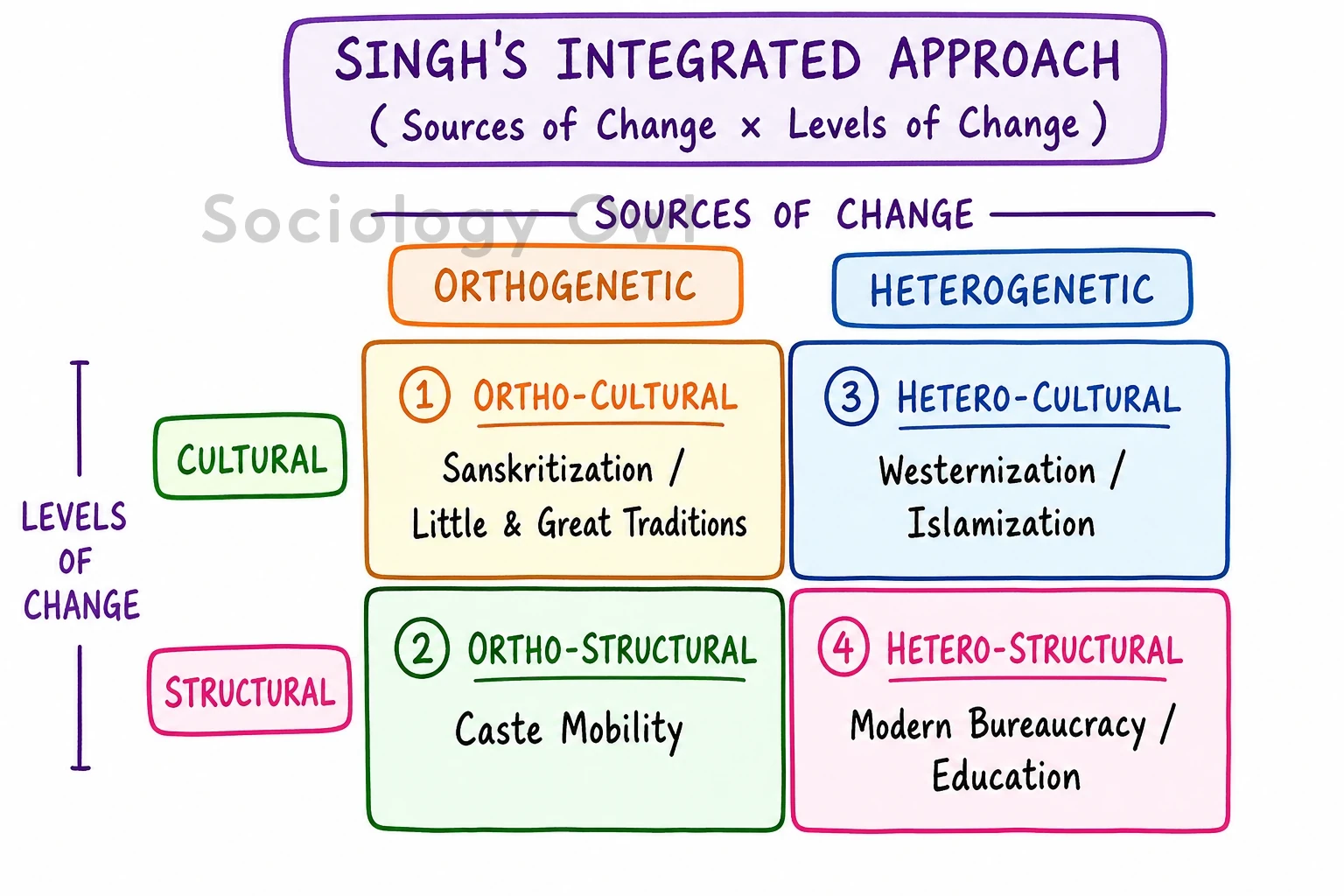
Yogendra Singh profoundly shaped the sociological discourse on India’s transition in his seminal work, Modernization of Indian Tradition (1973). Rejecting Eurocentric unilinear models, he utilized an “Integrated Approach”—combining structural-historical, structural-functional, and Marxist frameworks—to analyze the complex synthesis of tradition and modernity in India.
The Paradigm of Social Change
Singh’s most significant contribution is mapping India’s modernization across specific dimensions:
- Sources of Change: He categorized modernizing forces into Orthogenetic (internal sources like Sanskritization or the Bhakti movement) and Heterogenetic (external sources like colonial Westernization and Islamic influence).
- Levels of Change: Change operates distinctly at the Cultural Level (influencing localized “Little Traditions” and pan-Indian “Great Traditions”) and the Structural Level (transforming macro-structures like bureaucracy and micro-structures like family).
- Adaptive Modernization: He argued that modernity does not eradicate tradition; it is domesticated. This creates a “Traditionalization of Modernity”, where traditional structures adapt to modern roles (e.g., caste transforming into political vote-banks).
Globalization and Academic Critiques
In his later work, Culture Change in India: Identity and Globalization (2000), Singh theorized how global modernity paradoxically fuels the assertion of local identities. However, his framework has been actively debated:
- Marxist Critique: A.R. Desai argued that Singh’s cultural focus masks the deep class inequalities and capitalist exploitation structurally embedded in colonial modernization.
- Sociological Critique: Dipankar Gupta, in Mistaken Modernity, contends that India achieved technological advancement without true sociological modernization (civic values, equality).
- Subaltern Critique: Categorizing cultures into “Great and Little Traditions” is critiqued for carrying a Brahmanical bias that marginalizes Dalit and Adivasi experiences.
Singh’s concept of Adaptive Modernization is highly visible in modern digital India. The proliferation of algorithm-driven matrimonial apps to strictly enforce caste endogamy, or urban nuclear households retaining deep “functional jointness” through digital remittances, perfectly illustrates his thesis of continuity alongside change.
Conclusion
Yogendra Singh shifted the sociological paradigm from a Eurocentric zero-sum model—where modernity inevitably destroys tradition—to a nuanced, Indocentric framework. By demonstrating how Indian society actively negotiates change, his theories remain indispensable for understanding contemporary phenomena like cultural hybridization and glocalization.