Model Answer:
Emerging post-1991, India’s ‘New Middle Class’ (NMC) differs fundamentally from the old colonial middle class. Sociologist Satish Deshpande defines it not merely by income, but through its distinct “patterns of consumption” and cultural capital.
Sociological Features of the NMC
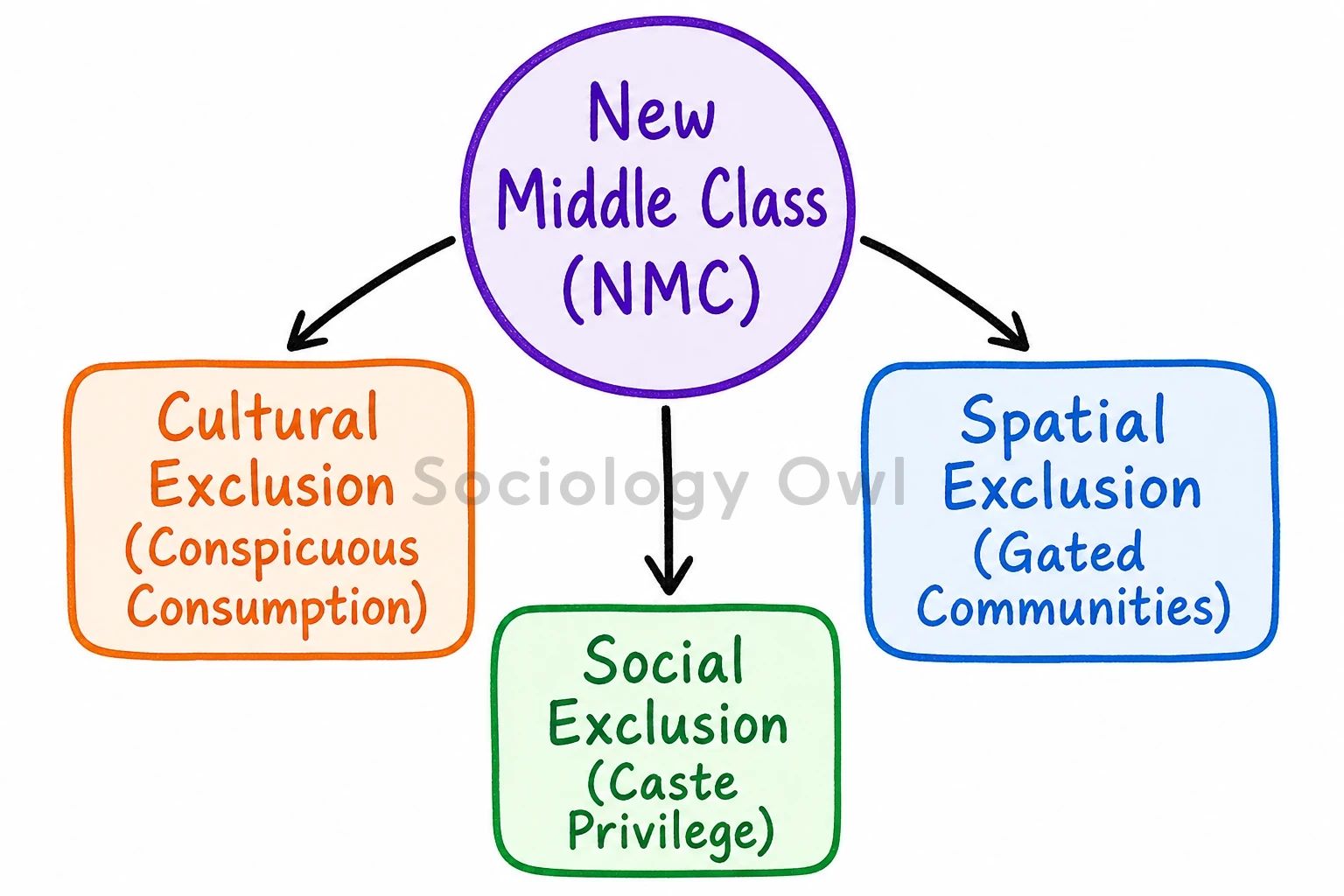
- Consumption-Driven Identity: Moving away from Nehruvian thrift, the NMC engages in conspicuous consumption. Yogendra Singh notes this shift towards globalization, while Pavan K. Varma in The Great Indian Middle Class critiques their aggressive individualism.
- Spatial Segregation: Leela Fernandes highlights the “politics of forgetting”, where the NMC physically and mentally distances itself from the working classes through privatized spaces and gated communities.
- Caste-Class Nexus: Surinder S. Jodhka argues that upper echelons of the NMC remain heavily upper-caste dominated, leveraging historical privileges. Concurrently, an emerging Dalit middle class faces unique status anxieties within these spaces.
NMC civic activism often manifests as “Bourgeois Environmentalism,” a concept by Amita Baviskar. For instance, Resident Welfare Associations (RWAs) frequently demand slum demolitions for “clean, green” cities, prioritizing aesthetics over the housing rights of the urban poor.
Conclusion
While the NMC is the engine of India’s globalizing economy, Dipankar Gupta rightly cautions that it functions more as a privileged elite than a true demographic ‘middle’, characterized by exclusionary spatial, social, and cultural practices.