Model Answer:
Daniel Thorner’s traditional agrarian model of Malik (landlord), Kisan (peasant), and Mazdoor (laborer) is rapidly fragmenting today due to state policies and capitalist penetration (A.R. Desai).
Transformations in Agrarian Class Structure
- Rise of Capitalist Farmers: The Green Revolution created profit-oriented capitalist farmers (Utsa Patnaik), consolidating economic power among middle-tier Dominant Castes like Jats (M.N. Srinivas).
- Marginalization: Relentless land fragmentation has spawned a precarious class of smallholders, expanding the “bulge in the middle” (Andre Beteille).
- De-peasantization & Proletarianization: Shrinking incomes force cultivators into wage labor, generating circular “footloose labor” (Jan Breman). Consequently, traditional Jajmani ties have shifted from status to contract (Kathleen Gough).
- Feminization of Agriculture: Rural male out-migration has left women as the primary agrarian working class (Bina Agarwal).
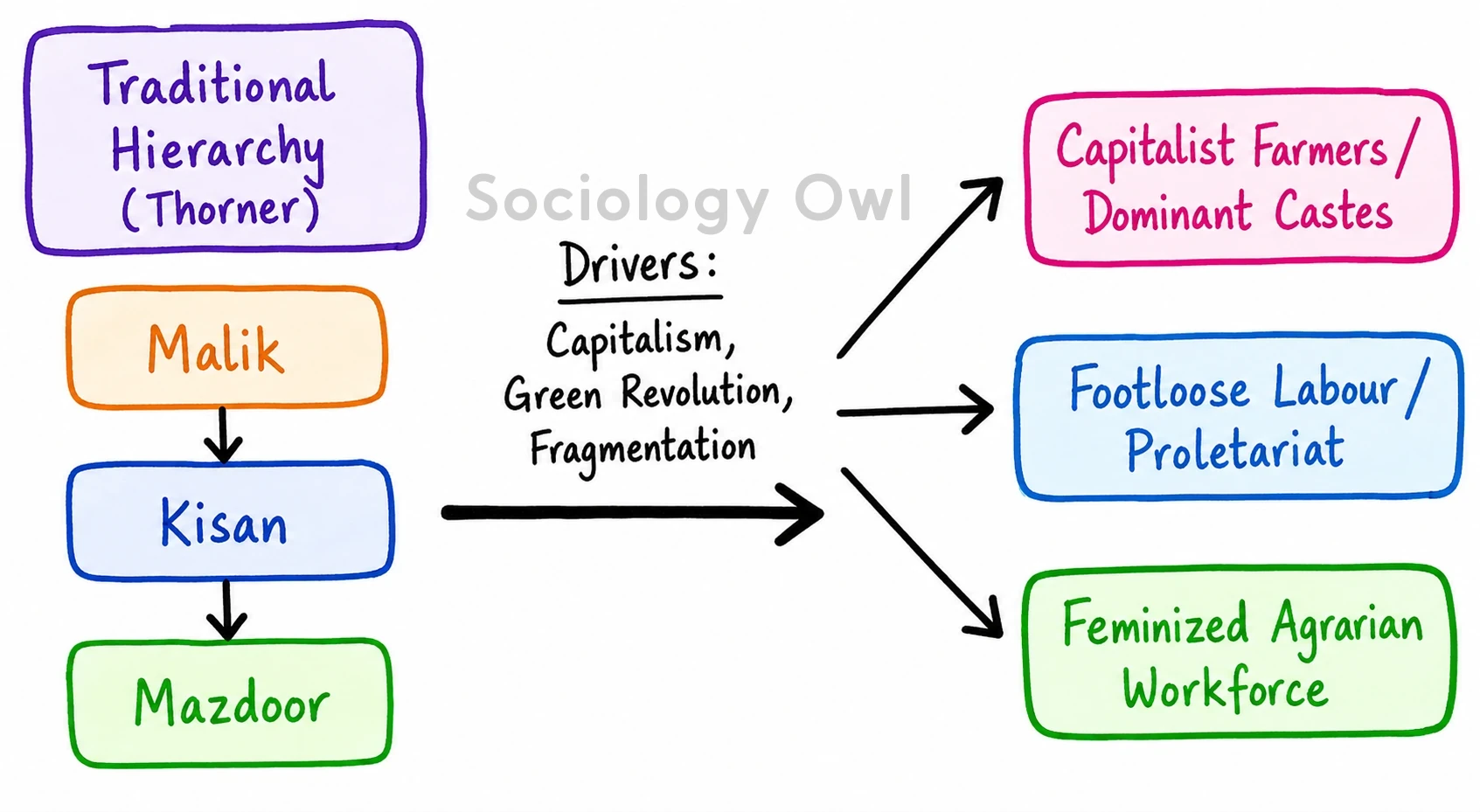
The recent Farmers’ Protests (2020-21) illustrate these shifting dynamics. As Surinder Jodhka notes, they reflect the economic anxieties of an agrarian middle class threatened by corporatization and distress diversification.
Conclusion
India’s agrarian structure has decisively transitioned from a rigid, caste-based feudal hierarchy to a highly fragmented, capitalist reality marked by complex intersections of class mobility and deep rural distress.