Model Answer:
Functional Integration and Critiques of M.N. Srinivas’s Sociology
M.N. Srinivas pioneered the structural-functional approach, rejecting the textual “Book-View” for an empirical “Field-View”. Influenced by A.R. Radcliffe-Brown, he analyzed society as an integrated whole where traditional institutions maintain equilibrium.
Functional Integration of Indian Society
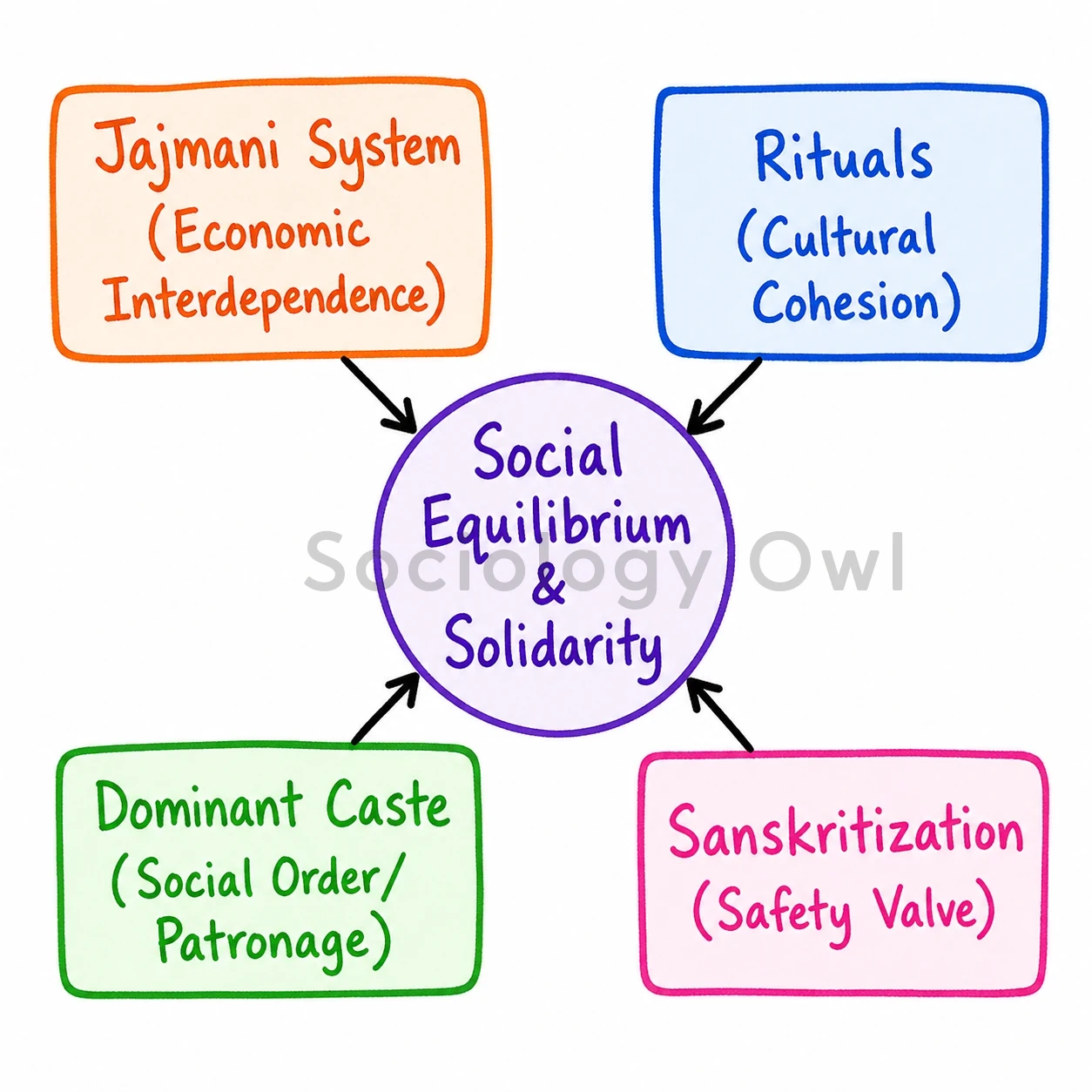
Vertical Solidarity: In The Remembered Village, he showed how interdependent castes cooperate via the Jajmani system, ensuring economic and social harmony.
Ritual Cohesion: In Religion and Society Among the Coorgs, he demonstrated how religious rituals reinforce structural unity across the society.
Systemic Equilibrium: Sanskritization acts as a “safety valve,” allowing cultural mobility for lower castes without dismantling the overarching caste framework.
Stability Anchor: The Dominant Caste serves as a local patron, settling disputes and upholding functional social order.
Critiques
Marxist Critique: A.R. Desai criticized his romanticization of village harmony, which overlooked deep-rooted economic exploitation and class conflicts.
Subaltern Critique: Critics highlight an upper-caste bias, arguing that emphasizing “equilibrium” downplays systemic Dalit oppression.
Srinivas’s functional framework helps analyze modern structural disruptions, such as the contemporary political demands for reservation by erstwhile Dominant Castes (e.g., Marathas and Patidars).
Conclusion
Despite critiques, Srinivas’s rigorous ethnography remains foundational, successfully transitioning Indian sociology towards the empirical study of dynamic, lived structural realities.