Model Answer:
Social Background of Indian Nationalism
The sociological understanding of this phenomenon is best encapsulated in A.R. Desai’s Marxist masterpiece, Social Background of Indian Nationalism. He argued that Indian nationalism was a product of new material conditions and structural transformations introduced by British colonial capitalism, rather than just an emotional awakening.
Colonial policies dismantled traditional structures, generating new social stratifications that fueled the movement:
- Agrarian Class Restructuring: Ramkrishna Mukherjee noted that colonial land settlements destroyed the self-sufficient village economy, creating polarized classes of absentee landlords and landless laborers.
- Emergence of the Intelligentsia: B.B. Misra, in The Indian Middle Classes, highlighted that Western-educated professionals, born from colonial administrative needs, experienced “relative deprivation” and became the vanguard of nationalist mobilization.
- Cultural Rationalization: Yogendra Singh viewed socio-religious reform movements as an attempt at the Modernization of Indian Tradition, creating a cultural bedrock for national consciousness.
Nationalism was not a monolithic, top-down phenomenon.
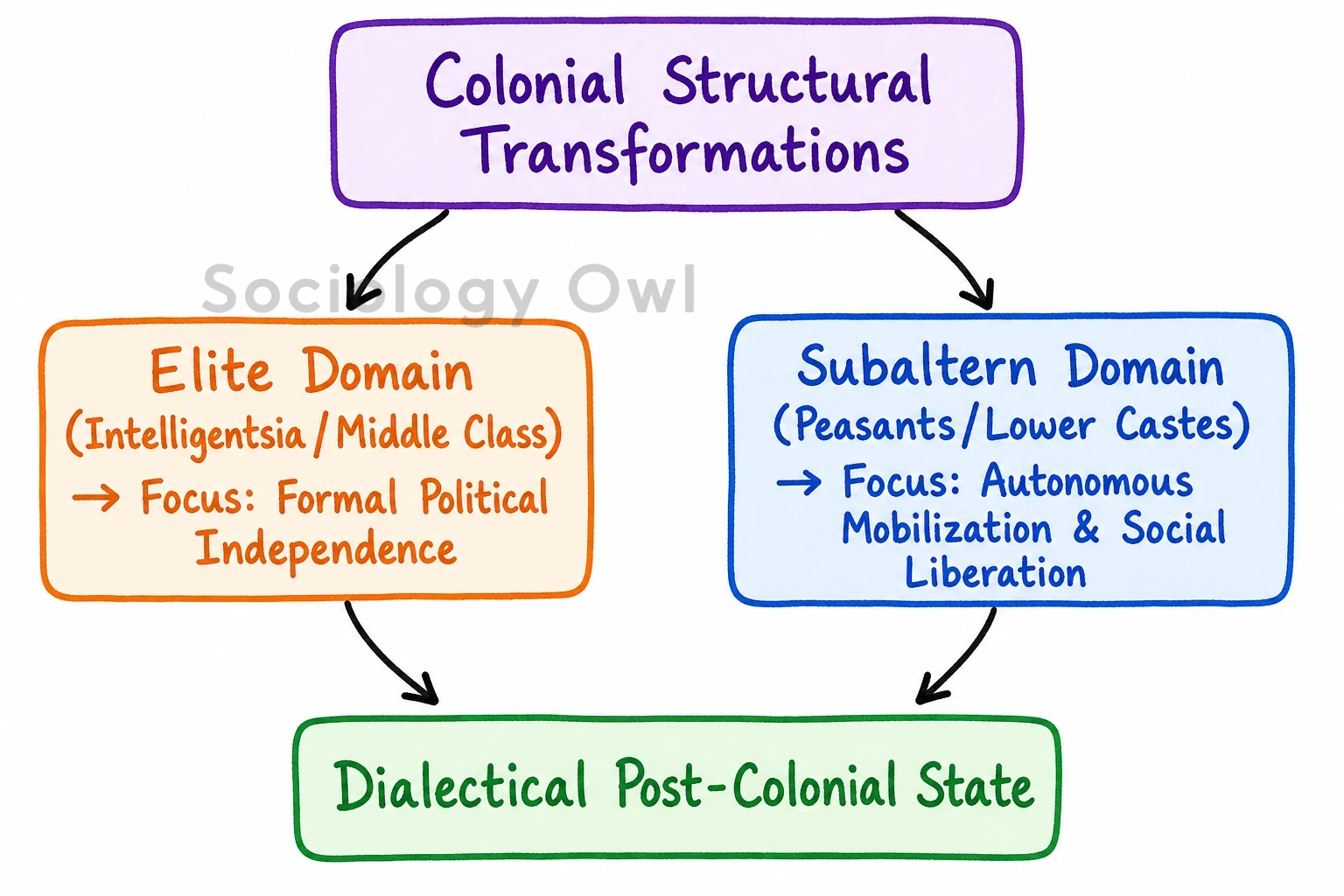
- The Subaltern Perspective: Critiquing Marxist and elitist views, Ranajit Guha and David Hardiman argued for an “autonomous domain” of subaltern nationalism. Peasants and tribals mobilized independently, often displaying more radical consciousness.
- The Caste Paradox: G. Aloysius, in Nationalism without a Nation in India, argued that for lower castes, dismantling Brahminical hegemony often superseded opposing British rule, creating tension between social liberation and political nationalism.
The complex social origins of nationalism heavily shape modern Indian polity. The historical contradiction between elite leadership and subaltern masses is visible today in the ongoing political mobilization of marginalized castes demanding equitable democratic representation.
Conclusion
Indian nationalism was a deeply stratified, dialectical process. As Partha Chatterjee observes, this fragmented legacy forged the post-colonial state, where the synthesis of middle-class institutional dominance and continuous subaltern assertion dynamically defines contemporary Indian society.