Model Answer:
Electoral reforms are imperative to insulate India’s democracy from structural flaws, prompting multiple expert committees to recommend systemic overhauls.
1. Need for Electoral Reforms: Committee Perspectives
- Money Power: Dinesh Goswami Committee recommended partial state funding to curb exorbitant election expenses.
- Criminalization: Vohra Committee warned against politico-criminal nexuses, demanding strict disqualification norms.
- Transparency: Law Commission (255th Report) urged stringent regulations targeting paid news and opaque political funding.
2. Analysis of the “One Nation – One Election” (ONOE) Principle
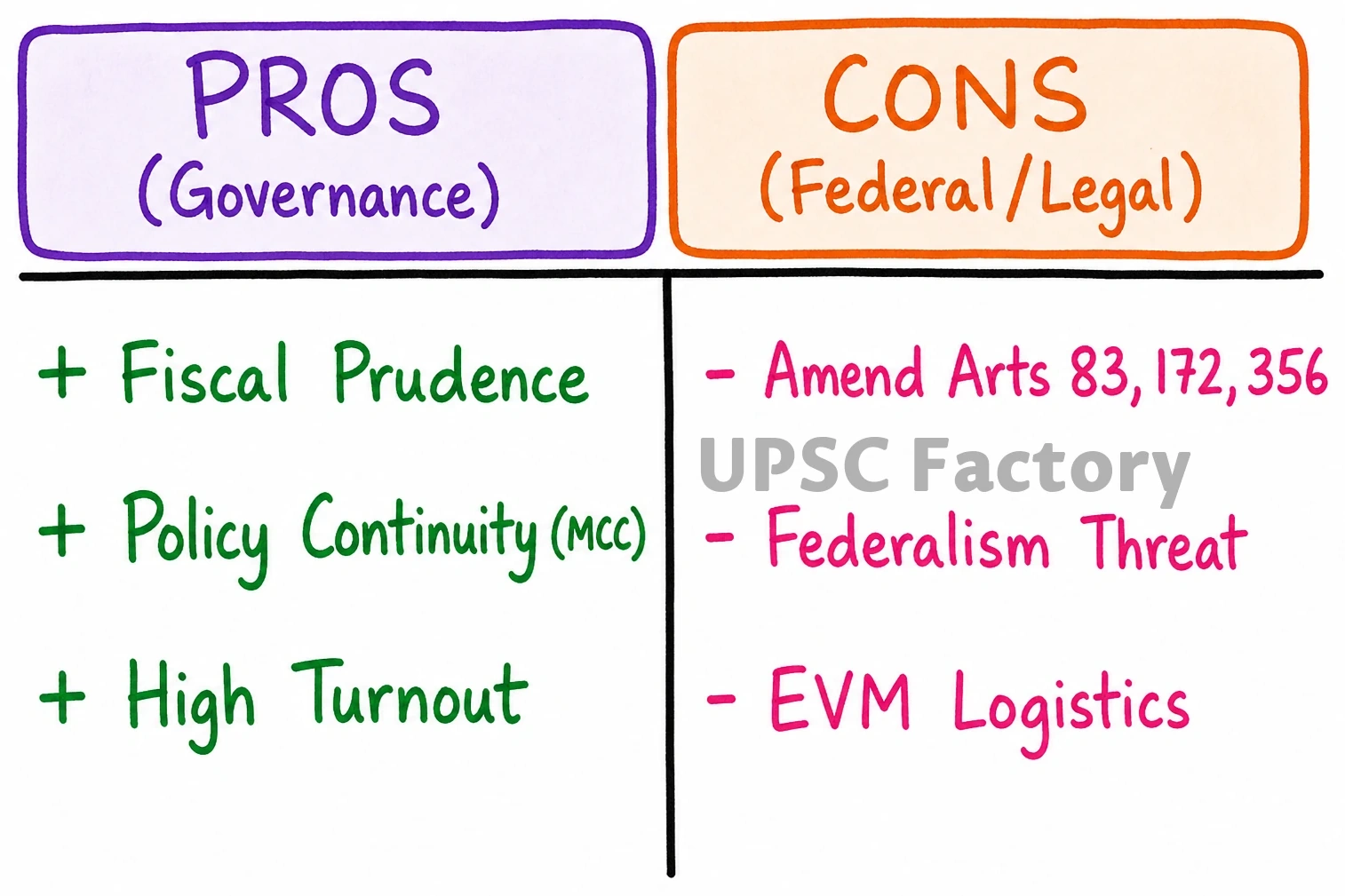
Backed by the Ram Nath Kovind Committee (2024) and the Law Commission (170th Report), ONOE seeks synchronized elections:
- Financial Prudence: Curtails recurring, massive electoral expenditures (CMS data: ₹60,000 crore spent in 2019).
- Governance Continuity: Prevents recurring policy paralysis caused by frequent Model Code of Conduct (MCC) enforcement.
- Voter Participation: Synchronized polling combats voter fatigue, structurally boosting overall democratic engagement.
- Constitutional Hurdles: Demands complex constitutional amendments (Articles 83, 85, 172, 356) and heavy logistical deployment (EVMs/VVPATs).
- Federalism Concerns: Risks overshadowing hyper-local and regional issues with dominant national political narratives.
Implementing ONOE effectively requires broad-based political consensus, a staggered transition mechanism, and robust federal safeguards to uphold India’s constitutional integrity.