Model Answer:
Colonial economic policy created asymmetric, port-centric enclaves (Bombay, Calcutta, Madras) geared for raw material extraction. Post-independence planning utilized the state-led Mahalanobis framework to engineer geographic parity and inclusive national development.
Planned Interventions to Rectify Colonial Imbalances
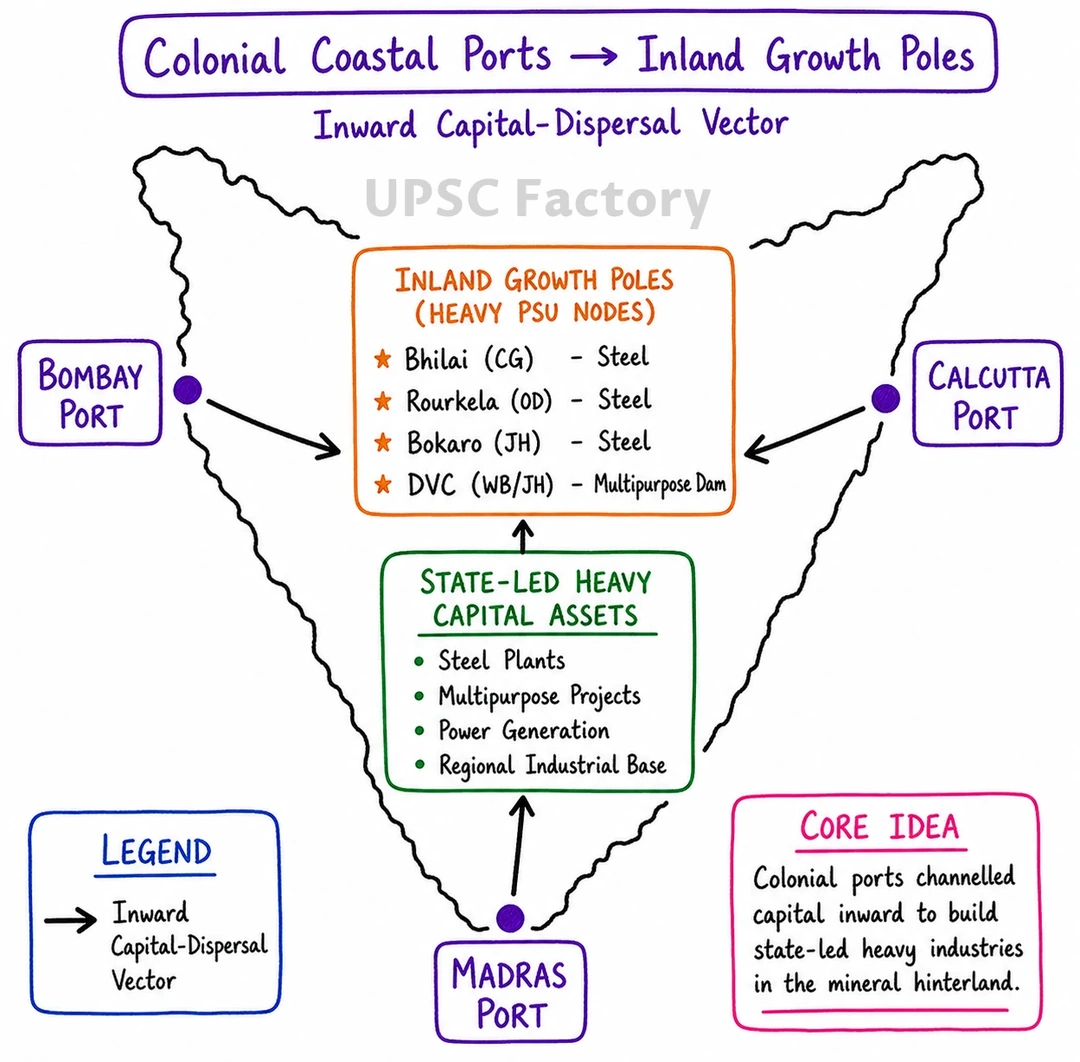
- Growth-Pole Industrialization: Heavy capital-goods Public Sector Undertakings (PSUs) were deliberately established in underdeveloped, mineral-rich tribal hinterlands (e.g., Bhilai, Rourkela, Bokaro steel plants).
- Industrial Policy Resolution (IPR) 1956: Deployed industrial licensing mechanisms to incentivize private factories in backward regions via tax holidays and subsidized land.
- Freight Equalisation Policy (1952): Subsidized rail freight for coal and steel to equalize raw material prices nationwide, encouraging decentralized manufacturing.
- Agrarian Infrastructure Dispersal: Large-scale multipurpose river valley projects targeted chronically drought-prone and flood-hit interiors (e.g., Damodar Valley Corporation, Hirakud Dam).
- Progressive Fiscal Allocation: Progressively weighted formulas under the Planning Commission prioritized low-income and special-category states for central capital assistance (e.g., Gadgil-Mukherjee Formula).
Critical Appraisal: Unintended Divergences and Limitations
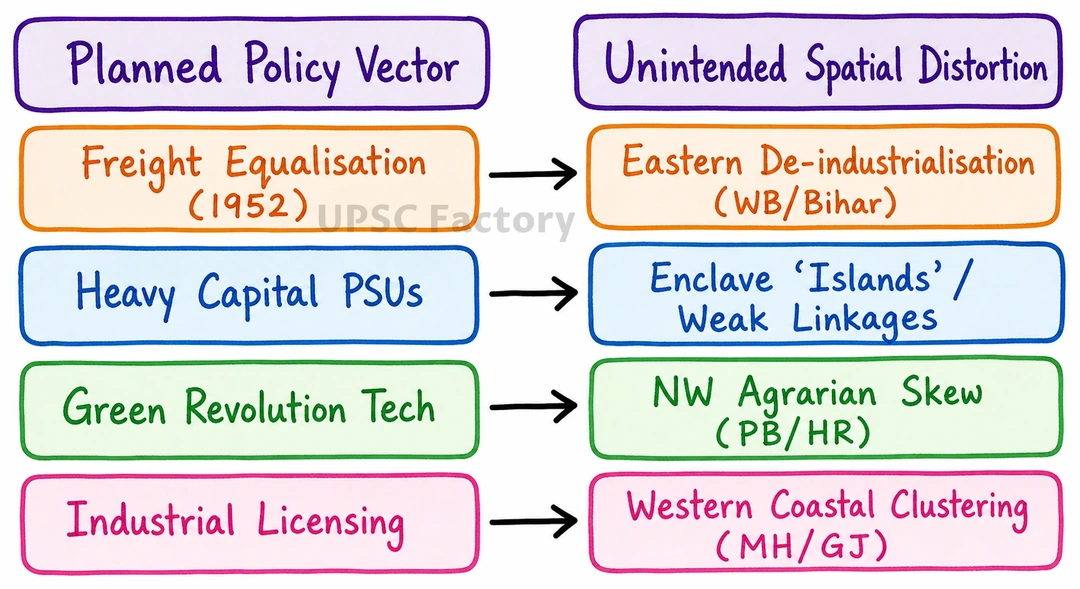
- Erosion of Eastern Advantage: Freight equalisation stripped eastern states of their natural comparative advantage without equalizing other inputs, triggering de-industrialization in Bihar and West Bengal.
- Green Revolution Disparity: The urgency for food self-sufficiency concentrated technology and price support in well-irrigated north-western pockets, bypassing eastern and dryland tracts (e.g., Punjab, Haryana vs. Eastern UP, Bihar).
- Limited Local Multipliers: Capital-intensive PSUs operated as isolated “islands of prosperity,” failing to develop dynamic forward-backward linkages with the local subsistence economy.
- License-Permit Distortions: Regulatory discretion led to private capital clustering in commercially mature coastal states (e.g., Maharashtra, Gujarat) due to superior proximity to capital and decision-makers.
While planned development established a nationwide industrial infrastructure and prevented extreme territorial Balkanization, enduring spatial inequalities underscore the transition from top-down central planning to localized, cluster-based competitive federalism (e.g., Aspirational Districts Programme).