Model Answer:
Satellite-based Earth Observation (EO) operationalizes the three pillars of Climate-Smart Agriculture (CSA)—productivity, adaptation, and mitigation—anchoring India’s national food and nutritional security amid intensifying climate risks.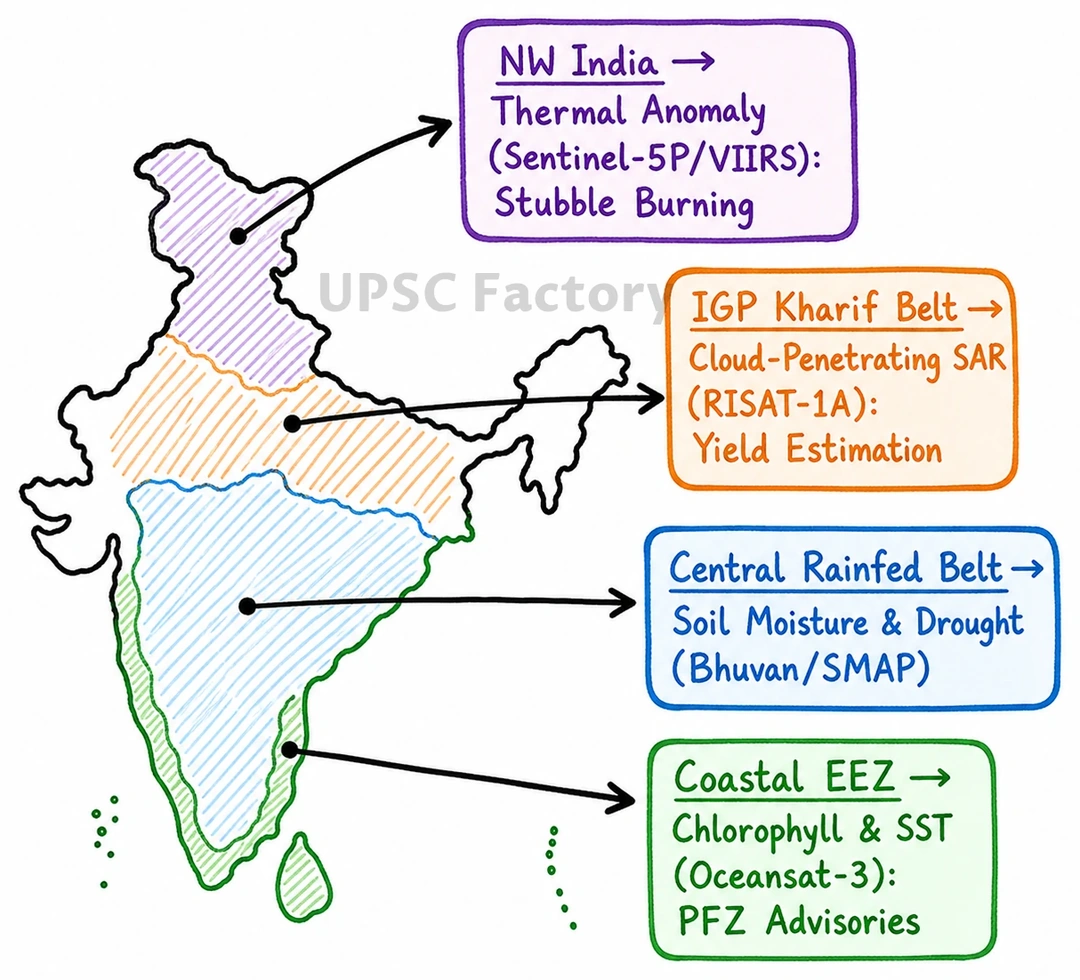
Enabling Climate-Smart Agriculture (CSA)
- Precision Water Management: Estimates evapotranspiration and root-zone soil moisture, driving micro-irrigation efficiency (NISAR, SMAP data).
- Agro-Meteorological Adaptation: Provides weather indexation and real-time drought surveillance for dynamic crop advisories (Bhuvan-Drought, INSAT-3DR).
- Mitigation & Residue Tracking: Monitors active crop-residue burning and greenhouse gas emissions via thermal anomalies (Sentinel-5P, S-NPP VIIRS).
- Crop Phenology & Zonation: Delineates suitable agro-climatic zones and monitors horticultural canopy health (CHAMAN Project, NDVI mapping).
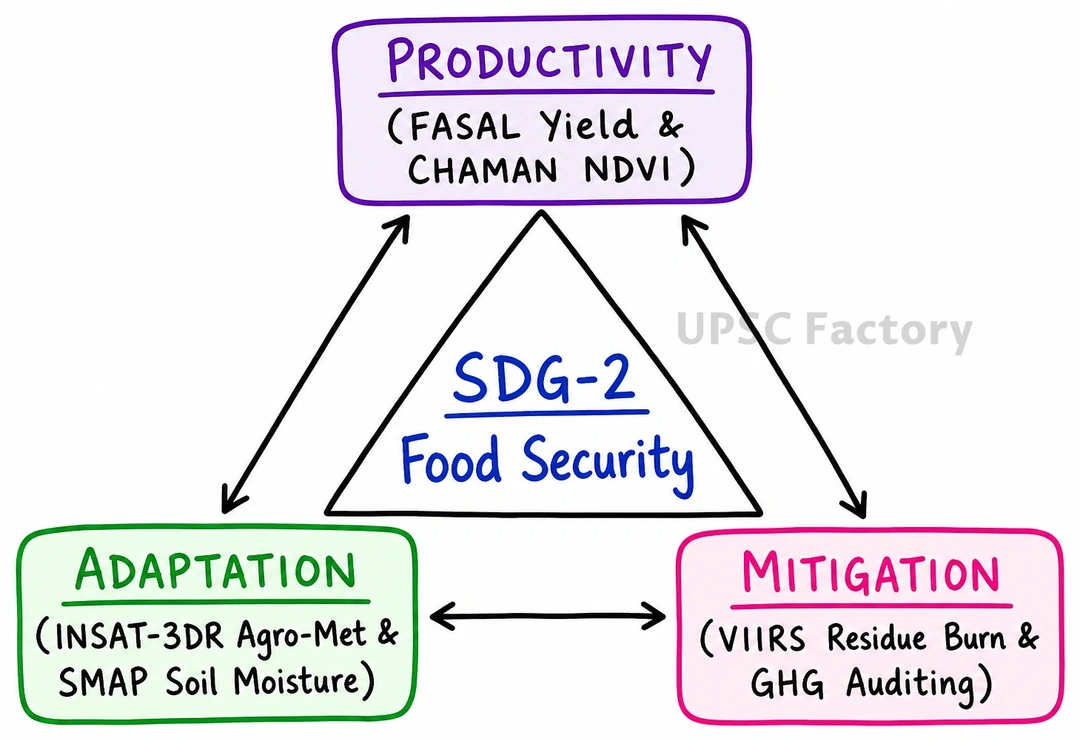
Bolstering Food Security & Policy Delivery
- Yield & Supply Forecasting: Generates pre-harvest national crop production estimates to stabilize buffer stocking and PDS supply chains (FASAL Project, MNCFC).
- Objective Risk Settlement: Eliminates disputed manual crop-cutting experiments through satellite-driven yield estimation (PMFBY YES-TECH, WINDS portal).
- Nutritional Marine Security: Maps chlorophyll concentration and sea surface temperature to delineate Potential Fishing Zones (INCOIS Oceansat-3).
- Addressing Structural Bottlenecks: Overcomes plot fragmentation challenges through high-resolution Synthetic Aperture Radar for cloud-penetrating Kharif surveillance (RISAT-1A).
Integrating satellite tele-sensing with village-level artificial intelligence will de-risk smallholder farming, ensuring systemic climate resilience and sustainable zero hunger (SDG 2).