Model Answer:
What is Identity Politics ?
Identity politics involves mobilization based on ascriptive markers (caste, religion) demanding dignity and cultural space over mere material resources (Dipankar Gupta). In India, Dalit mobilization exemplifies this, confirming Rajni Kothari’s thesis: “It is not politics that gets caste-ridden, it is caste that gets politicized,” transforming ascribed hierarchy into an instrument of democratic empowerment.
Sociological Trends in Dalit Movements
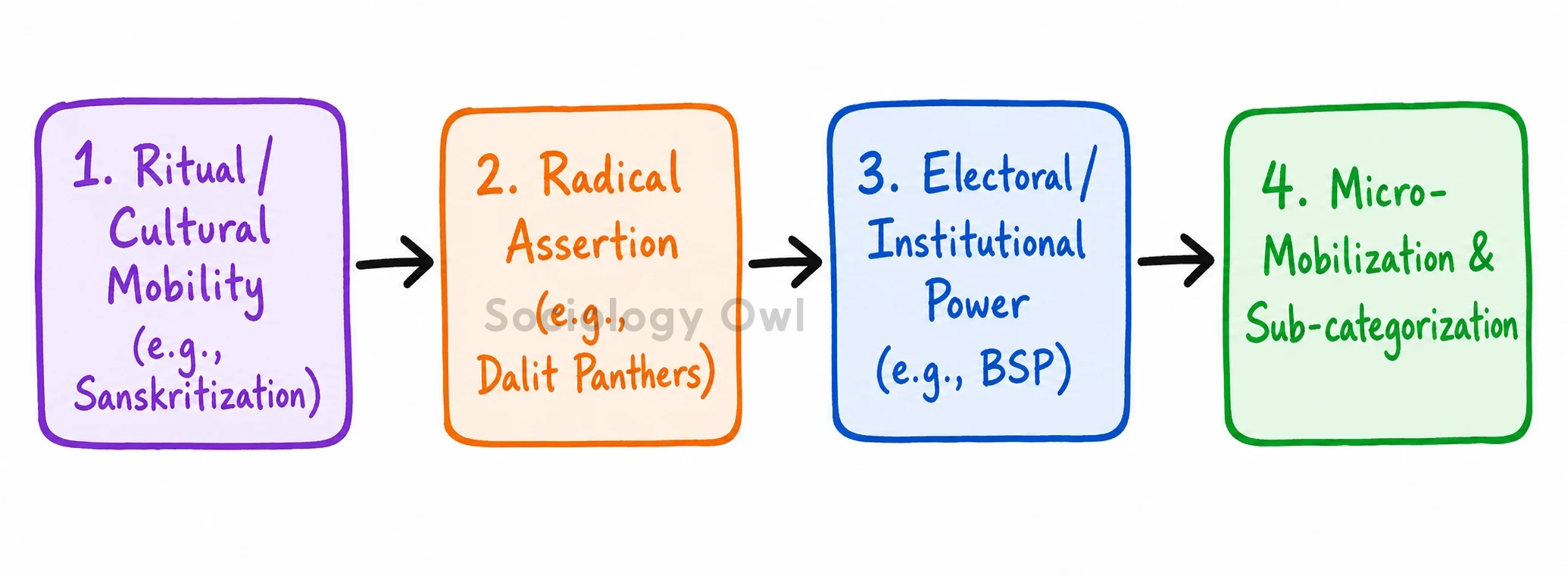
Driven by Relative Deprivation (M.S.A. Rao), Dalit movements transitioned from seeking ritual mobility to demanding structural power. Ghanshyam Shah frames these trends into distinct typologies:
- Reformative Movements: Early phases utilized Sanskritization (e.g., SNDP) and state welfare (Harijan Sevak Sangh) to seek integration within the existing social hierarchy.
- Alternative Movements: Aimed at annihilating the caste system. Eleanor Zelliot’s study of the Mahar movement highlights how Ambedkar utilized constitutional avenues and Buddhist conversion as tools for profound psychological empowerment.
- From Militancy to Electoral Assertion: The 1970s radical pan-Dalit identity (Dalit Panthers) evolved into institutional political power (BSP). Christophe Jaffrelot, in India’s Silent Revolution, details how Dalits transitioned from being captive vote banks for upper-caste parties to autonomous political actors.
Sociological Critiques and Intersectionality
- Marxist Critique: A.R. Desai argued that identity politics often obscures underlying class struggles. Focus on reservations benefits a small middle-class elite while ignoring the systemic exploitation of landless Dalit laborers by dominant-caste capitalist farmers.
- Intersectionality: Sharmila Rege emphasizes the concept of Brahmanical patriarchy, exposing how the specific caste-class-gender nexus of Dalit women is often sidelined in broader identity mobilizations.
Contemporary trends are defined by micro-mobilization and Competitive Identity Politics (Badri Narayan). A prime example is the Madiga Dandora movement in Telangana, which protested the disproportionate cornering of reservations by the dominant Mala caste. This grassroots push against intra-caste hegemony culminated in the landmark 2024 Supreme Court verdict permitting the sub-categorization of Scheduled Castes.
Conclusion
Dalit identity politics has evolved far beyond seeking mere state patronage. As Surinder Jodhka observes, it is actively democratizing the Indian public sphere, shifting the societal paradigm from mimicking upper castes (Sanskritization) to a proud, autonomous assertion of indigenous identity and rights.