Model Answer:
India’s demographic dividend depends heavily on transitioning youth from classrooms to the formal workforce. Skill development programs serve as critical catalysts in enabling this transition and fulfilling industry demands.
1. Impact of Skill Programmes on HR Supply
While programs have augmented the labor pool, gaps in quality and absorption persist:
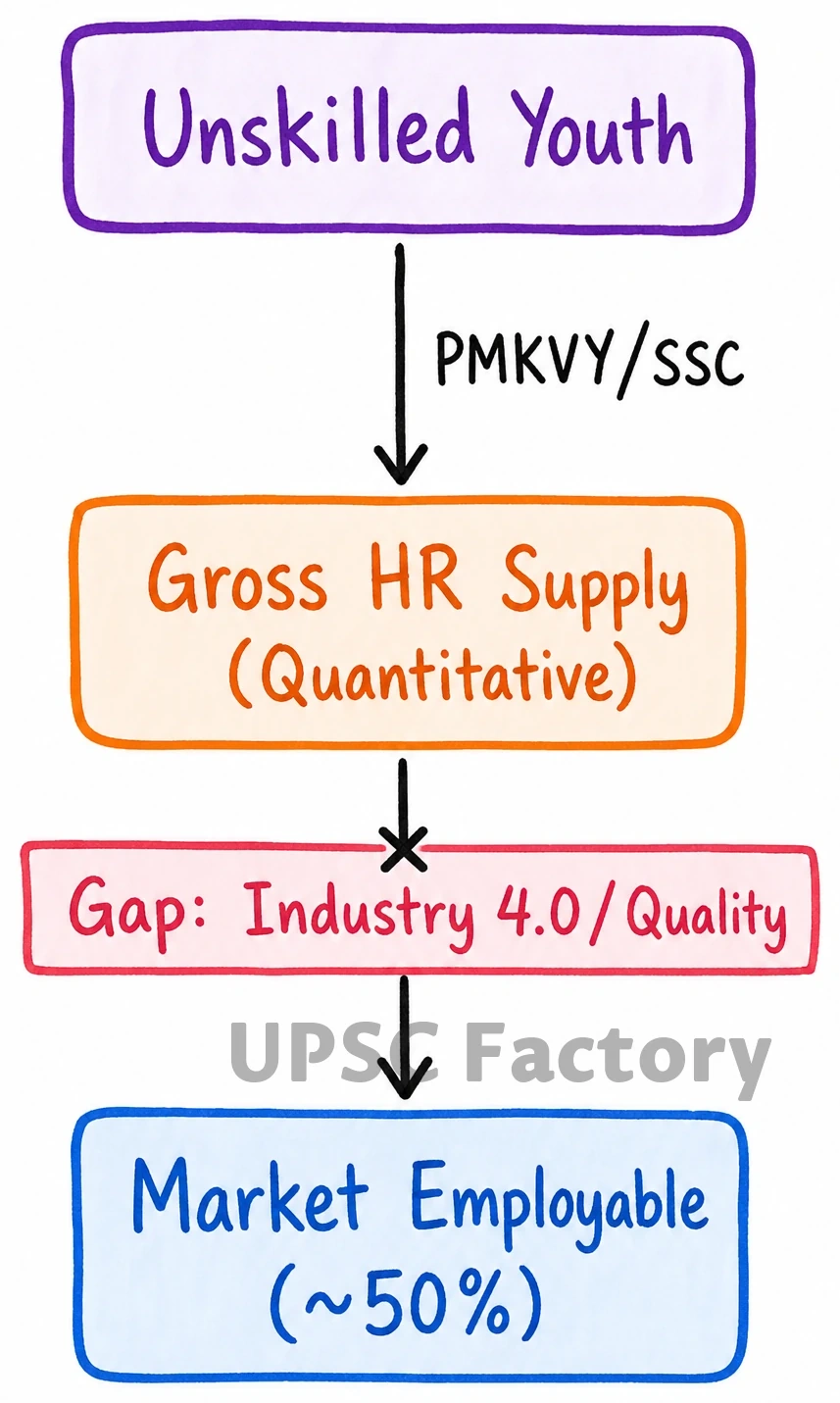
- Quantitative Expansion: Schemes like PMKVY significantly expanded short-term training infrastructure, certifying over 1.37 crore candidates to boost gross HR supply.
- Targeted Sectoral Supply: Sector Skill Councils aligned training with niche market demands, increasing workforce availability in targeted domains (Healthcare, Logistics, IT).
- Inclusive Mobilization: Initiatives integrated rural and marginalized youth into the formal HR pipeline (DDU-GKY for rural poor).
- Quality & Placement Deficits: Despite increased supply, employability remains mediocre (India Skills Report 2023 shows only 50.3% of youth are highly employable).
- Industry 4.0 Mismatch: The current HR supply often lacks the advanced, adaptable competencies required for emerging sectors (AI, Automation).
2. The Tri-Linkage Matrix: Education, Skill, and Employment
The transition from human population to human capital operates on an interconnected continuum:
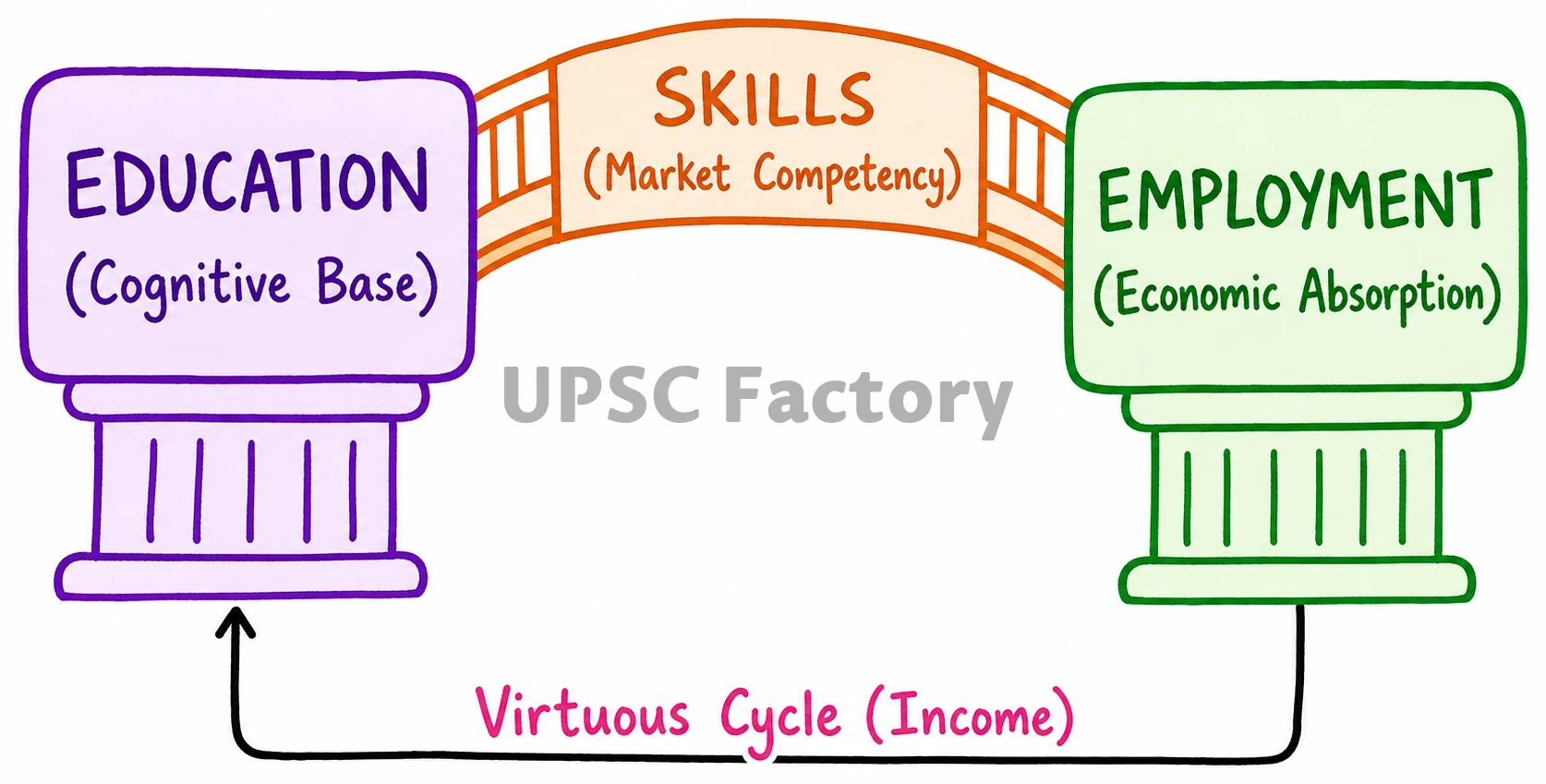
- Education as the Foundation (Cognitive Base): Quality formal education builds essential analytical and adaptable capacities. Weak foundational learning fundamentally hinders complex skill acquisition (ASER data highlights early learning deficits).
- Skill as the Bridge (Practical Competency): Skills translate theoretical academic potential into market-ready utility, reducing friction between raw talent and industry needs (National Apprenticeship Promotion Scheme).
- Employment as the Outcome (Economic Absorption): Job creation validates the continuum. A mismatch between education/skills and market demand leads to ‘educated unemployment’ or underemployment (PLFS data).
- The Virtuous Cycle: Aligned education and skilling yield high-productivity employment, raising incomes and funding better future educational outcomes.
- Policy Integration: The NEP 2020 acknowledges this crucial linkage by integrating vocational education from Class 6, actively blurring the rigid silos between academic and technical pathways.
To actualize its economic potential, India must shift from mere ‘certification’ to ‘competency-based’ training, seamlessly converging foundational academic education, industry-aligned skilling, and formal job creation.