Model Answer:
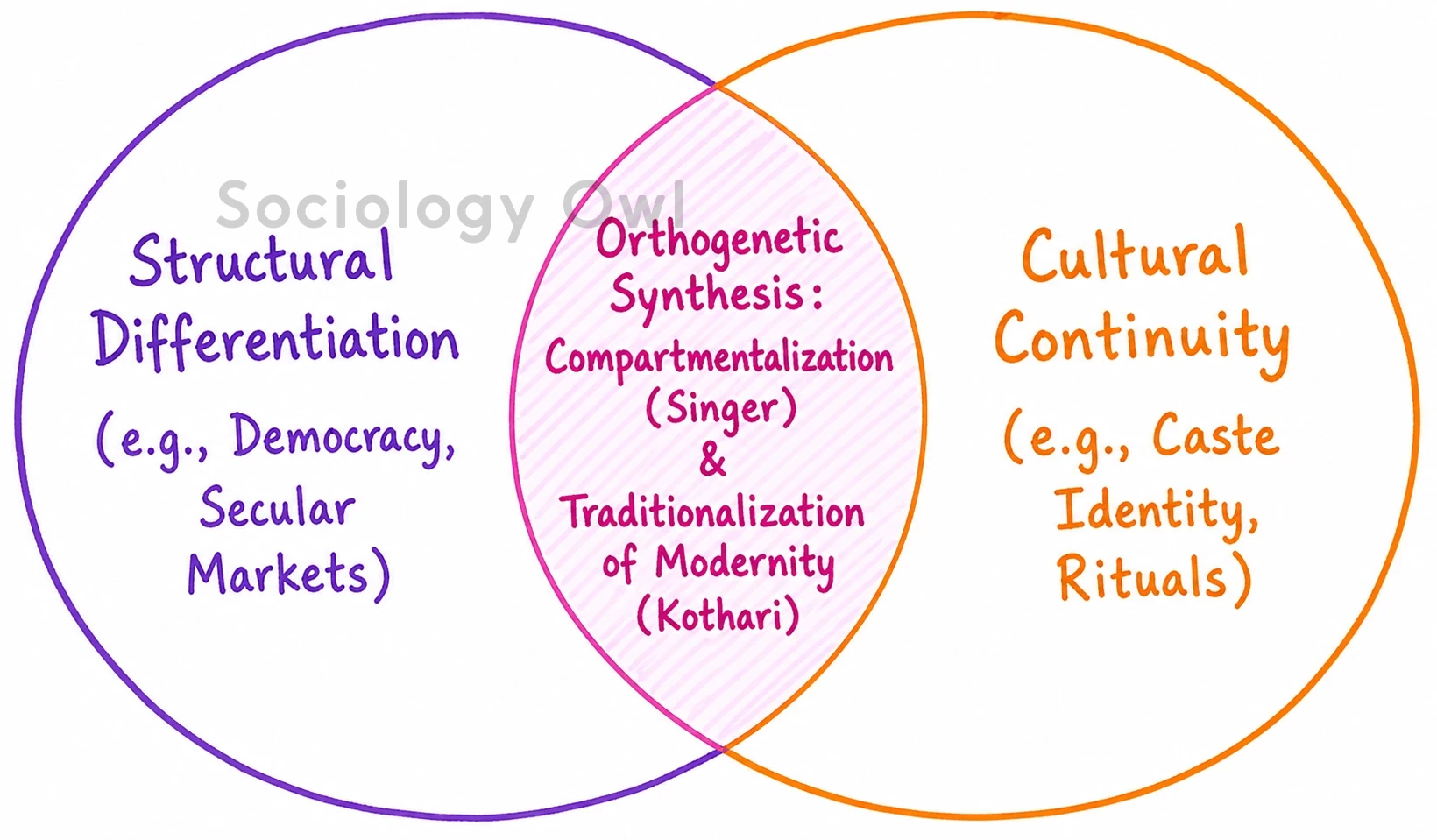
In Modernization of Indian Tradition, Yogendra Singh defines orthogenetic changes as internal cultural transformations (e.g., Buddhism, Sanskritization) that evolve without complete structural breakdown. He argues that Indian society undergoes modernization primarily through structural differentiation while maintaining deep civilizational continuity.
Orthogenetic Change through Differentiation
- Social Differentiation: Andre Beteille, in Caste, Class, and Power, demonstrates this in Sripuram, observing that the traditionally overlapping axes of caste, class, and political power have differentiated into distinct, separate spheres.
- Cultural Differentiation: M.N. Srinivas’s concept of Sanskritization exemplifies orthogenetic change, where lower castes differentiate their rituals and lifestyles to claim upward mobility within the traditional hierarchy.
- Economic Differentiation: The breakdown of the undifferentiated Jajmani system fostered specialized labor markets, enabling phenomena like “Dalit Capitalism” (noted by Chandrabhan Prasad) and disrupting hereditary caste-occupation linkages.
Continuities and Critique of Differentiation
- Compartmentalization: Milton Singer observes that Indians separate modern occupational spheres from traditional ritualistic spheres (e.g., scientists performing pujas before space launches), ensuring cultural continuity.
- Politicization of Caste: Rajni Kothari notes the “traditionalization of modernity,” wherein modern, differentiated democratic institutions are navigated using traditional caste arithmetic.
From a Marxist Perspective, A.R. Desai argues that differentiation has merely modernized traditional exploitation. The agrarian hierarchy has morphed into an urban Caste-Class Nexus, where differentiation bypasses the marginalized, leaving Dalits trapped in undifferentiated, exploitative roles like manual scavenging.
Modern matrimonial platforms (like Shaadi.com) perfectly illustrate this synthesis. They utilize highly differentiated, modern algorithms solely to enforce strict orthogenetic continuities, such as caste endogamy and Gotra-matching. Similarly, traditional Khap Panchayats have differentiated their functions to demand modern political reservations.
Conclusion
India’s orthogenetic evolution eschews unilinear Western displacement. It creates a unique social fabric where modern forms carry traditional content—a phenomenon Dipankar Gupta terms “Mistaken Modernity.” Ultimately, Indian society demonstrates dynamic structural differentiation intricately interwoven with profound cultural continuity.