Model Answer:
India provides comprehensive agricultural support to ensure sovereign food security, rural livelihoods, and price stabilization, which frequently creates structural friction with the multilateral trade rules under the WTO’s Agreement on Agriculture (AoA).
1. Types of Agricultural Subsidies and Supports in India
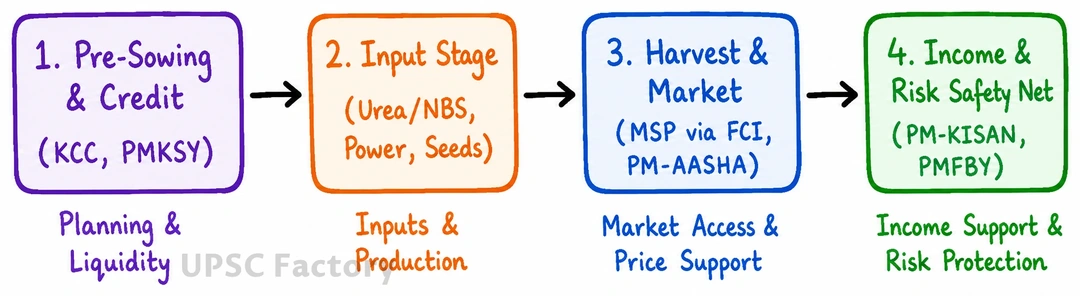
- Direct Income Support: Direct benefit cash transfers to farmer accounts without distorting production quantities (e.g., PM-KISAN, Rythu Bandhu).
- Input Subsidies (Indirect): Fiscal support on critical farm inputs like fertilizers (Urea/NBS), subsidized canal irrigation, zero-tariff power, and seed provisioning.
- Price & Market Support: Minimum Support Price (MSP) backed by procurement via FCI under the National Food Security Act (NFSA) and PM-AASHA.
- Credit & Risk Coverage: Concessional institutional credit via Interest Subvention Schemes (KCC) and subsidized actuarial premiums under PM Fasal Bima Yojana (PMFBY).
- Infrastructural & R&D Support: Non-trade distorting capital investments in irrigation (PMKSY), cold-chain infrastructure (AIF), and ICAR extension services.
2. WTO Agreement on Agriculture (AoA) Issues and Frictions
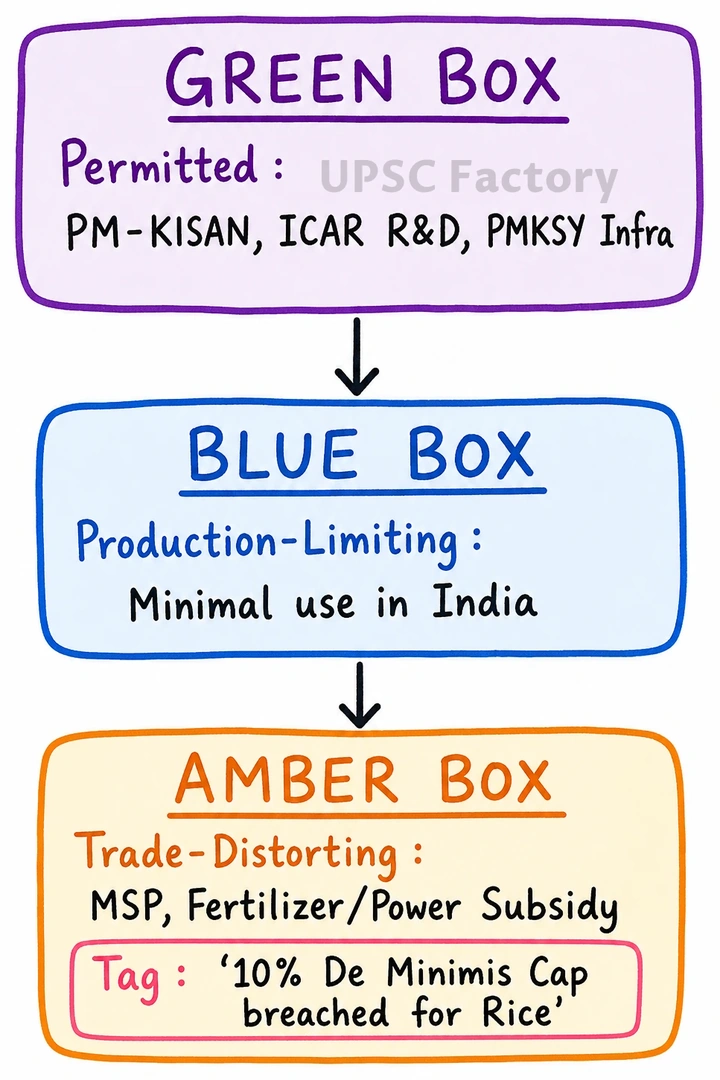
- Outdated External Reference Price (ERP): Fixation of fixed ERP at 1986–88 base prices artificially inflates India’s current Aggregate Measurement of Support (AMS), ignoring four decades of inflation.
- Breaching the De Minimis Ceiling: India’s product-specific support for rice has repeatedly breached the permissible 10% value-of-production cap, inviting global scrutiny.
- Fragility of Bali Peace Clause (2013): The interim Peace Clause shields public stockholding from dispute challenges but imposes onerous transparency covenants and covers only pre-2013 programs.
- Threat to Article 6.2 (S&DT) Exemptions: Developed nations frequently challenge India’s input subsidies, disputing the classification of low-income, resource-poor (LIRP) farmers.
- Public Stockholding (PSH) Impasse: Reluctance of developed nations at MC12/MC13 to negotiate a permanent PSH solution threatens developing countries’ domestic food procurement mandates.
Securing a permanent, inflation-adjusted solution for Public Stockholding is vital to harmonize WTO multilateral trade disciplines with India’s non-negotiable mandates of farmer welfare and nutritional security.